Does MoonPay Accept Palau ID? What Its 2026 API Shows
Does MoonPay accept Palau ID? National ID cards are on MoonPay's list, but the per-country list it publishes leaves the card off Palau's own row.
We may earn a commission if you apply through this link. This site is independent and is not the official RNS.ID or Palau government site.
Key takeaways
- The generic answer everyone repeats is "yes", and it is the wrong level of detail. MoonPay's help centre lists "National ID card (both sides)" among four acceptable documents, so a Palau digital residency card looks like a clean fit. It stops looking like one the moment you read MoonPay's own developer docs.
- MoonPay publishes a per-country document list, and it is machine-readable. Its
getCountriesendpoint returns asupportedDocumentsarray for every country. Nobody writing about Palau appears to have opened it. - Palau's row does not contain the national ID card. Fetched on 2026-10-04, Palau returns
supportedDocuments: ["passport", "residence_permit"]andsuggestedDocument: "passport". Of the 170 countries MoonPay marksisAllowed: true, 101 include the national ID card. Palau is one of the 69 that do not. - Palau is also buy-only. The same row carries
isBuyAllowed: trueandisSellAllowed: false, so a Palau-resident account could never sell back on MoonPay — a restriction 69 countries share and nobody has written up. - Residence is the driver, not the document, and MoonPay says so outright: "Country is the key driver: once you submit
residentialAddress.country, the API returns the full requirement set for that jurisdiction." That is the same conclusion we reached on Wise and Payoneer, arrived at this time from an API response rather than a help page.
On this page
- Does MoonPay accept Palau ID? The short answer
- What MoonPay says it accepts as an identity document
- The per-country list MoonPay publishes, and what Palau's row says
- The residence-permit row is the one that tempts people
- Palau is buy-only on MoonPay
- Does MoonPay accept Palau ID as proof of address?
- Can you pay for the Palau ID with MoonPay?
- Where MoonPay sits against the platforms we have checked
- Bottom line
- Related reading
- FAQ
Does MoonPay accept Palau ID? The short answer
Does MoonPay accept Palau ID? As a document class, the help centre says yes — "National ID card (both sides)" is one of four documents MoonPay names. As a practical route through MoonPay's verification, the answer is worse than that, and this is the first page we have written where the evidence came out of an API response rather than a support article.
MoonPay publishes its country rules in the same endpoint its widget calls, which means the accepted document list for every country is a public fact rather than an inference. We fetched it on 2026-10-04. Palau's row offers two documents, and the national ID card is not one of them. Meanwhile every buyer the card is actually sold to — someone resident in Germany, Portugal, the UK — is governed by their country's row, not Palau's, and that is the rule that decides the outcome.
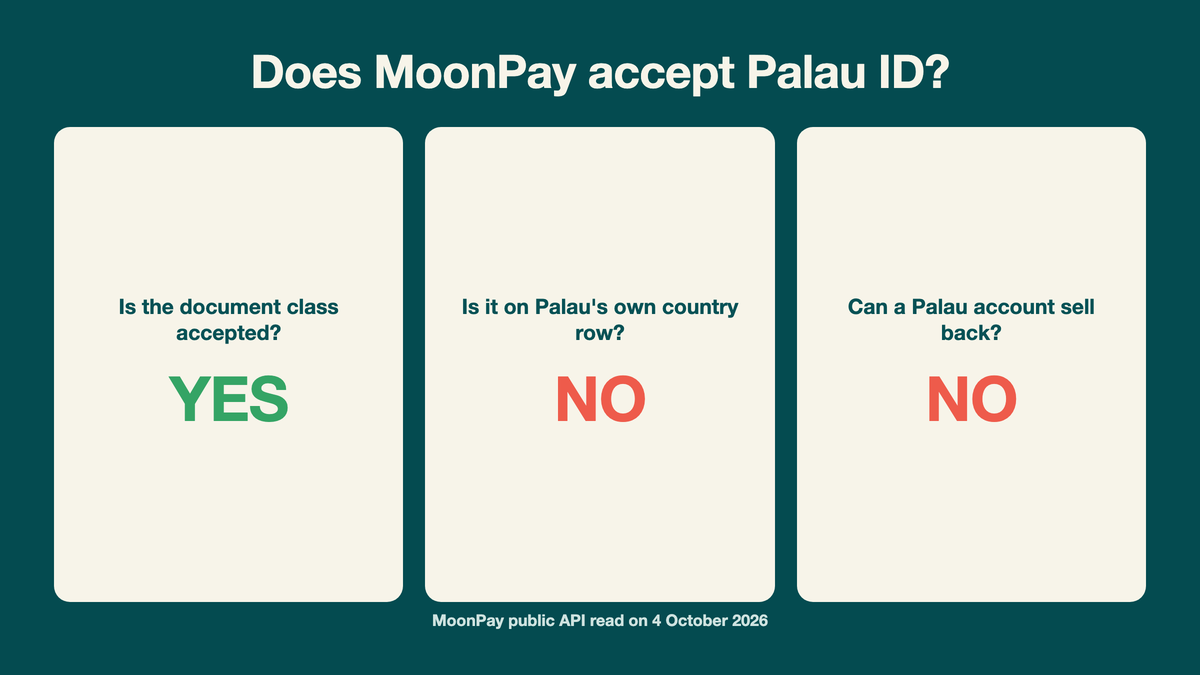
So the single question splits into three, and only the first gets the comfortable answer.
| The question people ask | What it actually means | Where Palau stands |
|---|---|---|
| Does MoonPay accept national ID cards? | Is the document class on the list at all? | Yes — "National ID card (both sides)" |
| Does MoonPay accept a Palau national ID card? | Is the class offered to Palau? | No — Palau's row is passport and residence permit only |
| Can I verify as a Palau resident? | Does digital residency make Palau my country of residence? | No — RNS: not "physical residency in Palau" |
One yes and two no's, and the yes is the one that is quoted everywhere. The rest of this page shows the working, because which of the three is blocking you changes what the card is still worth buying for.
What MoonPay says it accepts as an identity document
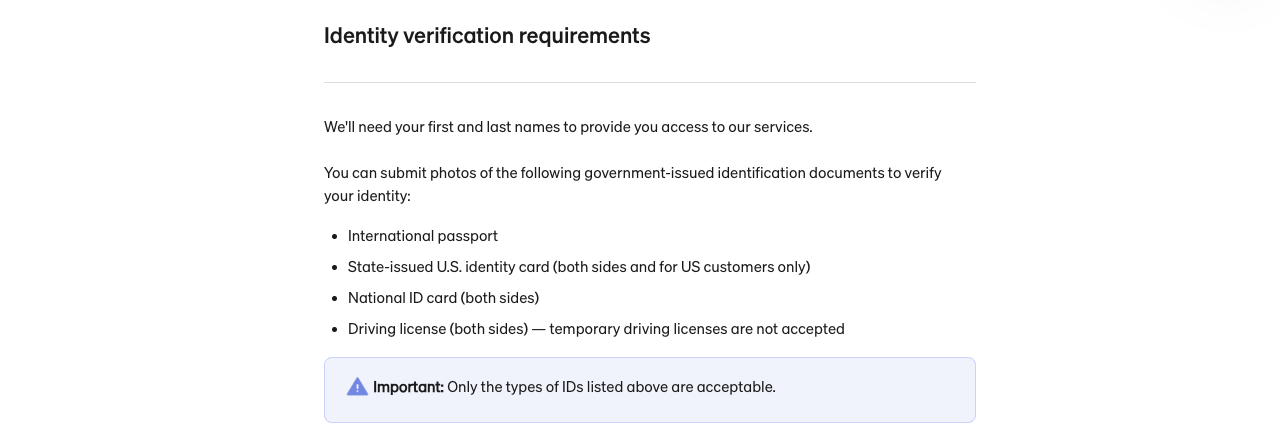
MoonPay's identity requirements page is short, closed-ended, and more specific about photography than about countries.
| Requirement | What MoonPay says | How a Palau card fares |
|---|---|---|
| Accepted types | International passport; state-issued U.S. identity card (US customers only); national ID card; driving licence | National ID — the class is named |
| Closed list | "Only the types of IDs listed above are acceptable" | No room to argue a fifth category |
| Sides | National ID card and driving licence: "both sides" | Needs the physical card in hand |
| Image source | "Original images, no screenshots or graphic editing software" | A downloaded PDF or app screen will not do |
| Framing | "All four corners of the document are visible" | Fine for a plastic card |
| Signature | "The document includes your signature" | Check your own card before you rely on this |
| Validity | "Valid for at least one month"; a soon-to-expire ID is a named rejection reason | 1, 5 and 10-year terms exist — a 1-year card near expiry is a risk |
| Script | Non-Latin scripts need an English translation | Not a Palau problem |
Two of those rows matter more than they look. "Original images, no screenshots" rules out the digital-first part of the product: a Palau digital residency begins as a digital credential and a downloadable PDF, and RNS is explicit that "downloading the PDF does not establish permission to use it in a particular verification process or guarantee acceptance by a third party." Until the physical card arrives there is nothing MoonPay will take, and our shipping and tracking guide covers how long that leg really runs. The same distinction drives physical vs digital Palau ID for KYC.
The second is that "Unsupported ID type" is a named rejection reason on MoonPay's rejection reasons page, sitting alongside expired IDs and blurry photos. That is the bucket a document outside your country's list falls into, and it is a decision rather than a retry prompt.
The per-country list MoonPay publishes, and what Palau's row says
Here is the part no other page on this question has used, and it took one request to settle.
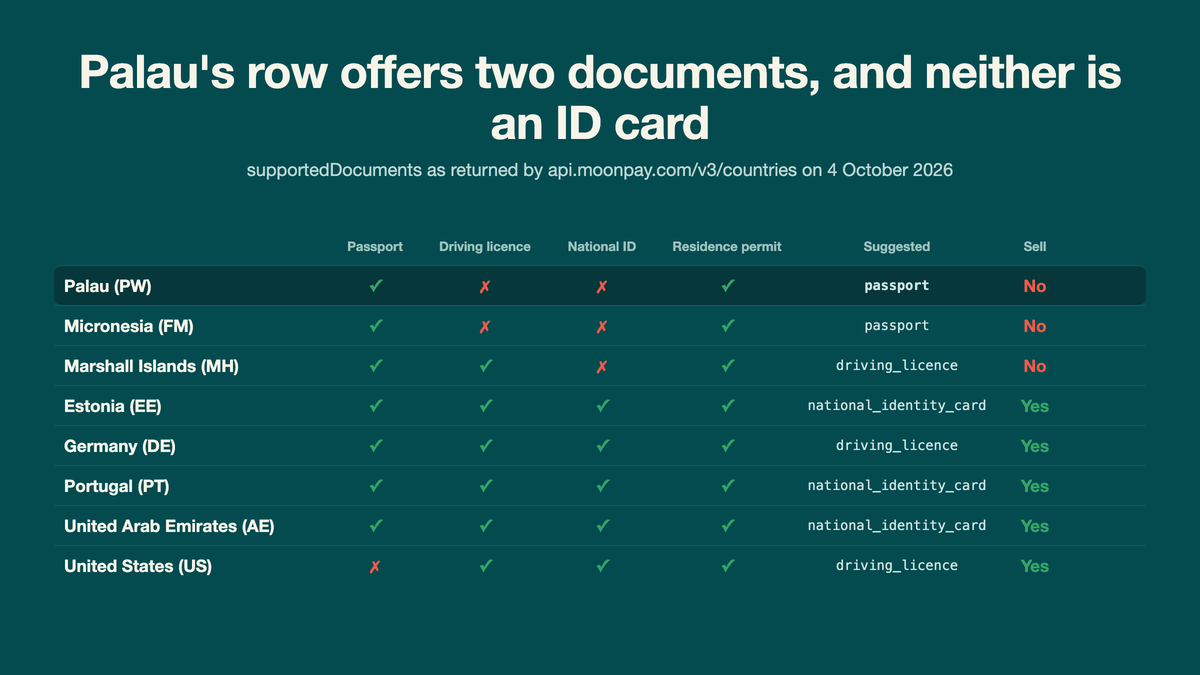
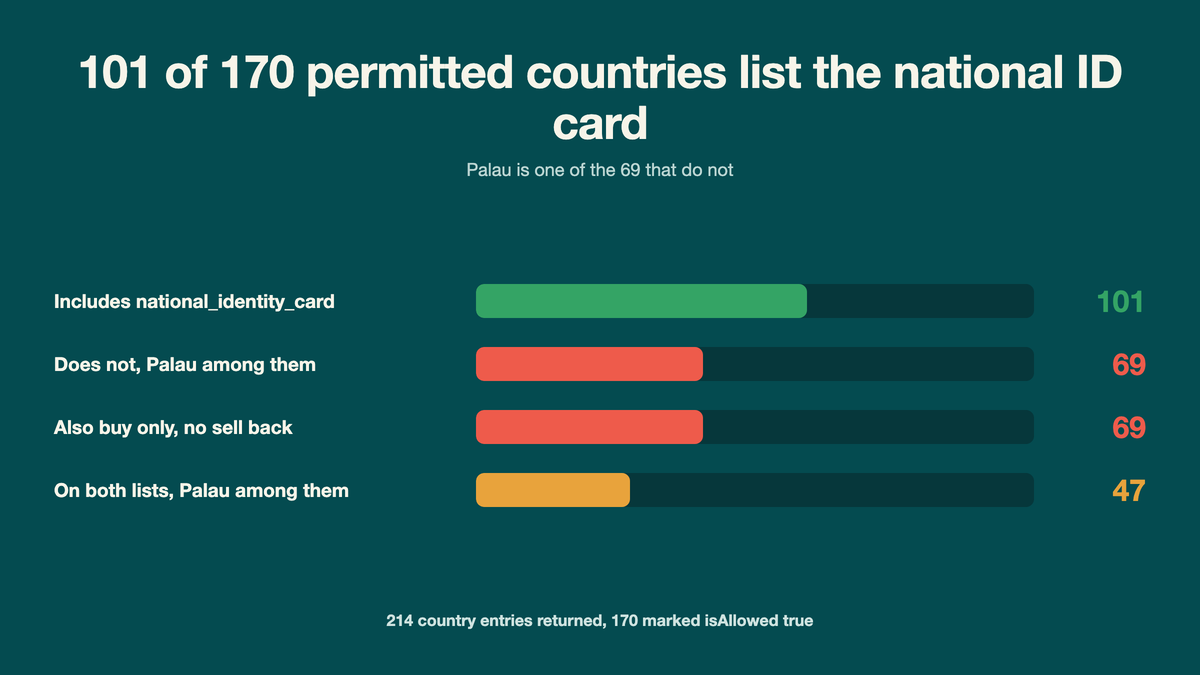
MoonPay's getCountries reference documents a supportedDocuments field described as the "array of accepted identity document types", alongside isAllowed, isBuyAllowed, isSellAllowed and a suggestedDocument. The endpoint needs no key. We fetched https://api.moonpay.com/v3/countries on 2026-10-04; it returned 214 country entries, 170 of them isAllowed: true.
101 of those 170 include national_identity_card. Palau is one of the 69 that do not.
| Country (ISO) | supportedDocuments as returned | suggestedDocument | Sell allowed? |
|---|---|---|---|
| Palau (PW) | passport, residence_permit | passport | No |
| Micronesia (FM) | passport, residence_permit | passport | No |
| Marshall Islands (MH) | passport, driving_licence, residence_permit | driving_licence | No |
| Estonia (EE) | passport, driving_licence, national_identity_card, residence_permit | national_identity_card | Yes |
| Germany (DE) | passport, driving_licence, national_identity_card, residence_permit | driving_licence | Yes |
| Portugal (PT) | passport, driving_licence, national_identity_card, residence_permit | national_identity_card | Yes |
| United Arab Emirates (AE) | passport, driving_licence, national_identity_card, residence_permit | national_identity_card | Yes |
| United States (US) | driving_licence, national_identity_card, residence_permit | driving_licence | Yes |
Read Palau's row next to Estonia's and the comparison this site keeps making gets an unusually clean illustration. Estonia's row suggests the national ID card, because the Estonian ID card is the primary credential of a functioning e-residency programme and document checkers have read it for twenty years. Palau's row does not list one at all. Our Palau vs Estonia e-residency comparison argues this from programme design; MoonPay's API shows it as a field.
The honest caveat is that the field's wording leaves two readings open. supportedDocuments may mean the documents MoonPay can verify as issued by that country, or the documents it will accept from residents of that country. Under the first reading, a Palau-issued national ID card is one MoonPay's checker does not read. Under the second, Palau residents are not offered the class. Neither reading produces a yes for a Palau national ID card, and that is the only thing this page needs it to settle.
Independent coverage points the same way. ID Analyzer, a document-recognition vendor, says it "supports 1 Palau identity document, including passports" and "currently covers passports for Palau." Two unrelated sources, both covering the Palau passport and neither covering a Palau ID card, is a pattern rather than a coincidence.
| What exists | In MoonPay's Palau row | Covered by the ID vendor we checked |
|---|---|---|
| Palau passport | Yes | Yes |
| Palau digital residency card | Not listed | Not listed |
| Residence permit | Yes (see the next section) | Not applicable |
And a fairness note, because this is not a verdict on Palau. The 69-country list includes Denmark, the Netherlands, Norway, Iceland, Malta and Monaco. The omission tracks what a jurisdiction issues and what automated checkers have been trained to read, not the respectability of the country — which is also why it can change without anyone announcing it.

The residence-permit row is the one that tempts people
Palau's row does contain a second document: residence_permit. It is the first thing a Palau digital resident will reach for, and it is the wrong row.
A residence permit is a government grant of permission to live in a place. Palau digital residency is not that, and RNS does not pretend otherwise — its own documentation states that "Palau Digital Residency is not the same as citizenship, a passport, or physical residency in Palau," and lists "guaranteed approval, access to a bank or exchange, universal third-party acceptance" among the things that are "not a promised outcome."
| Document MoonPay lists for Palau | What it is | Does a Palau digital residency card qualify? |
|---|---|---|
| Passport | A Palau passport, issued to Palau nationals | No — the programme grants no nationality |
| Residence permit | Permission to reside in the issuing country | No — RNS: not "physical residency in Palau" |
There is a second trap in the same row. Even if you hold a genuine residence permit, it has to belong to the country on your account. A permit for the country you actually live in is useful to you; nothing issued by Palau is evidence about Portugal. That is the identical structure we found at Wise, where the documents for its residence check "must be issued by your registered country" — and it is why Palau digital residency limitations is the page to read before any of this.
Palau is buy-only on MoonPay
This one has nothing to do with the card, and for anyone who did somehow verify as Palau-based it would matter more.
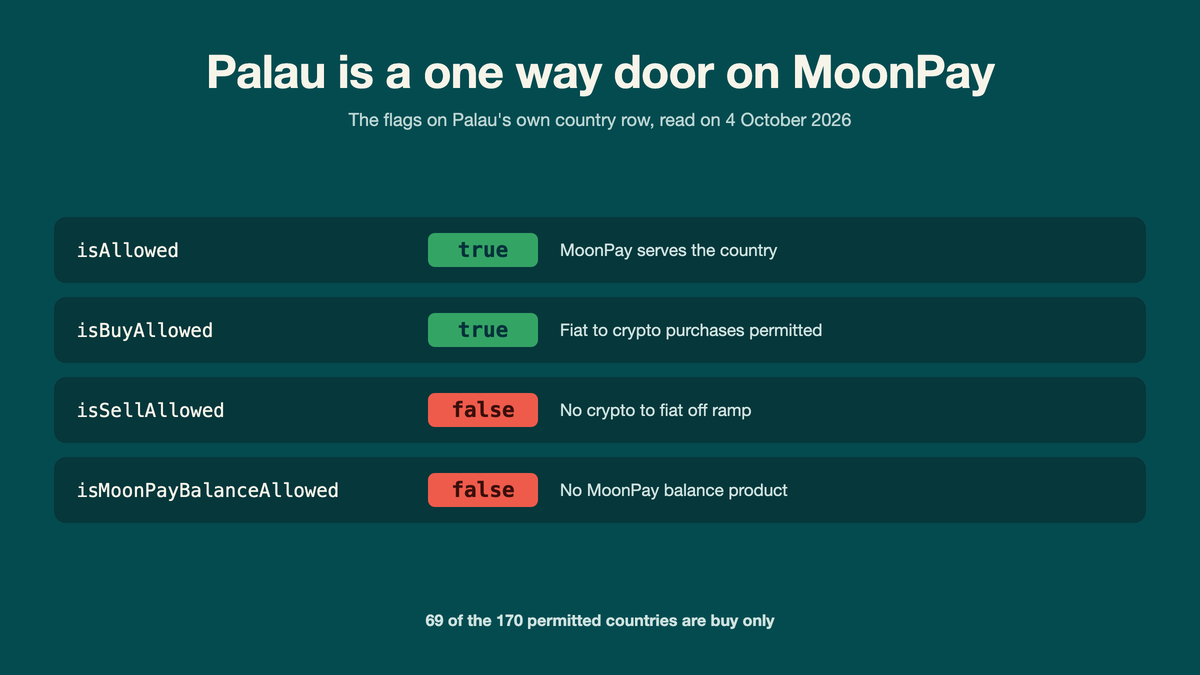
The same API row carries isAllowed: true and isBuyAllowed: true — and isSellAllowed: false. Palau-resident accounts can buy crypto through MoonPay and cannot sell it back. 69 of the 170 permitted countries sit in that position, and 47 countries, Palau among them, are on both the no-national-ID list and the buy-only list. The two restrictions are separate; they just both catch Palau.
| Flag in Palau's row | Value on 2026-10-04 | What it means in practice |
|---|---|---|
isAllowed | true | MoonPay serves the country |
isBuyAllowed | true | Fiat-to-crypto purchases permitted |
isSellAllowed | false | No crypto-to-fiat off-ramp |
isMoonPayBalanceAllowed | false | No MoonPay balance product |
A one-way door is a meaningful thing to learn before you route money through it, and it is the sort of per-country detail that only ever appears in the API. Compare Polymarket's supported countries, where the restriction list is published as prose and still widely misread.
Does MoonPay accept Palau ID as proof of address?
No. MoonPay's proof-of-address requirements are a separate check with their own closed list, and an identity card cannot satisfy any of it.
| MoonPay's position | Detail |
|---|---|
| Accepted | Utility bills, bank or credit card statements, tax invoices, government-issued statements |
| Recency | Nothing "issued over three months ago"; the dev docs put the window at "90 days" |
| Format | "Only accept PDF files or the original pictures" — screenshots and scans rejected |
| Framing | All four corners visible; folded documents rejected |
| Match | The address must match the account; a name mismatch is a named rejection reason |
| Not accepted | Document types outside that list |
An ID card carries no residential address and no issue date in the sense MoonPay means, so it fails on the document type before anyone looks at the fields. The RNS mailing service fares no better: RNS itself says it "is a mailing address, not a residential address or proof of residence, domicile, or tax residence," and adds that "third-party acceptance is not guaranteed." Our Palau mailing address and Palau ID proof of address pages cover what that service is genuinely good for, which is receiving post.
MoonPay also asks for tax identifiers in many jurisdictions — "SSN for US, CPF for Brazil, TIN for EEA/UK/others" — which is residence machinery again, and which connects to CARF crypto reporting and the MiCA rules for EU exchanges.
Can you pay for the Palau ID with MoonPay?
This is the question the first half of this page tends to invert into, and it has a more useful answer.
RNS says the "current checkout shows the methods supported for that product and account," and that "options can include card, crypto, or RNS Balance." If you intend to pay in crypto and do not already hold any, you need an on-ramp first — and an on-ramp verifies you, in the country you actually live in, with the documents your own country's row allows. MoonPay works perfectly well for that, using your own national ID or driving licence. The Palau card plays no part, because it does not exist yet at that point in the sequence.
Order matters, and getting it backwards is the common mistake:
- Verify on the on-ramp with your own country's documents. Your German, Portuguese or UK ID is on your row. The card you have not bought yet is not.
- Buy the stablecoin the checkout asks for, on the network it asks for. Our payment guide covers the network and token traps, and RNS.ID payment failed or refund covers a stuck checkout.
- Then apply. RNS is blunt that "payment starts the application" and that verification, screening, "video verification when required, internal review, and government review still apply."
- Treat the purchase as final. Check current terms on the live product page — RNS says prices and terms are "intentionally not hard-coded in these docs" — and see Palau digital residency cost for how the terms compare.
If what you actually need is a business banking and payments setup rather than a second identity document, that is a company-formation problem and not an ID problem. Firstbase and Doola both handle remote US LLC formation, and we cover the banking leg in US business bank accounts for nomads. Both are sponsored links and we may earn a commission at no cost to you. Neither issues a Palau ID, neither affects an RNS application, and forming a company does not make any payments provider accept you.
Where MoonPay sits against the platforms we have checked
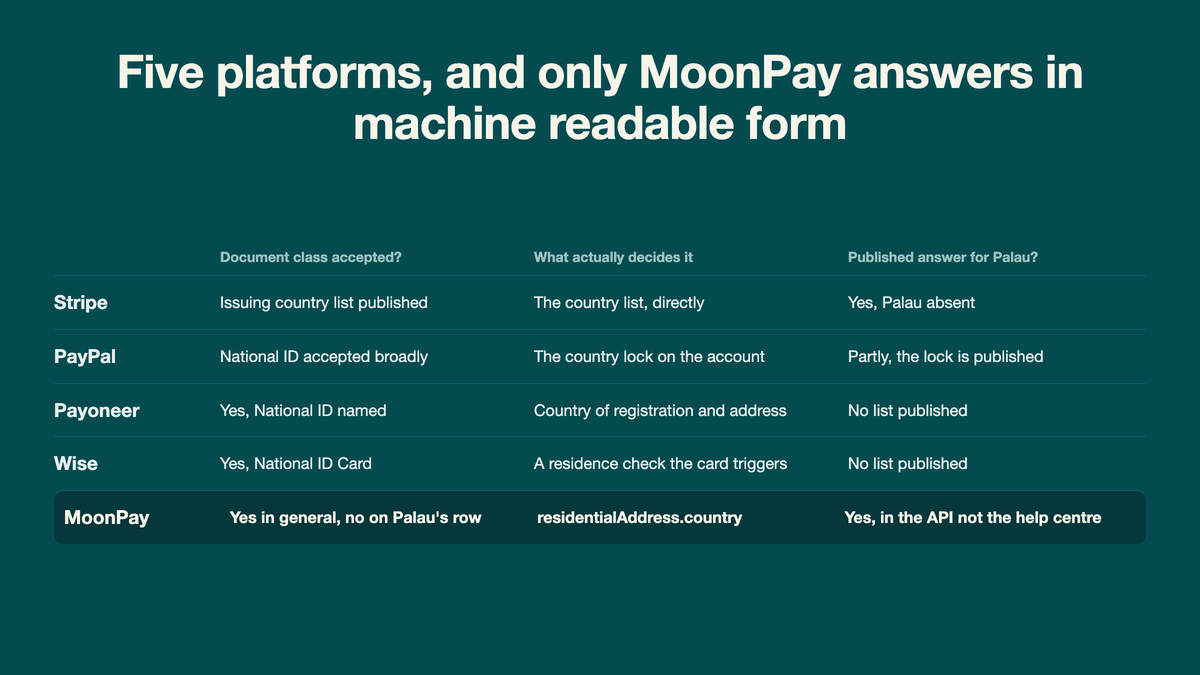
Five platforms in, the method has been identical every time: read the published rules, quote them, and keep the document question separate from the residence question.
| Platform | Document class accepted? | What actually decides it | Published answer for Palau? |
|---|---|---|---|
| Stripe | Issuing-country list published | The country list, directly | Yes — Palau absent |
| PayPal | National ID accepted broadly | The country lock on the account | Partly — the lock is published |
| Payoneer | Yes — "National ID" named | Country of registration and address | No list published |
| Wise | Yes — "National ID Card" | A residence check the card triggers | No list published |
| MoonPay | Yes in general, no on Palau's row | residentialAddress.country | Yes — in the API, not the help centre |
MoonPay is the clearest of the five, and the only one whose answer is machine-readable. Stripe publishes a country list a human has to read; MoonPay publishes a document list per country that a widget reads at runtime. The irony is that the clearest published "no" in this niche is the one nobody had looked up, because the help centre's generic list was easier to quote.
For the venues where an uploaded document genuinely is the deciding factor, our exchange KYC tracker records what we have checked platform by platform — and acceptance varies and changes without notice.
Bottom line
Does MoonPay accept Palau ID? The document class is accepted; a Palau national ID card is not offered on Palau's row. MoonPay's public API returned supportedDocuments: ["passport", "residence_permit"] for Palau on 2026-10-04, with suggestedDocument: "passport" and isSellAllowed: false. The national ID card that the help centre names is present for 101 of the 170 permitted countries and absent for 69, Palau among them.
More importantly, Palau's row is not even your row. MoonPay states that "country is the key driver" and that the requirement set follows residentialAddress.country. If you live in Lisbon, Portugal's row governs your verification, it offers the national ID card, and the card it means is a Portuguese one. The Palau card does not improve that position and the residence-permit slot does not fit it, because RNS says digital residency "is not the same as citizenship, a passport, or physical residency in Palau."
Buy the card for venues that verify an uploaded identity document and have been checked, and read Palau digital residency limitations first. Do not buy it to get through MoonPay. Nothing here is legal, tax or financial advice, platform rules change without notice, and acceptance is decided by each platform — re-check the live pages before you act. RNS also notes that "payment starts the application" rather than finishing it.
Related reading
- Does Stripe accept Palau ID? — the other platform with a published answer
- Does Wise accept Palau ID? — where the card triggers a check it cannot clear
- Palau ID for crypto KYC — the cluster overview before you buy
- Palau ID exchange KYC tracker — platform-by-platform status
- Palau digital residency payment guide — paying by card or crypto without losing funds
- Palau digital residency supported countries — who can apply at all
FAQ
Does MoonPay accept a Palau digital residency ID?
MoonPay's help centre names "national ID card (both sides)" as one of four acceptable documents, so the class is accepted in general. Palau's own entry in MoonPay's public country list does not include it: fetched on 2026-10-04, Palau returned supportedDocuments: ["passport", "residence_permit"] with suggestedDocument: "passport". For a buyer resident anywhere else, their own country's row governs the upload, and the national ID card it allows means one issued by that country.
Where does MoonPay publish its per-country document list?
In the same endpoint its purchase widget calls. The getCountries API reference documents a supportedDocuments array alongside isAllowed, isBuyAllowed and isSellAllowed, and the live response at https://api.moonpay.com/v3/countries needs no API key. It is the most directly checkable country rule we have found in this niche, which is why the generic help-centre answer has gone unchallenged for so long.
Can I verify with MoonPay as a Palau resident?
Not on the strength of digital residency. RNS states that the programme "is not the same as citizenship, a passport, or physical residency in Palau," and MoonPay's requirement set follows the residential address you submit. Setting your MoonPay country to Palau without living there would misstate your country of residence, and it would also move you onto a row with no national ID card option and no sell permission.
Is "residence permit" a route for a Palau ID holder?
No. residence_permit appears in Palau's row, but a residence permit is permission to live in the issuing country, which digital residency explicitly is not. A permit also has to come from the country your account is registered in, so even a genuine one from elsewhere would not help. RNS lists "universal third-party acceptance" among the outcomes it does not promise.
Why can't I sell crypto on MoonPay as a Palau resident?
Because Palau's row carries isSellAllowed: false alongside isBuyAllowed: true. MoonPay does not publish a reason, and 69 of the 170 permitted countries are in the same position, so it is a routine licensing and payout constraint rather than anything Palau-specific. The practical effect is a one-way door: purchases work, cashing out does not.
Can a Palau ID be used as proof of address on MoonPay?
No. MoonPay's address check accepts utility bills, bank or credit card statements, tax invoices and government-issued statements, nothing issued more than three months ago, as "PDF files or the original pictures" rather than screenshots. An identity card is not on that list and carries no residential address. The RNS mailing service does not fill the slot either — RNS calls it "a mailing address, not a residential address or proof of residence, domicile, or tax residence."
Can I use MoonPay to pay for the Palau ID itself?
Usually yes, and that is the sequence that works. RNS says the checkout's "options can include card, crypto, or RNS Balance," so if you are paying in crypto you need an on-ramp first — verified with your own country's documents, before the Palau card exists. Confirm the token and network on the live checkout, read our payment guide before sending anything, and note that RNS treats payment as the start of the application rather than the end.