Does Wise Accept Palau ID? 2026 Rules and the Catch
Does Wise accept Palau ID? Wise takes plastic national ID cards, but a Palau card is the one choice that triggers a residence check it cannot clear.
We may earn a commission if you apply through this link. This site is independent and is not the official RNS.ID or Palau government site.
Key takeaways
- Wise accepts the document class without reservation. Its identity page lists "National ID Card — Plastic card format, showing both sides" as one of three acceptable documents. A Palau digital residency card is one, so nothing disqualifies it on paper.
- That is where the good news stops, because of a rule nobody writing about this has quoted. Wise runs a separate country-of-residence check, and it fires when "the ID you used to verify your identity (like a passport) wasn't issued by the same country as the address on your Wise account." Unless you live in Palau, the card guarantees that check.
- The card cannot clear the check it just triggered. The documents Wise accepts there "must be issued by your registered country," and it rejects digital-only IDs outright.
- Proof of address is a third, separate wall, and the RNS mailing address hits it. Wise refuses "PO box addresses" and "Address proofs that have been issued to a business," and RNS says its mailing service "is not a residential address or proof of residence, domicile, or tax residence."
- Wise publishes no list of accepted issuing countries — only the places it does not serve, and Palau is not among them. That is the inverse of Stripe, where the list is published and Palau is absent.
On this page
- Does Wise accept Palau ID? The short answer
- What Wise actually accepts as an identity document
- The extra check a Palau ID switches on
- Why the Palau card cannot clear a right-to-reside check
- Does Wise accept Palau ID as proof of address?
- Wise publishes no supported-country list, and that cuts both ways
- The automation gap nobody mentions
- Where Wise sits against the platforms we have already checked
- If a Wise account is the actual goal
- Bottom line
- Related reading
- FAQ
Does Wise accept Palau ID? The short answer
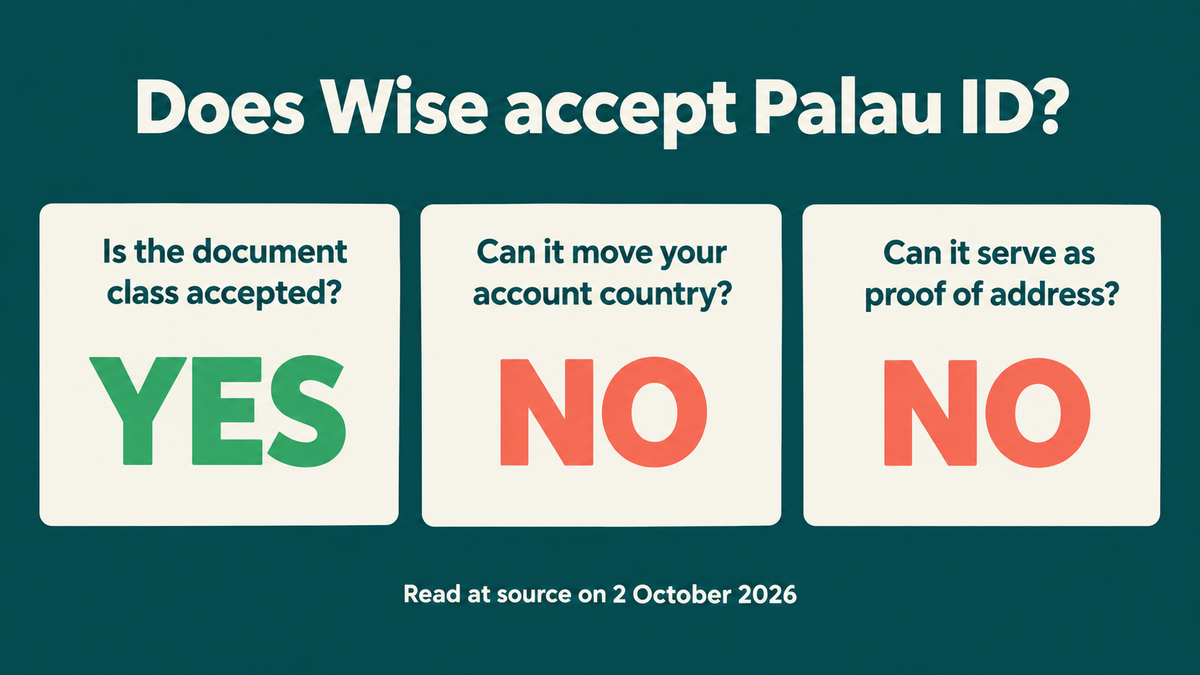
Does Wise accept Palau ID? As a document type, yes — Wise's identity verification page names "National ID Card" as one of three acceptable forms of government photo ID, and a Palau digital residency card is one. As a route to a working Wise account, the honest answer is that it makes your verification harder rather than easier, and we did not expect that when we started reading.
Every other page we found on this question stops at the document. Wise's own help centre does not, and the second rule is the one that decides outcomes: Wise checks the country you live in separately from who you are, and it starts that check precisely when your ID was not issued by the country on your account. That is not an edge case for a Palau cardholder. It is the default.
So the single question people type splits into three, and only the first one gets a yes.
| The question people ask | What it actually means | Where Palau stands |
|---|---|---|
| Will Wise take my Palau card as photo ID? | Is a plastic national ID card an acceptable document class? | Yes — named on Wise's list, both sides required |
| Can I verify as a Palau resident? | Does digital residency make me Palau-based? | No — RNS: not "physical residency in Palau" |
| Will it satisfy proof of address? | Can the card or the RNS mail address fill the address slot? | No — no residential address, and PO boxes are refused |
One yes and two no's — and the yes is the one that costs you, because using it switches on a check the other two answers cannot pass. The rest of this page shows the working, because which of the three is blocking you decides whether the card is still worth buying for other reasons.
What Wise actually accepts as an identity document
Wise's list is short and unusually specific about format, which matters more here than it looks.
| Requirement | What Wise says | How a Palau card fares |
|---|---|---|
| Accepted types | "Passport", "National ID Card", "Photo Driver's Licence" | National ID — the class is accepted |
| Format | "Plastic card format, showing both sides" | Needs the physical card in hand |
| Electronic versions | "Electronic Driving Licences aren't accepted" | A signal about digital-only credentials |
| Must show | Full name, clear photo, date of birth, unique document number | The card carries all four |
| Validity | Must not be expired | 1, 5 or 10 year terms — check yours |
| Known exclusions | US Military IDs; documents issued by the Russian government; no driving licence if you live in Europe | None Palau-specific |
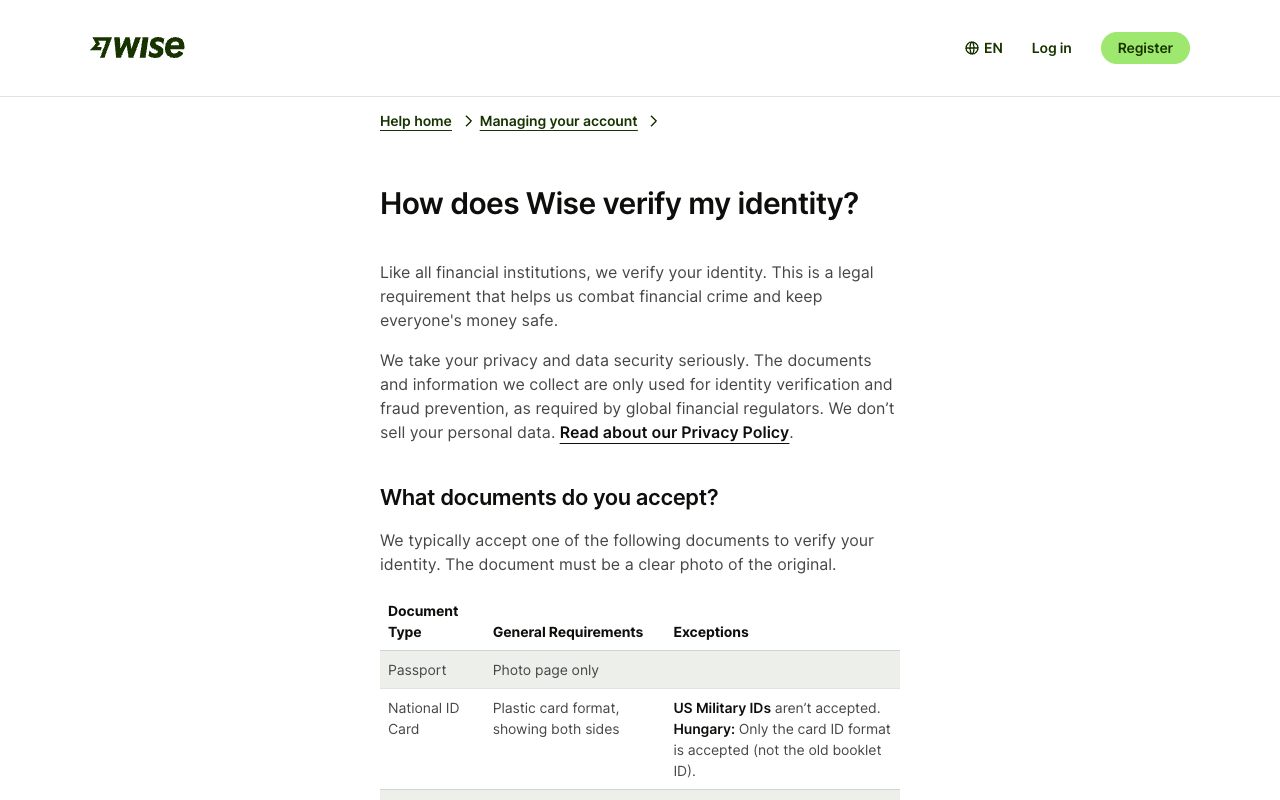
Two things are worth pulling out. The first is "plastic card format, showing both sides." A Palau digital residency begins as a digital credential and a downloadable PDF, and RNS is blunt that "downloading the PDF does not establish permission to use it in a particular verification process or guarantee acceptance by a third party." Until the physical card is in your hands there is no back side to photograph and no Wise flow to test — our shipping and tracking guide covers how long that leg really takes, and physical vs digital Palau ID for KYC covers why the distinction keeps mattering.
The second is that Wise's exclusions are about issuing governments and residence, not about obscurity. It refuses Russian-issued documents outright and refuses a driving licence from anyone living in Europe. Nothing on that list touches Palau. The card is not blacklisted; it is simply unhelpful for the question Wise asks next.
The extra check a Palau ID switches on
This is the part the existing coverage misses entirely, and it reframes the whole question.
Wise runs a check it calls verifying the country you live in, and it states the purpose plainly: "To meet financial regulations, we sometimes need to check that you have a legal right to live in the country your Wise account is registered in." This is not address verification, and it is not identity verification. It is a third thing, with its own document list.
What triggers it is the detail that matters. Wise says it asks when "the ID you used to verify your identity (like a passport) wasn't issued by the same country as the address on your Wise account."
| Your situation | Does the residence check fire? |
|---|---|
| German resident, German ID card | No — issuer matches the account country |
| German resident, Palau card | Yes — issuer and account country differ |
| UK resident, Palau card | Yes — same mismatch |
| Palau resident, Palau card | No — but digital residency does not make you one |
| Any resident, own passport | No — issuer matches |
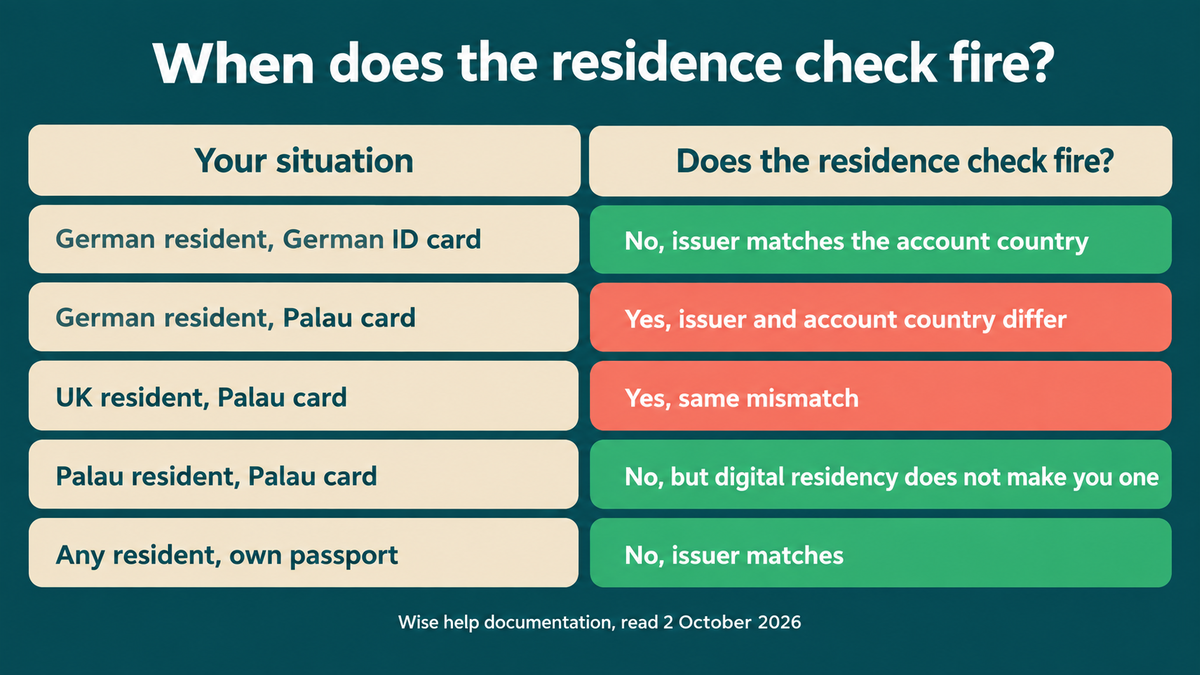
Read that table again, because it inverts the usual assumption about what a second identity document buys you. For almost every buyer, the Palau card is the only document in their wallet that creates the mismatch. Your own national ID or passport sails past this check; the Palau card walks straight into it.
The consequence is not a polite footnote. Wise says that "until this check is complete, we may have to limit access to some features, like ordering a card, adding a currency or sending a transfer" — which is to say, the three things people open a Wise account to do.
None of this is a judgement about Palau's credential. It is the ordinary machinery of a regulated money-transmission business, and RNS does not pretend otherwise: its own documentation says that "whether any organization accepts an identity document is determined by that organization and its rules."
Why the Palau card cannot clear a right-to-reside check
Having triggered the check, the obvious hope is that the Palau card also answers it. It cannot, and Wise's own list is specific about why.
| Document | Accepted for the residence check? |
|---|---|
| Passport issued by your registered country | Yes |
| National ID card issued by your registered country | Yes |
| Valid residence permit | Yes |
| Long-term visa (90+ days) | Yes |
| Refugee or asylee documents | Yes |
| A national ID card issued by some other country | No — must be issued by your registered country |
| Digital-only IDs | No — UK eVisas are the only exception |
| Utility bills, bank statements, rental agreements | No — "not accepted" for this check |
| Short-term visas, application forms | No |
The qualifier does all the work: the documents Wise accepts here "must be issued by your registered country." A Palau-issued card evidences a relationship with Palau. If your Wise address is in Portugal, Wise needs evidence about Portugal, and no amount of Palauan paperwork is evidence about Portugal.
There is a second trap in that list for anyone tempted to use the credential before the card arrives. Digital-only IDs are refused, with UK eVisas carved out as the single exception. So the digital-first nature of the product, which is the whole pitch, is specifically disqualifying at this step.
And the row people find most surprising: utility bills and bank statements, the documents everyone reaches for, are explicitly not accepted for the residence check. They belong to the address check, which is a different wall again.
Does Wise accept Palau ID as proof of address?
No, and neither does the RNS mailing address that is often sold alongside it. This is the third wall, and it has the clearest published rules of the three.
Wise's address verification page wants a document showing four things: "Your full name" matching the account, "Your full home address" matching the account, a "Date of issue", and "A logo or clear name of the sender."
| Wise's position | Detail |
|---|---|
| Accepted | Utility bill (gas, electric, landline), bank or credit card statement, council tax bill, vehicle registration or tax document, rental agreement, photo driving licence showing address and expiry |
| Also accepted | "Other documents issued by a government or financial institution" |
| Recency | Utility bills, bank statements and council tax bills "can't be older than 3 months" |
| Not accepted | "PO box addresses" |
| Not accepted | "Address proofs that have been issued to a business" |
| Not accepted | Mobile phone bills; documents from "Moneygram, WesternUnion or Revolut"; Wise's own statements and receipts |
| Not accepted | A driving licence, if you already used it as proof of identity |
An identity card is not on the accepted list at all, and it could not satisfy the fields even if it were: a Palau card carries no residential address and no date of issue in the sense Wise means.
The RNS mailing address fares worse, because two separate exclusions catch it. RNS itself says the service "is a mailing address, not a residential address or proof of residence, domicile, or tax residence," and Wise refuses both PO box addresses and address proofs issued to a business. Our Palau mailing address and Palau ID proof of address pages cover what the service is genuinely useful for, which is receiving post, not passing compliance.
One incidental find if you bank with neobanks: Wise names Revolut among the senders whose documents it will not take as proof of address — a reminder that a statement from one fintech is not a universal address document. We cover that pairing in Palau ID for Revolut.
Wise publishes no supported-country list, and that cuts both ways
A fair question at this point is whether Wise serves Palau at all. The answer is that Wise does not publish a list of countries it does serve. It says it aims "to make Wise available everywhere" and then publishes only the inverse — the places it does not serve.
That list, at the time of writing, is Afghanistan, Belarus, Burundi, the Central African Republic, Chad, Congo, the Democratic Republic of the Congo, Cuba, Eritrea, Iran, Iraq, North Korea, Libya, Myanmar, Somalia, the Republic of South Sudan, Russia, Sudan, Syria, Yemen, Venezuela, and the Ukrainian regions of Crimea, Donetsk, Luhansk, Kherson and Zaporizhzhia.
Palau is not on it, and Palau is not mentioned anywhere on the page.
| Platform | Publishes a list of accepted issuing countries? | What that means for Palau |
|---|---|---|
| Stripe | Yes — and Palau is absent from it | A published no |
| PayPal | Country availability published; the account country locks behaviour | A published constraint |
| Payoneer | No — says "accepted documents can vary by country" | Unknowable from documentation |
| Wise | No — publishes only the countries it does not serve | Unknowable, but not excluded |
So the accurate framing is: Wise has not excluded Palau, has not approved it, and has never addressed it. Anyone telling you Wise accepts Palau ID is reading a document-class list and stopping one rule early. Anyone telling you Wise bans it is inventing a row that is not there. The reason the question has no clean answer is that the thing that decides your account is where you live, and Wise is explicit about that.
The automation gap nobody mentions
Here is a practical wrinkle we found while checking how the card behaves in automated flows, and it explains a class of failure that looks like rejection but is not.
Wise, like most regulated fintechs, leans on document-recognition tooling to read an uploaded ID. Those vendors publish coverage lists, and the coverage for Palau is thinner than the country's paperwork suggests. ID Analyzer, one such vendor, lists exactly one Palau document: the Palau Passport. Its page states that it "currently covers passports for Palau." The digital residency card is not listed.
| What exists | Covered by the ID vendor we checked |
|---|---|
| Palau passport | Yes |
| Palau digital residency card | Not listed |
We cannot see which vendor Wise uses, and Wise does not say — so treat this as context, not as a prediction about Wise specifically. But the shape of the problem is worth understanding before you spend money: a document class can be accepted by policy and still fail an automated read, which typically surfaces as a loop of unclear retry prompts rather than a clean decision. That is a different problem from being rejected, and it is usually resolved by manual review rather than by uploading the same card again.
Where Wise sits against the platforms we have already checked
We have now worked through four payment platforms with the same method — read the published rules, quote them, and separate the document question from the residence question. The pattern is consistent enough to be useful.
| Platform | Document class accepted? | What actually decides it | Published answer for Palau? |
|---|---|---|---|
| Stripe | Published list of issuing countries | The country list, directly | Yes — Palau is absent |
| PayPal | National ID accepted broadly | The country lock on the account | Partly — the lock is published |
| Payoneer | Yes — "National ID" named | Country of registration and address | No list published |
| Wise | Yes — "National ID Card" | A residence check the card triggers | No list published |
Wise is the most interesting of the four, because it is the only one where using the Palau card is actively counterproductive rather than merely useless. On Stripe the card is irrelevant because the list excludes Palau. On PayPal and Payoneer it is irrelevant because residence decides. On Wise, choosing it over your own national ID converts a one-step verification into a two-step one, and the second step is one the card cannot pass.
If your real question is which venues do run an identity check on an uploaded document, where the card can genuinely help, our exchange KYC tracker records every platform we have tested — and acceptance varies by platform and changes without notice.
If a Wise account is the actual goal
Then solve the residence question, because that is the one Wise is asking. Its own rules point at what works:
- Register in the country you actually live in, using an ID that country issued. This is the single biggest thing you can do, and it is free.
- Have a dated address document ready — a utility bill, bank statement or council tax bill from the last three months, in your own name, at the address on the account, from a named sender.
- Do not use a mail-forwarding address. PO boxes and business-issued address proofs are refused, and that includes the RNS service.
- If your ID and your address country genuinely differ, get the document Wise actually wants for that case: a residence permit or a long-term visa issued by the country you live in.
For founders whose underlying need is a business account rather than a personal one, the constraint is jurisdiction rather than paperwork — most often solved by forming a company somewhere with straightforward remote registration, commonly a US LLC. Firstbase and Doola both do this, and we cover the banking leg in US business bank accounts for nomads. Both are sponsored links and we may earn a commission at no cost to you. Neither issues a Palau ID, neither affects an RNS application, and forming a company is not the same as being approved by any payments provider.
That is a different purchase from an identity card, solving a different problem. Knowing which of the two you need is most of the value on this page.
Bottom line
Does Wise accept Palau ID? The document class is accepted — Wise names "National ID Card — Plastic card format, showing both sides," and a Palau digital residency card is one. But that yes is the least useful yes in this niche, because Wise asks two more questions and the card answers neither.
It triggers a country-of-residence check by being issued somewhere other than where you live, cannot clear that check because the documents Wise accepts there must come from your registered country, and cannot touch proof of address. RNS does not oversell this: digital residency is "not the same as citizenship, a passport, or physical residency in Palau."
Buy the card for venues that run an identity check on a document you upload, and read Palau digital residency limitations before you do. Do not buy it expecting a Wise account. Nothing here is legal, tax or financial advice, provider rules change without notice, and acceptance is decided by each platform — check the live pages before you act. RNS also notes that "purchasing a term does not guarantee approval."
Related reading
- Does Stripe accept Palau ID? — the same question where the country list is published
- Does PayPal accept Palau ID? — where the country lock decides everything
- Does Payoneer accept Palau ID? — no published list, residence decides
- Palau ID for Wise and payment apps — the shorter overview of neobanks and transfer services
- Palau ID proof of address — why an ID card rarely fills the address slot
- Palau digital residency cost — current tiers and what they include
FAQ
Does Wise accept a Palau digital residency ID?
Wise lists "National ID Card — Plastic card format, showing both sides" as an acceptable identity document, so a Palau digital residency card is an accepted document class. That is not the same as Wise accepting it as a route to an account: because the card was not issued by the country your Wise address is in, uploading it triggers a separate country-of-residence check the card cannot satisfy.
Can I open a Wise account as a Palau digital resident?
No. RNS states that digital residency "is not the same as citizenship, a passport, or physical residency in Palau." Your Wise account is registered to the country you actually live in, and Wise checks that you have "a legal right to live in the country your Wise account is registered in." The card creates no such right.
Will using my Palau ID make Wise verification harder?
In most cases, yes — the counter-intuitive part. Wise asks for residence documents when "the ID you used to verify your identity (like a passport) wasn't issued by the same country as the address on your Wise account." Your own national ID or passport avoids that mismatch; the Palau card creates it. Until it clears, Wise "may have to limit access to some features, like ordering a card, adding a currency or sending a transfer."
Can a Palau ID be used as proof of address on Wise?
No. Wise's address check wants a dated document from a named sender showing your full name and full home address — utility bills, bank statements, council tax bills or rental agreements. An identity card is not on the list and carries no residential address. Wise also refuses "PO box addresses" and "Address proofs that have been issued to a business," and RNS says its mailing service "is not a residential address or proof of residence, domicile, or tax residence."
Does Wise publish a list of countries whose IDs it accepts?
No. Wise says it aims "to make Wise available everywhere" and publishes only the countries and regions it does not serve — 21 countries plus five Ukrainian regions. Palau is on neither list and is not mentioned on the page, so Wise has neither approved nor excluded it. That is the inverse of Stripe, where the issuing-country list is published and Palau is absent from it.
Can I use the digital version of the Palau ID before the physical card arrives?
Not for Wise. It requires "plastic card format, showing both sides," so the physical card is needed, and for the residence check it refuses digital-only IDs outright, with UK eVisas the only exception. RNS adds that "downloading the PDF does not establish permission to use it in a particular verification process or guarantee acceptance by a third party."
What does the Palau ID cost in 2026, and is it worth it for Wise?
RNS lists $288 for one year, $1,199 for five and $2,339 for ten, though its documentation says current prices are "intentionally not hard-coded in these docs" — confirm on the live product page before budgeting. For Wise it is not a sensible purchase, because none of the three checks Wise runs is improved by holding it. Buy it for platforms that verify an uploaded identity document, and note that "purchasing a term does not guarantee approval."