Does PayPal Accept Palau ID? 2026 Verification Rules
Does PayPal accept Palau ID? PayPal names no issuing countries, but its ID field rules, 12-month address proof and country lock decide the answer in 2026.
We may earn a commission if you apply through this link. This site is independent and is not the official RNS.ID or Palau government site.
Key takeaways
- PayPal publishes no list of accepted issuing countries, so nobody can honestly tell you "Palau is approved" or "Palau is rejected." What PayPal does publish is a list of document categories — "Your ID card", a driving licence, a passport, or "Other photo ID issued by a government body" — and a Palau digital residency card is a government-issued ID card. As everywhere else on this site, acceptance varies.
- PayPal names four pieces of information it must be able to see on your photo ID: first and last name, date of birth, issue and expiration dates, and document ID number. RNS's own platform documentation lists the credential's fields, and date of birth is not among them — only an optional
IssueAge. That is the single most checkable reason a submission could bounce, and it has nothing to do with Palau's standing. - The Palau card almost certainly cannot be your proof of address, but the reason is narrower than usual. PayPal does accept an "Identity card or driver's license with physical address listed (must be current)". The Palau credential carries no residential address field, so it fails that specific clause rather than failing because it is an ID card.
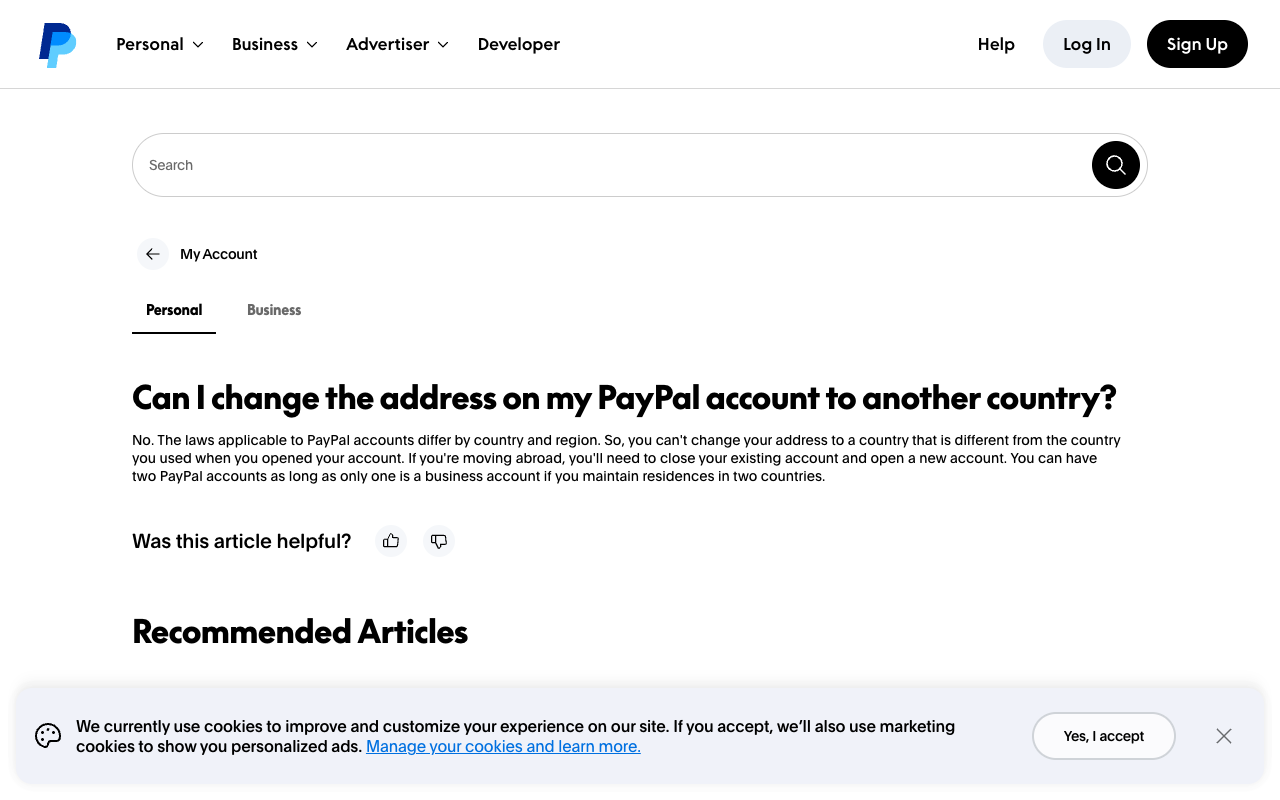
- The country lock is the real wall, and no document moves it. PayPal says plainly that "you can't change your address to a country that is different from the country you used when you opened your account." A Palau ID does not create Palau residence and cannot relocate an existing account.
- RNS lists $288 for one year, $1,199 for five and $2,339 for ten. Several pages ranking for this topic still quote the older $248 / $1,039 / $2,039 figures, which is worth knowing before you budget from them.
On this page
- The short answer, and why the question is shaped wrong
- What PayPal actually asks for, in its own words
- Where a Palau card fits PayPal's identity requirement
- The four fields PayPal wants to see
- Proof of address: the clause everyone misses
- The country lock is the real wall, not the document
- Is Palau even a PayPal country? Two official lists disagree
- Five checks before you spend $288
- Bottom line
- Related reading
- FAQ
The short answer, and why the question is shaped wrong
You want to know whether PayPal accepts a Palau ID before you spend $288 on a card and wait for it to cross the Pacific. That is the right order to make the decision in, and as far as we can tell nobody has actually answered it. Search this question and you get 2024-era articles about crypto exchanges; not one of the pages ranking for Palau ID verification mentions PayPal at all.
So we did it from primary documents. We pulled PayPal's own help pages on identity confirmation, on the documents it accepts to lift an account limitation, and on changing an account's country, and set each requirement against the fields RNS publishes for the Palau credential. The honest answer is that PayPal names no country, and the binding constraint is not your identity document. It is whether the card shows the four fields PayPal asks to see, and — much more decisively — which country your PayPal account already belongs to.
That is a more useful answer than yes or no, because it tells you in advance which half of a PayPal verification a Palau card could plausibly cover and which half it cannot touch. Take what PayPal asks for first, because everything else follows from it.
What PayPal actually asks for, in its own words
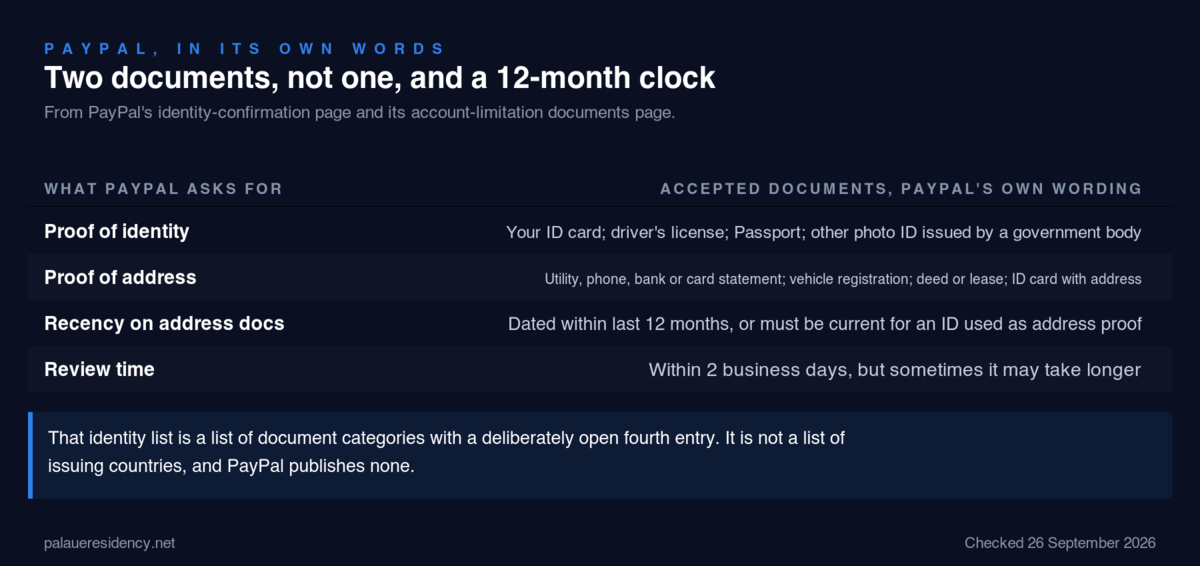
PayPal's identity confirmation page is short and states the shape of the request: it "usually need[s] a copy of your government-issued ID, and a proof of address issued within the past 12 months." It adds that PayPal will "try to review your documents within 2 business days, but sometimes it may take longer."
Two documents, then, not one. That split matters more than anything else on this page, and it is the part most write-ups about Palau ID skip entirely.
The itemised list lives on a different page — the one covering documents that remove an account limitation — and it is the closest thing PayPal publishes to an accepted-document schedule.
| What PayPal asks for | Accepted documents (PayPal's own wording) |
|---|---|
| Proof of identity | "Your ID card"; "Your driver's license (the plastic card, not the official letter)"; "Your Passport"; "Other photo ID issued by a government body" |
| Proof of address | Utility bill; cell or landline phone bill; motor vehicle registration; 401k/brokerage statement; grant deed or lease agreement; bank or credit card statement; "Identity card or driver's license with physical address listed" |
| Recency on address documents | "dated within last 12 months", or "must be current" for an ID used as address proof |
| Review time | "within 2 business days, but sometimes it may take longer" |
Notice what that identity list is and is not. It is a list of document categories, with a deliberately open fourth entry. It is not a list of issuing countries, and we could find no PayPal page that publishes one. That absence is precisely why confident claims about Palau on PayPal should be treated with suspicion in either direction.
Where a Palau card fits PayPal's identity requirement
Now set the credential against the requirement. RNS's platform documentation lists what the Palau digital residency credential carries: ID Number, Issue Date, Expiration Date, Jurisdiction, an IsRevoked flag and verification URLs, with IssueAge and BirthGender as optional fields. RNS's FAQ describes the card as "a government-issued identification card that can be used for any purpose that requires legal proof of identity," and — relevantly here — lists "payment processor" among the things members use it for.
| PayPal asks for | Can a Palau ID do it? | Why |
|---|---|---|
| Government-issued photo ID | Possibly — this is the one real slot | It is a government-issued photo ID card, and PayPal's category list is open-ended. Whether its reviewer accepts the jurisdiction is PayPal's call, and unpublished |
| Date of birth visible on that ID | Doubtful | RNS's documented field list has no date-of-birth field, only an optional age at issue. See the next section |
| Proof of address (12 months) | No | The credential carries no residential address field. Covered two sections down |
| Country of residence matching your account | No | Digital residency is not residence. This is the wall, and it is below |
| Linked local bank account or card | No | Nothing to do with an identity document |
One operational detail catches people out before any of this matters: RNS's own rule is that only the physical copy of your ID can be used for KYC. The image you can download from the portal exists so you can check your details are right, not to upload to a payment processor. So even in the best case, this route is gated on the card physically arriving — our page on the physical versus digital Palau ID covers what that means for timing.
The four fields PayPal wants to see
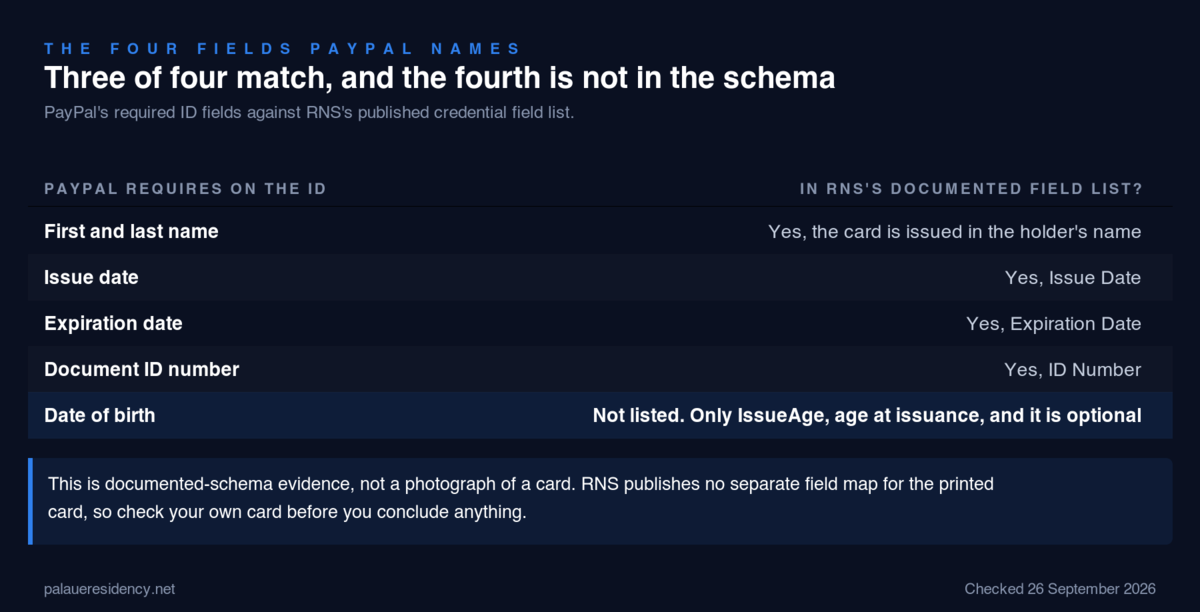
This is the most checkable thing on the page, and we have not seen it discussed anywhere. PayPal's limitation-documents page does not just name document types — it names the information that has to be legible on them. A proof-of-identity document must show your first and last name, date of birth, issue and expiration dates, and document ID number.
Line those four up against RNS's published field list and three of them match cleanly.
| PayPal requires on the ID | In RNS's documented field list? |
|---|---|
| First and last name | Yes — the card is issued in the holder's name |
| Issue date | Yes — Issue Date |
| Expiration date | Yes — Expiration Date |
| Document ID number | Yes — ID Number |
| Date of birth | Not listed. Only IssueAge (age at issuance), and it is optional |
Be careful how much weight you put on that last row, because we want to be straight about what kind of evidence it is. RNS's documentation describes the credential's field schema and does not publish a separate field map for the printed card, so this is documented-schema evidence, not a photograph of a card in someone's hand. Your physical card may well print a date of birth that the schema does not enumerate.
Which is exactly why it belongs in your own pre-flight rather than in a confident claim from us: look at your card, or at the sample RNS shows you, and check whether a date of birth is printed on it. If it is not, PayPal's stated requirement is unmet on its face, and you will want a passport or driving licence for that slot regardless of how PayPal feels about Palau. Our proof-of-address resource centre collects the same kind of field-level checking for the other half of the request.
Proof of address: the clause everyone misses
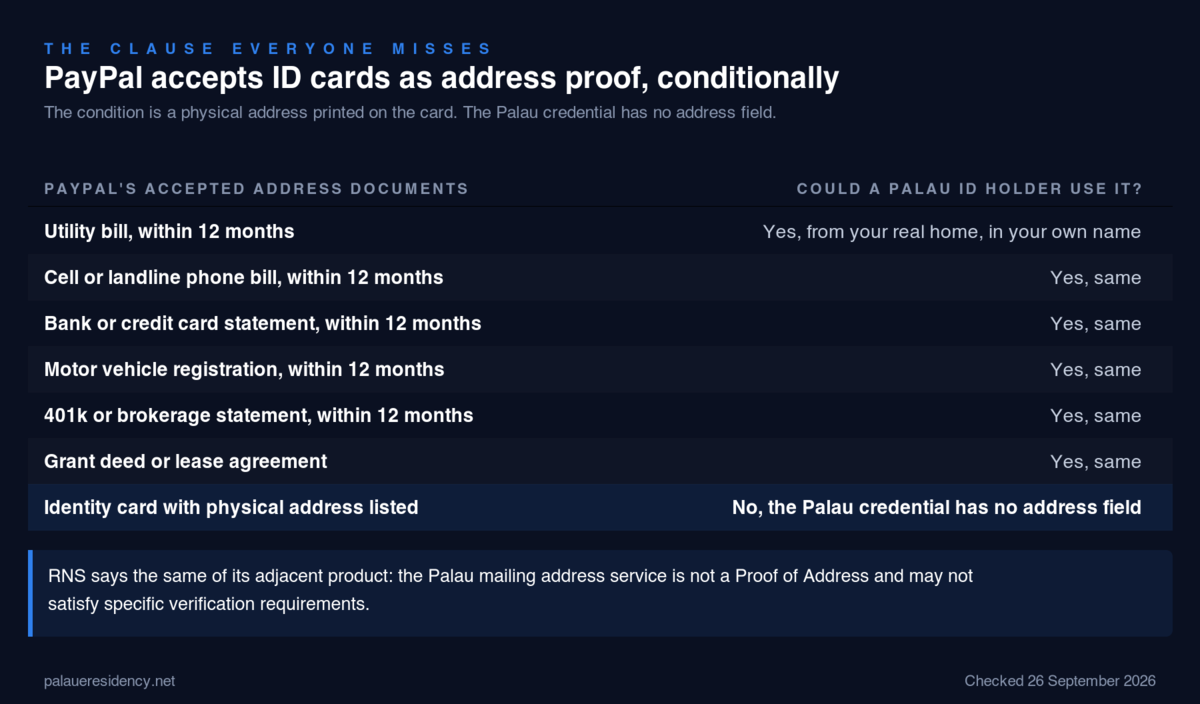
Every venue we check runs into the address requirement, and the Palau card loses on it every time. PayPal is no exception — but its list contains a clause that makes the reason unusually precise, and worth getting right.
Look again at the last item PayPal accepts as proof of address: "Identity card or driver's license with physical address listed (must be current)."
So PayPal does not reject identity cards as address evidence. It accepts them, conditionally — the condition being that the card has a physical address printed on it. Plenty of national ID cards do. The Palau digital residency credential does not: there is no residential address field anywhere in RNS's documented schema, and there could not usefully be one, since holders live in 80-odd other countries.
| PayPal's accepted address documents | Could a Palau ID holder use it? |
|---|---|
| Utility bill (within 12 months) | Yes — but from your real home, in your own name |
| Cell or landline phone bill (within 12 months) | Yes — same |
| Bank or credit card statement (within 12 months) | Yes — same |
| Motor vehicle registration (within 12 months) | Yes — same |
| 401k or brokerage statement (within 12 months) | Yes — same |
| Grant deed or lease agreement | Yes — same |
| Identity card with physical address listed (current) | No — the Palau credential has no address field |
RNS is straightforward about the adjacent product, too: its Palau mailing address service, run through a third-party partner, "is not a Proof of Address and may not satisfy specific verification requirements." That is the issuer saying it, not us. If your plan was that the card and the mailing address together would replace your documents, PayPal is one more venue where that plan stops. We gave this wall its own page because it recurs everywhere, and the mailing address question a separate one.
The country lock is the real wall, not the document
Here is the part that makes PayPal different from a crypto exchange, and the reason a Palau ID cannot do for PayPal what people hope it does.
A PayPal account belongs to a country. Not to a document — to a country, chosen when the account was opened. PayPal's help page on the question is unambiguous: "you can't change your address to a country that is different from the country you used when you opened your account," because "the laws applicable to PayPal accounts differ by country and region." If you have moved, "you'll need to close your existing account and open a new account."
Read that against what a Palau digital residency card is. RNS states that "digital residency does not support pathways to citizenship or future Palau passports." It is an identity credential, not a change of residence. It does not make you resident in Palau for PayPal's purposes, it cannot convert a German or Brazilian PayPal account into a Palauan one, and presenting it to suggest otherwise would be a misrepresentation of your residence to a regulated payment institution. That is not a grey area and it is not something this site will help you do.
Where the card could honestly help is narrower and less exciting: as the government photo ID on a PayPal account that already belongs to the country you actually live in, if PayPal's reviewer accepts it and if your card carries the fields above. That is a real use, and it is the only one we can see. PayPal does add that "you can have two PayPal accounts as long as only one is a business account if you maintain residences in two countries" — but that is about genuinely maintaining two residences, which a digital residency card does not give you either. Our page for US citizens goes through the same logic for a jurisdiction where it bites hardest.
Is Palau even a PayPal country? Two official lists disagree
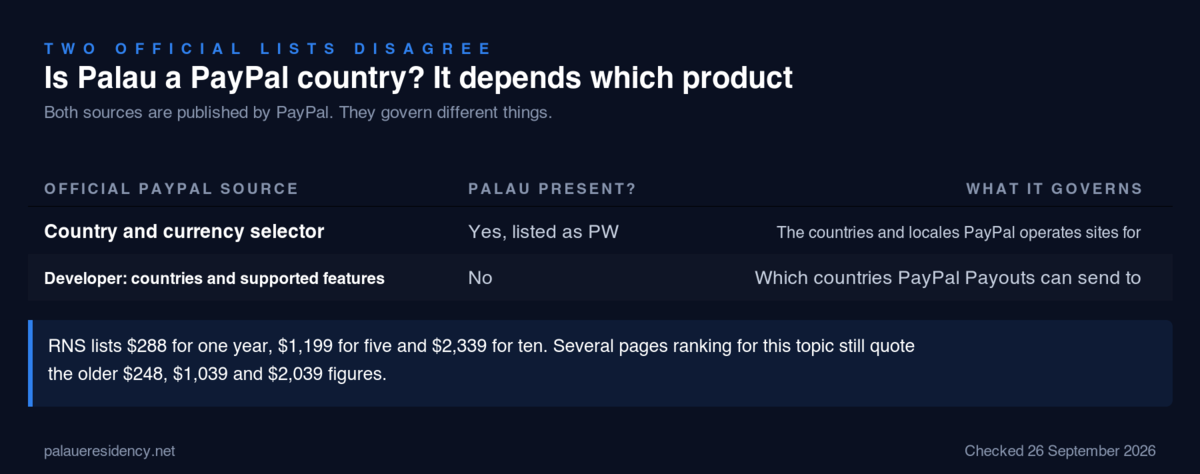
Suppose you are genuinely connected to Palau and wondered about a Palau-based account. Two PayPal-published lists give different impressions, and we would rather show you both than pick one.
| Official PayPal source | Palau present? | What it governs |
|---|---|---|
PayPal's own country and currency selector (paypal.com/us/webapps/mpp/country-worldwide) | Yes — listed as PW, "Palau", English | The countries and locales PayPal operates sites for |
| PayPal Developer — countries and supported features | No — not in the eligible-countries table | Which countries PayPal Payouts can send to |
Those are different products, so this is not a contradiction so much as a reminder that "PayPal supports country X" is never one fact. Sending, receiving, withdrawing to a local bank and receiving Payouts are separately gated, and the Payouts table's silence on Palau is a real signal about at least one of them. Third-party "countries that accept PayPal" listicles flatten all of this, which is why we have linked PayPal's own pages instead.
The practical reading: do not plan around a Palau-based PayPal account on the strength of a country appearing in a locale picker. Check the specific capability you need, on PayPal's own pages, for the country your account will actually live in.
Five checks before you spend $288
Free, quick, and between them they answer this better than any article can, this one included.
- Check which country your PayPal account already belongs to. If it is not the country you intend to verify from, no ID fixes that — PayPal's own page says the country cannot be changed. That check takes ten seconds and settles most people's question.
- Look for a date of birth on the card. PayPal requires it to be visible on your photo ID, and RNS's documented field list does not include one. If your card does not print it, plan on a passport or licence for that slot.
- Name your proof of address before you order anything. If you cannot point to a utility bill, phone bill, bank or card statement, lease or vehicle registration in your own name dated within 12 months, the address half of PayPal's request is unmet whatever ID you hold.
- Do not count on the mailing address service closing that gap. RNS says it "is not a Proof of Address and may not satisfy specific verification requirements."
- Open the account and reach the document screen before you buy. Signing up is free. The upload screen tells you which document categories and country fields you actually face — the one thing no third-party page, ours included, can tell you reliably.
If after those five the card still looks worthwhile for other reasons, read the cost breakdown and what the programme does not do before ordering. RNS lists $288 for one year, $1,199 for five and $2,339 for ten.
Bottom line
Does PayPal accept Palau ID? PayPal has not said, and anyone claiming otherwise in either direction is filling a gap rather than reporting one. What its documentation does tell you is more useful than a yes or a no: there is exactly one slot a Palau card could occupy — the government photo ID — and it occupies that slot only if your card shows the four fields PayPal asks to see, one of which does not appear in RNS's published schema at all.
The proof-of-address requirement closes the second slot, and the interesting detail is why. PayPal accepts identity cards as address evidence when they print a physical address. The Palau credential does not print one, so it fails a specific condition rather than a general prejudice. That is a distinction worth carrying to the next venue you check.
And the country lock closes the question people are usually really asking. A PayPal account belongs to the country it was opened in, that country cannot be changed, and digital residency is not residence — RNS says so itself. The cheapest thing you can do is check your account's country and your card's date-of-birth field before any money changes hands, and both are free. Nothing here is legal, tax or financial advice, exchange and processor rules change without notice, and acceptance varies — check the live pages before you act.
Related reading
- Palau ID for Wise and payment apps — the same question across neobanks and transfer services
- Palau ID for Revolut — where supported-country rules matter as much as the document
- Palau ID proof of address — why an ID card is usually not an address document
- Palau mailing address — what the address service is, and what RNS says it is not
- Palau ID bank account — what is realistic on the banking side
- Palau ID exchange KYC tracker — every venue we have checked, side by side
FAQ
Does PayPal accept a Palau digital residency ID for verification?
PayPal publishes no list of accepted issuing countries, so there is no documented yes or no. Its accepted-document categories are "Your ID card", a driving licence, "Your Passport", and "Other photo ID issued by a government body" — and a Palau digital residency card is a government-issued photo ID card. Whether a reviewer accepts that jurisdiction is PayPal's decision and is not published, so acceptance varies and should be tested on the document screen before you buy anything.
Can a Palau ID be used as proof of address on PayPal?
Almost certainly not, and the reason is specific. PayPal accepts an "Identity card or driver's license with physical address listed (must be current)" as address evidence, so it does not rule out ID cards as a class. It rules out cards with no address printed on them, and RNS's documented field list for the Palau credential contains no residential address field. RNS also states that its separate Palau mailing address service "is not a Proof of Address and may not satisfy specific verification requirements."
Does the Palau ID show a date of birth?
RNS's platform documentation lists the credential's fields — ID Number, Issue Date, Expiration Date, Jurisdiction, an IsRevoked flag and verification URLs, plus optional IssueAge and BirthGender — and a date of birth is not among them. RNS does not publish a separate field map for the printed card, so check your own card or RNS's sample rather than assuming either way. It matters because PayPal names date of birth as information that must be visible on your photo ID.
Can I use a Palau ID to open a PayPal account in Palau?
A Palau digital residency card does not make you a resident of Palau. RNS states that "digital residency does not support pathways to citizenship or future Palau passports," and PayPal ties an account to the country it was opened in based on where you actually live. Palau appears in PayPal's own country and currency selector but not in PayPal's Payouts eligible-countries table, so capability varies by product and should be checked on PayPal's pages for the specific feature you need.
Can I change my PayPal account's country with a Palau ID?
No. PayPal's help page states that "you can't change your address to a country that is different from the country you used when you opened your account," because "the laws applicable to PayPal accounts differ by country and region," and says that if you move you will "need to close your existing account and open a new account." No identity document changes that, and a digital residency credential does not establish residence in Palau for this purpose.
What documents does PayPal ask for when confirming identity?
PayPal says it "usually need[s] a copy of your government-issued ID, and a proof of address issued within the past 12 months," and that it will "try to review your documents within 2 business days, but sometimes it may take longer." Its limitation-documents page adds that the identity document must show your first and last name, date of birth, issue and expiration dates, and document ID number, and lists seven accepted address documents ranging from utility bills to lease agreements.
How much does the Palau ID cost in 2026?
RNS's FAQ lists a Trial Version at $288 for one year, a Regular Version at $1,199 for five years, and an Ultimate Version at $2,339 for ten years. Several pages still circulating on this topic quote an older $248 / $1,039 / $2,039 structure, so check RNS's own pages before budgeting. Our cost page breaks down what is and is not included, and none of it is a guarantee that any particular platform will accept the card.