Does Bitpanda Accept Palau ID? What Its 2026 List Shows
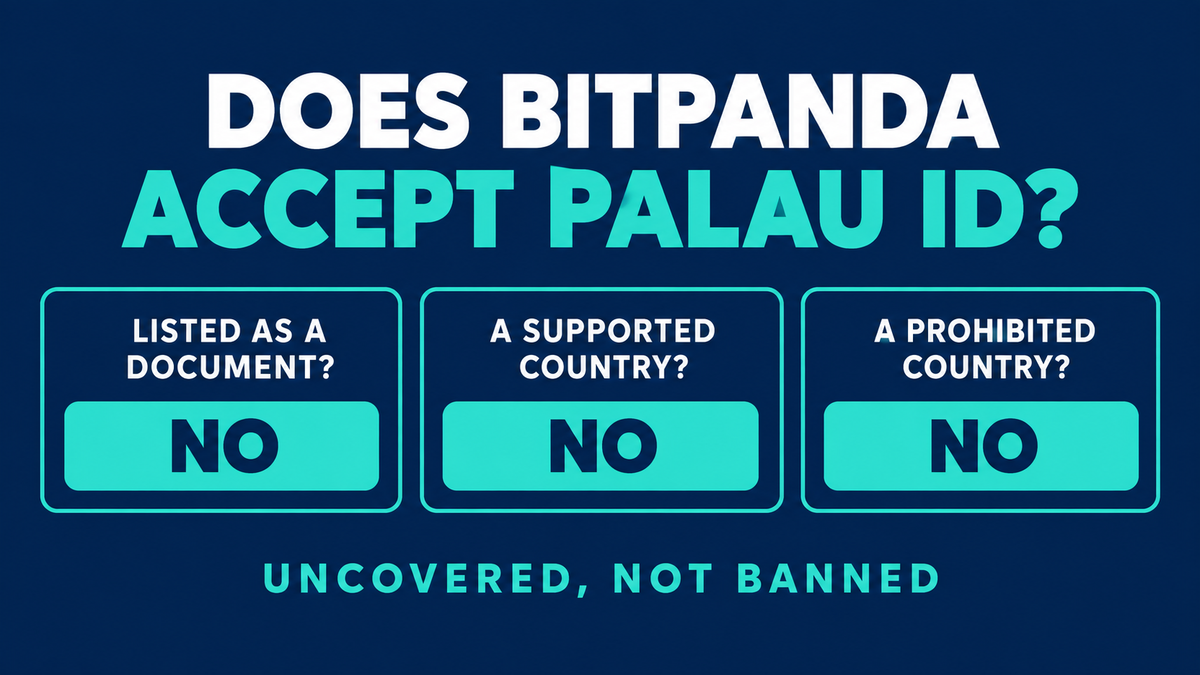
Does Bitpanda accept Palau ID? Across four legal entities its 2026 policy offers no row for the card, and Palau is not an accepted country of residence.
We may earn a commission if you apply through this link. This site is independent and is not the official RNS.ID or Palau government site.
Key takeaways
- Bitpanda publishes its acceptance rules as four tables, one per legal entity, and a Palau card has no row in any of them. Read on 2026-10-06, the policy was last updated 2026-08-06. Every table sorts you by citizenship into EEA & EU, United Kingdom, Switzerland / Microstates, or Other Nationalities — and a Palau ID holder is always in the last bucket.
- "Other Nationalities" is never offered a national ID card. Depending on where you live, that row offers an EEA/EU or Swiss residence permit, an EEA/EU ID card, an EEA/EU driving licence, or a passport. A Palau-issued ID card is none of those things, and no row anywhere accepts a non-EEA ID card.
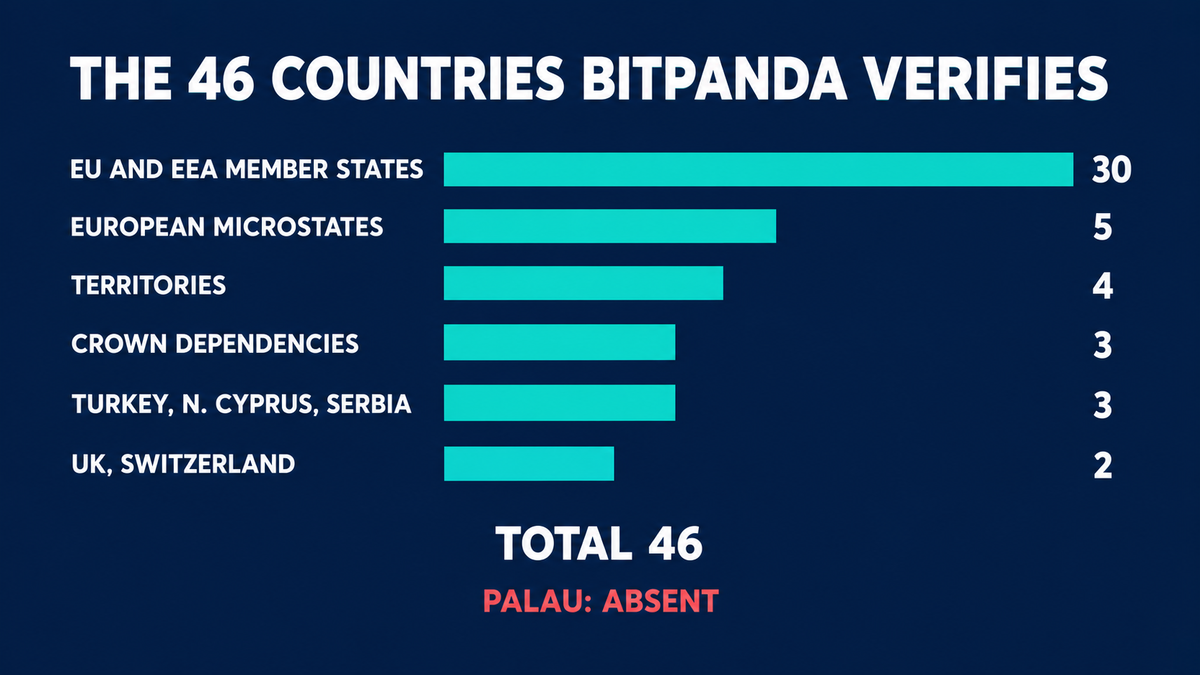
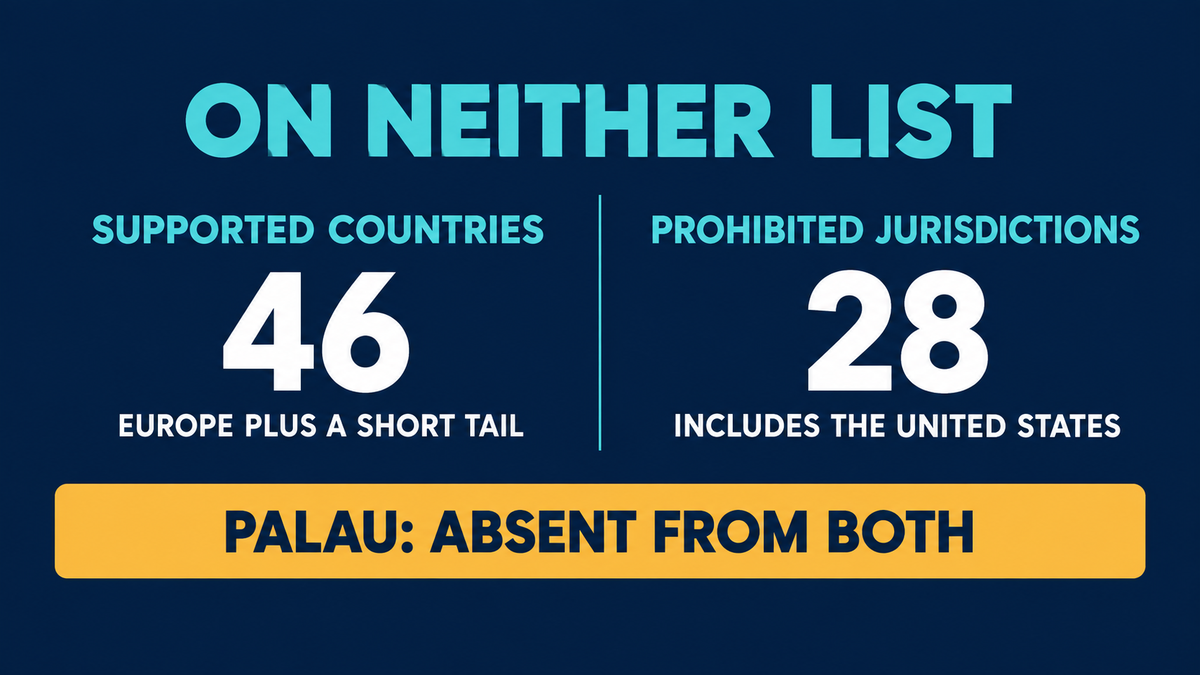
- Palau is also not an accepted country of residence. Bitpanda's supported-countries article lists 46 entries, all of them European plus Turkey, Northern Cyprus, Serbia and the Crown Dependencies. Palau is absent, so you cannot onboard as a Palau resident either.
- This is a coverage gap, not a ban — and that distinction has no practical upside. Palau is not among the 28 jurisdictions Bitpanda prohibits. It is simply not covered, and Bitpanda says that when a document or country is unsupported, "verification with Bitpanda is currently not possible" with no verification "by post, via email or in person."
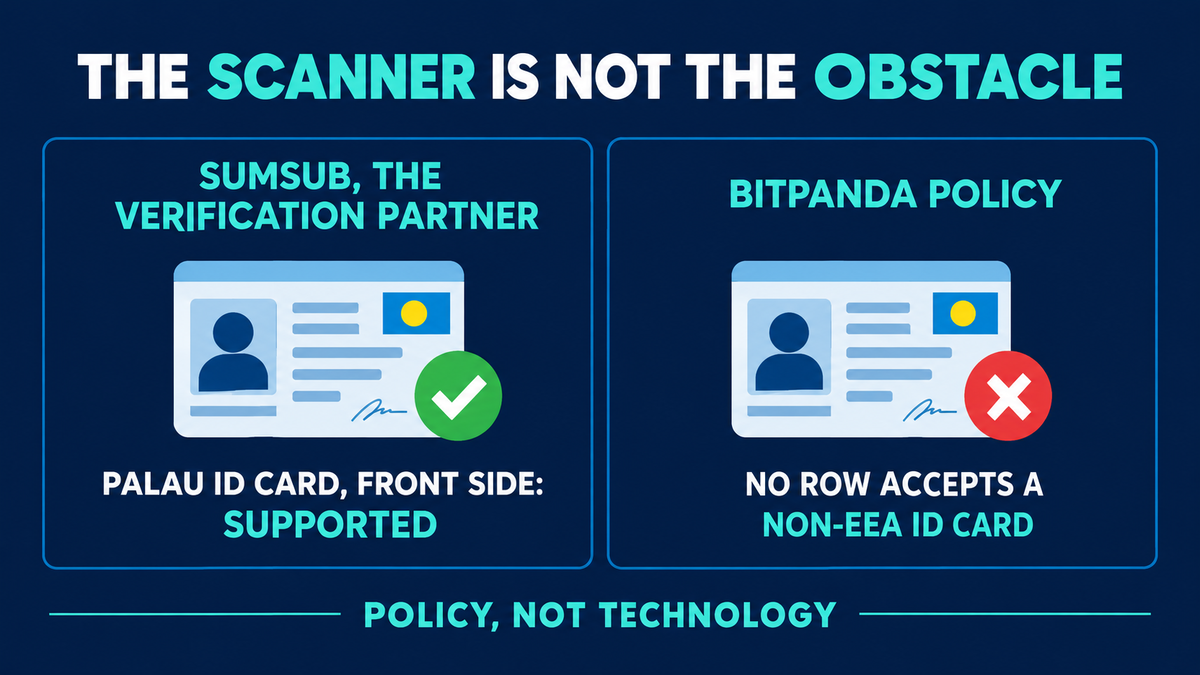
- The sharpest finding is that the technology is not the obstacle. Bitpanda names Sumsub as its verification partner, and Sumsub's own country reference does support Palau — "ID Card – front side" included. The card can be read. It is Bitpanda's policy, not the scanner, that leaves it out.
On this page
- Does Bitpanda accept Palau ID? The short answer
- Two questions Bitpanda answers separately
- Palau is not one of the 46 countries Bitpanda verifies
- The four document tables, and the row you land in
- The exception in Bitpanda's own FAQ is a passport exception
- Bitpanda's verification partner does read Palau ID cards
- Proof of address, where the mailing address fails twice
- US citizens, FATCA, and why the card cannot help
- Bottom line
- Related reading
- FAQ
Does Bitpanda accept Palau ID? The short answer
Does Bitpanda accept Palau ID? No. Not as a listed document, and not as a country of residence. We went looking for the usual fudge — the document class accepted in general but missing from one country's row, which is what we found at MoonPay — and Bitpanda does not even offer that much. Its published acceptance policy sorts every customer into four citizenship buckets across four legal entities, and in none of the sixteen resulting cells is a non-EEA national ID card accepted.
That matters because the Palau card is sold to people who want a second identity document for exchange onboarding, and Bitpanda is one of the largest regulated venues in Europe — it was the first major crypto firm to secure a MiCAR licence, from Germany's BaFin in January 2025. If a card worked anywhere in regulated EU crypto, this is where you would expect it to work.
We read Bitpanda's own two reference articles on 2026-10-06, both last updated 2026-08-06, and cross-checked the verification vendor Bitpanda names. The answer is consistent and it is documented rather than inferred.
| The question people ask | What Bitpanda actually asks | Where a Palau ID holder lands |
|---|---|---|
| "Does Bitpanda accept national ID cards?" | Yes — if issued in the EEA, EU or Switzerland | The card is Palau-issued, so no |
| "Is Palau a supported country?" | Residency decides your legal entity | Palau is not among the 46 listed |
| "Is Palau blocked?" | 28 jurisdictions are prohibited | Palau is not on that list either |
| "Can my verification vendor read it?" | Bitpanda uses Sumsub | Yes — and it changes nothing |
So the single question splits into four, and only the last one gets a comfortable answer.
Two questions Bitpanda answers separately
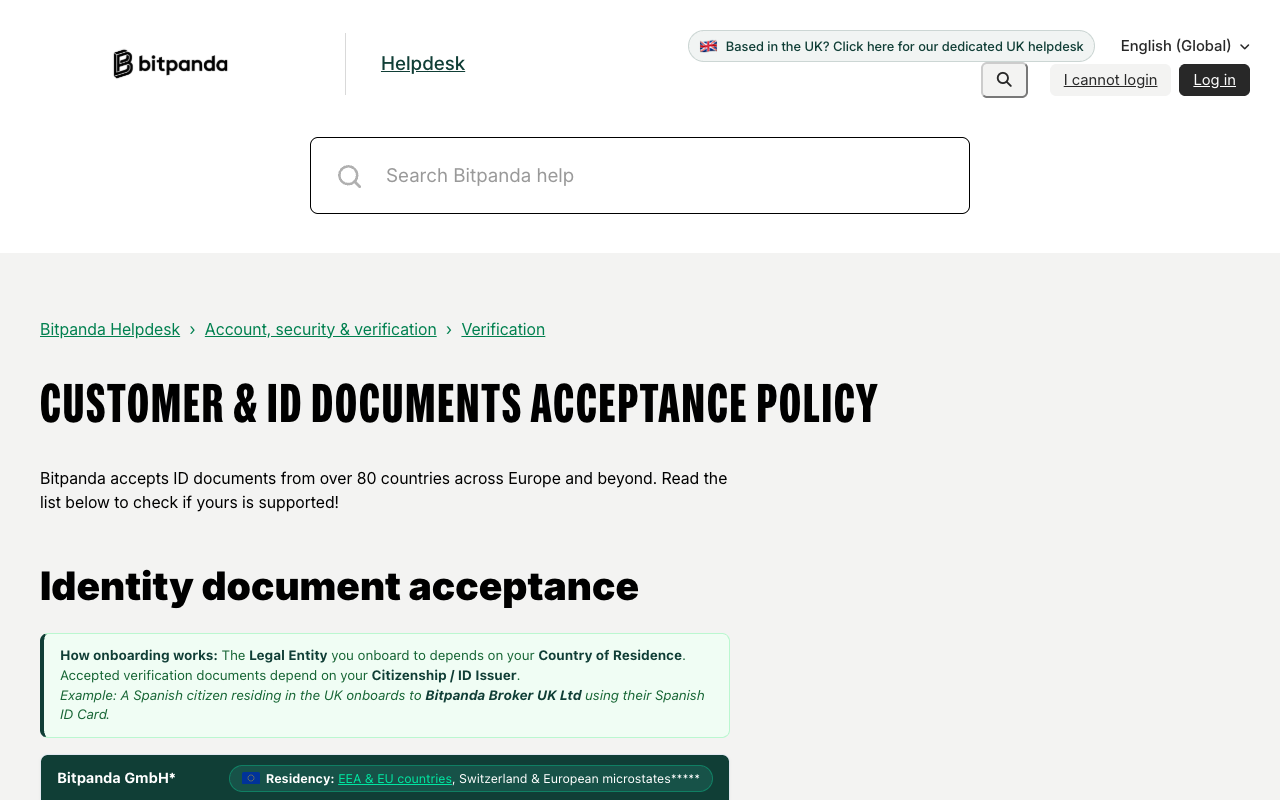
Most write-ups on Palau ID treat "will they take my document?" as one question. Bitpanda splits it in two, and says so in a line at the top of its customer and ID documents acceptance policy that is easy to skim past:
"The Legal Entity you onboard to depends on your Country of Residence. Accepted verification documents depend on your Citizenship / ID Issuer."
Its own worked example: "A Spanish citizen residing in the UK onboards to Bitpanda Broker UK Ltd using their Spanish ID Card." Two different inputs, two different effects. Residence picks the rulebook; the document's issuer picks the row inside it. A Palau card fails on the second axis no matter which rulebook you reach, and if you were to claim Palau residence you would not reach a rulebook at all.
This is the same structural point we reached from the other direction in Palau ID and EU crypto exchanges under MiCA: the regime asks where you live before it asks what you can show. Bitpanda is the clearest published example of a venue that formalises both questions in one table, which is why it is worth reading even if you never intend to use it.
The practical consequence is that the card cannot be rescued by moving countries. Changing your residence only changes which of the four entity tables applies — and the "Other Nationalities" row of every one of them still has no slot for a Palau-issued ID card.
Palau is not one of the 46 countries Bitpanda verifies
Bitpanda's supported-countries article says it is "available in over 40 countries" and lists them with a tick. We counted the ticks: 46. The list is Europe plus a short tail.
| Group | Entries | Palau present? |
|---|---|---|
| EU and EEA member states | 30 | No |
| European microstates (Andorra, Monaco, San Marino, Liechtenstein, Vatican) | 5 | No |
| Crown Dependencies (Guernsey, Jersey, Isle of Man) | 3 | No |
| UK, Switzerland | 2 | No |
| Turkey, Northern Cyprus, Serbia | 3 | No |
| Territories (Åland, Faroe, Réunion, Svalbard and Jan Mayen) | 4 | No |
| Total listed | 46 | Absent |
Nothing in the Pacific appears anywhere on it. Palau is equally absent from the 28 prohibited jurisdictions Bitpanda publishes — a list that includes Russia, Iran, North Korea, Cuba and, notably, the United States and its territories. That absence from both lists is the precise shape of the situation: Palau is not a banned nationality, it is an uncovered one.
The difference sounds like it should leave room to negotiate. It does not. Bitpanda's FAQ closes the door in its own words: "if we do not support your identity document or country of residence, this means that verification with Bitpanda is currently not possible," and "there is nothing we can do... We also do not offer the possibility to be verified by post, via email or in person."
The four document tables, and the row you land in
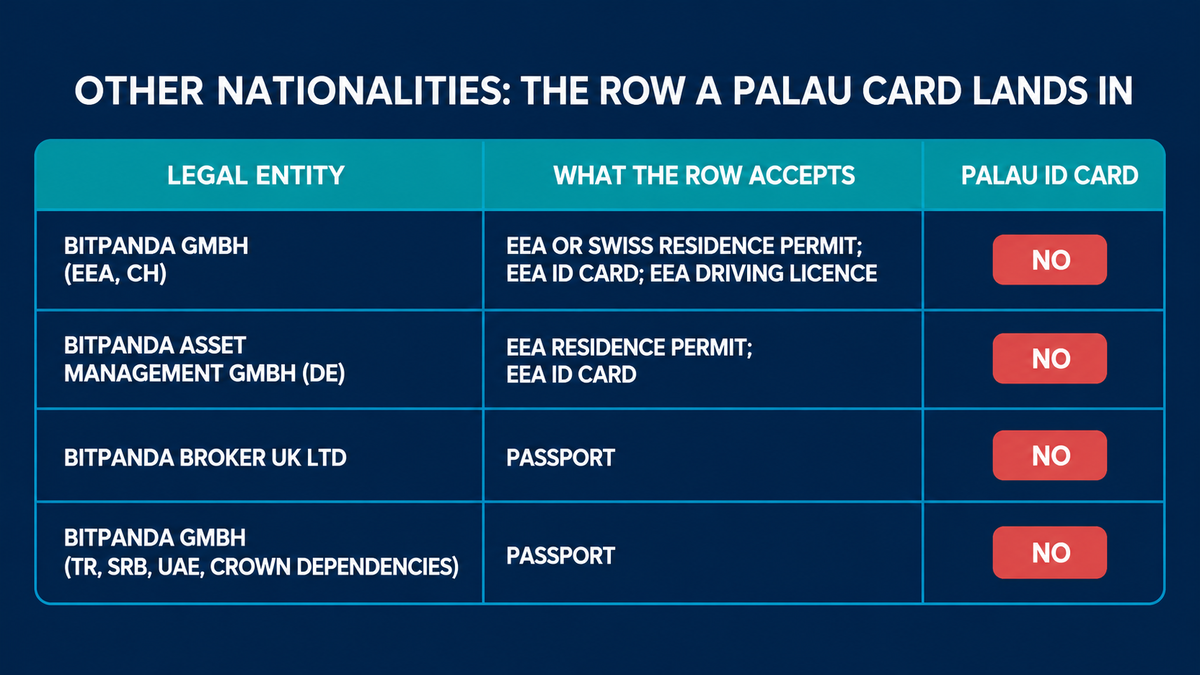
Here is the part nobody appears to have transcribed. Bitpanda runs four onboarding entities, and each publishes its own document table. We have reproduced the Other Nationalities row from each, because that is the row a Palau ID holder occupies in all four.
| Legal entity | Residency it covers | What "Other Nationalities" may use | Palau ID card? |
|---|---|---|---|
| Bitpanda GmbH | EEA & EU, Switzerland, European microstates | EEA/EU or Swiss residence permit; EEA/EU ID card; EEA/EU driving licence | No |
| Bitpanda Asset Management GmbH | Germany | EEA/EU residence permit; EEA/EU ID card | No |
| Bitpanda Broker UK Ltd | United Kingdom | Passport | No |
| Bitpanda GmbH | Turkey, Northern Cyprus, Serbia, UAE, Guernsey, Jersey, Isle of Man | Passport | No |
Two details deserve attention. First, the two entities serving EEA and German residents do not offer Other Nationalities a passport at all — only EEA-issued documents or a residence permit. That is stricter than most people expect, and it is the row most Palau-ID buyers sit in, because most of them live in the EU.
Second, where a passport is the route, it has to be a passport. RNS is explicit in its own documentation that Palau Digital Residency "is not the same as citizenship, a passport, or physical residency in Palau," and lists "guaranteed approval, access to a bank or exchange, universal third-party acceptance" among outcomes it does not promise. A Palau passport would satisfy the UK and Turkey/Serbia/UAE tables; a Palau digital residency card is a different object.
On residence permits, Bitpanda adds a condition that rules the card out independently: "the holder must reside in the country where the permit was issued, and the permit must be valid for at least one year." Digital residency involves no physical residence, which RNS states plainly.
The exception in Bitpanda's own FAQ is a passport exception
There is one line in Bitpanda's documentation that looks like a way through, and it is the line a hopeful reader will seize on:
"Why is my ID supported but not my country of residence? Due to regulatory reasons, verification is only possible in certain countries. However, in some cases, the verification providers accept ID documents even from non-supported countries. Example: Although verification is not available in Argentina, an Argentinian passport can be a valid verification document."
Read it carefully and it runs the opposite way to the one people need. The exception covers a document from a non-supported country being usable by someone who lives in a supported one — and the example Bitpanda chooses is a passport. It does not say a non-EEA ID card becomes acceptable, and it does not make Palau a country you can live in and still onboard.
| What the exception says | What people read into it |
|---|---|
| A passport from an unlisted country may still verify | Any document from an unlisted country may verify |
| You must still reside in a supported country | Palau becomes a usable country of residence |
| The document tables still govern which type is accepted | The vendor's capability overrides the tables |
So for a Palau ID holder the exception is empty: the document is not a passport, and the four tables are what decide. Our exchange KYC tracker records the same pattern across venues — the published document type list beats every inference about what might scan.
Bitpanda's verification partner does read Palau ID cards
This is the finding we did not expect, and it is the one that explains why so many people believe the card should work.
Bitpanda names its vendor in its own support article on failed verifications: it re-runs checks "via our partner Sumsub," and describes the flow — ID upload, selfie, liveness check. So Sumsub's coverage is a checkable fact rather than a guess. We pulled Sumsub's country reference on 2026-10-06, and Palau is there, with a document list:
| Source | What it says about Palau | Effect on your Bitpanda account |
|---|---|---|
| Sumsub supported documents | Passport (biodata page), ID Card – front side, Driving Licence – front side | None — capability is not permission |
| Bitpanda countries article | Palau not among the 46 supported | You cannot onboard as a Palau resident |
| Bitpanda document policy | No row accepts a non-EEA ID card | The card has nowhere to be uploaded |
The scanner can read your card. The policy never asks for it. That gap is, we think, the whole reason this question keeps getting answered wrongly online: search for "Palau ID supported" and you will land on KYC vendor pages — Sumsub, Shufti, ID Analyzer, Didit — which describe what their software can parse. Those pages are accurate and completely beside the point. A vendor's document library is the set of things it can verify; the venue's policy is the set of things it will accept. Only the second one opens an account.
It also means no amount of retrying helps. A clearer photo, a different browser, a fresh Sumsub link from Bitpanda's own re-verification form — none of it changes a table that has no row for your document.
Proof of address, where the mailing address fails twice
Even for someone whose identity document is fine, Bitpanda may ask for proof of residence: "a utility bill or bank statement issued within the last 3 months," requested "if your identity document does not verify your address or if you reside in a different country than your citizenship." A Palau ID holder living elsewhere trips that second condition by definition.
The RNS mailing address does not fill the slot, and RNS says so in its own FAQ: it is "a mailing address, not a residential address or proof of residence, domicile, or tax residence." Sumsub's Palau proof-of-address list is also tied to a property — tax bill, mortgage statement, utility bill "linked to the property," a lease "with the signatures of the landlord and the tenant." A forwarding address produces none of these.
| Document Bitpanda or Sumsub wants | Can an RNS mailing address produce it? |
|---|---|
| Utility bill linked to the property, under 3 months | No |
| Bank statement in your name, under 3 months | No, not at that address |
| Signed lease agreement | No |
| Tax bill or mortgage statement | No |
There is a third layer for anyone who gets an account open: under the Travel Rule, which Bitpanda implements for EU Regulation 2023/1113, it must collect "your name, address, and other relevant details" for transfers to other platforms and to self-custody wallets. An address you do not live at is a bad thing to have on file there. We cover this ground in Palau ID as proof of address and the Palau mailing address.
US citizens, FATCA, and why the card cannot help
A large share of the "Palau ID loophole" writing online is aimed at Americans locked out of non-US exchanges. For Bitpanda specifically, the card cannot address the problem, because the exclusion is not about documents.
Bitpanda states that "due to FATCA regulations, Bitpanda cannot offer services to US citizens, green card holders, or US tax residents," and the United States, Puerto Rico, American Samoa and the US Virgin Islands all appear on its 28-entry prohibited list. That test is citizenship and tax residence, not the card you upload. Buying a Palau ID does not end US citizenship, and presenting one while remaining a US person would misstate your status to a regulated firm rather than solve anything.
If the underlying goal is business banking and payments rather than a second identity document, that is a company-formation problem. Firstbase and Doola both handle remote US LLC formation and we cover the banking leg in US business bank accounts for nomads. Both are sponsored links and we may earn a commission at no cost to you. Neither issues a Palau ID, neither affects an RNS application, and neither makes any venue accept a document its policy does not list.
Bottom line
Does Bitpanda accept Palau ID? No, on two independent grounds, both of them published. Palau is not one of the 46 countries Bitpanda lists for verification, so it is not a country of residence you can onboard from. And across four legal entities, the Other Nationalities row never offers a national ID card — only EEA/EU or Swiss documents, a qualifying residence permit, or a passport, depending on where you live. Read on 2026-10-06; the policy was last updated 2026-08-06.
The part worth carrying to the next venue is the method. Bitpanda's verification partner, Sumsub, does support Palau ID cards, and that fact is freely available and completely useless for opening an account. Check what the venue's policy lists, not what its scanner can read. If a page tells you a platform accepts Palau ID because a KYC vendor supports Palau, it has answered a different question.
Before spending $288 for the one-year option, $1,199 for five years or $2,339 for ten, read Palau digital residency limitations and check acceptance at the specific venues you care about. Nothing here is legal, tax or financial advice, platform rules change without notice, and acceptance is decided by each platform — re-check the live pages before you act. RNS also notes that "payment starts the application" rather than finishing it.
Related reading
- Palau ID for crypto KYC — the cluster overview before you buy
- Palau ID and EU crypto exchanges under MiCA — why authorisation is asked before your document
- Does MoonPay accept Palau ID? — the same question answered from a public API
- Does Wise accept Palau ID? — where the card triggers a check it cannot clear
- Palau ID exchange KYC tracker — platform-by-platform status
- Palau digital residency supported countries — who can apply at all
FAQ
Does Bitpanda accept a Palau digital residency ID?
No. Bitpanda publishes four document tables, one per onboarding entity, and sorts customers by citizenship into EEA & EU, United Kingdom, Switzerland / Microstates, or Other Nationalities. A Palau ID holder falls into Other Nationalities, and that row offers an EEA/EU or Swiss residence permit, an EEA/EU ID card, an EEA/EU driving licence, or a passport depending on the entity — never a non-EEA national ID card. Read 2026-10-06, policy last updated 2026-08-06.
Is Palau a supported country on Bitpanda?
No. Bitpanda's supported-countries article lists 46 ticked entries: EU and EEA states, the European microstates, the Crown Dependencies, the UK, Switzerland, Turkey, Northern Cyprus, Serbia and four territories. Palau does not appear, so you cannot set Palau as your country of residence and onboard. One small inconsistency worth knowing: the document policy's footnotes name the UAE among "other accepted jurisdictions" while the countries article does not list it, so the two pages do not perfectly agree.
Is a Palau ID blocked or banned by Bitpanda?
Neither, strictly. Palau is not among the 28 jurisdictions Bitpanda prohibits — a list that includes Russia, Iran, North Korea, Cuba and the United States. Palau is simply not covered. Practically the outcome is the same, because Bitpanda states that where a document or country is unsupported, "verification with Bitpanda is currently not possible," with no verification by post, email or in person.
Bitpanda's KYC vendor supports Palau. Doesn't that mean it works?
No, and this is the most common mistake on this topic. Bitpanda names Sumsub as its verification partner, and Sumsub's country reference does list Palau with "Passport – biodata page only, ID Card – front side, Driving License – front side." That describes what the software can read, not what Bitpanda will accept. The venue's published document tables decide, and they contain no row for a Palau-issued ID card.
Could I verify with a Palau passport instead?
If you genuinely hold one, yes, for some entities — Bitpanda Broker UK Ltd and the Turkey/Serbia/UAE/Crown Dependencies table both accept a passport under Other Nationalities. But digital residency does not produce a passport. RNS states that Palau Digital Residency "is not the same as citizenship, a passport, or physical residency in Palau," and lists universal third-party acceptance among the things it does not promise.
Does the Palau mailing address work as proof of address on Bitpanda?
No. Bitpanda may request a proof of residence such as a utility bill or bank statement issued within the last three months, particularly if you reside in a different country from your citizenship. RNS describes its service as "a mailing address, not a residential address or proof of residence, domicile, or tax residence." Sumsub's Palau address list is tied to a property — utility bills linked to the property, a signed lease, a tax bill — none of which a forwarding address can produce.
I'm a US citizen. Will a Palau ID get me onto Bitpanda?
No. Bitpanda says that under FATCA it "cannot offer services to US citizens, green card holders, or US tax residents," and the US and its territories are on the prohibited list. That test turns on citizenship and tax residence, not the document you upload, so no second ID changes the answer — and presenting one while remaining a US person would misstate your status to a regulated firm.