Does Payoneer Accept Palau ID? What the 2026 Rules Say
Does Payoneer accept Palau ID? Payoneer takes national ID cards but publishes no country list, so residence and address rules decide the answer in 2026.
We may earn a commission if you apply through this link. This site is independent and is not the official RNS.ID or Palau government site.
Key takeaways
- Payoneer accepts the document class. It publishes no list of issuing countries. Its verification FAQ names three acceptable forms of government photo ID — "National ID, Driver's license, Passport" — and adds that "accepted documents can vary by country, so you may see different options depending on where you are." There is no
PWto look for and no list to check, which makes this a different question from Stripe, where the country list is published and Palau is absent from it. - The country you register under is the gate, and a Palau ID cannot move it. Payoneer's options are driven by the country on your account, and RNS states plainly that "Palau Digital Residency is not the same as citizenship, a passport, or physical residency in Palau." Buying the card does not make you a Palau-based Payoneer customer.
- Changing country afterwards is harder than opening an account, and Payoneer says so. It warns there are cases "where we cannot change an address from one country to another because of laws and regulations to which we are subject (such as non-EU to EU countries and visa versa)," and that moving to or from the UK, India, Japan, Russia, Belarus, Afghanistan or Australia means applying for a new account entirely.
- Proof of address is where this fails for most people, not identity. Payoneer wants a document showing "your name, the exact address on your Payoneer account, and a recent date" — utility bills and statements from the last six months, bank statements from the last three. An ID card carries no recent date, the Palau credential carries no residential address, and RNS says its own mailing service "is not proof of residence."
- RNS lists $288 for one year, $1,199 for five and $2,339 for ten. Several pages still ranking for Palau ID quote the older $248 / $1,039 / $2,039 figures. RNS's documentation also says prices are "intentionally not hard-coded in these docs," so check the live product page before budgeting from anyone's numbers, ours included.
On this page
- The short answer, and the two questions inside it
- What Payoneer actually accepts as identity
- The real gate: the country your account lives in
- Changing country later is harder than opening the account
- Proof of address is where this actually breaks
- Why Payoneer will never publish a Palau answer
- Where Payoneer sits against the platforms we have already checked
- Is the $288 card wasted if Payoneer was the goal?
- If Payoneer is the requirement, what actually works
- Bottom line
- Related reading
- FAQ
The short answer, and the two questions inside it
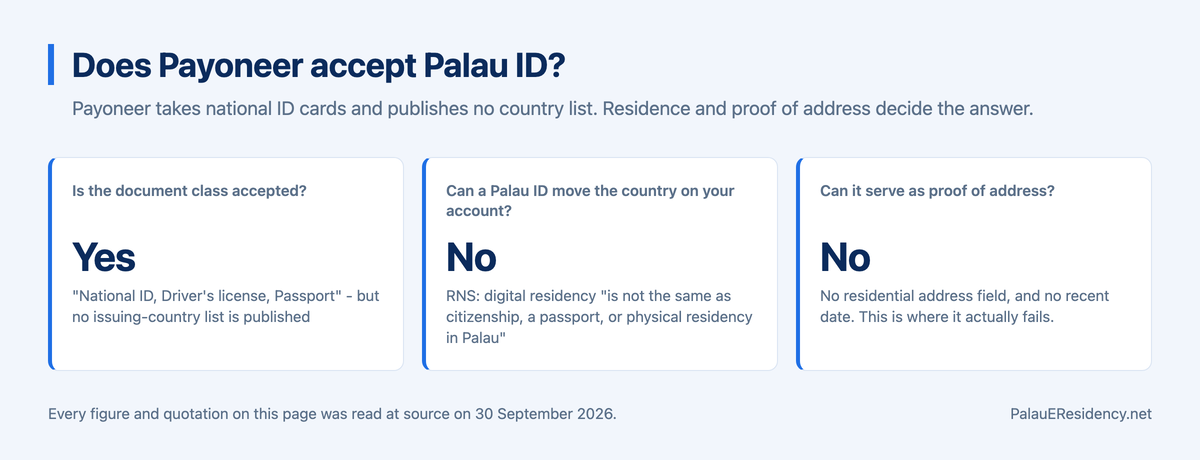
Does Payoneer accept Palau ID? As a document type, there is nothing disqualifying about it — Payoneer's verification FAQ lists "National ID" among the three forms of government photo ID it accepts, and a Palau digital residency card is a government-issued national ID card. As a route to a Payoneer account, that is not the question that decides anything, and we spent longer than expected working out why.
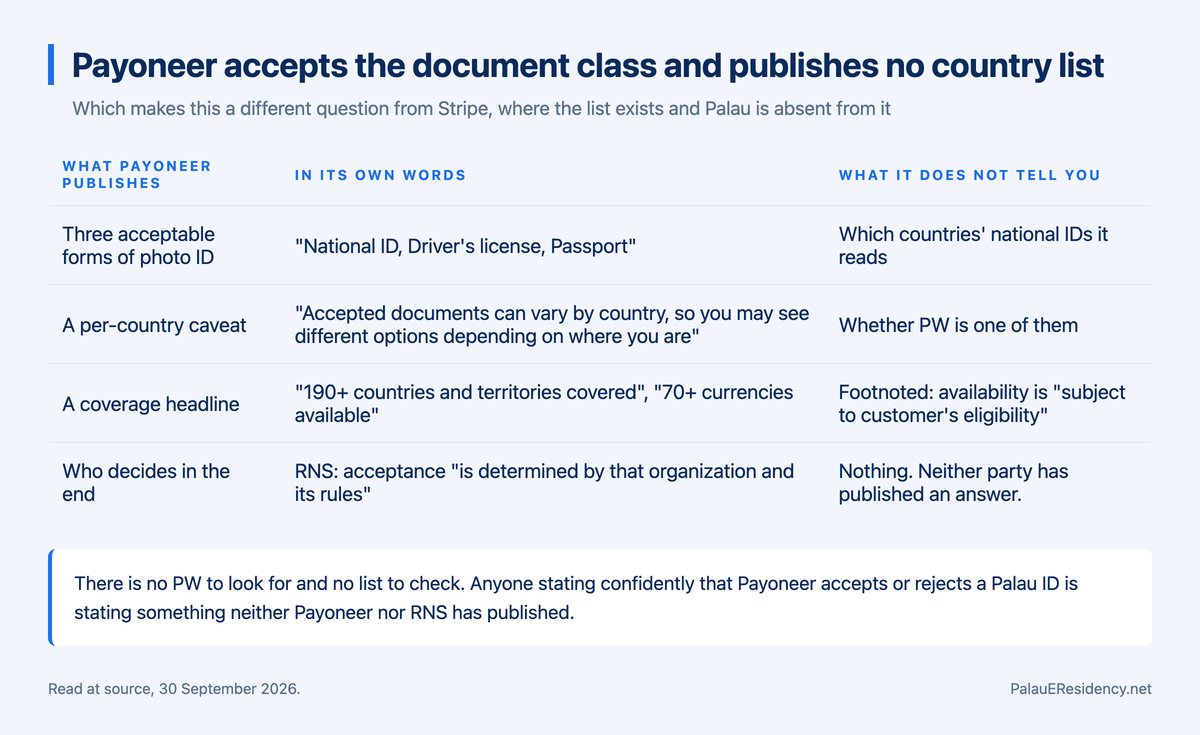
We went looking for the Stripe treatment: a published list of issuing countries you can check for PW. Payoneer does not publish one. What it publishes instead are document categories and a caveat — "accepted documents can vary by country, so you may see different options depending on where you are" — which quietly relocates the whole question. The menu you are shown is a function of the country your account is registered in, not of the card in your hand.
So "does Payoneer accept Palau ID" is really two questions that every write-up we found collapses into one.
| The question people ask | What it actually means | Where Palau stands |
|---|---|---|
| Will Payoneer take my Palau card as photo ID? | Is a national ID card an acceptable document class? | Yes as a class — "National ID" is one of three accepted forms |
| Can I open a Payoneer account as a Palau resident? | Does a digital residency make me Palau-based? | No — RNS: digital residency is "not the same as … physical residency in Palau" |
| Will it satisfy proof of address? | Can one document fill the address slot? | No — the credential carries no residential address and no recent date |
Three questions, one useful answer and two no's. The rest of this page shows the working, because which of the three is blocking you decides whether the card is still worth $288 for other purposes.
What Payoneer actually accepts as identity
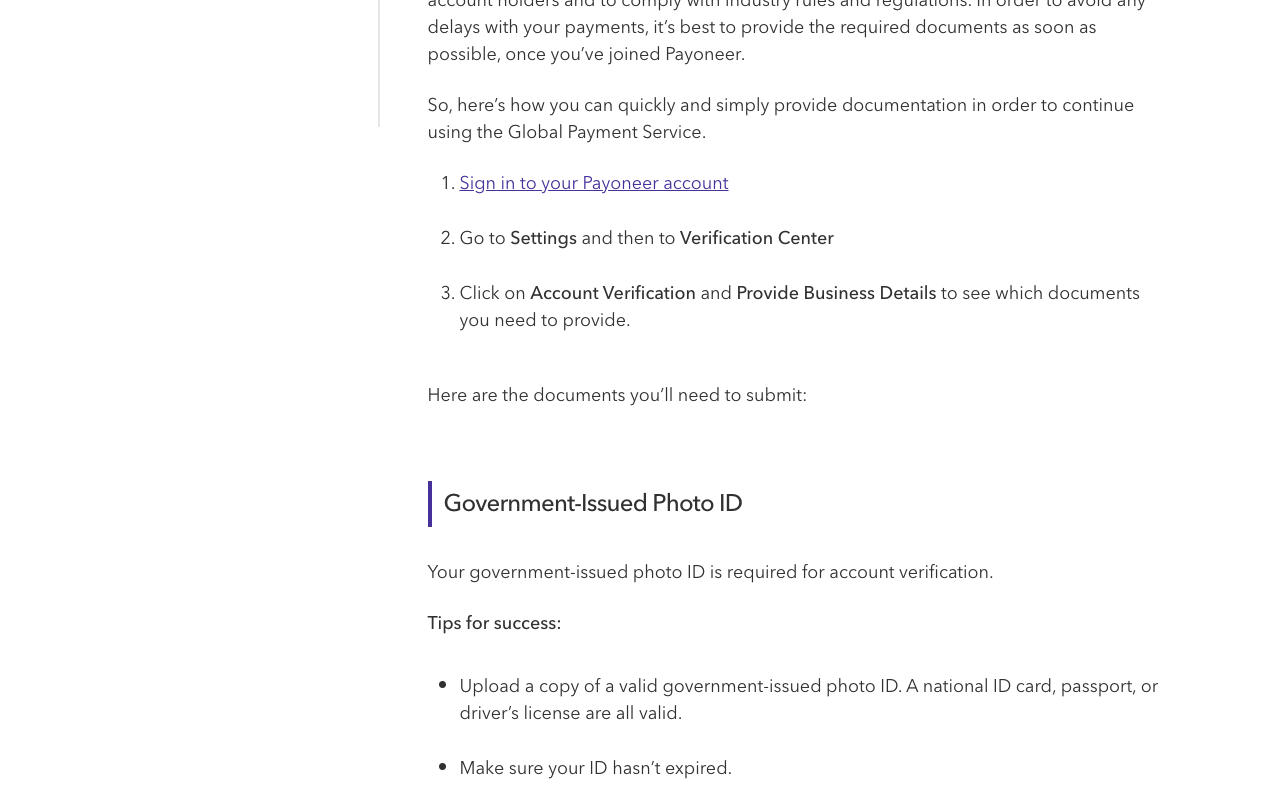
Payoneer's document verification FAQ is short and unusually plain. Three document types, one caveat, and a set of image rules that matter more than they look.
| Requirement | What Payoneer says | How a Palau card fares |
|---|---|---|
| Document type | "National ID, Driver's license, Passport" | National ID — the class is accepted |
| Country variation | "Accepted documents can vary by country" | Unknown for Palau; nothing published |
| Validity | Must be valid and not expired | 1, 5 or 10 year terms; check yours |
| Both sides | Both sides of the document must be uploaded | Needs the physical card in hand |
| Image quality | Clear, unobstructed, all edges visible | Standard; no special obstacle |
The "both sides" rule is the one that bites earliest and nobody mentions it. A Palau digital residency begins life as a digital credential and a downloadable PDF, and RNS is explicit that "downloading the PDF does not establish permission to use it in a particular verification process." Until the physical card reaches you, there is no back side to photograph, and no Payoneer flow is testable. Our shipping and tracking guide covers how long that leg actually takes.
Payoneer also states why it asks at all: "As a regulated US company, we often require documentation to ensure the security of our account holders and to comply with industry rules and regulations." That sentence is worth holding on to, because it explains the shape of every restriction further down this page. A US-regulated money transmitter cares about where you are, not which government printed your card.
The real gate: the country your account lives in
Here is the part the crypto-focused coverage of the Palau ID misses entirely, because crypto exchanges and money transmitters are not built the same way. Payoneer's account is anchored to a country. The currencies you can hold, the receiving accounts you get, whether a card is issued, and the document menu you are shown all follow from it.
RNS does not dispute what its product is. Its own Palau ID documentation says the credential "is issued through the Republic of Palau Digital Residency Program" and that "Palau Digital Residency is not the same as citizenship, a passport, or physical residency in Palau." It also says the thing that settles this whole category of question: "Whether any organization accepts an identity document is determined by that organization and its rules."
| What the card does | What a Payoneer account needs | Gap |
|---|---|---|
| Proves an identity, government-issued | An acceptable photo ID | Closed — national ID is an accepted class |
| Grants digital residency in Palau | A country of residence you can evidence | Open — digital ≠ physical residency |
| Provides a mailing address (separate service) | A residential address on the account | Open — RNS: "not proof of residence" |
| Carries ID number, issue and expiry dates, jurisdiction | Name, address and a dated document | Partly open — no address, no recent date |
So the honest framing is this: the Palau card is an identity document that may well pass an identity check, attached to a residency that cannot answer the residence question Payoneer is actually asking. We reached the same conclusion from a different direction on PayPal, where the country lock is published and absolute.
Changing country later is harder than opening the account
A version of this question we see often is not "can I sign up with it" but "can I use it to move my account somewhere better." Payoneer publishes an answer to that one, and it is firmer than most people expect.
Its help article on changing the country on an account says you must submit a form and supporting documents, and then adds the part that matters: "There are situations where we cannot change an address from one country to another because of laws and regulations to which we are subject (such as non-EU to EU countries and visa versa)." For seven jurisdictions it is harder still — moving to or from the UK, India, Japan, Russia, Belarus, Afghanistan or Australia means applying for a new account rather than editing the old one.
| Scenario | Payoneer's published position |
|---|---|
| Ordinary country change | Form plus documents; case by case |
| Non-EU to EU (or the reverse) | May be refused outright — "laws and regulations to which we are subject" |
| To or from UK, India, Japan, Russia, Belarus, Afghanistan, Australia | New account required |
| Change backed only by a digital residency | No residence established, so nothing to evidence |
None of those four rows is a Palau-specific judgement. They are the ordinary machinery of a regulated payments business, and a $288 credential does not interact with them. If relocating an account is the underlying goal, the constraint is regulatory geography, not paperwork.
Proof of address is where this actually breaks
Every page we read about the Palau ID treats KYC as a single yes-or-no on a photo ID. Payments platforms do not work that way, and this is the gap in the existing coverage worth closing.
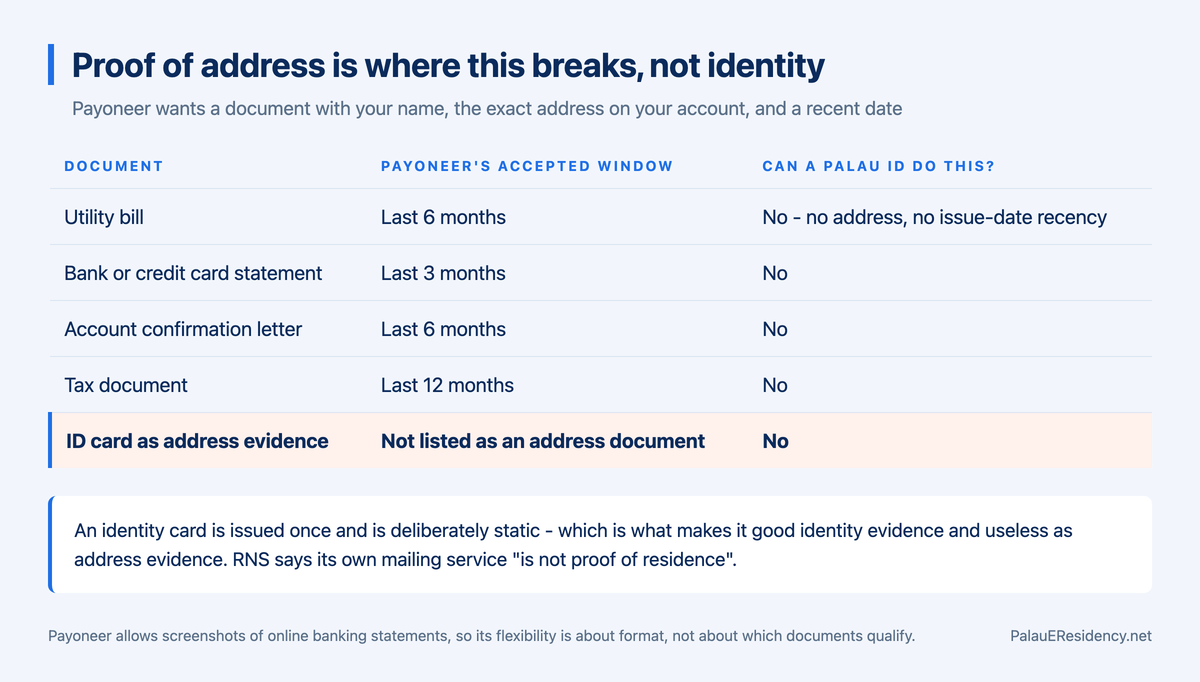
Payoneer's FAQ asks for a proof-of-address document carrying "your name, the exact address on your Payoneer account, and a recent date." Three conditions, and an identity card fails at least two of them regardless of who issued it.
| Document | Payoneer's accepted window | Can a Palau ID do this? |
|---|---|---|
| Utility bill | Last 6 months | No — no address, no issue-date recency |
| Bank or credit card statement | Last 3 months | No |
| Account confirmation letter | Last 6 months | No |
| Tax document | Last 12 months | No |
| ID card as address evidence | Not listed as an address document | No |
The recency requirement is the structural problem. An identity card is issued once and is deliberately static — that is what makes it good identity evidence and useless as address evidence. Payoneer does allow screenshots of an online banking statement, provided they show the required details and the website URL, so the flexibility it has is about format, not about which documents qualify.
And the Palau credential specifically has no residential address field to offer. RNS sells a mailing address as a separate service and states in its own documentation that it "is not proof of residence." We went through that in detail in Palau ID as proof of address, and the conclusion has not moved: a mail-forwarding address is not a residence, and compliance teams are built to notice the difference.
Why Payoneer will never publish a Palau answer
It is tempting to read the silence as evasion. It is more likely structural, and the contrast with Stripe makes the reason visible.
Stripe's Identity product verifies documents on behalf of other businesses, so the set of documents its models can read is a published technical capability — hence a country list you can check. Payoneer is the account provider itself. Its question is not "can we read this card" but "who are you, where do you live, and may we serve you there." That question is answered by residence and sanctions screening, not by a document catalogue, and its answer changes per person.
Payoneer's own marketing carries the caveat in plain sight. Its freelancer page claims "190+ countries and territories covered" and "70+ currencies available," then footnotes both: "Not all products/services are available in all jurisdictions in the same manner" and "any products/services availability are subject to customer's eligibility." A 190+ figure describes where money can be sent, not where every applicant can open an account.
Which means anyone telling you confidently that Payoneer accepts or rejects Palau ID is telling you something neither Payoneer nor RNS has published. RNS puts the boundary where it belongs: acceptance "is determined by that organization and its rules."
Where Payoneer sits against the platforms we have already checked
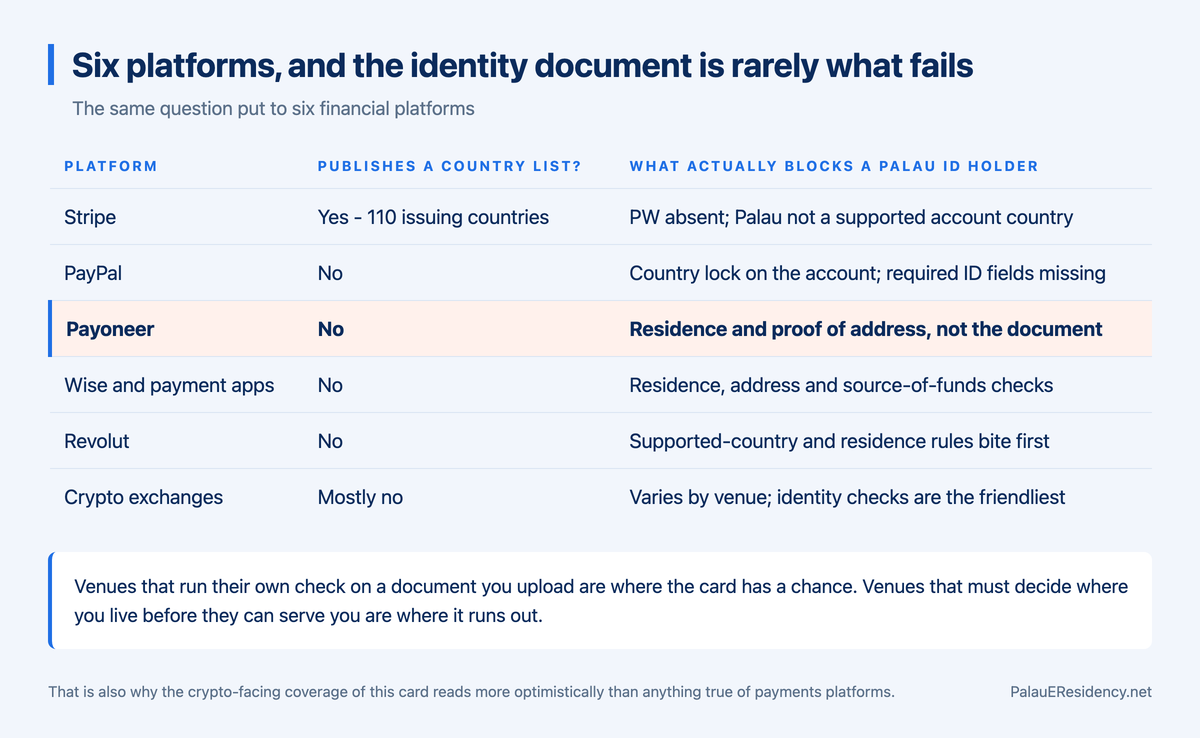
We have now put the same question to six financial platforms. The pattern is consistent enough to be useful as a prediction: the identity document is rarely the thing that fails.
| Platform | Publishes a country list? | What actually blocks a Palau ID holder |
|---|---|---|
| Stripe | Yes — 110 issuing countries | PW absent; Palau not a supported account country |
| PayPal | No | Country lock on the account; required ID fields missing |
| Payoneer | No | Residence and proof of address, not the document |
| Wise and payment apps | No | Residence, address and source-of-funds checks |
| Revolut | No | Supported-country and residence rules bite first |
| Crypto exchanges | Mostly no | Varies by venue; identity checks are the friendliest |
Read down the last column and the shape is obvious. Venues running their own identity check on a document you upload are where the card has any chance. Venues that must decide where you live before they can serve you are where it runs out, and Payoneer is firmly in the second group. That also explains why the crypto-facing coverage of this card reads so much more optimistically than anything we can write about payments platforms.
Is the $288 card wasted if Payoneer was the goal?
If Payoneer access was the only reason you were reaching for the card, then yes, and we would rather say so than sell it to you.
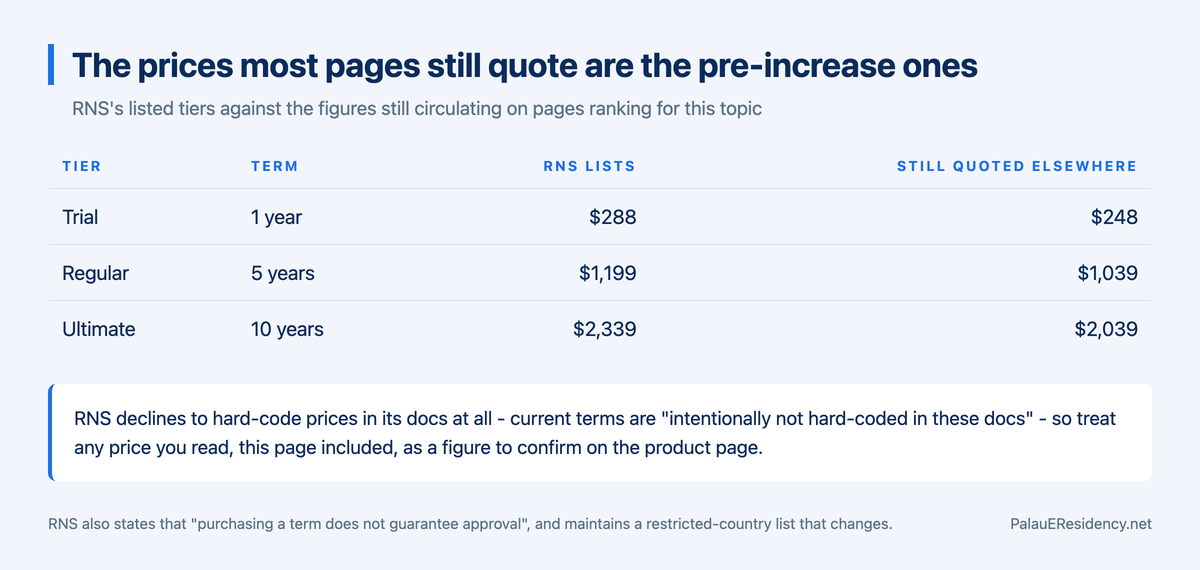
| Tier | Price | Term |
|---|---|---|
| Trial | $288 | 1 year |
| Regular | $1,199 | 5 years |
| Ultimate | $2,339 | 10 years |
Those are the figures RNS lists, and they are worth stating because a lot of pages still ranking for this topic quote $248 / $1,039 / $2,039 — the pre-increase numbers. RNS's own documentation declines to hard-code prices at all, saying current terms are "intentionally not hard-coded in these docs," so treat any price you read anywhere, this page included, as a figure to confirm on the product page rather than a quote.
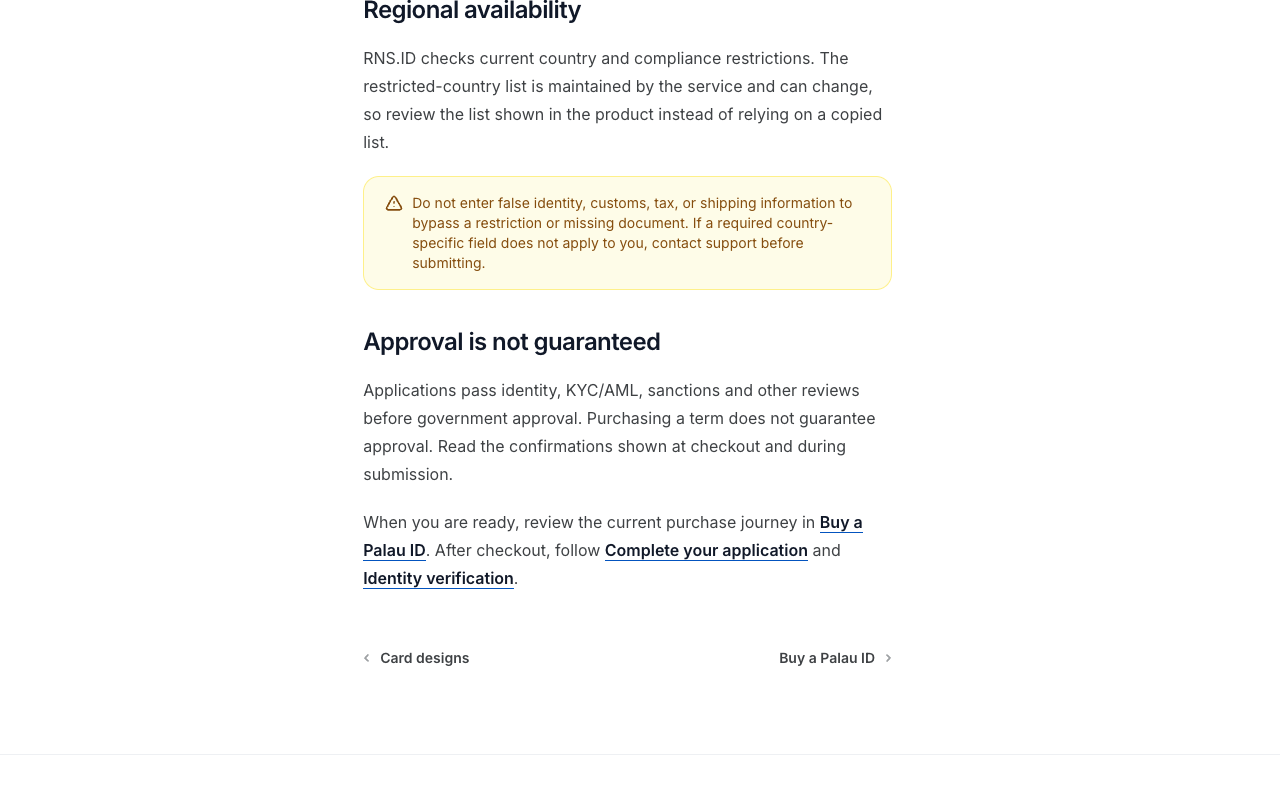
Two further things RNS says before you spend, both on its eligibility page. Approval is not bundled with payment — "purchasing a term does not guarantee approval" — and the programme maintains a restricted-country list that changes, which you are told to read in the product rather than from a copied list. Our cost breakdown and the limitations page set out the rest of what the card does and does not do.
If Payoneer is the requirement, what actually works
The route that answers the underlying need is the one Payoneer's own rules point at: be a person or business in a jurisdiction it can serve, with an address you can evidence on a dated document. For location-independent founders that usually means a company in a country with straightforward remote formation — most often a US LLC, which non-residents can form remotely. Firstbase and Doola both do this, and we cover the banking leg in US business bank accounts for nomads. Both are sponsored links and we may earn a commission at no cost to you. Neither issues a Palau ID, neither affects an RNS application, and forming a company is not the same thing as being approved by any payments provider.
That is a different purchase from a $288 identity card, solving a different problem. Being clear about which problem you have is most of the value on this page.
Bottom line
Does Payoneer accept Palau ID? The document class is accepted — Payoneer names "National ID" as one of three acceptable forms of government photo ID, and a Palau digital residency card is one. But Payoneer publishes no list of issuing countries, so nobody can honestly tell you Palau is approved or rejected, and the question turns out not to be about the document at all.
What decides it is residence. Payoneer's menus, currencies and eligibility follow the country on your account; its address requirements want a recent, name-matched document; and RNS states that digital residency is "not the same as … physical residency in Palau" and that its mailing service "is not proof of residence." A credential with no residential address and no recency cannot answer either question, however legitimate it is as identity.
Buy it for venues that run an identity check on a document you upload — our exchange KYC tracker records every one we have tested. Do not buy it expecting a Payoneer account. Nothing here is legal, tax or financial advice, provider rules change without notice, and acceptance is decided by each platform — check the live pages before you act.
Related reading
- Does Stripe accept Palau ID? — the same question where the country list is published
- Does PayPal accept Palau ID? — where nothing is published and the country lock decides
- Palau ID for Wise and payment apps — neobanks and transfer services side by side
- Palau ID proof of address — why an ID card rarely fills the address slot
- Palau digital residency cost — current tiers and what they include
- Palau ID exchange KYC tracker — every venue we have checked
FAQ
Does Payoneer accept a Palau digital residency ID?
Payoneer accepts "National ID, Driver's license, Passport" as forms of government photo ID, so a Palau digital residency card is an accepted document class. Payoneer does not publish a list of issuing countries, so there is no way to confirm Palau specifically, and it states that "accepted documents can vary by country." The document is rarely the blocker; residence and proof of address usually are.
Can I open a Payoneer account as a Palau digital resident?
No. A Palau digital residency does not make you resident in Palau — RNS states that it "is not the same as citizenship, a passport, or physical residency in Palau." Payoneer accounts are anchored to a country of residence you can evidence, and the card does not create one. You would still be applying as a resident of wherever you actually live.
Can a Palau ID be used as proof of address on Payoneer?
No. Payoneer asks for a document showing "your name, the exact address on your Payoneer account, and a recent date," and lists utility bills, bank or credit card statements, account confirmation letters and tax documents. An identity card is not among them, it carries no recent date, and the Palau credential has no residential address field. RNS also says its separate mailing address service "is not proof of residence."
Does Payoneer publish a list of countries whose IDs it accepts?
Not that we could find. Its verification FAQ names document categories and says "accepted documents can vary by country, so you may see different options depending on where you are," which points the question at your registration country rather than at a document list. This is the opposite of Stripe, which publishes 110 issuing countries and does not include Palau.
Will a Palau ID let me change my Payoneer account to another country?
No. Payoneer requires a form and supporting documents for a country change, and warns that "there are situations where we cannot change an address from one country to another because of laws and regulations to which we are subject (such as non-EU to EU countries and visa versa)." Moving to or from the UK, India, Japan, Russia, Belarus, Afghanistan or Australia requires a new account. A digital residency evidences no move, so it contributes nothing to that process.
Can I use the digital version of the Palau ID before the physical card arrives?
Not for Payoneer. Payoneer requires both sides of the document to be uploaded as clear, unobstructed images, which needs the physical card. RNS also states that "downloading the PDF does not establish permission to use it in a particular verification process." Until the card is delivered, there is nothing to test.
What does the Palau ID cost in 2026?
RNS lists $288 for one year, $1,199 for five years and $2,339 for ten. Older pages still quote $248 / $1,039 / $2,039, which were the pre-increase figures. RNS's documentation says current prices are "intentionally not hard-coded in these docs," so confirm on the product page before you budget, and note that "purchasing a term does not guarantee approval."
If Payoneer is what I need, what should I do instead?
Solve the residence question rather than the document one: be a person or company in a jurisdiction Payoneer serves, with an address you can evidence on a dated bill or statement. For remote founders that usually means forming a company in a country with straightforward non-resident registration, most commonly a US LLC. That is a company-formation purchase, not an identity-document purchase, and it is worth knowing which of the two you actually need before spending on either.