Does Bitfinex Accept Palau ID? 2026 Verification Rules
Does Bitfinex accept Palau ID? It publishes no country list, but its four verification levels and 90-day address rule decide the answer in 2026.
We may earn a commission if you apply through this link. This site is independent and is not the official RNS.ID or Palau government site.
Key takeaways
- Bitfinex does not publish a list of accepted issuing countries, so nobody can honestly tell you "Palau is approved" or "Palau is banned." Its published requirements name document types — passport, national ID card, driving licence, residency card — and leave the rest to its compliance team. As everywhere else on this site, acceptance varies.
- The level you are aiming for decides everything. Bitfinex has four: Basic Access, Basic Plus, Intermediate and Full. Basic Plus asks for one official photo ID and clears in 10 to 30 seconds. Intermediate asks for a second official photo ID plus a proof of address. So at the level most spot traders stop at, a Palau card has one slot it could fill; at the next level up it can never be your only document.
- The Palau card can never be your proof of address, at any level. Bitfinex accepts six document types for that, all of them statements, and the document "must be no older than 90 days." An ID card carries no residential address field and has a multi-year expiry — it fails the recency rule structurally, before anyone looks at the jurisdiction.
- If you are a U.S. Person, no document fixes this. Bitfinex's own FAQ is blunt: "No U.S. Person may directly or indirectly use any of the Services or the Site" — and that includes anyone holding a U.S. passport. A Palau ID does not change what you are.
- The widely repeated claim that Palau "restricted the programme for U.S. citizens" is unsourced, and RNS's own FAQ contradicts it: the programme excludes six places, and the United States is not among them.
On this page
- The short answer, and the question underneath it
- Bitfinex has four levels, and only one of them is the easy one
- What each level actually asks you to upload
- Where a Palau card can and cannot sit in that stack
- Proof of address is the wall, and it is a 90-day wall
- The rule that overrides your document entirely
- Where the "Bitfinex banned Palau ID" claim came from
- Four checks before you spend $288
- Bottom line
- Related reading
- FAQ

The short answer, and the question underneath it
You want to know whether Bitfinex accepts a Palau ID before you spend $288 on a card and wait for it to ship. Fair enough — that is the order the decision should happen in, and almost nobody writes it that way. The pages ranking for this question mostly sell something else: the top result is a citizenship-by-investment platform whose headline claim about Bitfinex rests on a linked social media post and nothing more.
Here is what we did instead. We pulled Bitfinex's own verification documentation — four help-centre articles, the most recent of them updated on 4 September 2026 — and set its published requirements against what RNS actually puts on the Palau credential. The honest answer is that Bitfinex names no country, and the real constraint is not your ID at all. It is which of four verification levels you need, and whether you can produce a dated address statement that no identity card of any kind can be.
That turns out to be a much more useful answer than yes or no, because it tells you in advance which parts of Bitfinex a Palau card could plausibly get you into and which parts it cannot touch. Let us take the levels first, because everything else hangs off them.
Bitfinex has four levels, and only one of them is the easy one
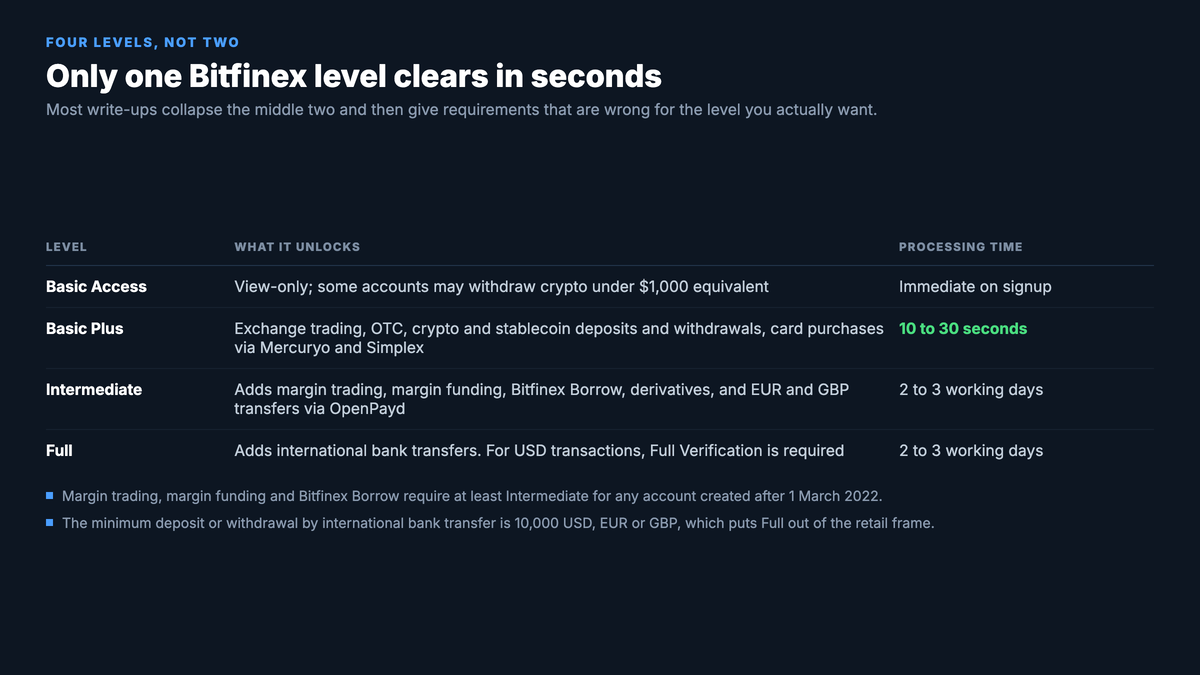
Bitfinex splits individual accounts into Basic Access, Basic Plus, Intermediate and Full. This matters more than it sounds, because most write-ups collapse the middle two and then give you requirements that are wrong for the level you actually want.
Basic Access is what you get on signing up and linking an email. Bitfinex describes it as "a view-only mode" — certain Basic Access accounts can withdraw crypto under a $1,000 equivalent, and that is the extent of it.
| Level | What it unlocks | Processing time |
|---|---|---|
| Basic Access | View-only; some accounts may withdraw crypto under $1,000 equivalent | Immediate on signup |
| Basic Plus | Exchange trading, OTC, crypto and stablecoin deposits and withdrawals, card purchases via Mercuryo and Simplex | Instant — "10-30 seconds" |
| Intermediate | Adds margin trading, margin funding, Bitfinex Borrow, derivatives, and EUR/GBP transfers via OpenPayd (SEPA) | 2-3 working days |
| Full | Adds international bank transfers; "For USD transactions, Full Verification is required" | 2-3 working days |
Two footnotes from that page are worth carrying with you. Margin trading, margin funding and Bitfinex Borrow require at least Intermediate for any account created after 1 March 2022 — only older accounts still reach them on Basic Plus. And the minimum deposit or withdrawal by international bank transfer is 10,000 USD, EUR or GBP, which quietly puts Full verification out of the retail frame for most readers anyway.
So the practical question narrows fast. If you want to buy and sell spot and move crypto in and out, you want Basic Plus. If you want leverage or a euro bank rail, you want Intermediate. Those two levels ask for very different things.
What each level actually asks you to upload
This is the part that decides the Palau question, and Bitfinex states it plainly on its verification levels page.
| Level | Documents required |
|---|---|
| Basic Plus | Official Photo ID; biometric photo (selfie); phone number; residence address |
| Intermediate | Everything in Basic Plus, plus a second official photo ID, a Proof of Address, a financial questionnaire and a KYC declaration |
| Full | Everything in Intermediate, plus a bank statement |
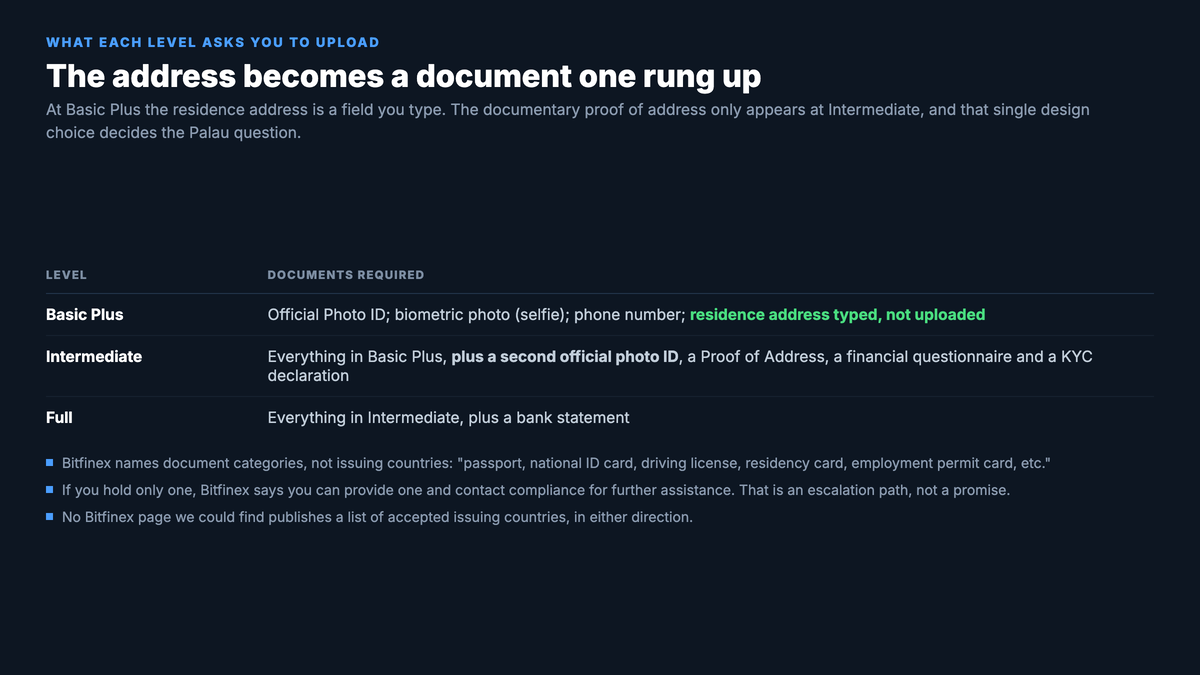
Read the Basic Plus row again, because there is something easy to miss in it. The residence address at Basic Plus is a field you type, not a document you upload. The documentary proof of address only appears one rung higher. That single design choice is why a Palau card is a live option at Basic Plus and a partial one at Intermediate.
Bitfinex's separate article on verifying an individual account describes the full document set for the upper levels: you must be at least 18; it wants your telephone number, email address and residential address; and it asks for "Two forms of valid government-issued identification with photo, i.e., passport, national ID card, driving license, residency card, employment permit card, etc." plus a selfie. If you only have one, Bitfinex says you "can provide one and contact compliance@bitfinex.com for further assistance" — an escalation path, not a promise.
Notice what that list is and is not. It is a list of document categories, with "etc." on the end. It is not a list of issuing countries, and we could not find any Bitfinex page that publishes one. That absence is the whole reason confident answers about Palau on this exchange should be treated with suspicion in either direction.
Where a Palau card can and cannot sit in that stack
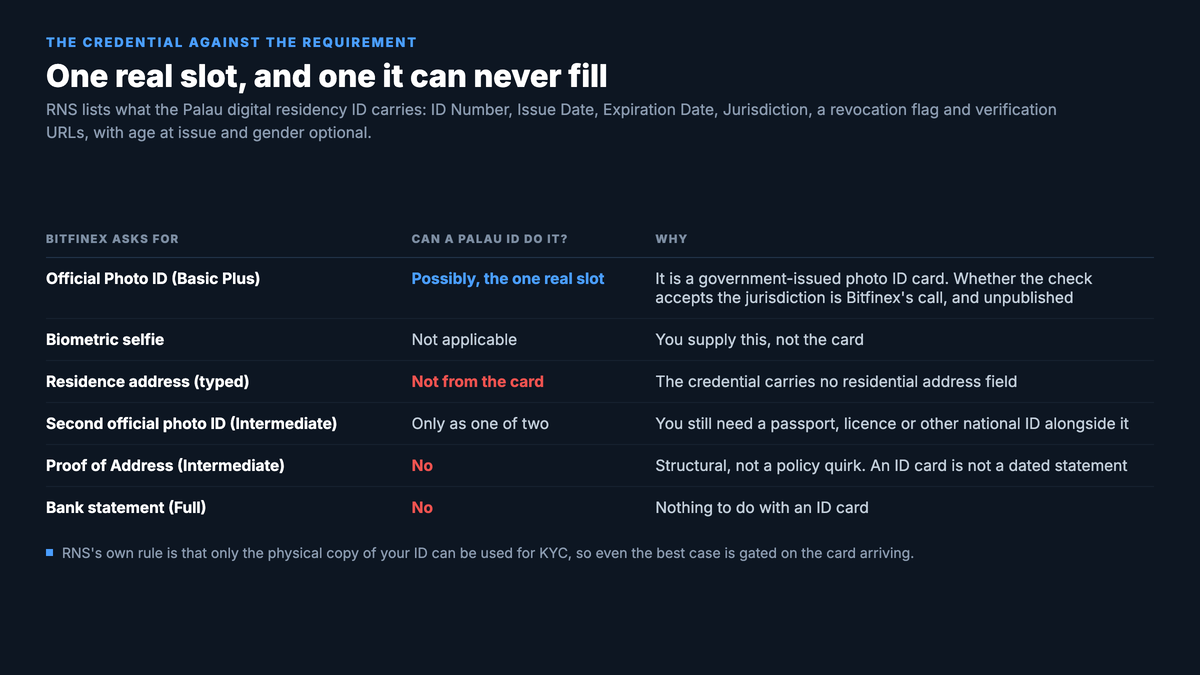
Now set the credential against the requirement. RNS's platform documentation lists what the Palau digital residency ID carries: ID Number, Issue Date, Expiration Date, Jurisdiction, a revocation flag and verification URLs, with age at issue and gender as optional fields. RNS's FAQ describes it as "a government-issued identification card that can be used for any purpose that requires legal proof of identity."
| Bitfinex asks for | Can a Palau ID do it? | Why |
|---|---|---|
| Official Photo ID (Basic Plus) | Possibly — this is the one real slot | It is a government-issued photo ID card. Whether Bitfinex's check accepts the jurisdiction is Bitfinex's call, and unpublished |
| Biometric selfie | Not applicable | You supply this, not the card |
| Residence address (typed, Basic Plus) | Not from the card | The credential carries no residential address field |
| Second official photo ID (Intermediate) | Only as one of two | You still need a passport, licence or other national ID alongside it |
| Proof of Address (Intermediate) | No | See the next section — this is structural, not a policy quirk |
| Bank statement (Full) | No | Nothing to do with an ID card |
One operational detail that catches people out: RNS's own rule is that only the physical copy of your ID can be used for KYC. The downloadable image from the portal is there so you can check your details are correct, not to upload to an exchange. So even in the best case, the Palau route to a Bitfinex account is gated on the card physically arriving. Our page on the physical versus digital Palau ID goes through what that means for timing.
Proof of address is the wall, and it is a 90-day wall
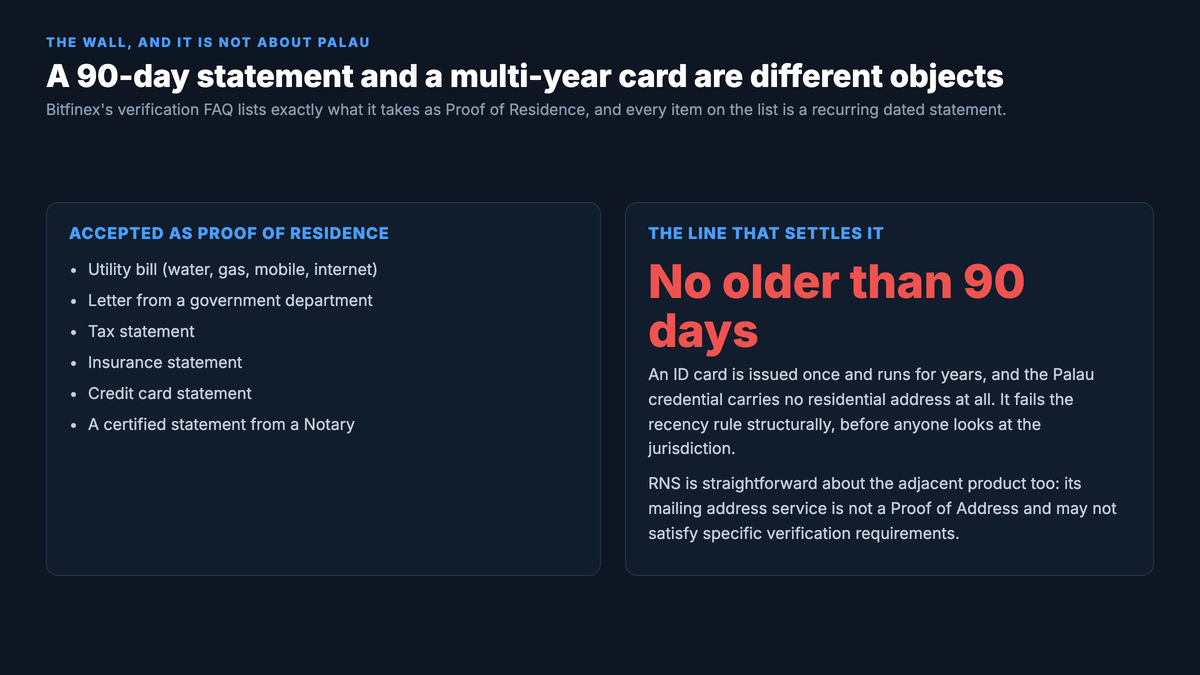
Bitfinex's verification FAQ lists exactly what it takes as Proof of Residence:
- Utility bill (water, gas, mobile, internet, etc.)
- Letter from a government department
- Tax statement
- Insurance statement
- Credit card statement
- A certified statement from a Notary
And then the line that settles it: "The Proof of Residence provided must be no older than 90 days." Its individual-verification page says the same thing in different words — a statement "can't be older than three months from a utility, service company, licensed corporation or government authority indicating your name and residential address."
An identity card cannot satisfy that, and not because of anything to do with Palau. Every item on that list is a recurring statement with a recent date on it. An ID card is issued once and runs for years, and the Palau credential carries no residential address at all. RNS is straightforward about the adjacent product too: its mailing address service "is not a Proof of Address and may not satisfy specific verification requirements."
This is the same wall we keep finding on venue after venue, which is why we gave it its own page. If your plan was "the Palau card replaces my documents," Intermediate verification on Bitfinex is where that plan stops — and it stops for holders of every ID card on earth, not just this one.
The rule that overrides your document entirely
If you are a U.S. Person, none of the above matters, and this is the most important paragraph on the page.
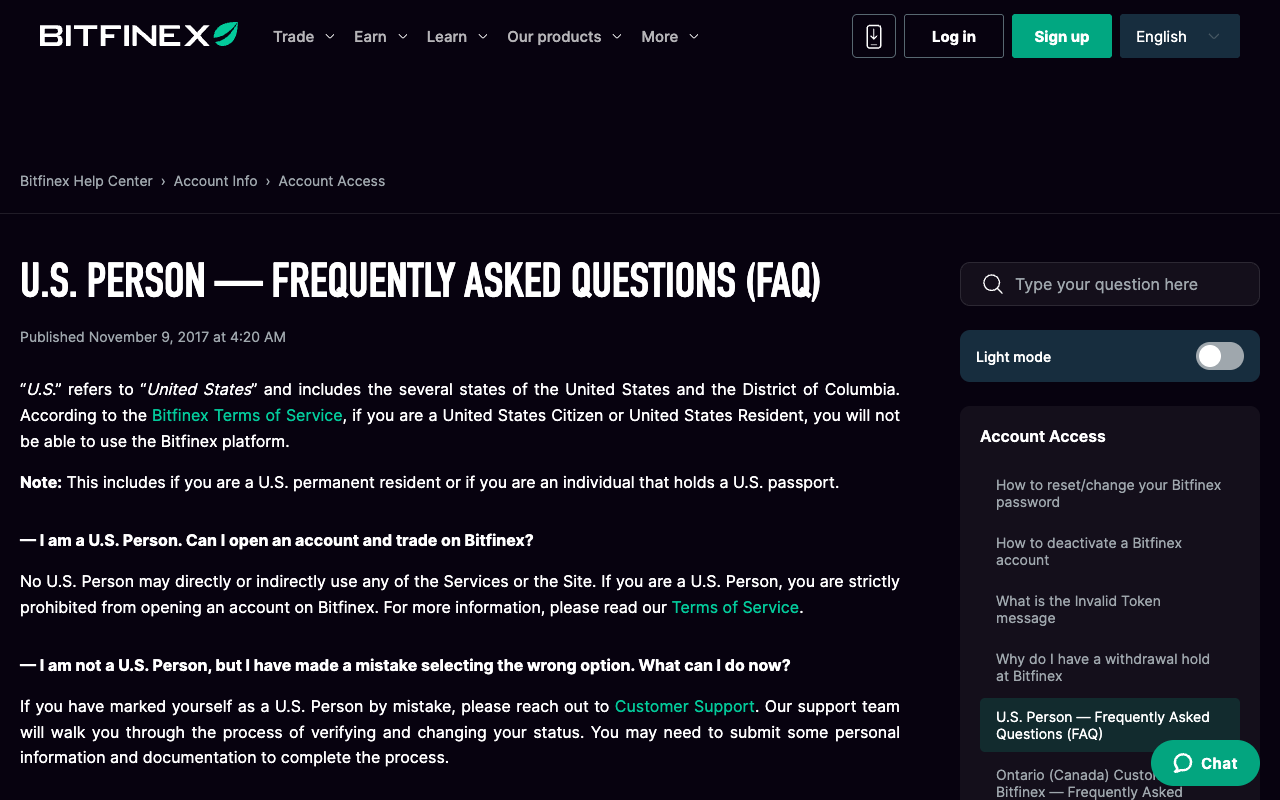
Bitfinex's U.S. Person FAQ, updated on 23 May 2026, states that under its Terms of Service, "if you are a United States Citizen or United States Resident, you will not be able to use the Bitfinex platform," and adds that this "includes if you are a U.S. permanent resident or if you are an individual that holds a U.S. passport." It goes further: "No U.S. Person may directly or indirectly use any of the Services or the Site."
Read "indirectly" carefully. That wording is aimed squarely at the idea of presenting a different jurisdiction's paperwork to get around a status restriction. A Palau digital residency card does not change your citizenship, your residence or what passport you hold — RNS says outright that "digital residency does not support pathways to citizenship or future Palau passports." Using one to misrepresent your status to an exchange is not a grey area, and it is not something this site will help you do. If you are a U.S. person weighing this programme for any reason, our page for U.S. citizens is the honest version.
Bitfinex's separate securities platform runs a wider exclusion list again — U.S., Canadian, Spanish, non-exempt Japanese and non-exempt U.K. persons, among others — which is a useful reminder that on this exchange, who you are is checked before what you carry.
Where the "Bitfinex banned Palau ID" claim came from
Search this question and you will hit a confident claim that Palau digital residency "is over" on Bitfinex, because "the Republic of Palau recently introduced restrictions on the program for US citizens, along with impossibility of using the Palau Digital Residency as proof of address."
Half of that is true and half is invented, and they have been welded together.
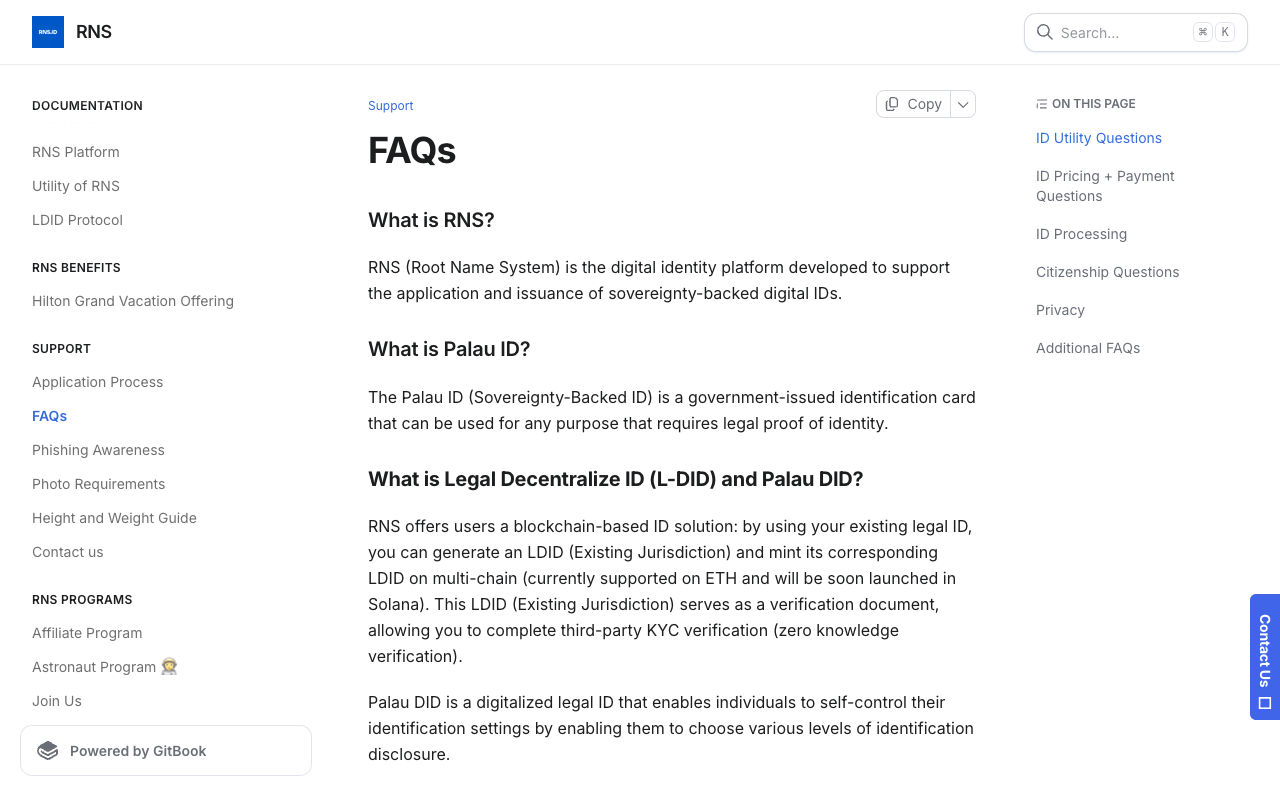
The proof-of-address half is correct, as the section above shows — though it is a fact about ID cards generally, not a Bitfinex ruling on Palau. The U.S.-restriction half is sourced to a social media post and nothing else, and RNS's own FAQ contradicts it: the programme is described as accepting "all global citizens with the exception of North Korea, Iran, Syria, Cuba, Crimea and Sudan." The United States is not on that list. The page making the claim sells citizenship-by-investment programmes, which is worth knowing when weighing how hard it argues that a $288 alternative has stopped working.
We have no field report of a Palau ID being accepted at Bitfinex, and none of one being rejected. That is a genuinely open question, and we would rather say so than fill it. Our exchange KYC tracker records what is documented venue by venue, including the gaps.
Four checks before you spend $288
Free, quick, and they answer the question better than any article can — including this one.
- Decide your level first. If Basic Plus covers what you want to do, you need one photo ID and no address document. If you need margin or a euro rail, you need Intermediate, a second ID and a dated address statement. That decision changes whether the card is worth buying at all.
- Check you are not a U.S. Person under Bitfinex's definition. It is broader than most people assume, and it includes holding a U.S. passport regardless of where you live.
- Work out what you would submit as proof of address. If you cannot name a utility bill, tax statement, insurance or credit card statement in your own name dated within 90 days, Intermediate is closed to you whatever ID you hold.
- Register and reach the document screen before you buy. Signing up is free and Basic Access is immediate. The upload screen tells you which document categories and country fields you face — the one thing no third-party page, ours included, can tell you reliably.
If after those four the card still looks worthwhile, read the cost breakdown and what the programme does not do before ordering. RNS lists $288 for one year, $1,199 for five and $2,339 for ten.
Bottom line
Does Bitfinex accept Palau ID? Bitfinex has not said, and anyone claiming otherwise in either direction is filling a gap rather than reporting one. What its documentation does tell you is more useful: at Basic Plus there is exactly one slot a Palau card could occupy, and at Intermediate there are two slots it cannot fill on its own and one it can never fill at all.
The proof-of-address requirement is the part worth internalising, because it recurs everywhere and it is not about Palau. A 90-day-old statement and a multi-year identity card are different kinds of object. No card from any jurisdiction closes that gap, and RNS says its own mailing address product does not either.
And if you are a U.S. Person, the document question never gets asked. Bitfinex screens for status first and says so in one sentence. That is the cheapest thing to check, it takes ten seconds, and it is better discovered now than after a card has shipped halfway across the Pacific. Nothing here is legal, tax or financial advice, and exchanges change their rules without notice — check the live pages before you act.
Related reading
- Palau ID for crypto KYC — the document question across exchanges
- Palau ID exchange KYC tracker — every venue we have checked, side by side
- Palau ID proof of address — why an ID card is not an address document
- Does Bitstamp accept Palau ID? — a venue where one rejection is documented
- Palau ID and EU crypto exchanges after MiCA — when authorisation comes before your document
- Palau digital residency limitations — what the programme does not do
FAQ
Does Bitfinex accept a Palau digital residency ID for verification?
Bitfinex has published no list of accepted issuing countries, so there is no documented yes or no. Its requirements name document types — "passport, national ID card, driving license, residency card, employment permit card, etc." — and a Palau digital residency card is a government-issued photo ID card. Whether its compliance check accepts that jurisdiction is Bitfinex's decision and is not published, so acceptance varies and should be tested on the verification screen before you buy anything.
Which Bitfinex verification level can a Palau ID realistically help with?
Basic Plus is the only level where it could be your sole identity document. Bitfinex asks there for one official photo ID, a selfie, a phone number and a typed residence address, and says the level clears in 10 to 30 seconds. Intermediate requires a second official photo ID as well as a documentary proof of address, so a Palau card can only ever be one half of the identity requirement at that level.
Can I use a Palau ID as proof of address on Bitfinex?
No. Bitfinex accepts six document types as Proof of Residence — utility bill, letter from a government department, tax statement, insurance statement, credit card statement, or a certified statement from a Notary — and requires that the document be no older than 90 days. The Palau credential carries no residential address field, and RNS states that its separate mailing address service "is not a Proof of Address and may not satisfy specific verification requirements."
Can a U.S. citizen use a Palau ID to open a Bitfinex account?
No, and this is not a documents question. Bitfinex's U.S. Person FAQ says that "No U.S. Person may directly or indirectly use any of the Services or the Site," and defines that to include U.S. citizens, U.S. residents, U.S. permanent residents and anyone holding a U.S. passport. A digital residency card does not change any of those facts about you, and RNS states that the programme offers no path to citizenship or a Palau passport.
Did Palau restrict its digital residency programme for U.S. citizens?
We found no evidence for that claim. It circulates widely and is sourced to a social media post rather than to Palau or RNS. RNS's published FAQ describes the programme as open to "all global citizens with the exception of North Korea, Iran, Syria, Cuba, Crimea and Sudan" — a list of six places that does not include the United States. Bitfinex's own restriction on U.S. persons is real and separate, and it applies whatever ID you hold.
How long does Bitfinex verification take?
Bitfinex says Basic Access is available immediately once you create an account and link an email, Basic Plus is instant at 10 to 30 seconds, and Intermediate and Full take 2 to 3 working days for most applications. It notes that incomplete submissions or periods of heavy public interest in crypto can stretch that. Add the shipping time for the physical Palau card on top, since RNS says only the physical copy can be used for KYC.
Do I need Bitfinex verification at all to trade?
For anything beyond viewing, yes. Basic Access is described as view-only, with some accounts able to withdraw crypto under a $1,000 equivalent. Basic Plus is the level that opens exchange trading, OTC and crypto and stablecoin deposits and withdrawals. Margin trading, margin funding and Bitfinex Borrow need at least Intermediate for every account created after 1 March 2022.