Palau ID and EU Crypto Exchanges After MiCA (2026)
MiCA's transition ended by 1 July 2026. What that changes for a Palau ID on EU crypto exchanges, and the ESMA register check worth running first.
We may earn a commission if you apply through this link. This site is independent and is not the official RNS.ID or Palau government site.
Key takeaways
- The question that decides your EU account is no longer "which documents do you accept?" It is whether the venue is authorised to serve you at all. MiCA's transitional regime has now run out everywhere, and a firm without authorisation is not supposed to be taking you on, whatever your ID says.
- There was never a single EU-wide deadline, and almost every page telling you there was is wrong. ESMA's own statement says Member States had "complete discretion not to apply this transitional regime or to reduce its duration", which produced "different transitional periods applicable across EU Member States". 1 July 2026 was the outer limit, not a common cliff edge.
- ESMA warns investors directly that entities still providing crypto-asset services after the end of the transitional period "are not guaranteed to be authorised under MiCA", and tells you to check the ESMA Interim MiCA Register for the specific entity you are a client of.
- MiCA does not publish a list of acceptable identity documents, so it neither blesses nor bans a Palau ID. It authorises and supervises firms. What the firm must collect from you comes from anti-money-laundering law and the firm's own policy — which is why acceptance varies venue by venue, and why it always has.
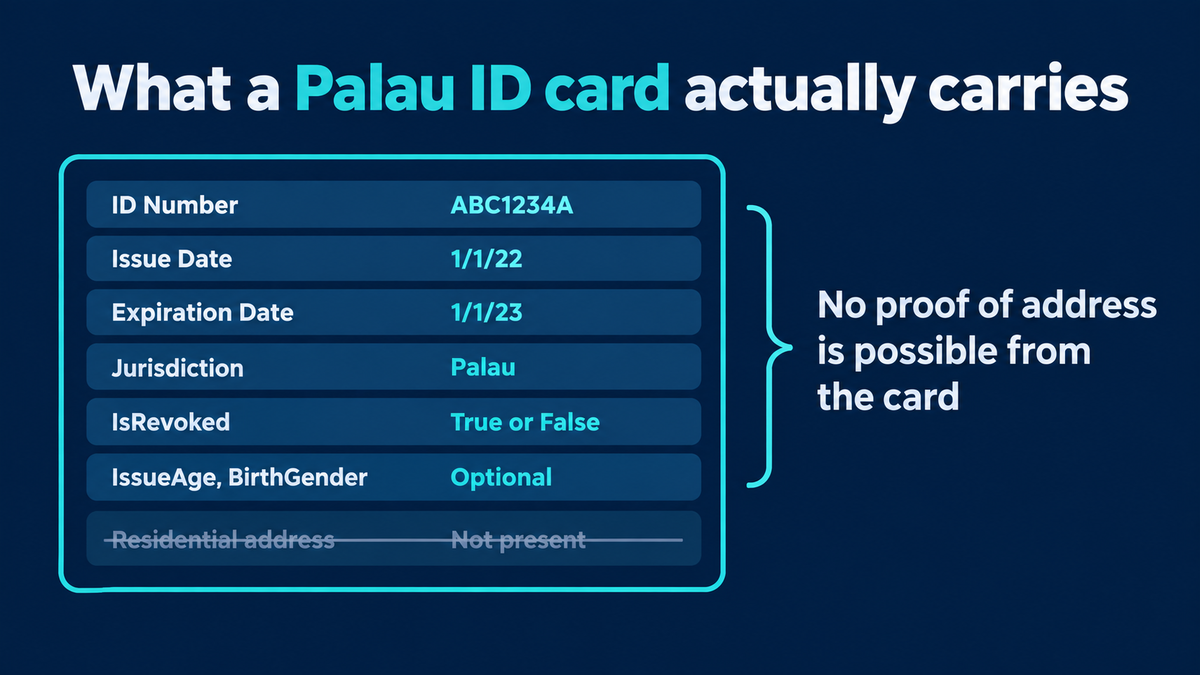
- A Palau card still cannot answer the question the EU regime asks first. RNS's own documentation lists no residential address on the credential, and says its mailing address "is not a Proof of Address". Residence decides which entity may serve you; the card speaks to identity.
On this page
- What actually changed, and when
- There was never one EU deadline
- The check that comes before your document
- Why MiCA is quiet about your ID, and AML law is not
- What a Palau ID card actually carries
- What an authorised venue looks like in practice
- Where this leaves an EU resident holding a Palau ID
- Four checks before you spend $288 to $2,339
- Bottom line
- Related reading
- FAQ

What actually changed, and when
If you live in the EU and you bought or are considering a Palau digital residency card to clear a crypto exchange's verification screen, the ground moved under that plan during 2026 — and not in the way most pages describe.
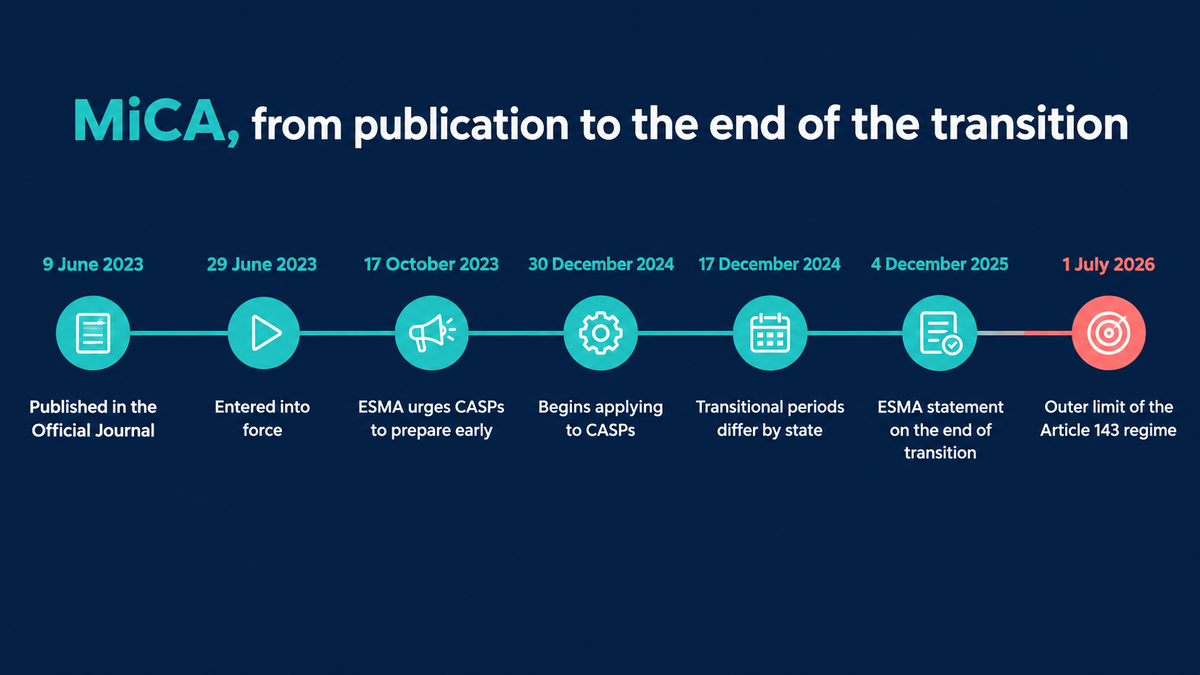
The Markets in Crypto-Assets Regulation, Regulation (EU) 2023/1114, was published on 9 June 2023 and entered into force on 29 June 2023, per the European Commission. It began applying to crypto-asset service providers (CASPs) in December 2024. Firms already operating legally under national rules before 30 December 2024 were given extra time to come into line, under the transitional clause in Article 143.
That extra time is what ran out. ESMA describes the clause as allowing those entities "to continue to do so until 1 July 2026 or until they are granted or refused a MiCA authorisation" — whichever came first. As of today, September 2026, that window is shut everywhere in the Union.
| Date | What happened | Source |
|---|---|---|
| 9 June 2023 | MiCA published in the Official Journal | European Commission |
| 29 June 2023 | MiCA entered into force | European Commission |
| 17 October 2023 | ESMA statement urging CASPs to prepare early | ESMA |
| 30 December 2024 | MiCA begins applying to CASPs; cut-off for the transitional regime | ESMA |
| 17 December 2024 | ESMA notes transitional periods now differ by Member State | ESMA |
| 4 December 2025 | ESMA statement on the end of transitional measures | ESMA |
| 1 July 2026 | Outer limit of the Article 143 transitional regime | ESMA |
Nothing in that timeline mentions Palau, or any identity document. That absence is the point, and the next two sections are about what it means for you.
There was never one EU deadline
This is where nearly every article on the subject gets it wrong, including some that sell residency products.
MiCA's transitional regime was not a uniform EU-wide grace period. ESMA's statement of 4 December 2025 is explicit: the regime gave "individual Member States complete discretion not to apply this transitional regime or to reduce its duration in view of fostering financial stability and investor protection." ESMA had already recorded, a year earlier, that "the inherently non-unified approach to transitional periods foreseen by Article 143 of MiCA has resulted in different transitional periods applicable across EU Member States."
So a firm might have lost its transitional cover in one Member State in 2025 while still trading under it in another into 2026. If you read somewhere that "EU exchanges all had until 1 July 2026", that is the outer boundary being mistaken for a common date.
Why this matters to you specifically: your country of residence determined when the music stopped for the venue you use. It is the same structure we keep running into on this site from a different direction — at Gate, where a Maltese licence sits behind a Malta entry on the restricted list, and at Bitstamp, whose own footer says which of seven legal entities serves you "depending on client residency". Residence picks the rulebook. It did so before MiCA and it does so more sharply now.
ESMA also set out what it expects of firms that did not get authorised: they should have "implemented orderly wind-down plans" where the period is over, and plans "ready for implementation" elsewhere, organised so as to avoid "undue economic harm to their clients" — for instance by "organising the transfer of the crypto-assets held for clients to another authorised CASP". National regulators, meanwhile, are told to "be ready to cooperate with one another to enforce against the unauthorised provision of crypto-asset services."
That is a supervisor describing an exit, not a paperwork tidy-up.
The check that comes before your document
Here is the practical consequence, and it is the part no competing page on this keyword covers.
ESMA closes its statement with a warning aimed at retail investors rather than firms. Two sentences, and they are worth having in full:
entities active in providing crypto asset services after the end of the transitional period are not guaranteed to be authorised under MiCA
and it is therefore "important to check in the ESMA Interim MiCA Register that the CASP entity of which they are clients are authorised to provide crypto asset services under MiCA to ensure that they benefit from the protections afforded by MiCA."
Articles 109 and 110 of MiCA require ESMA to maintain that register. It currently sits on ESMA's MiCA page as downloadable CSV files, republished at regular intervals, and ESMA has said it will be folded into its main IT systems during 2026. Alongside authorised CASPs, the register carries a file of non-compliant entities providing crypto-asset services.
So the order of operations for an EU resident has changed:
- Is this venue's entity in the register, for the service I want? If not, that is a live problem regardless of your documents.
- Does that entity serve my country of residence? Authorisation is entity-by-entity; being licensed somewhere is not being licensed for you.
- Only then: what identity documents does it accept, and is a Palau card among them?
Step three is the one everyone starts with. It is now the last one that matters, because a venue that fails step one may be winding down its book rather than opening new accounts — and an account you cannot keep is worth less than one you were never sold.
Why MiCA is quiet about your ID, and AML law is not
It would be convenient if MiCA settled the Palau question outright. It does not, and understanding why saves you from a lot of confident nonsense.
MiCA is an authorisation, conduct and disclosure regime for firms. It decides who may offer crypto-asset services in the Union, what they must disclose, how they must safeguard client assets, and who supervises them. It does not publish a schedule of acceptable passports and ID cards, and it names no country's identity documents as good or bad.
What a venue must collect from you when you open an account comes from a different body of law — the EU's anti-money-laundering framework, as transposed and applied nationally, plus each firm's own risk-based policy on top. That is the layer where "we accept a national identity card from this list of countries" lives, and it is why two MiCA-authorised firms can reach opposite answers on the same document.
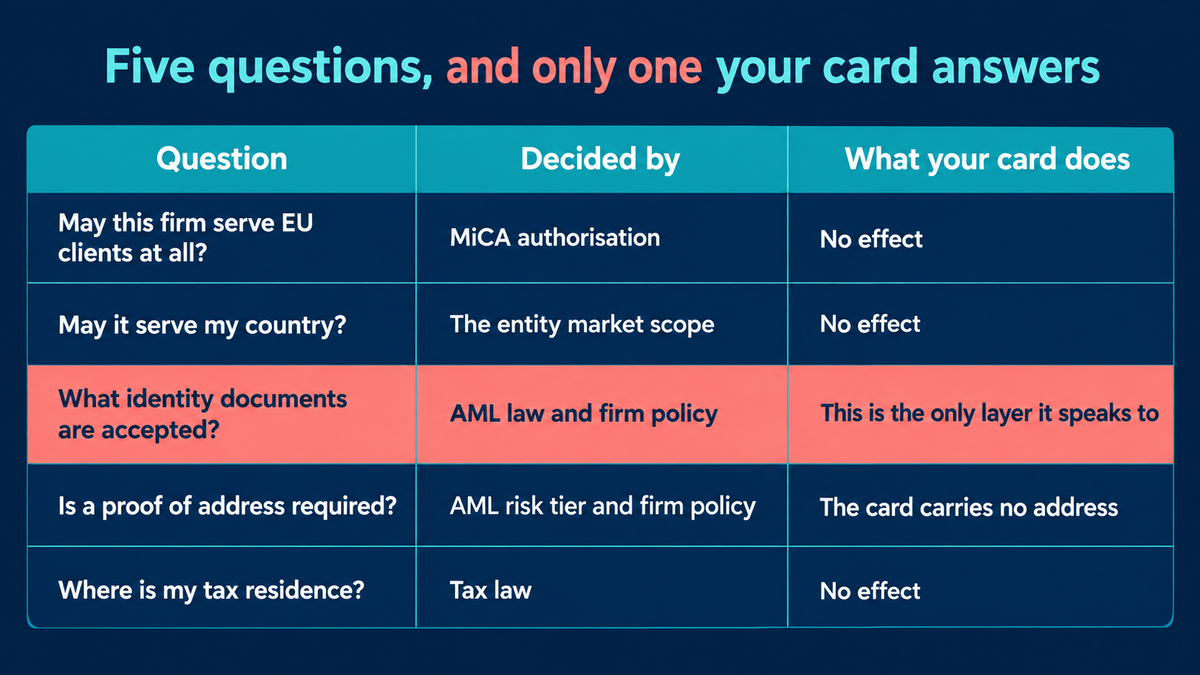
| Question | Decided by | What it means for a Palau ID |
|---|---|---|
| May this firm serve EU clients at all? | MiCA authorisation (Regulation (EU) 2023/1114) | No effect — your document does not authorise a firm |
| May it serve my country? | The entity's authorisation and its own market scope | No effect — decided by your residence, not your card |
| What identity documents are accepted? | AML law as applied nationally, plus firm policy | This is the only layer your card speaks to |
| Is a proof of address required? | AML risk tier and firm policy | The card carries no address (see below) |
| Where is my tax residence? | Tax law, unaffected by any of the above | No effect — see Palau crypto tax |
Read down that table and the shape of the thing is clear. A Palau digital residency card is an input to one row out of five. It was never capable of answering the other four, and the 2026 changes made the first two rows louder.
This is the same conclusion we reach coming at it from the document side in Palau ID for crypto KYC, and from the address side in Palau ID proof of address.
What a Palau ID card actually carries
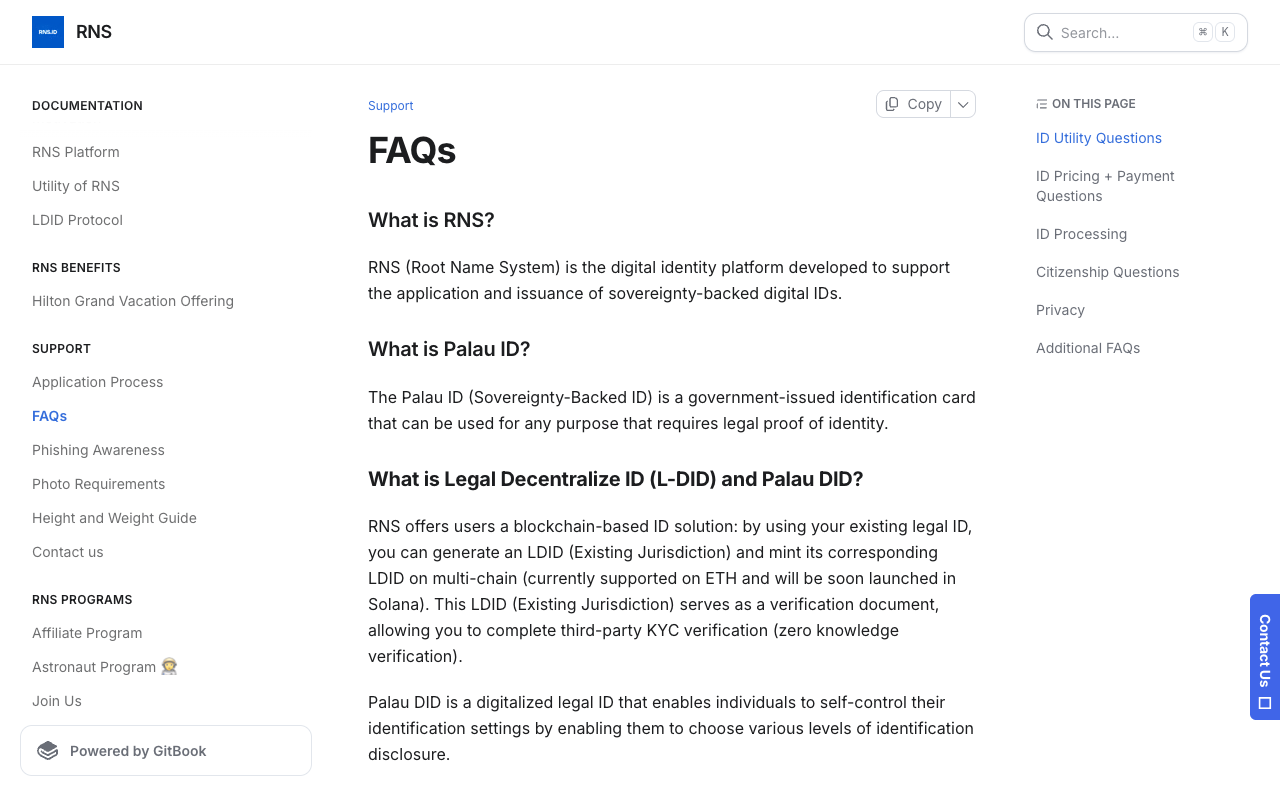
Claims about this credential online routinely describe a document that does not exist, so it is worth restating from the issuer's own platform documentation what the card holds.
| Field | RNS documentation example | Use against an EU verification flow |
|---|---|---|
| ID Number | ABC1234A | Identity only |
| Issue Date | 1/1/22 | Supports a validity check |
| Expiration Date | 1/1/23 | Must be unexpired |
| Jurisdiction | Palau | Speaks to nationality, not residence |
| IsRevoked | True / False | Not a verification field |
| IssueAge, BirthGender | Optional | Identity only |
| Residential address | Not present | No proof of address is possible from the card |
Three statements from RNS's own FAQ bound the product further, and all three cut against the way it is often sold:
- "Only the physical copy of your ID can be used for KYC" — the digital credential you receive first is not the artefact to submit, which Palau ID card covers in detail.
- The RNS mailing address "is not a Proof of Address and may not satisfy specific verification requirements" — unpacked at Palau mailing address.
- "Digital residency does not support pathways to citizenship or future Palau passports" — it is an identity credential, and it is not a passport.
Applications are accepted from global citizens other than a short excluded list — North Korea, Iran, Syria, Cuba, Crimea, and Sudan — which is a statement about who may buy the card, not about who will accept it afterwards.
What an authorised venue looks like in practice
A worked example helps, and there is one already documented on this site.
Gate Technology Ltd announced on 1 October 2025 that it had "obtained a MiCA License under the regulation and supervision of MFSA, to provide exchange and custody services", passporting across Europe from Malta. That is what the finished state looks like: a named legal entity, a named national regulator, a scope of services, and a date.
Note what it does not tell you. The announcement says nothing about which identity documents that entity accepts, because MiCA authorisation and document policy are different questions. As our Gate page sets out, Malta appears on Gate's own restricted-locations list for the global platform precisely because the European entity serves that market separately — structure you have to infer, because no page states it outright.
The same split shows up at consumer fintechs. Revolut does not list Palau among its supported document countries, and Revolut controls its own verification rules; its licensing status is a separate matter from that list entirely.
So "is it MiCA-authorised?" and "will it take my Palau ID?" are two independent checks, and you need both to come back yes. Our exchange KYC tracker keeps the document half of that side by side across the venues we have examined.
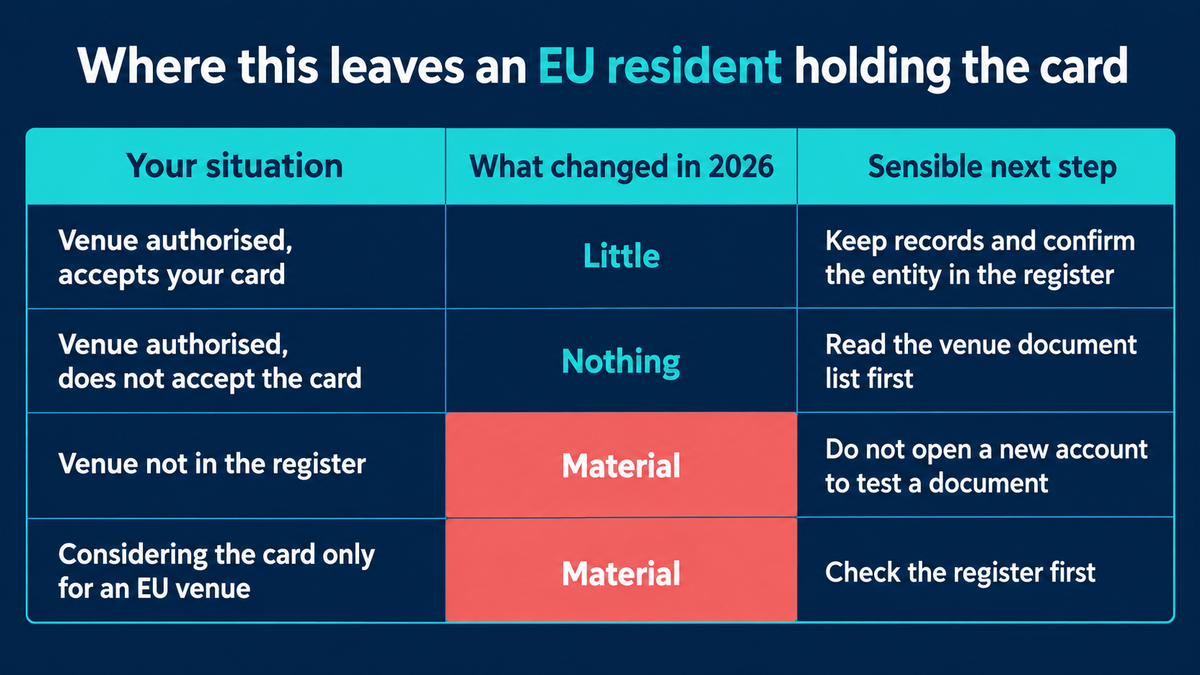
Where this leaves an EU resident holding a Palau ID
Honestly: in a slightly worse position than in 2024, and for a reason that has nothing to do with Palau.
| Your situation | What changed in 2026 | Sensible next step |
|---|---|---|
| EU resident, venue is MiCA-authorised, accepts your card | Little — the account rests on a supervised entity | Keep records; confirm the entity in the register |
| EU resident, venue authorised, does not accept the card | Nothing — this was always a firm-policy question | Read the venue's own document list before buying anything |
| EU resident, venue not in the register | Material — it should not be onboarding you | Do not open a new account to test a document |
| EU resident considering the card only for an EU venue | Material — the binding constraint is now authorisation | Check the register first; the card may be irrelevant |
| Non-EU resident using an EU-licensed venue | Depends on the entity's scope, not your card | Confirm the entity that would serve you |
The uncomfortable row is the fourth. A large share of people buy this card to clear one screen. If that screen belongs to an EU venue, the decisive question in 2026 is one your card has no bearing on — and it costs nothing to answer, while the card costs $288 for the one-year trial, $1,199 for five years, or $2,339 for ten on RNS's published pricing.
None of this is legal, tax or financial advice, and acceptance varies: every venue reviews accounts itself, changes policy without notice, and its live verification flow is the authority over any guide, this one included.
Four checks before you spend $288 to $2,339
Free, about fifteen minutes, and they settle the question before money moves.
- Look your venue up in the ESMA Interim MiCA Register. Find the entity name, not the brand. If the entity that would hold your account is not there, treat that as the answer and stop.
- Get to the venue's document screen before you buy anything. Registration is free. The screen tells you which document categories and which country fields you will face — the thing no third-party page can reliably tell you.
- Decide what you would use as proof of address. No version of the Palau card supplies one, and RNS says its mailing address is not one either. If the venue asks at your risk tier, the card does not close that gap.
- Check whether this venue is your only reason for buying. If it is, read the cost breakdown and what the programme does not do before ordering. If reporting is on your mind, CARF crypto reporting is the page to read next — a second ID does not make an account invisible.
Bottom line
The 2026 changes did not ban Palau IDs in the EU, and nobody should tell you they did. MiCA never had an opinion on your documents. What it did was put a prior question in front of the one you were asking: whether the firm you are handing your identity to is authorised to be taking it.
That prior question now has a free, public, authoritative answer — ESMA's register — and a supervisor explicitly telling retail investors to go and look. Meanwhile the document question is exactly where it was: decided firm by firm, under AML rules and internal policy, with a card that carries a jurisdiction and no address.
The practical upshot for an EU resident is that the order changed. Check authorisation, check that the entity serves your country of residence, and only then ask whether a Palau card clears the document screen. Run it in that order and you will sometimes discover you never needed the card. That is a cheaper discovery to make before $2,339 than after, and it is the one this page exists to make easy.
Related reading
- Palau ID for crypto KYC — the document question across exchanges
- Palau ID exchange KYC tracker — every venue we have checked, side by side
- Palau ID proof of address — why an ID card is not an address document
- Does Gate.io accept Palau ID? — a MiCA-licensed European entity in practice
- Palau digital residency limitations — what the programme does not do
- CARF crypto reporting and Palau ID — why a second ID is not privacy
FAQ
Did MiCA ban Palau IDs on EU crypto exchanges in 2026?
No. MiCA authorises and supervises firms; it publishes no list of acceptable identity documents and names no country's ID as valid or invalid. What changed in 2026 is that the transitional regime for firms operating under older national rules ran out, so the venue's own authorisation became the first question. Whether a Palau card clears a given verification screen is still decided by that firm under anti-money-laundering law and its own policy, and acceptance varies.
What exactly happened on 1 July 2026?
That date was the outer limit of MiCA's transitional regime under Article 143. ESMA describes it as allowing firms that operated lawfully under national rules before 30 December 2024 to continue "until 1 July 2026 or until they are granted or refused a MiCA authorisation". It was not a single EU-wide deadline: ESMA's December 2025 statement records that Member States had discretion to shorten or not apply the regime, producing different end dates across the Union.
How do I check whether my exchange is authorised?
Use the ESMA Interim MiCA Register, published on ESMA's MiCA page as downloadable CSV files and updated at regular intervals. Search for the legal entity that would hold your account rather than the brand name — large venues operate several entities, and only some may be authorised. The register also includes a file listing non-compliant entities providing crypto-asset services.
Does a Palau ID help if my exchange lost its authorisation?
No. Authorisation is about the firm, not about you, and no identity document from any jurisdiction changes a firm's regulatory status. ESMA expects unauthorised firms to run "orderly wind-down plans", including transferring client crypto-assets to an authorised provider. Opening a new account at such a venue to test a document is the opposite of what that guidance points to.
Can I use a Palau ID as proof of address in the EU?
No. RNS's platform documentation lists the credential's fields as ID Number, Issue Date, Expiration Date, Jurisdiction and a revocation flag, with optional age and gender — there is no residential address on the card. RNS separately states that its mailing address service "is not a Proof of Address and may not satisfy specific verification requirements", so it is not a substitute where a venue asks for one.
Does holding a Palau ID change my tax position in the EU?
Nothing on this page should be read as tax advice, and a digital residency credential is not a change of tax residence. Tax residence is determined by tax law in the countries concerned, on facts such as where you actually live, not by which identity card you hold. See Palau crypto tax and CARF crypto reporting for how reporting frameworks treat accounts.
Is it still worth buying a Palau ID if I live in the EU?
That depends entirely on why you want it, and the honest answer is that the EU changes make one common reason weaker. If the sole purpose is clearing one EU venue's verification screen, check that venue's register entry and its published document list first — both are free, and either may make the purchase unnecessary. If you want it for identity use across a range of non-EU platforms, the 2026 changes do not bear on that, but read what the programme does not do before ordering.