Does Bitstamp Accept Palau ID? 2026 KYC Rules
Does Bitstamp accept Palau ID? One documented rejection says no, and Bitstamp publishes no rule either way. We checked what is verifiable in 2026.
We may earn a commission if you apply through this link. This site is independent and is not the official RNS.ID or Palau government site.
Key takeaways
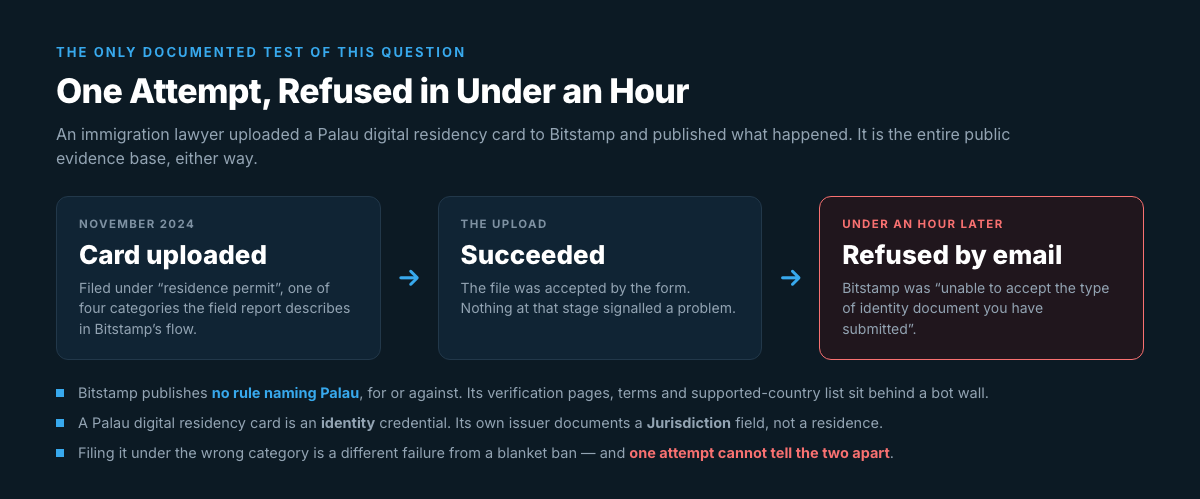
- There is exactly one documented attempt, and it was refused. An immigration lawyer uploaded a Palau digital residency card to Bitstamp in November 2024, watched the upload succeed, and received an email under an hour later saying Bitstamp was "unable to accept the type of identity document you have submitted".
- Bitstamp publishes no rule naming Palau, for or against. Unlike Coinbase's country-by-country table or Gate's restricted-locations clause, Bitstamp's verification pages, terms and supported-country list sit behind a bot wall. Every claim about its document list circulating online is second-hand, including the one in the field report.
- The rejected submission was filed as a "residence permit" — one of four categories the field report describes in Bitstamp's flow. A Palau digital residency card is an identity credential; its own issuer documents a Jurisdiction field, not a residence. Filing it under the wrong category is a different failure from a blanket ban, and one attempt cannot tell the two apart.
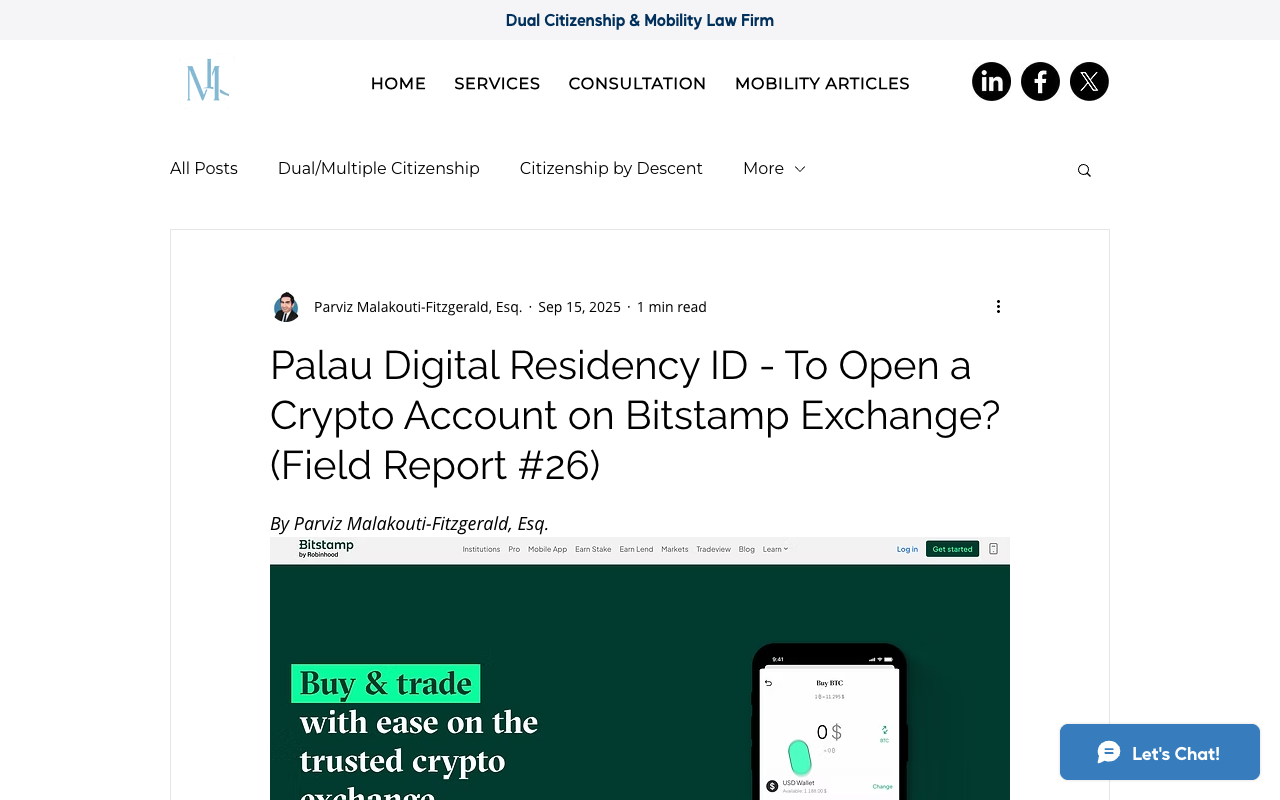
- You are not applying to one Bitstamp. Its own site footer names seven legal entities — Luxembourg (CSSF), the UK (FCA), the British Virgin Islands (FSC), Singapore (MAS), Slovenia (ATVP), Bitstamp Ltd and Bitstamp USA (NYDFS) — and says which one serves you depends "on client residency". Your residence picks the rulebook before any document is looked at.
- Bitstamp has been owned by Robinhood since 2 June 2025, which matters because the pages arguing about this question all predate that close, and because a card with no address field has to survive whatever verification stack the combined business settles on.
On this page
- Does Bitstamp accept Palau ID? The short answer
- The one documented attempt, and exactly what it said
- The category trap: a Palau ID is not a residence permit
- Which Bitstamp you are actually applying to
- What Bitstamp publishes, and what it keeps closed
- What is actually printed on a Palau ID card
- How Bitstamp compares with the venues we have checked
- What to check before you spend $288 to $2,339
- Bottom line
- Related reading
- FAQ

Does Bitstamp accept Palau ID? The short answer
Search does Bitstamp accept Palau ID and the first page of results holds one page that has actually tried it. The rest is a Bybit walkthrough on Medium, three Wikipedia articles, a forum thread, and two affiliate pages that answer a different venue's question. That is an unusually thin result for a question with real money attached.
The one on-topic page is a field report by an immigration lawyer who uploaded the card to Bitstamp and published what came back. It is the best evidence anyone has, and it is a single attempt from November 2024 — closer to a data point than a policy. Bitstamp itself has published no rule naming Palau in either direction that we could read.
The stakes are worth stating plainly. A Palau digital residency costs $288 for the one-year trial, $1,199 for five years and $2,339 for ten, on RNS's own published pricing, and a large share of buyers are buying it to clear one verification screen. If that screen is Bitstamp's, the only documented outcome so far is a refusal.
Nothing here is legal, tax or financial advice, and acceptance varies: Bitstamp reviews each account itself, changes its rules without notice, and its live verification flow is the authority over any guide, this one included.
The one documented attempt, and exactly what it said
The detail is worth having in full, because the shape of the rejection tells you more than the fact of it.
| Stage | What happened | What it tells you |
|---|---|---|
| Registration | Account opened, verification started | No block at signup |
| Document category chosen | "Residence permit" | The category was the applicant's choice, not Bitstamp's classification |
| Upload | Front and back images of the Palau ID accepted; success screen shown | The upload check is not the decision |
| Response | Rejection email under an hour later | Fast enough to suggest a rule or a template, not a long manual review |
| Wording | "unable to accept the type of identity document you have submitted" | It names the type of document, not the person, the country or the quality of the scan |
That last row is the one that carries information. Bitstamp did not say the images were unclear, that the applicant's country was restricted, or that the account failed screening. It said the type of document was not one it accepts — which is the sentence a platform sends when a submission falls outside its accepted-document categories.
The report also describes the categories Bitstamp's flow offered: driver licences, national identity cards, passports and residence permits. Note where that description comes from. It is one person's account of what the screen showed him in 2024, not a quote from a Bitstamp page, because those pages are not openly readable. We flag that because the difference matters when you are deciding whether to spend $2,339.
The category trap: a Palau ID is not a residence permit
Here is the part nobody else works through. The submission was filed under residence permit. A Palau digital residency card is not a residence permit in the sense that phrase normally carries, and its issuer's own documentation says as much by omission.
| Bitstamp category (per the field report) | What it normally means | Is a Palau ID card one? |
|---|---|---|
| Passport | A travel document issued by a state to its nationals | No — RNS states digital residency "does not support pathways to citizenship or future Palau passports" |
| National identity card | A state-issued photo ID card | Arguably yes — this is the closest fit, and the category the card is built to resemble |
| Driver licence | A licence to drive, used as photo ID | No |
| Residence permit | A document granting the holder the right to reside in the issuing country | No — the card grants no right of residence; it documents identity |
So the documented rejection is genuinely evidence, but it is evidence about a specific submission: a Palauan identity credential offered as a residence permit. Whether the same card filed as a national identity card would clear is not something the field report tested, and not something we are going to assert on a guess.
That distinction is not a loophole and we are not suggesting one. Picking a category that describes your document accurately is what the form is asking for. The honest reading is that the strongest available evidence points to "no", and that it is one attempt, in one category, nearly two years old.
Which Bitstamp you are actually applying to
Every page arguing about this question treats Bitstamp as a single company with a single rulebook. Its own site footer says otherwise, and the list is specific enough to quote:
| Entity | Regulator | Licence / registration |
|---|---|---|
| Bitstamp Europe S.A. (Luxembourg) | CSSF | Payment institution Z00000012; crypto-asset service provider N00000003 |
| Bitstamp UK Ltd. | FCA (Money Laundering Regulations) | Firm reference 978690 |
| Bitstamp Ltd. (London) | — | Registration 8157033 |
| Bitstamp Global Ltd. (BVI) | BVI Financial Services Commission | VASP registration 2086429 |
| Bitstamp Asia Pte Ltd (Singapore) | MAS | Major payment institution PS20200667 |
| Bitstamp USA, Inc. | NYDFS | Virtual currency business activity; NMLS 1905429 |
| Bitstamp Financial Services Ltd. (Slovenia) | ATVP | MiFID investment firm, derivatives only |
The footer's own framing is the important part: crypto-asset services "are provided by the following Bitstamp legal entities depending on client residency". That is the same structure we found at Gate, where a Maltese licence sits behind a Malta entry on the restricted list, and at eToro with its separate entities per region.
The consequence for this question is blunt. Before any document is assessed, your declared country of residence decides which of seven regulated entities handles you, and therefore which AML rulebook applies. A Palauan document does not move you between those entities, because none of them is selected by the jurisdiction on your card. This is the trap we set out in Palau ID proof of address: the card answers a question about who you are, and platforms increasingly ask where you are first.
Bitstamp has also been a Robinhood company since 2 June 2025, when Robinhood closed the acquisition — both companies published it. Bitstamp was founded in 2011, holds "over 50 active licenses and registrations globally", and has offices in Luxembourg, the UK, Slovenia, Singapore and the US. Nothing in either announcement mentions identity documents, but it dates every competing page on this question to before the owner changed.
What Bitstamp publishes, and what it keeps closed
This deserves its own section because it explains why the search results for this question are so poor.
| Bitstamp resource | Openly readable? | Useful for this question? |
|---|---|---|
| Learn Center — KYC | Yes | General principles only — no document list |
| Company blog | Yes | Ownership, entities, licences |
| Help centre verification articles | No — bot-walled | This is where the document rules live |
| Terms of use, AML policy | No — bot-walled | Would settle the restricted-country half |
| Supported countries list | No — bot-walled | Would settle whether Palau appears at all |
We tried each of these. The Learn Center and the blog return their content; the help centre, the terms and the supported-country list return an Imperva challenge instead of a page. A human in a browser can read them. Anyone checking a claim from outside cannot, and that includes us.
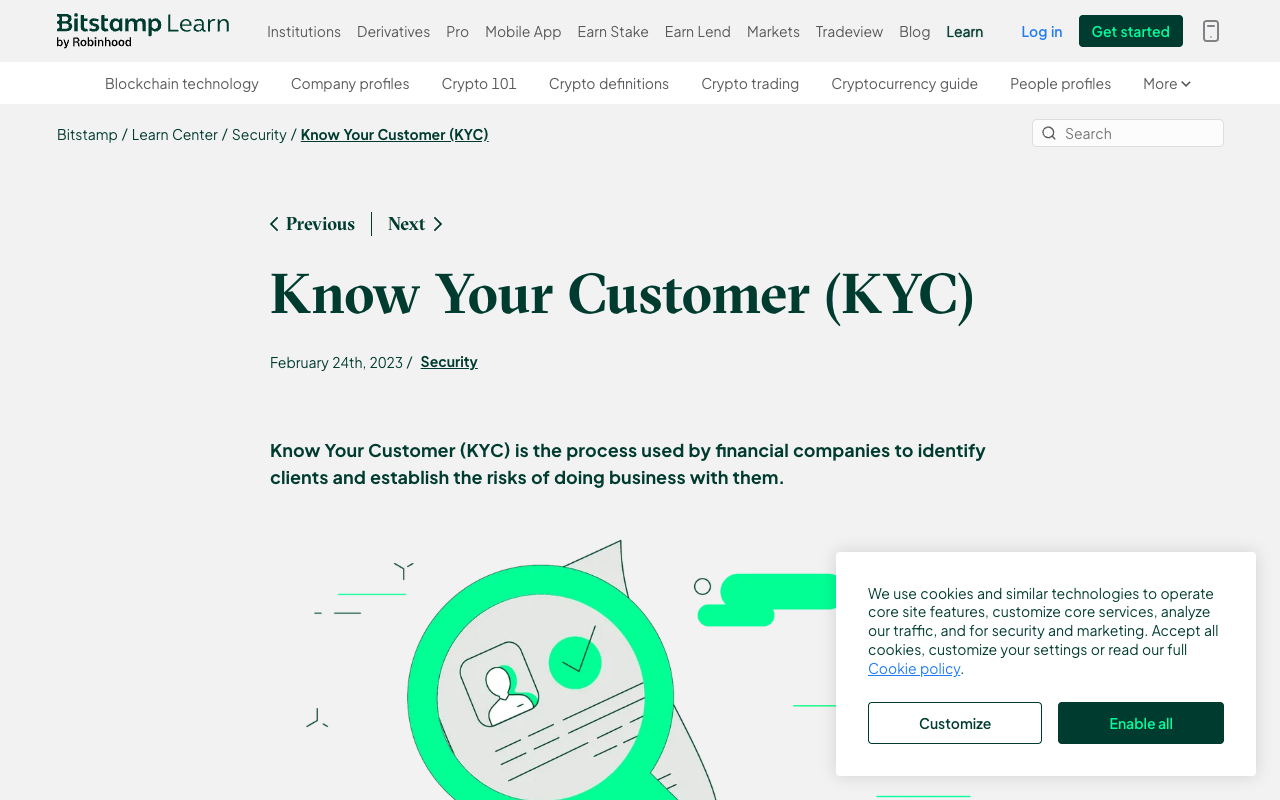
What the Learn Center does say is worth quoting, because it is Bitstamp in its own voice on how it thinks about this: "Basic KYC checks may only require a copy of a government-issued ID to identify a customer", while "depending on the level of risk, the institutions may ask for additional information such as a tax identification number, ID picture, proof-of-address, or financial documentation." The page splits due diligence into simplified, standard and enhanced tiers. A card with no address field is fine for the first sentence and has nothing for the second.
So the reason a lawyer's blog post is the best source on this question is that Bitstamp has not made a better one available to check against.
What is actually printed on a Palau ID card
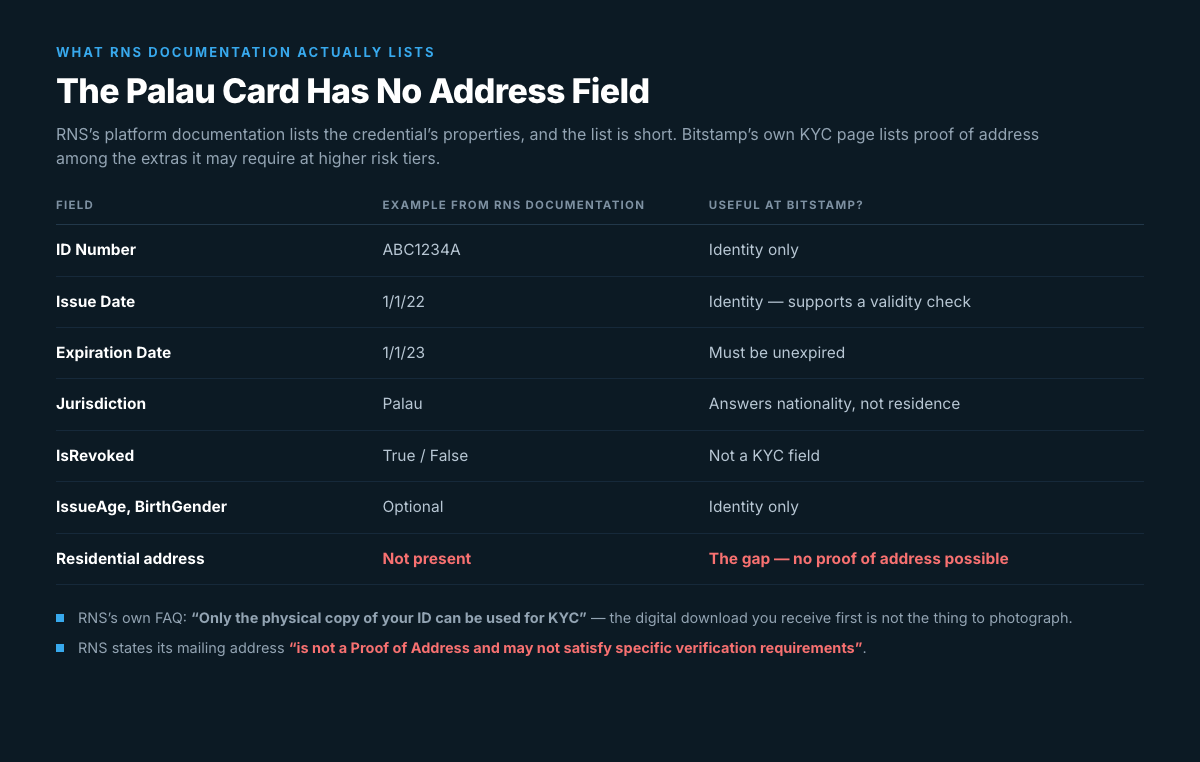
Claims made about this card online routinely describe a document that does not exist. RNS's platform documentation lists the credential's properties, and the list is short.
| Field | Example from RNS documentation | Useful at Bitstamp? |
|---|---|---|
| ID Number | ABC1234A | Identity only |
| Issue Date | 1/1/22 | Identity — supports a validity check |
| Expiration Date | 1/1/23 | Must be unexpired |
| Jurisdiction | Palau | Answers nationality, not residence |
| IsRevoked | True / False | Not a KYC field |
| IssueAge, BirthGender | Optional | Identity only |
| Residential address | Not present | The gap — no proof of address possible |
RNS describes the credential as "a legally recognized and government-issued form of identification" that "can be used for any ID requirement". That is the issuer's characterisation of the document, not a commitment from any platform, and the two are constantly confused by pages selling something.
Two further points from RNS's own FAQ, both of which cut against the reseller pitch. "Only the physical copy of your ID can be used for KYC" — the digital download you receive first is not the thing to photograph, which our Palau ID card page covers in more detail. And the RNS mailing address "is not a Proof of Address and may not satisfy specific verification requirements", a limitation we unpack at Palau mailing address.
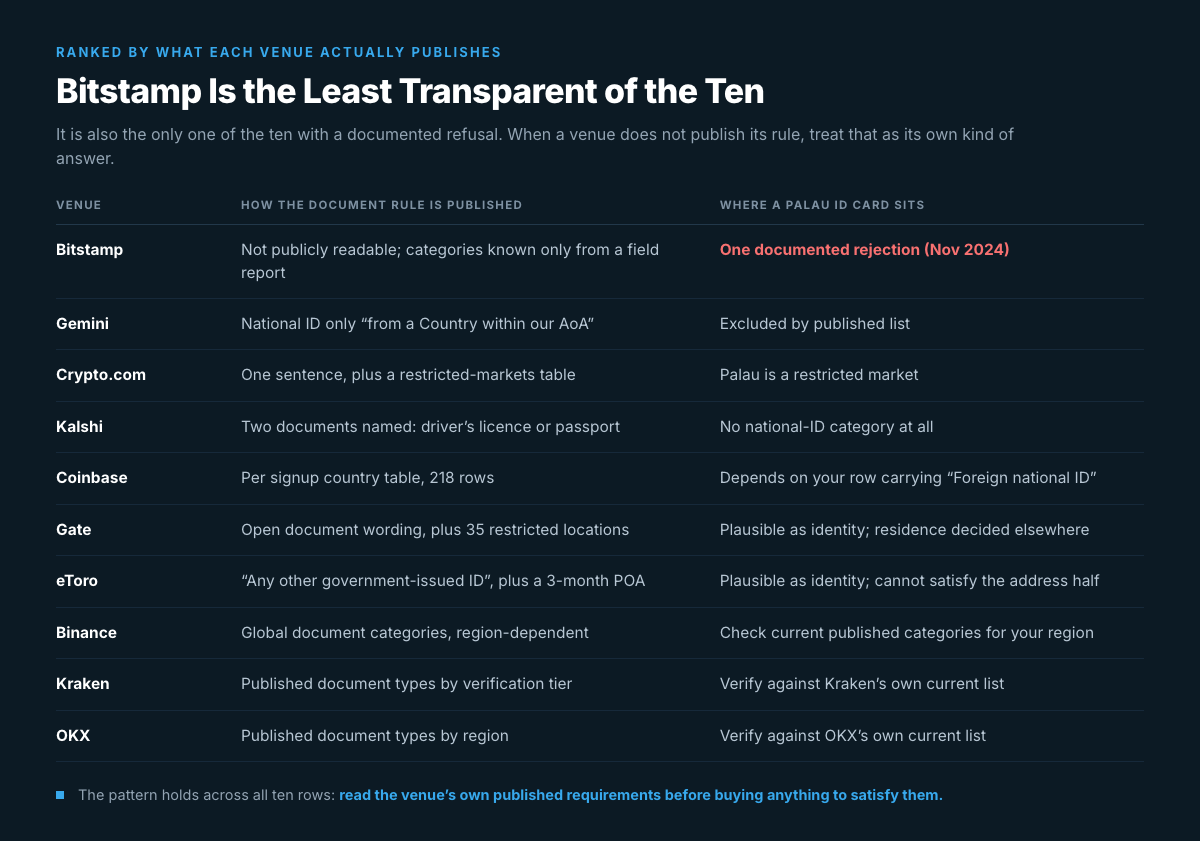
How Bitstamp compares with the venues we have checked
Ranked by what each venue actually publishes, Bitstamp is the least transparent of the ten and the only one with a documented refusal.
| Venue | How the document rule is published | Where a Palau ID card sits |
|---|---|---|
| Bitstamp | Not publicly readable; categories known only from a field report | One documented rejection (Nov 2024) — filed as a residence permit |
| Gemini | National ID only "from a Country within our AoA" | Excluded by published list |
| Crypto.com | One sentence, plus a restricted-markets table | Palau is a restricted market |
| Kalshi | Two documents named: driver's licence or passport | No national-ID category at all |
| Coinbase | Per signup country table, 218 rows | Depends on your row carrying "Foreign national ID" |
| Gate | Open document wording, plus 35 restricted locations | Plausible as identity; residence decided elsewhere |
| eToro | "Any other government-issued ID", plus a 3-month POA | Plausible as identity; cannot satisfy the address half |
| Binance | Global document categories, region-dependent | Check current published categories for your region |
| Kraken | Published document types by verification tier | Verify against Kraken's own current list |
| OKX | Published document types by region | Verify against OKX's own current list |
The pattern holds across all ten rows: read the venue's own published requirements before buying anything to satisfy them — and when a venue does not publish them, treat that as its own kind of answer. Our exchange KYC tracker keeps these side by side, and Palau ID supported exchanges shows how to run the check yourself on a venue we have not covered.
What to check before you spend $288 to $2,339
Four free checks, about ten minutes, and they settle this before any money moves.
- Open Bitstamp's signup and get to the document screen first. It costs nothing, it takes a few minutes, and it tells you which categories and which country fields you will face — the thing no public page can tell you. Do this before you buy a card to feed it.
- Check your residence, not your document. Bitstamp routes you to one of seven entities by where you live. If your residence is the problem, no identity card from any jurisdiction changes it.
- Decide what you would use for proof of address. Bitstamp's own KYC page lists proof-of-address among the extras it may require at higher risk tiers. No version of the Palau card supplies one, and RNS says its mailing address is not one either.
- Check whether Bitstamp is your only reason. If it is, keep the money until you have read the cost breakdown and what the programme does not do. If it is one of several venues, the documents checklist is the next page.
Bottom line
On the evidence available in September 2026, Bitstamp is the weakest bet of the ten venues we have checked. It is the only one where someone has published a refusal in Bitstamp's own words, and the only one that does not publish the rules that would let you check the refusal against policy.
But the evidence is thinner than the confident answers circulating online suggest. One attempt, in November 2024, filed under a category the card arguably is not, before the business changed owners. That is enough to say the odds look poor and to say why — the card carries no address, Bitstamp's own KYC page reserves the right to ask for one, and your residence picks the rulebook before the document is read. It is not enough to say Bitstamp has a policy against Palau IDs, because no such policy has been published, and we are not going to invent one to round off the answer. Acceptance varies, Bitstamp decides each account itself, and the five minutes it takes to reach its document screen is worth more than any page arguing about it.
Related reading
- Palau ID for crypto KYC — the category answer across exchanges
- Does Gemini accept Palau ID? — the other venue that comes out as a no
- Does Gate.io accept Palau ID? — open document wording, restrictive on residence
- Palau ID proof of address — why an ID card is not an address document
- Palau ID exchange KYC tracker — every venue we have checked, side by side
- Palau digital residency limitations — what the programme does not do
FAQ
Does Bitstamp accept Palau ID in 2026?
Bitstamp publishes no rule naming Palau IDs either way that is openly readable. The only documented attempt — by an immigration lawyer in November 2024 — was refused with the wording "unable to accept the type of identity document you have submitted", under an hour after the upload was accepted. That is the strongest evidence available and it points to no, but it is one attempt and not a published policy. Acceptance varies, because Bitstamp reviews each account itself.
Why can't you just quote Bitstamp's list of accepted documents?
Because it is not open. Bitstamp's Learn Center and company blog return their content to anyone, but its help-centre verification articles, its terms of use and its supported-countries list return a bot-protection challenge instead of a page. A human in a browser can read them; nobody verifying a claim from outside can. That is precisely why a lawyer's field report is the best public source on this question.
Was the Palau ID rejected because Palau is banned on Bitstamp?
Nothing in the documented rejection says so. The email named the type of document, not the country, the applicant or the image quality. Bitstamp's supported-countries page is not publicly readable, so whether Palau appears on any list it keeps is not something we can confirm. Treat "Palau is banned at Bitstamp" as an unverified claim, the same as its opposite.
Does it matter that the ID was submitted as a "residence permit"?
It may matter a great deal. A Palau digital residency card documents identity and a jurisdiction; it grants no right to reside in Palau, and RNS states the programme "does not support pathways to citizenship or future Palau passports". Filing it as a residence permit describes it inaccurately, and the rejection wording is the sentence platforms send when a document falls outside the chosen category. Whether the same card filed as a national identity card would clear has not been tested publicly.
Can I use a Palau ID as proof of address on Bitstamp?
No. RNS's platform documentation lists the credential's fields as ID Number, Issue Date, Expiration Date, Jurisdiction and a revocation flag, with optional age and gender — no residential address is printed on the card. RNS separately states that its mailing address service "is not a Proof of Address and may not satisfy specific verification requirements", so it is not a substitute. Bitstamp's own KYC page lists proof-of-address among the documents it may require at higher risk tiers.
Does Robinhood owning Bitstamp change the answer?
Not in any way either company has published. Robinhood closed the acquisition on 2 June 2025; both announcements cover licences, entities and institutional products, and neither mentions identity documents. What it does change is the age of the evidence: the documented rejection predates the close, as does every competing page on this question, so all of it describes a business under previous ownership.
If Bitstamp is not the answer, what should I check next?
Check the venue you actually intend to use, against its own published requirements, and read all of them rather than the identity list alone. Our exchange KYC tracker collects what each venue publishes, and Palau ID supported exchanges explains how to run the check yourself. Treat any list of "exchanges that accept Palau ID" that cites no source as a starting point, not an answer — including the ones that agree with you.