Palau ID for Kraken KYC: What Kraken's Own Rules Say
Kraken names one e-residency card it rejects. What its document policy actually requires, and how to check a Palau ID against it before you submit.
We may earn a commission if you apply through this link. This site is independent and is not the official RNS.ID or Palau government site.
The cautious answer
People search for Kraken and Palau ID together because they want a yes or no. The honest answer is that acceptance varies, and Kraken has not published a decision either way on Palau-issued identity cards.
What makes Kraken worth writing about separately is that its published document policy is more specific than most exchanges'. Where OKX, Bybit and KuCoin describe verification in general terms, Kraken names document types, sets a test that a non-standard ID has to meet, and names one digital-residency credential it refuses. That gives you something to check your own card against before you spend a submission attempt on it.
This page works through Kraken's stated rules and RNS's stated rules, and leaves the parts nobody has published as open questions rather than filling them in.
What Kraken says it accepts
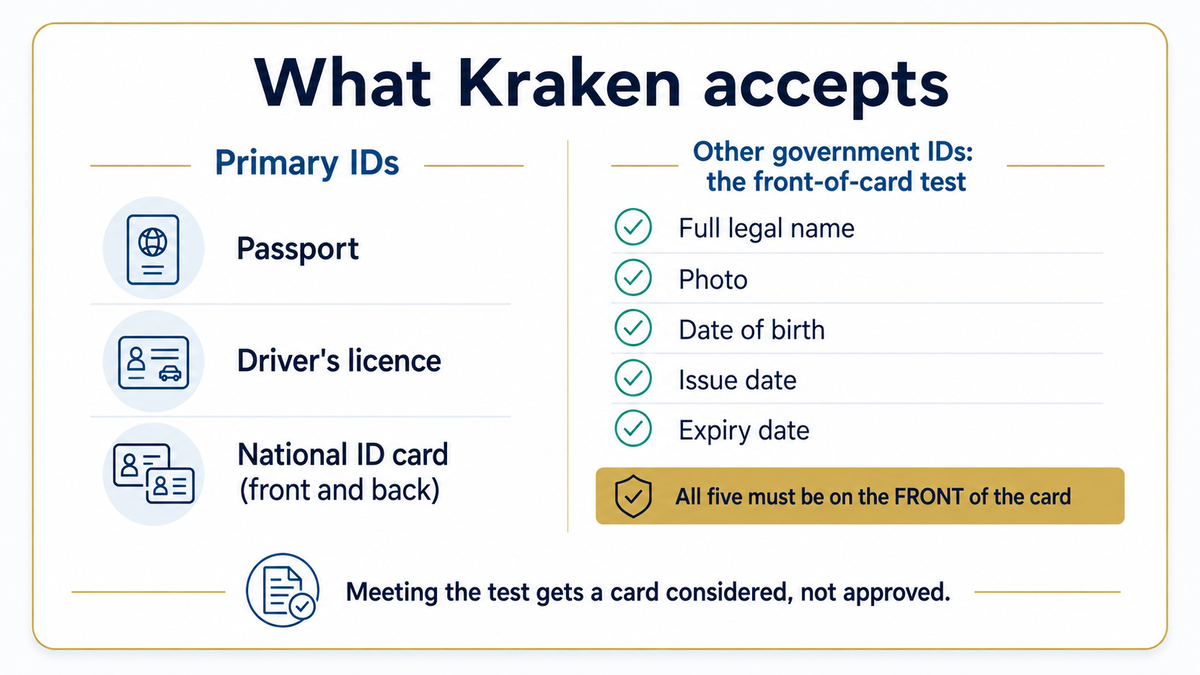
Kraken's document requirements article lists three primary government-issued IDs: a passport, a driver's licence, and a national identity card submitted front and back.
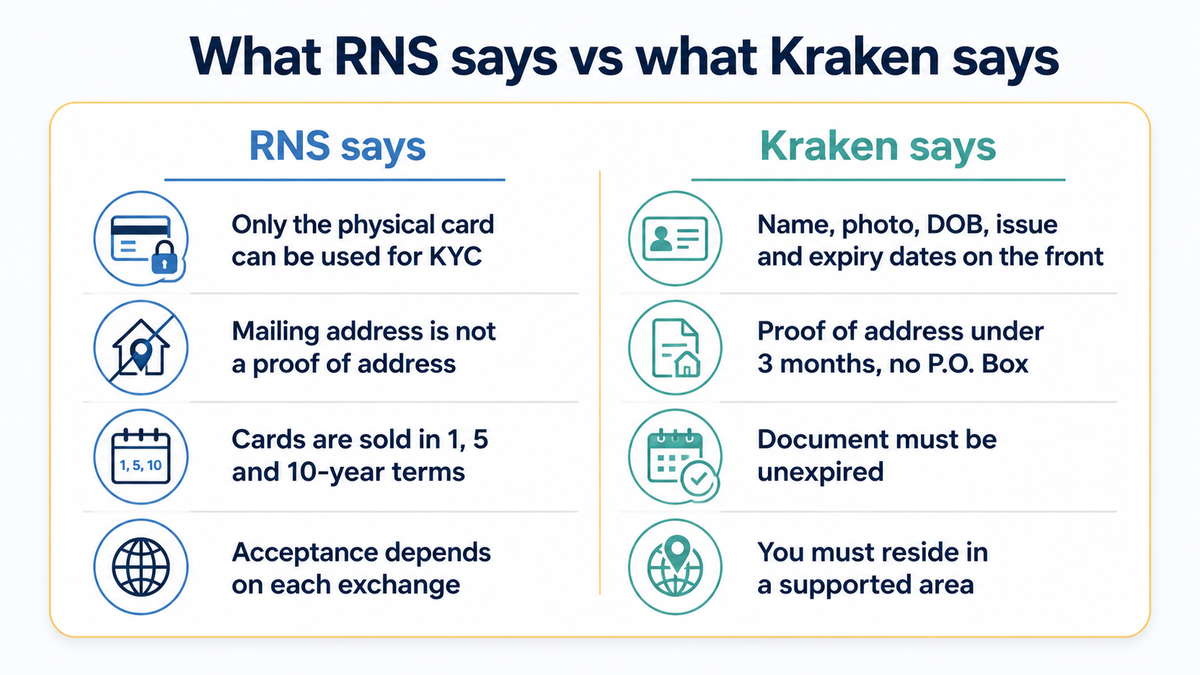
Then it adds the clause that matters for any card outside those three. Other government-issued IDs, Kraken says, "may be accepted if it has your full legal name, photo, date of birth and issue and expiry dates all on the front of your ID."
Read that carefully, because it is a specific and checkable test rather than a vague disclaimer:
- full legal name — matching the name on your Kraken account
- photo
- date of birth
- issue date
- expiry date
- all on the front — not split across both faces of the card
"May be accepted" is doing real work in that sentence. Meeting the test is what gets a non-standard document considered; it is not a commitment to approve it. Kraken reviews documents itself and can decline one that ticks every box.
The one e-residency card Kraken rejects by name
The same article contains a line that anyone researching digital residency for exchange KYC should read: "Liberland E-Residency and Firearm licenses are not accepted."
It is worth being precise about what that does and does not tell you.
It does not say Palau. Liberland is a self-declared micronation without recognition or a seat at the United Nations, and the credential it issues is not comparable to an identity card issued under the authority of a sovereign state. Palau is a UN member state, and RNS describes itself as the official technology provider issuing the Palau ID on the government's behalf. Treating the two as equivalent would be sloppy.
What the line does tell you is that Kraken's compliance team has looked at the digital-residency category specifically, formed a view on at least one product in it, and put that view in public documentation. That is more attention than most exchanges have paid to this category at all. It also means the absence of Palau from that rejection list is a genuine absence rather than an oversight of a category Kraken has never considered — while equally not being an endorsement.
The practical reading: Kraken evaluates unusual identity documents on their own terms, and it publishes exclusions when it makes them. Your card will be judged against the front-of-card test above, not against the brand on it.
Check your own card against the test
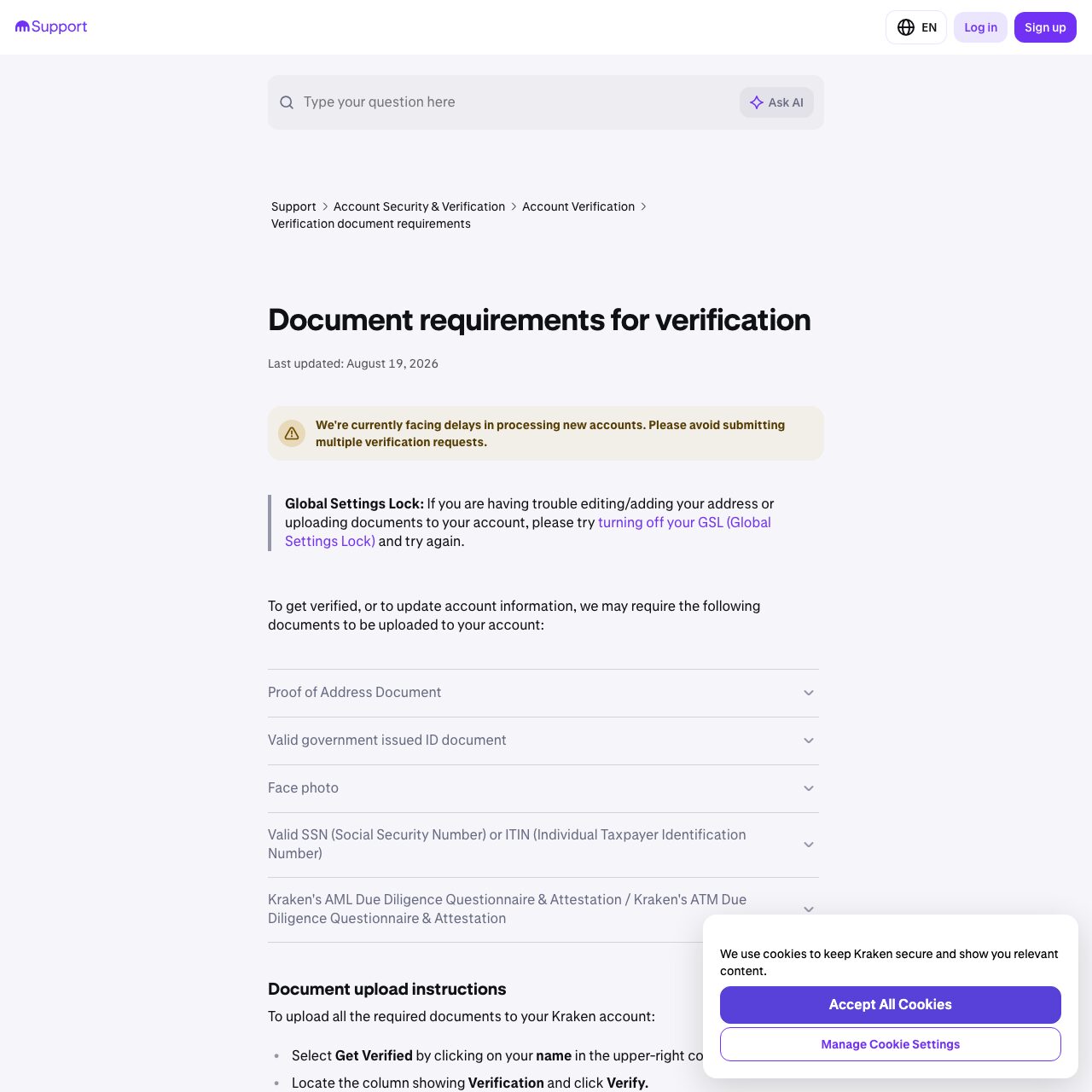
This is the step most people skip. Before you submit anything, put the physical card in front of you and confirm which of the five required data points are printed on the front face.
We are not going to state a field layout for the current Palau ID card here, because RNS does not publish a specification of the printed card and card designs change between print runs. Anyone telling you with confidence that the card passes or fails Kraken's front-of-card test — in either direction — is guessing. You have the card; they do not.
If a required field is on the back, or the card carries no expiry date on the front, you know the outcome of Kraken's stated test before you spend an attempt on it. If all five are on the front, you meet the published threshold and the decision moves to Kraken's discretion.
Residence decides eligibility, not the card
A point that catches people out across this whole category: Kraken gates accounts on where you live, not on which country issued your ID.
Kraken's verification requirements state that to register you must "Be 18 years of age or older" and "Reside in a supported area." Both verification tiers collect your full name, date of birth, phone number and physical address, plus occupation, alongside the ID document itself. US clients additionally provide a Social Security Number or Tax ID.
Holding a Palau ID does not make you a resident of Palau, and RNS does not claim that it does. Digital residency is an identity product, not an immigration status — see Palau digital residency limitations for where that line sits. If your actual country of residence is one Kraken does not serve, or one where a particular product is unavailable, the ID in your hand changes nothing about that. Kraken maintains its own list of supported and restricted areas and updates it; check it against your real address rather than against a third-party summary.
Entering an address you do not live at to get around a country restriction is a false statement on a regulated financial application. It is also the fastest route to a frozen account with funds inside it.
Proof of address is a separate check
Identity and address are two different requirements, and the Palau ID answers only the first.
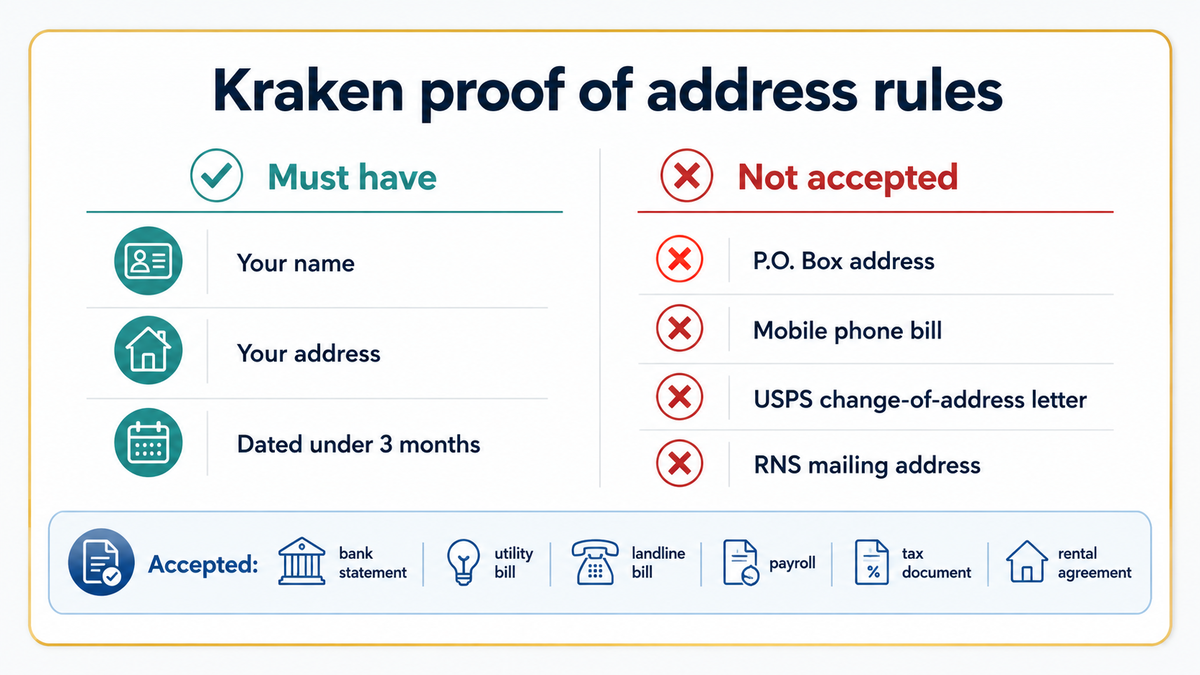
Kraken's rules on proof of address are strict and specific. The document must contain your name and address, and be "dated less than three months before the date of submission." Kraken does not accept P.O. Box addresses from any country, and explicitly does not accept USPS change-of-address letters. Accepted documents include bank and financial institution statements, utility bills, landline phone bills — mobile bills are rejected — payroll statements, insurance and tax documents, government agency letters, mortgage statements, signed rental agreements, voter registration confirmations and court documents.
There is one wrinkle in your favour. Kraken notes that depending on your country of residence, if your address is not automatically confirmed you may be asked for a face photo instead of a proof-of-address document. That is Kraken's call, not something you can select.
RNS is direct about the boundary here. Of its mailing address service, RNS says: "This service is not a Proof of Address and may not satisfy specific verification requirements." Before you plan around it, read Palau ID proof-of-address limits and Palau mailing address.
Use the physical card
RNS states it plainly in its FAQs: "Only the physical copy of your ID can be used for KYC. The sole purpose of downloading the image of your ID is to allow us to verify that the information on your ID is correct."
So a Kraken submission built on a portal screenshot, a downloaded preview or the on-chain LDID is the wrong starting point regardless of Kraken's own policy. It also means shipping time sits on the critical path — if Kraken verification is your reason for applying, read physical vs digital Palau ID for KYC and the application timeline before you order.
Kraken checklist
| Question | Why it matters |
|---|---|
| Are name, photo, DOB, issue date and expiry date all on the front of the card? | This is Kraken's published test for non-standard government IDs |
| Does the name on the card match your Kraken account exactly? | Mismatches are a common rejection cause independent of document type |
| Does Kraken support your actual country of residence? | Eligibility follows where you live, not who issued your ID |
| Can you produce a compliant proof of address dated under three months? | The Palau ID is not a proof of address, and a P.O. Box will not do |
| Are you submitting the physical card? | RNS says only the physical copy can be used for KYC |
| Is the card unexpired? | Kraken lists validity as a requirement; RNS sells 1, 5 and 10-year terms |
Bottom line
Kraken neither lists the Palau ID as accepted nor rejects it by name, and it does reject a comparable credential from an unrecognised micronation — which tells you the category is on its radar without telling you its answer for Palau. What you can act on is the published front-of-card test, the residence requirement, and the separate proof-of-address rules, all three of which you can check yourself before submitting.
Treat the Palau ID as a document that may satisfy Kraken's identity step if the card meets that test and Kraken accepts it, never as a route around a residence restriction or an address requirement. RNS itself says "acceptance by exchanges and banks will depend on their individual policies and requirements."
If you are comparing venues, use the exchange KYC tracker and the supported exchanges overview, or read the per-exchange notes for OKX, Bitget and MEXC.