Does Gemini Accept Palau ID? 2026 KYC Rules
Gemini's own onboarding page accepts a national ID only from a country inside its Areas of Availability. Palau is not on that list. We read the 2026 rules.
We may earn a commission if you apply through this link. This site is independent and is not the official RNS.ID or Palau government site.
Key takeaways
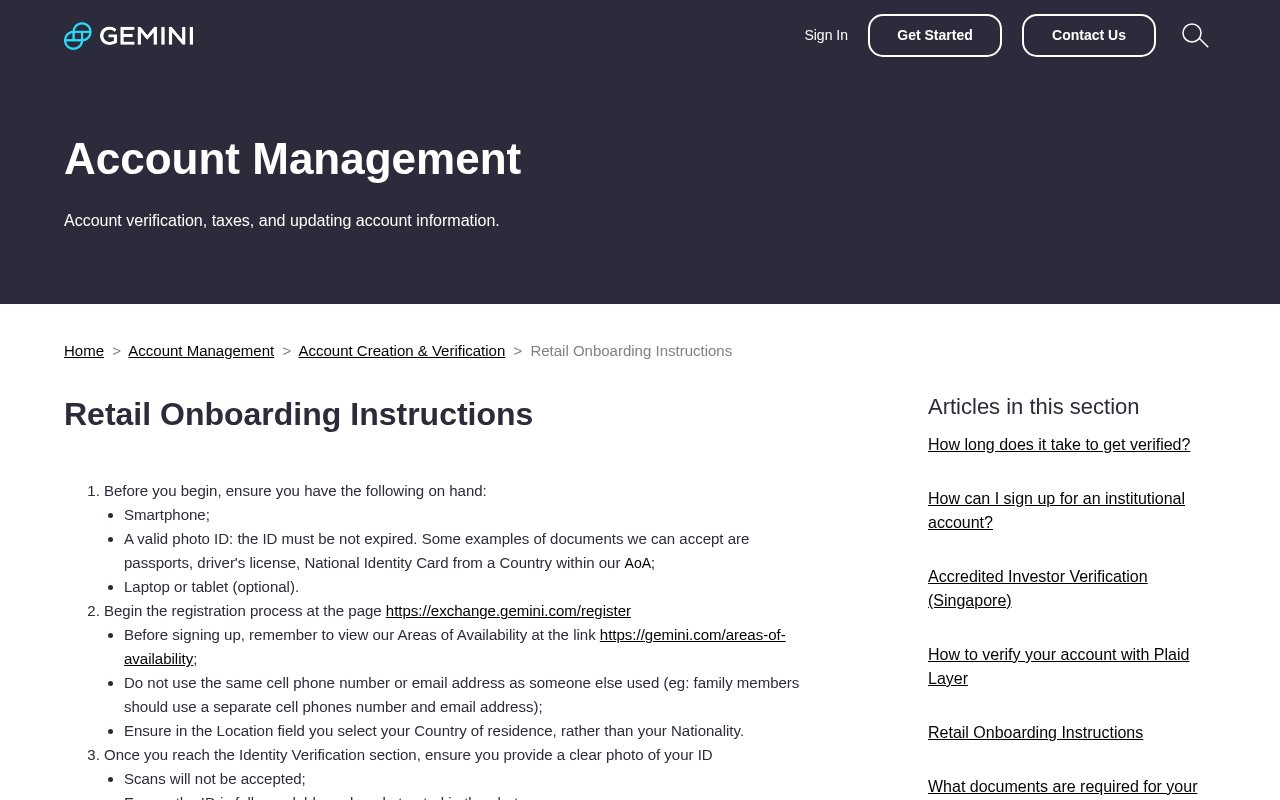
- Gemini writes the rule down, and almost nobody quotes it. Its Retail Onboarding Instructions list the documents it accepts as "passports, driver's license, National Identity Card from a Country within our AoA" — AoA being its Areas of Availability page. That single clause decides this question, because a Palau ID is a national identity card from a country that is not on that page.
- Palau is not in the Areas of Availability. We pulled the page and counted it: 58 jurisdictions across six regions, and Palau appears in none of them. Neither does any other Pacific island state.
- After 6 April 2026 there is no Pacific row left at all. Gemini closed every customer account in the UK, the European Economic Area and Australia on that date. Australia was its only Oceania listing, which takes the working list down to roughly 25 jurisdictions.
- The signup flow asks for residence, not nationality. Gemini's own instruction is to "select your Country of residence, rather than your Nationality" in the Location field — so the workaround that sometimes clears Coinbase, signing up on Palau's country row, has no equivalent here.
- Gemini's own pages disagree on the headline number. The help article "Which countries and U.S. states does Gemini support?" still says "60+ countries" (updated 21 January 2026) while the Areas of Availability page says "50+". Neither number includes Palau, so the discrepancy changes nothing here — but it is a useful reminder to read the list, not the summary.
On this page
- The short answer, and the clause nobody quotes
- What Gemini actually publishes about documents
- Palau is not in Gemini's Areas of Availability
- The 6 April 2026 exit removed a third of the list
- The Location field: residence, not nationality
- What is actually printed on a Palau ID card
- How Gemini compares with the venues we have checked
- What to check before you spend $288 to $2,339
- Bottom line
- Related reading
- FAQ

The short answer, and the clause nobody quotes
Ask does Gemini accept Palau ID and the first pages you meet answer with a confident no, cite a single social-media post, and then try to sell you a second passport. We went looking for the evidence behind that answer and could not find any, so we read Gemini's own 2026 documentation instead: the verification-documents article, the retail onboarding walkthrough, the closure FAQ and the Areas of Availability page.
The stakes are worth an hour of reading. A Palau digital residency costs $288 for the one-year trial, $1,199 for five years and $2,339 for ten, per RNS's published pricing, and a large share of buyers are buying it for exactly one purpose: to clear an exchange's identity check. Spending $1,199 on the strength of a tweet is an expensive way to test a policy.
What we found is narrower and firmer than a yes or a no. Gemini does not publish a sentence about Palau. It publishes something better for our purposes — a rule that ties the national-ID category to a specific published list, and a list that does not contain Palau. We counted the rows on that list rather than trusting anyone's summary of it, including Gemini's own.
Nothing here is legal, tax or financial advice, and acceptance varies. Gemini changes onboarding rules without notice, and its live signup flow is the authority over any guide, this one included.
What Gemini actually publishes about documents
Coinbase gives you a 218-row country table. Crypto.com gives you four short help articles. Gemini sits between them: a handful of pages, one of which carries the decisive clause and is not where most people look for it.
| Gemini page | What it covers | What it actually gives you |
|---|---|---|
| What documents are required for your verification? | Identity verification | The US and non-US document lists, and the biometric face scan requirement |
| Retail Onboarding Instructions | Signing up | The "National Identity Card from a Country within our AoA" clause and the Location-field rule |
| Areas of Availability | Where Gemini operates | The actual jurisdiction list the clause above points at |
| Which countries and U.S. states does Gemini support? | Availability summary | Two sentences and a pointer — the "60+ countries" figure |
| Closing accounts in the UK, EU, and Australia | The 2026 exit | The wind-down dates and what happened to those accounts |
The documents article was last updated 23 February 2026 and the closure FAQ 7 May 2026, which matters in a niche where most competing articles are quoting rules from two years ago.
Read in that order, the answer assembles itself. The documents article tells you which categories exist; the onboarding article tells you which countries those categories may come from; the availability page tells you what is on that list. It is worth noting what is not anywhere in the set: no mention of Palau, no mention of digital residency, and no per-country document table.
Palau is not in Gemini's Areas of Availability
This is the finding the page turns on. Gemini's onboarding instructions do not say "any national ID". They say a National Identity Card from a Country within our AoA — and then link the page that defines it. So the question stops being "what does Gemini think of Palau's card?" and becomes the much easier "is Palau on this list?"
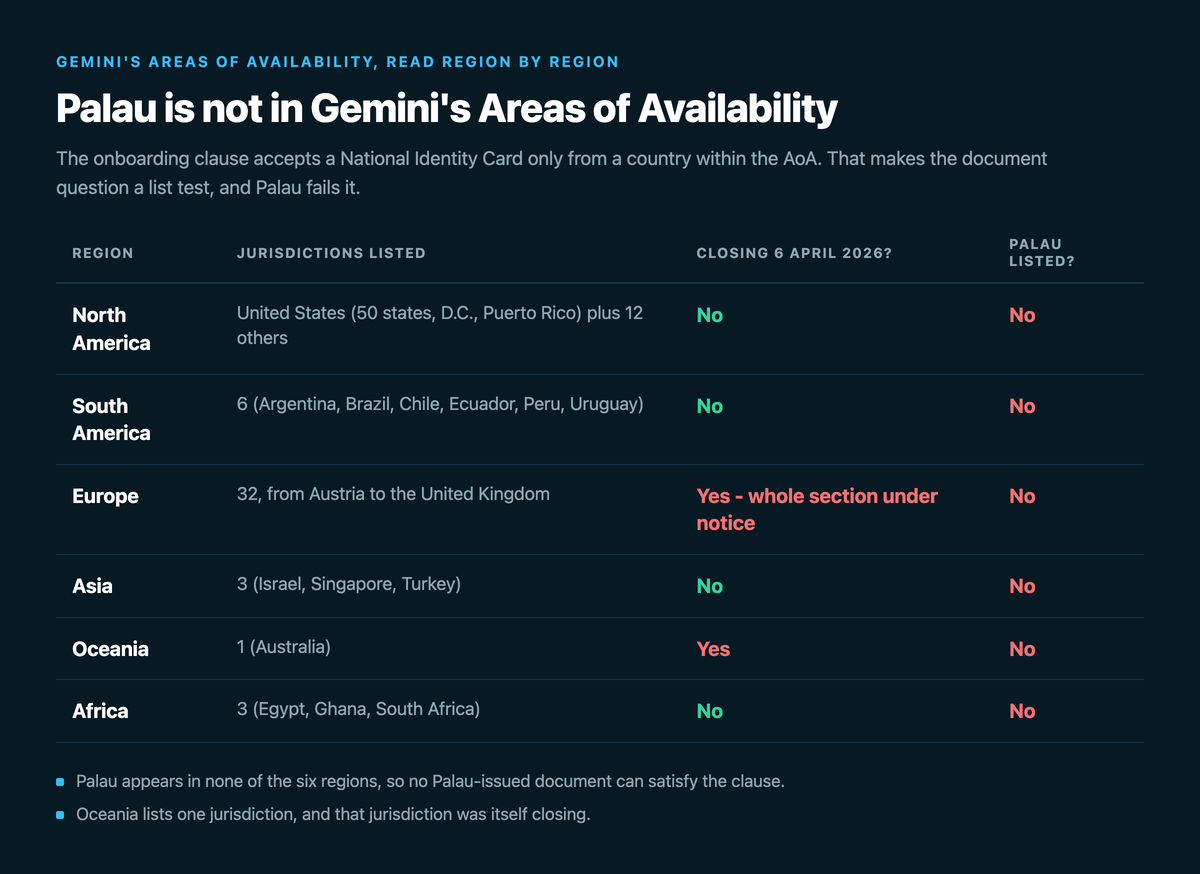
We fetched the page and counted every row. It is headed "Gemini is available in 50+ countries" and breaks into six regions:
| Region | Jurisdictions listed | Closing 6 April 2026? | Palau listed? |
|---|---|---|---|
| North America | United States (50 states, D.C., Puerto Rico) plus 12 others | No | No |
| South America | 6 (Argentina, Brazil, Chile, Ecuador, Peru, Uruguay) | No | No |
| Europe | 32, from Austria to the United Kingdom | Yes — whole section under notice | No |
| Asia | 3 (Israel, Singapore, Turkey) | No | No |
| Oceania | 1 (Australia) | Yes | No |
| Africa | 3 (Egypt, Ghana, South Africa) | No | No |
That is 58 jurisdictions in total, and Palau is in none of them. Nor are the Marshall Islands, Micronesia, Nauru, Kiribati, Tonga, Samoa or Fiji. Gemini's Pacific footprint before April 2026 was Australia and nothing else.
A Palau ID card is, on RNS's own description, a government-issued national identity document from Palau. Since Palau is not a country within the AoA, that card does not satisfy the category Gemini's onboarding page defines. This is a cleaner exclusion than the one at most venues, because it does not depend on a reviewer's judgement about an unfamiliar card — it fails a published list test before a human sees it.
The 6 April 2026 exit removed a third of the list
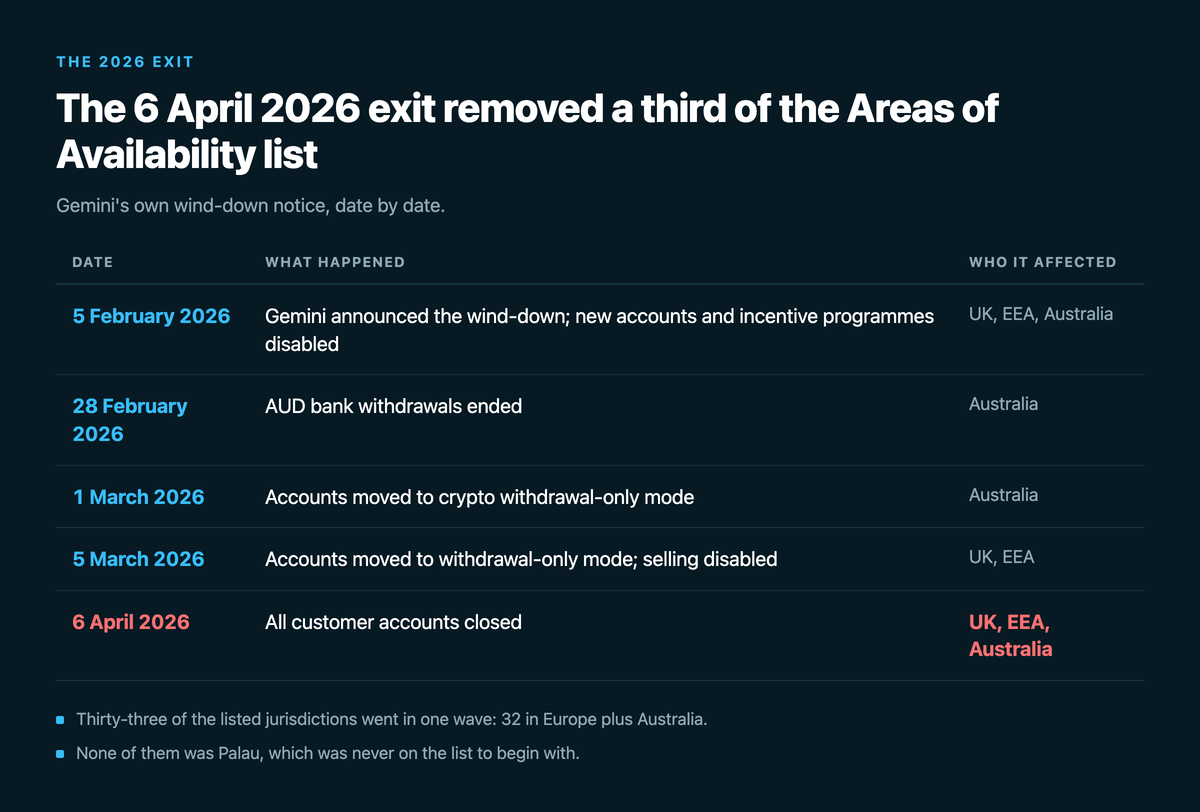
If you are reading this from Europe, there is a second problem sitting on top of the first, and it is the one most guides published before February 2026 do not mention.
| Date | What happened | Who it affected |
|---|---|---|
| 5 February 2026 | Gemini announced the wind-down; new accounts and incentive programmes disabled | UK, EEA, Australia |
| 28 February 2026 | AUD bank withdrawals ended | Australia |
| 1 March 2026 | Accounts moved to crypto withdrawal-only mode | Australia |
| 5 March 2026 | Accounts moved to withdrawal-only mode; selling disabled | UK, EEA |
| 6 April 2026 | All customer accounts closed | UK, EEA, Australia |
Gemini's FAQ puts it in one line: "Effective 6 April 2026, Gemini will close all customer accounts in the United Kingdom, European Economic Area, and Australia." It partnered with eToro to move departing customers, and recommended that balances be withdrawn before the deadline.
Strip those 33 rows out and the Areas of Availability page has roughly 25 live jurisdictions — the United States, twelve Caribbean and Central American markets, six in South America, three in Asia and three in Africa. One detail the page does not resolve: Guernsey and Jersey are Crown Dependencies, in neither the UK nor the EEA, yet both sit under the Europe heading that carries the closure notice. If that is your situation, ask Gemini directly rather than reading the notice either way.
The practical effect for a reader weighing a Palau ID: if you live in the EEA or the UK, Gemini is not an option for you at any price, with any document. Buying a card to satisfy it would be solving the wrong problem.

The Location field: residence, not nationality
At Coinbase the interesting question is which documents your signup country's row happens to list, which is why "sign up on the Palau row" circulates as a tactic. Gemini closes that door explicitly, in a numbered instruction rather than in fine print:
"Ensure in the Location field you select your Country of residence, rather than your Nationality."
Two consequences follow. First, Palau is not selectable as a country of residence in a flow limited to the AoA, so there is no Palau row to sign up on. Second, the non-US document rule in the verification article reads "a national ID or driver's license from your country of residence (as registered with Gemini)" — the document and the Location field are tied together. A card from a country you are not registered as living in does not fit either half of that sentence.
The same onboarding page adds two mechanical rules worth remembering wherever you verify: scans will not be accepted, and you may be asked for both sides of the card. Our guide to photo rejections covers the same ground for the RNS application itself.
What is actually printed on a Palau ID card
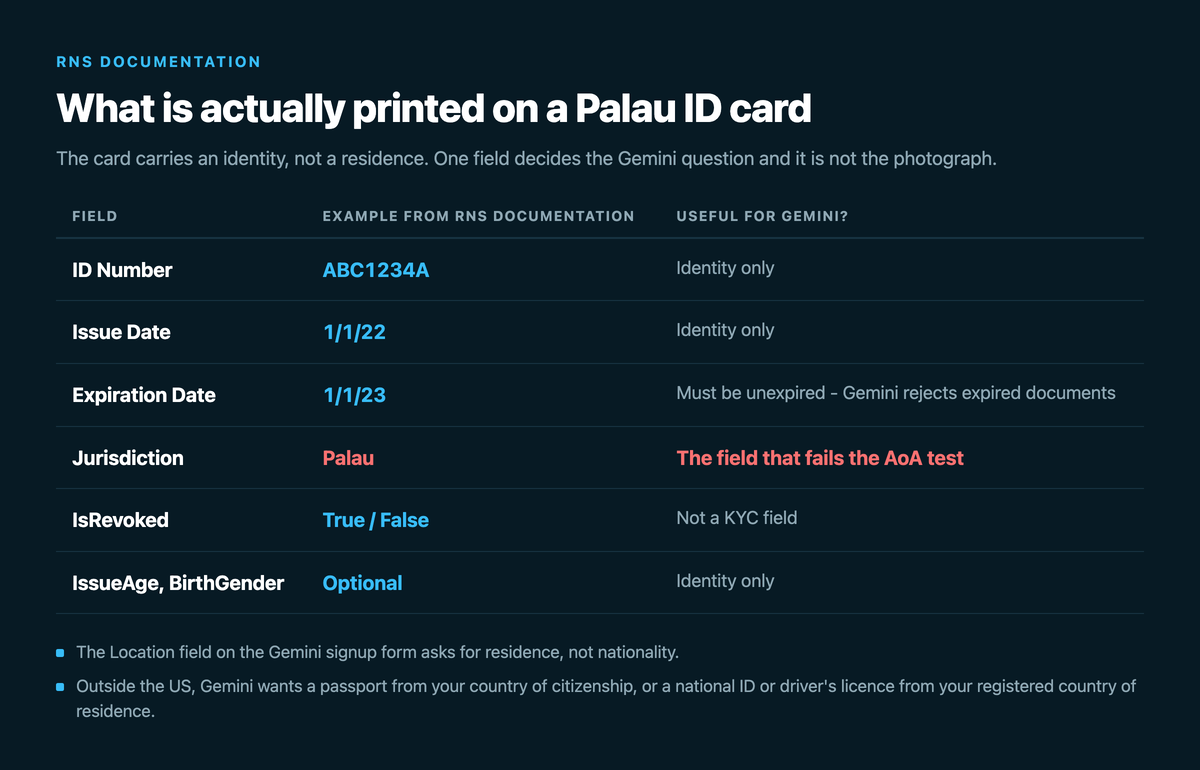
It is worth being concrete about the document, because several of the claims made about it online describe a card that does not exist. RNS's platform documentation lists the printed properties:
| Field | Example from RNS documentation | Useful for Gemini? |
|---|---|---|
| ID Number | ABC1234A | Identity only |
| Issue Date | 1/1/22 | Identity only |
| Expiration Date | 1/1/23 | Must be unexpired — Gemini rejects expired documents |
| Jurisdiction | Palau | The field that fails the AoA test |
| IsRevoked | True / False | Not a KYC field |
| IssueAge, BirthGender | Optional | Identity only |
Note what is absent: there is no residential address on the card. That rules it out as a proof-of-address document anywhere, which is the subject of a persistent myth we unpick in Palau ID proof of address. RNS itself is careful about the boundaries — its FAQs state that digital residency "does not support pathways to citizenship or future Palau passports", and that by Palau's Constitution only Palauans may hold citizenship.
RNS does say members have used the ID for identity verification and KYC at "most of the crypto exchanges, banks/neobanks, and non-bank payment provider". That is a report of member experience, not a guarantee from any exchange, and it is not specific to Gemini.
How Gemini compares with the venues we have checked
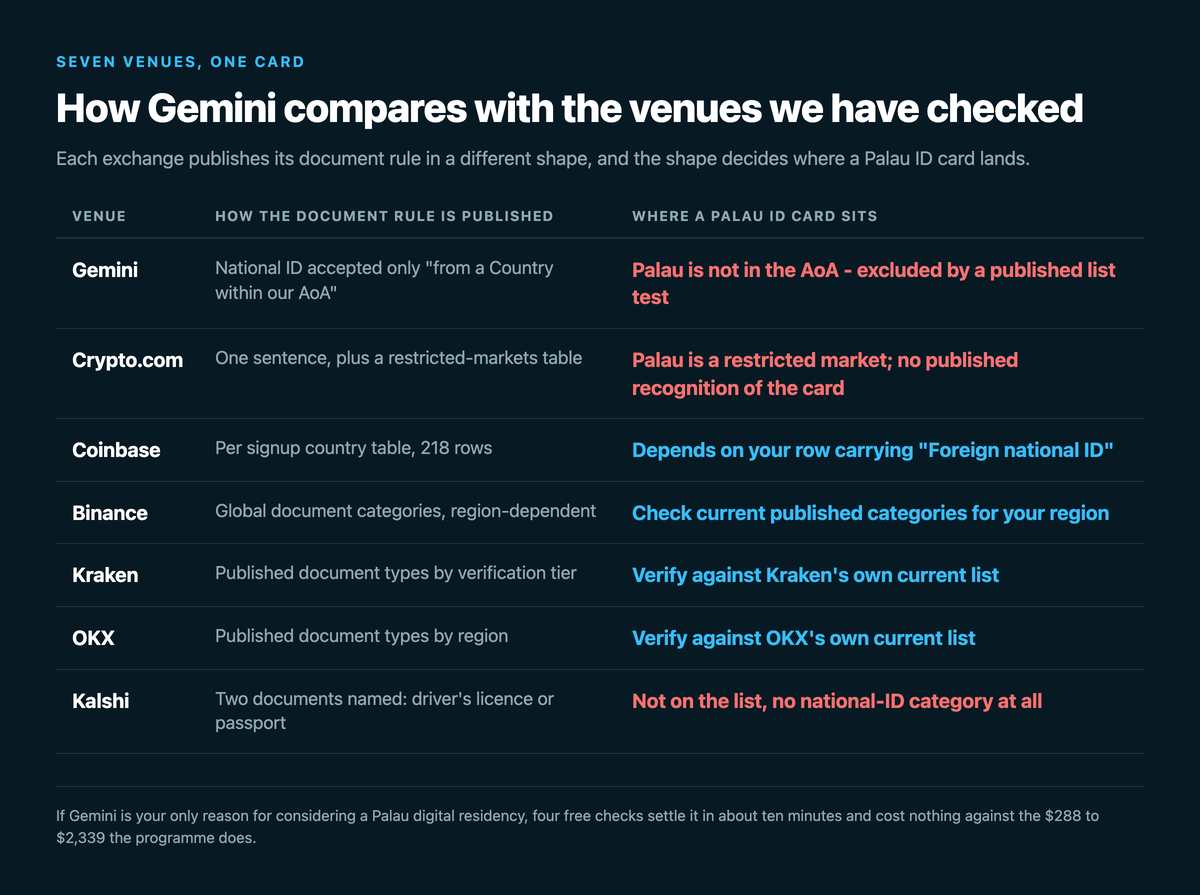
Gemini is not the harshest venue in this comparison. It is the most legible one, which is unusual and, for a buyer, genuinely useful: you can settle the question in advance instead of after paying.
| Venue | How the document rule is published | Where a Palau ID card sits |
|---|---|---|
| Gemini | National ID accepted only "from a Country within our AoA" | Palau is not in the AoA — excluded by a published list test |
| Crypto.com | One sentence, plus a restricted-markets table | Palau is a restricted market; no published recognition of the card |
| Coinbase | Per signup country table, 218 rows | Depends on your row carrying "Foreign national ID" |
| Binance | Global document categories, region-dependent | Check current published categories for your region |
| Kraken | Published document types by verification tier | Verify against Kraken's own current list |
| OKX | Published document types by region | Verify against OKX's own current list |
| Kalshi | Two documents named: driver's licence or passport | Not on the list, no national-ID category at all |
The habit that survives all of these pages is the same one: read the platform's own published list before you buy anything to satisfy it. Our exchange KYC tracker keeps the comparison in one place so you are not re-reading nine help centres, and Palau ID supported exchanges shows how to run the check yourself on a venue we have not covered.
What to check before you spend $288 to $2,339
If Gemini is your reason for considering a Palau digital residency, four free checks will settle it in about ten minutes.
- Open the Areas of Availability page and find your own country. If it is not there, or it sits in the Europe or Oceania section, Gemini is closed to you and no document changes that. Palau is not there either, which answers the document question at the same time.
- Read the onboarding clause, not the summary. "National Identity Card from a Country within our AoA" is the operative sentence, and it is on the Retail Onboarding Instructions page rather than the documents page most people land on.
- Check which document you would actually use. Outside the US that is a passport from your country of citizenship, or a national ID or driver's licence from your registered country of residence. Inside the US it is a state ID, driver's licence, passport or Green Card — all US-issued.
- Check whether Gemini is your only reason. If it is, stop here and keep the money. If it is one of several, the cost breakdown and what the programme does not do are the two pages worth reading before you decide, and US readers should add Palau digital residency for US citizens.
Bottom line
Gemini never says "we do not accept Palau IDs", and it does not need to. It says national identity cards must come from a country within its Areas of Availability, it publishes that list, and Palau is not on it — along with every other Pacific jurisdiction except Australia, which it left on 6 April 2026. The signup flow asks where you live rather than what you hold, so the Palau-row tactic that sometimes works elsewhere has nothing to attach to.
That is a firmer answer than this query usually gets, and it comes entirely from Gemini's own 2026 pages rather than from anyone's summary. If you want the card for other reasons — and there are real ones — that case is unaffected. If you want it for Gemini, the published evidence does not support the purchase.
Related reading
- Palau ID for crypto KYC — the category answer across exchanges
- Does Coinbase accept Palau ID? — the venue that publishes a Palau row
- Does Crypto.com accept Palau ID? — the other venue that restricts Palau outright
- Palau ID supported exchanges — how to research acceptance yourself
- Palau ID proof of address — why an ID card is not an address document
- Palau passport vs digital residency — the distinction most guides get wrong
FAQ
Does Gemini accept a Palau ID in 2026?
Gemini publishes no rule naming Palau IDs either way. What it does publish is an onboarding instruction accepting a "National Identity Card from a Country within our AoA" — its Areas of Availability list — and Palau is not on that list. On Gemini's own published rules a Palau card does not fit the national-ID category, and acceptance is never guaranteed.
Is Palau on Gemini's Areas of Availability list?
No. We counted the page in September 2026: 58 jurisdictions across North America, South America, Europe, Asia, Oceania and Africa, and Palau appears in none of them. The only Oceania entry was Australia, whose accounts Gemini closed on 6 April 2026, so there is now no Pacific jurisdiction on the list at all.
What identity documents does Gemini accept?
For US residents: a state-issued ID, driver's licence, passport or passport card, or a Permanent Resident Card. For everyone else: a passport from your country of citizenship, and/or a national ID or driver's licence from your country of residence as registered with Gemini. A biometric face scan is required in both cases, and expired documents are not accepted.
Can I sign up to Gemini as a resident of Palau?
Not in practice. Gemini's onboarding instructions say to select your country of residence rather than your nationality in the Location field, and the selectable countries are those on the Areas of Availability page, which does not include Palau. The Palau-row tactic that circulates for other exchanges has nothing to attach to here.
Can I use a Palau ID as proof of address on Gemini?
No. RNS's platform documentation lists the printed fields as ID Number, Issue Date, Expiration Date, Jurisdiction and a revocation flag, with optional age and gender — there is no residential address on the card to read. Gemini collects your address separately to meet its own licensing requirements.
Why did Gemini close UK, EEA and Australian accounts?
Gemini's FAQ states that all customer accounts in the United Kingdom, European Economic Area and Australia closed on 6 April 2026, with accounts moving to withdrawal-only mode on 5 March 2026 (1 March for Australian crypto withdrawals). The FAQ sets out the wind-down steps and an eToro transfer partnership; it does not publish a reason beyond the closure itself.
Gemini's help centre says 60+ countries but the list looks shorter — which is right?
Read the list. The help article "Which countries and U.S. states does Gemini support?" says "60+ countries" and was last updated 21 January 2026, before the exit took effect; the Areas of Availability page it points to says "50+" and carries the closure notices. Palau is absent from both, so the discrepancy does not change this answer — but it is a good argument for never trusting a headline count.
If Gemini will not take the card, which exchange should I check next?
Check the venue you actually intend to use, against its own published document list, before buying anything. Our exchange KYC tracker collects what each venue publishes, and Palau ID supported exchanges explains how to run the check yourself. Treat any list of "exchanges that accept Palau ID" that cites no source, including ones that quote member reports, as a starting point rather than an answer.