Kalshi KYC 2026: Which ID Kalshi Actually Accepts
Kalshi KYC names only two documents: a driver's license or a passport. Here is what that means for Palau ID holders and non-US traders in 2026.
We may earn a commission if you apply through this link. This site is independent and is not the official RNS.ID or Palau government site.
Key takeaways
- Kalshi KYC names exactly two documents. Its help centre lists "a valid driver's license" or "a valid passport" for document verification. A national identification card is not on that list, and Kalshi does not publish an exception for one.
- A Palau digital residency card is a national ID card. RNS describes it as a government-issued identification card, not a passport and not a driving document — so on Kalshi's published rules it is the wrong document type, however good the card is elsewhere.
- Kalshi is open to many countries in 2026, not just the US. Its own help centre says you can trade from many countries and that you do not need a US phone number, which makes the widely repeated "non-US residents cannot sign up" claim out of date.
- The address field trips people up more often than the ID does. Kalshi asks for a residential address and says it cannot accept commercial addresses or PO boxes — which rules out using a mail-forwarding address as your address of record.
- Your country of residence is a separate check from your ID. Holding a Palau ID does not make you a resident of Palau, and Kalshi asks you to confirm where you actually live.

The short answer: Kalshi names two documents, and a Palau ID is neither
The question arrives in our inbox in more or less one form: I have a Palau ID, can I verify a Kalshi account with it? The answer, on Kalshi's published rules, is no — and the reason is narrower and more useful than "Kalshi is strict".
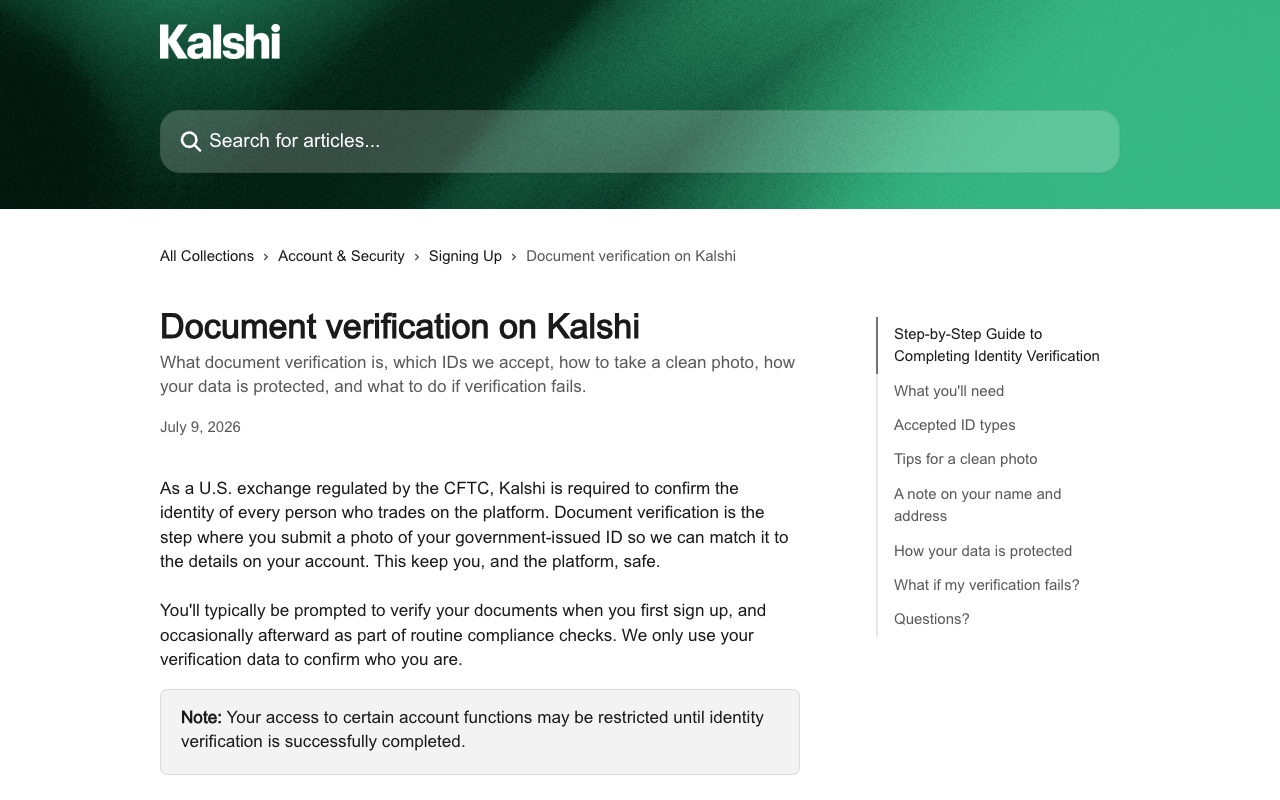
Kalshi's document verification page names the accepted documents in one line: "A valid driver's license" or "A valid passport." There is no third option listed, no national-ID category, and no country-by-country annex. That is unusual. Most crypto exchanges publish a document list three or four items long that includes national identity cards, which is exactly why a Palau ID has any KYC story at all.
We read Kalshi's own help articles on document verification, account information, individual signup and international access, and set them against what RNS actually issues. The gap is a document-type gap, not a country gap — and knowing which one you are facing changes what you should do next.
Nothing here is legal, tax or trading advice, and acceptance varies: platforms change onboarding rules without notice, so treat Kalshi's live signup flow as the authority over any guide, including this one.
What Kalshi asks for before you can trade
Kalshi's verification requirements are short, and every field is a check a Palau ID either speaks to or does not.
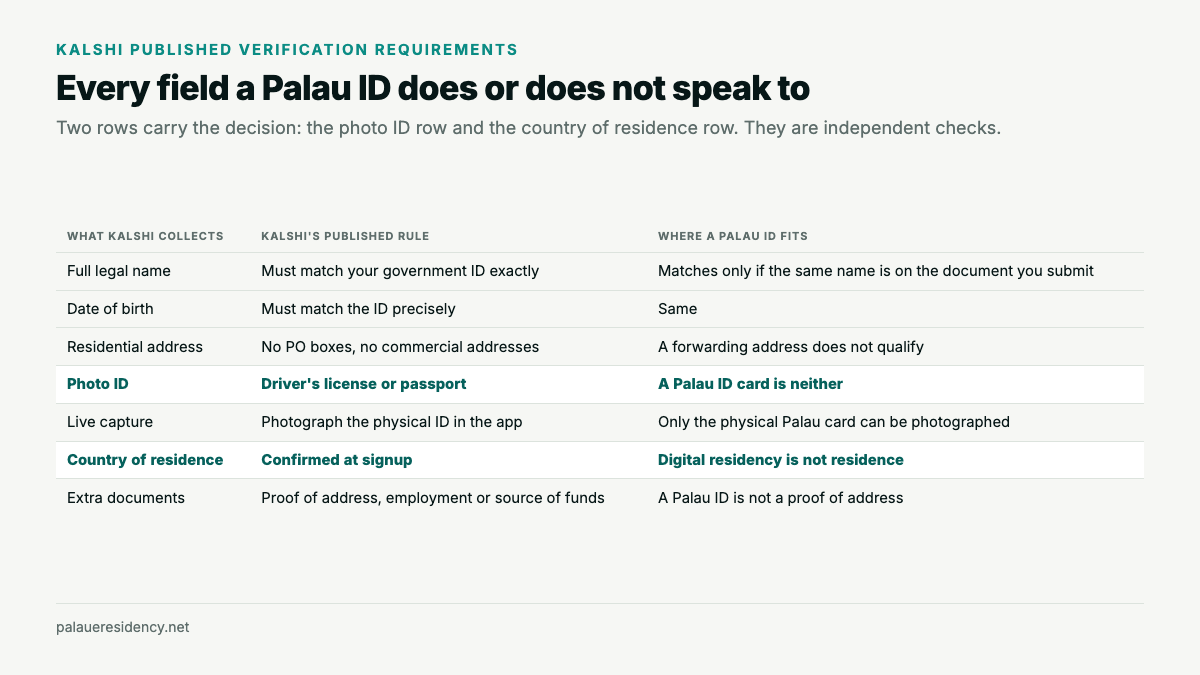
| What Kalshi collects | Kalshi's published rule | Where a Palau ID fits |
|---|---|---|
| Full legal name | Must match your government ID exactly, middle names included | Matches only if the same name is on the document you actually submit |
| Date of birth | Must match the ID precisely | Same |
| Residential address | No PO boxes, no commercial addresses | A forwarding address does not qualify |
| Photo ID | Driver's license or passport | A Palau ID card is neither |
| Live capture | Photograph the physical ID in the app; camera-roll uploads and screenshots are rejected | Only the physical Palau card exists in a form you could photograph |
| Selfie | May be requested in some cases | Not affected by which ID you hold |
| Country of residence | Confirmed at signup | Digital residency is not residence |
| Extra documents | Kalshi notes CFTC rules may require proof of address, employment information or source of funds | A Palau ID is not a proof of address |
Two rows matter more than the rest. The photo ID row decides whether you get through document verification at all, and the country-of-residence row decides whether you should be signing up in the first place. They are independent, and a Palau ID answers neither in your favour.
The document list, and what gets rejected
Kalshi's rejection rules are as specific as its acceptance rules, which is genuinely helpful — most platforms leave you guessing after a failure.
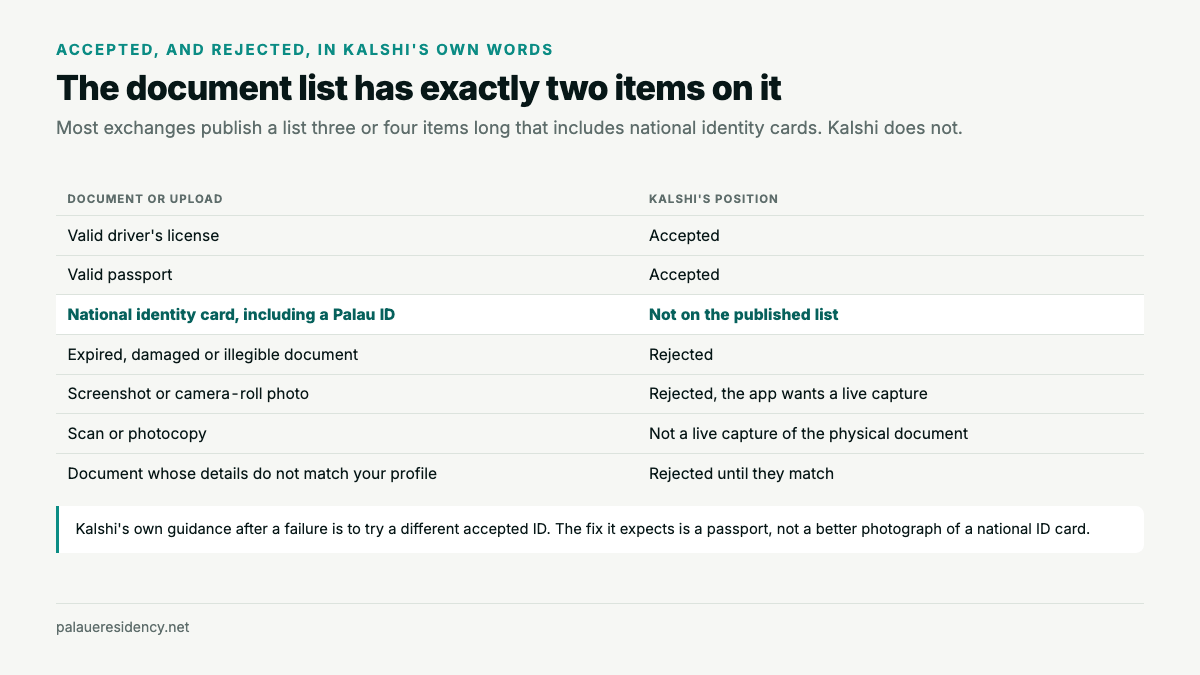
| Document or upload | Kalshi's position |
|---|---|
| Valid driver's license | Accepted |
| Valid passport | Accepted |
| National identity card (including a Palau ID) | Not on the published list |
| Expired, damaged or illegible document | Rejected |
| Screenshot or camera-roll photo | Rejected — the app wants a live capture |
| Scan or photocopy | Not a live capture of the physical document |
| Document whose details do not match your profile | Rejected until they match |
Kalshi's guidance after a failure is to retry in better lighting, try a different accepted ID, confirm the document is valid, and check that your profile details match the document exactly — and it warns that account functions may stay restricted until identity verification succeeds. "Try a different accepted ID" is the load-bearing phrase: the fix Kalshi expects is a passport, not a better photo of a national ID card.
If your Palau card is still in transit and you were hoping to verify with the digital version, that route is closed twice over. RNS is explicit that only the physical copy of the ID can be used for KYC, and Kalshi wants a live photo of a physical document. See what the Palau ID card is and is not before you plan around it.
Trading from outside the US in 2026
Here is where most guides are simply out of date. A large share of the pages ranking for Kalshi signup questions still say that non-US residents cannot open an account and point readers to Polymarket instead. Kalshi's own help centre says something different: "Yes, you can trade on Kalshi from many countries," subject to the terms of its Member Agreement, and no, you do not need a US phone number — though some country codes are unsupported.
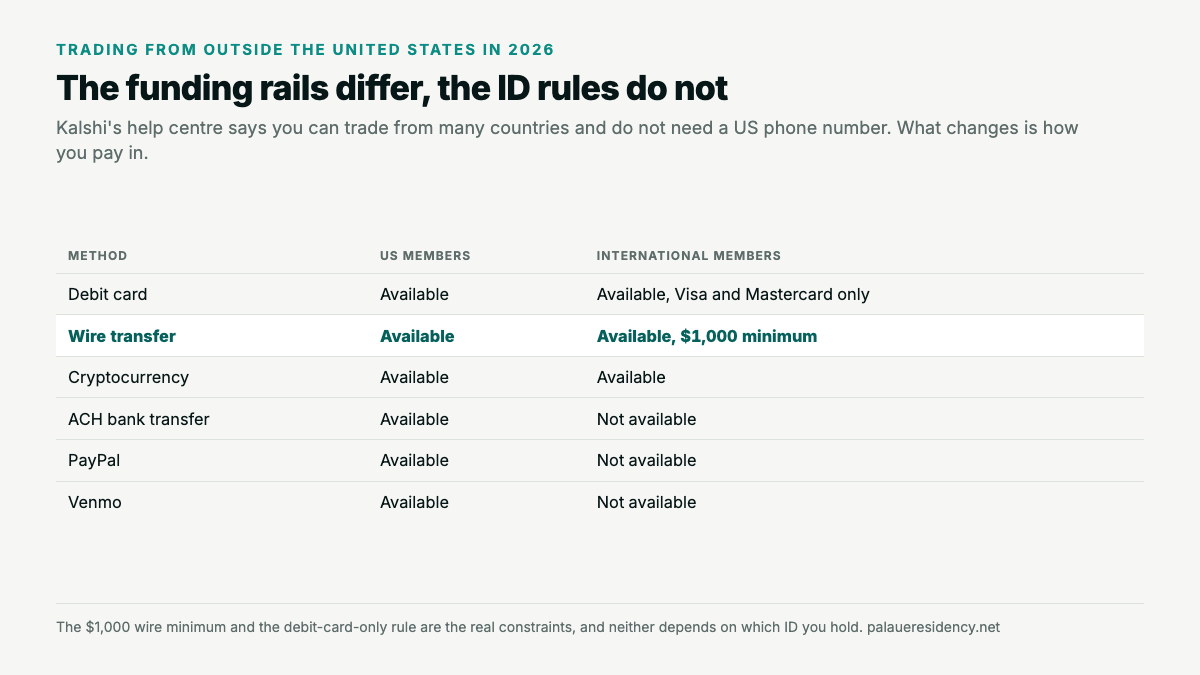
Funding is where the international experience actually differs.
| Method | US members | International members |
|---|---|---|
| Debit card | Available | Available (Visa/Mastercard only) |
| Wire transfer | Available | Available, $1,000 minimum |
| Cryptocurrency | Available | Available |
| ACH bank transfer | Available | Not available |
| PayPal | Available | Not available |
| Venmo | Available | Not available |
The $1,000 wire minimum and the debit-card-only rule are the practical constraints for someone outside the US, and neither is affected by which ID you hold. Kalshi also puts the burden squarely on you: it is your responsibility to make sure your access and use of the exchange is permissible and lawful where you are.
The address field is where Palau digital residents get stuck
A Palau ID comes with an address printed on it, and the temptation is obvious — put the Palau address on the Kalshi profile so the document and the profile agree. That is the wrong move for two reasons, and it is the mistake we see most often.
First, Kalshi asks for a residential address and says plainly that it cannot accept addresses that are commercial in nature or associated with PO boxes. A mail-forwarding or agent address is commercial in nature. Our Palau mailing address guide covers why that kind of address is not a proof of address anywhere, and the same logic applies here.
Second, the address on your account is a statement about where you live, which feeds the country-of-residence check and, downstream, the eligibility question. Putting an address you do not live at on a regulated exchange's account is not a formatting shortcut; it is a false statement to the platform.
The clean version is dull and correct: your real residential address, and a passport as the document. If those two do not currently exist together, that is the problem to solve — not the ID.
Restricted jurisdictions live in the Member Agreement, not in a blog post
Kalshi restricts access from a list of jurisdictions, and it keeps that list in its Member Agreement rather than in a help article. It also reserves the right to change the list. Third-party trackers publish snapshots of it — and those snapshots go stale quickly, which is precisely why we are not reproducing one here.
What matters for planning is the shape of the rule, not today's country count:
- Eligibility follows where you are and where you reside, not the issuer of the card in your wallet.
- The list changes, so a page that was accurate in January can be wrong by September.
- Kalshi's help centre routes every eligibility question back to the Member Agreement, which means the agreement is the only citation worth trusting.
A Palau ID changes none of this. It is not a nationality, it does not relocate you, and it cannot move you off or onto a restricted list. If you have read our Polymarket VPN risk page, the underlying point is the same one: location controls are not a document problem, and trying to solve them with a document is how accounts get frozen.
Kalshi vs Polymarket: where a Palau ID can and cannot help
The two platforms are often mentioned in the same breath, but they check different things in different ways, and a Palau ID lands differently on each.
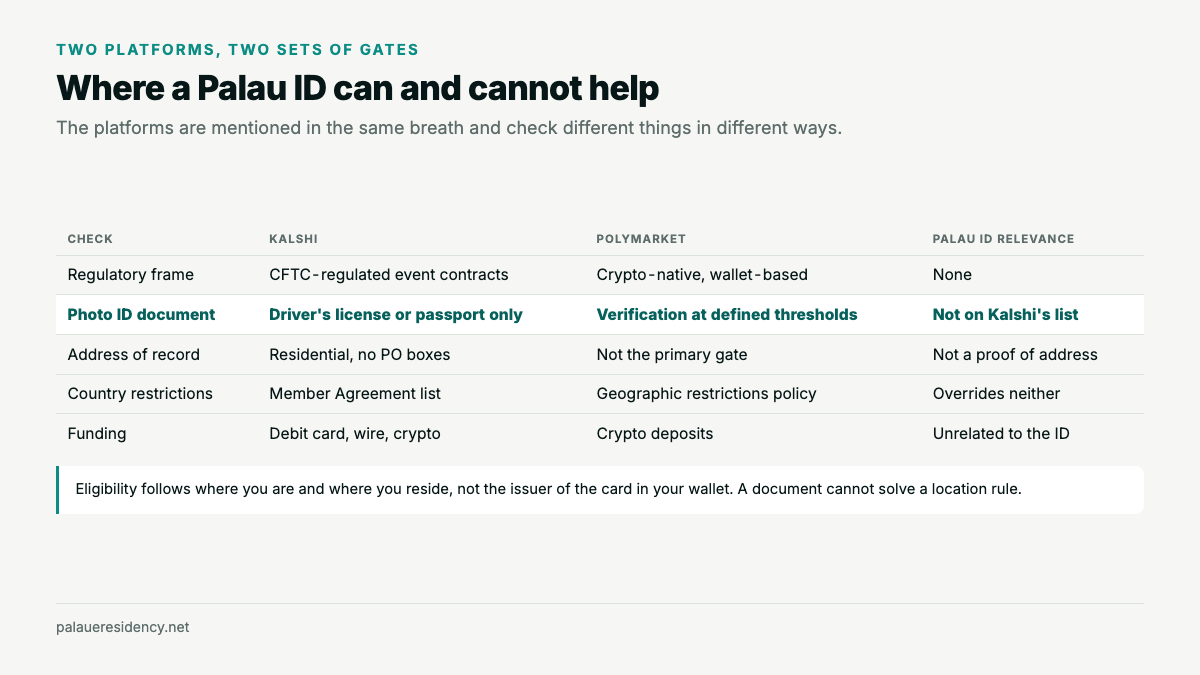
| Check | Kalshi | Polymarket | Palau ID relevance |
|---|---|---|---|
| Regulatory frame | CFTC-regulated event contracts | Crypto-native, wallet-based | None — the ID does not change the frame |
| Photo ID document | Driver's license or passport only | Identity verification at defined thresholds | Not accepted on Kalshi's published list |
| Address of record | Residential address required, no PO boxes | Not the primary gate | ID is not a proof of address either way |
| Country restrictions | Member Agreement list | Geographic restrictions policy | ID does not override either |
| Funding | Debit card, wire, crypto | Crypto deposits | Unrelated to the ID |
For a fuller treatment of the layers a prediction market can check, our prediction market KYC guide walks through identity, age, location, sanctions, wallet and funding as separate gates, and Polymarket KYC covers the other platform's own rules. The CFTC's prediction markets page is worth ten minutes if you have never read a regulator's framing of event contracts.
If a national ID card is the only photo ID you have
This is the honest bind, and it deserves a straight answer rather than a workaround.
If your only government photo ID is a national identity card — Palau's or anyone else's — Kalshi's published document list does not cover you. The routes that exist are ordinary ones: obtain a passport from the country you are a national of, or obtain a driving licence where you live. Neither is fast, and neither is what people want to hear from a page about a card that starts at $288 for one year.
What a Palau ID does do is documented elsewhere on this site, and it is not nothing. RNS members report using it for identity verification with payment processors, marketplaces and crypto platforms, and acceptance varies by platform. Our Palau ID for crypto KYC page covers where that story is strongest. But the limits are real, and Palau digital residency limitations exists because pretending otherwise costs readers money.
The one thing not to do is submit a Palau ID repeatedly to a platform that has published a two-document list, or dress up an address you do not live at to make a profile match. Failed verification attempts and mismatched profiles are exactly what Kalshi's own troubleshooting article tells you to fix.
Bottom line
Kalshi's KYC is unusually narrow on documents and unusually open on geography. It takes a driver's license or a passport, from many countries, at a real residential address — and a Palau digital residency card, whatever else it is good for, is not one of those two documents.
If you are shopping for an ID to unlock a specific platform, check that platform's published document list before you buy anything. That single habit would prevent most of the disappointed emails we receive.
Related reading
- Palau ID and prediction markets — where the ID fits across this category
- Prediction market KYC — the full stack of checks a platform can run
- Polymarket KYC — what the other major venue asks for
- Polymarket supported countries — how geographic restrictions are written
- Palau ID proof of address — why an ID is not an address document
- Palau passport vs digital residency — the passport question, answered directly
FAQ
Does Kalshi accept a Palau ID for verification?
Kalshi's document verification article lists a valid driver's license or a valid passport, and nothing else. A Palau digital residency card is a national identification card, so it is not on that list. Kalshi does not publish an exception process for other document types, and acceptance varies over time, so check the live signup flow before assuming anything has changed.
What ID does Kalshi accept in 2026?
A valid driver's license or a valid passport. Kalshi requires the document to be government-issued, unexpired, undamaged, legible and to show a photo of you, with the details matching your profile exactly.
Can I upload a photo of my ID from my camera roll?
No. Kalshi asks you to photograph your physical ID live through the app, and it rejects screenshots and camera-roll uploads. In some cases it may also ask for a live selfie.
Can non-US residents use Kalshi?
Kalshi's help centre says you can trade from many countries, subject to its Member Agreement, and that a US phone number is not required — though some country codes are unsupported. Restricted jurisdictions are listed in the Member Agreement, which Kalshi can update, so that document is the only reliable source.
Does Kalshi need a proof of address?
Kalshi collects a residential address but does not require a separate proof-of-address document as standard. It notes that CFTC requirements may lead it to request extra documents such as proof of address, employment information or source of funds.
Can I use a Palau mailing address on my Kalshi account?
No. Kalshi says it cannot accept addresses that are commercial in nature or associated with PO boxes, and a mail-forwarding address falls into that category. The address on your account should be where you actually live.
Does holding a Palau ID make me a resident of Palau for Kalshi's purposes?
No. Palau digital residency is an identity product, not a change of residence, and it does not support a pathway to citizenship or a Palau passport. Kalshi asks you to confirm your country of residence separately from your ID.
What happens if my Kalshi verification fails?
Kalshi suggests retrying with better lighting or a different accepted ID, confirming the document is valid and unexpired, and checking that your profile details match it exactly. If it still fails, its guidance is to contact support. Some account functions can stay restricted until verification succeeds.