Does Crypto.com Accept Palau ID? 2026 KYC Rules
Crypto.com lists Palau on its own restricted-markets table. We read its 2026 KYC, ID and proof-of-address pages to find where a Palau ID still fits.
We may earn a commission if you apply through this link. This site is independent and is not the official RNS.ID or Palau government site.
Key takeaways
- Palau is on Crypto.com's own restricted list. Its App Geo-Restrictions page opens "People from the following locations are restricted from using the Crypto.com App", and Palau sits in that table with the country code PW / PLW. So the one route that works at Coinbase — signing up on Palau's own country row — is closed here before any document question arises.
- Nine other Pacific micro-states are restricted alongside it: the Cook Islands, Kiribati, the Marshall Islands, Micronesia, Nauru, Samoa, Tonga, Tuvalu and Wallis and Futuna. Fiji is the Pacific exception, and it is the one that appears on Crypto.com's available-regions lists.
- Crypto.com publishes far less than Coinbase. There is no per-country document table. The rule is one sentence: your passport is best, and "a National ID or a Driving License will usually suffice" — with US citizens and residents required to use a state-issued licence or ID.
- Its proof-of-address list is the only one in this niche that names a government ID — but the document must be "under your name", show a residential address, and have been issued within 6 months (3 months for the UK and Turkey). A Palau ID card fails on the address and usually on the date too.
- The card carries no address at all. RNS's own platform documentation lists the printed fields as ID Number, Issue Date, Expiration Date and Jurisdiction, with optional age and gender. There is no residential address on it to read.
On this page
- The short answer, and the table nobody else quotes
- What Crypto.com actually publishes about documents
- Palau is on Crypto.com's restricted-markets table
- The document rule: passport first, national ID "usually"
- Proof of address: the one list that names a government ID
- What is actually printed on a Palau ID card
- How Crypto.com compares with the venues we have checked
- What to check before you spend $288 to $2,339
- Bottom line
- Related reading
- FAQ
The short answer, and the table nobody else quotes
Ask does Crypto.com accept Palau ID and you will find three or four pages that answer with a confident no and cite nothing at all — usually on the way to selling you a second passport instead. We went looking for the source behind that claim and could not find one, so we read Crypto.com's own 2026 help documentation instead: the KYC article, the Exchange verification walkthrough, the proof-of-address rules and the geo-restrictions table.
The stakes justify the reading. A Palau digital residency costs $288 for the one-year trial, $1,199 for five years and $2,339 for ten, per RNS's published pricing, and a large share of buyers are buying it for exactly one purpose: to clear an exchange's identity check.
Here is what we found, and it is more specific than a yes or a no. Crypto.com restricts Palau as a market outright, which removes the single path that works at Coinbase. For everyone else, the question narrows to one dropdown and one sentence of published policy — and then to a proof-of-address rule that is unusually generous on paper and unusually hard to satisfy with this card. We pulled the restricted-markets table and counted the rows rather than trusting anyone's summary of it.
Nothing here is legal, tax or financial advice, and acceptance varies. Crypto.com changes onboarding rules without notice, and its live signup flow is the authority over any guide, this one included.
What Crypto.com actually publishes about documents
Coinbase gives you a 218-row country table. Crypto.com gives you four short help articles and a dropdown, which is why so much of the writing on this query is guesswork. Knowing which page says what is most of the work.
| Crypto.com help page | Product it covers | What it actually gives you |
|---|---|---|
| All About: KYC verification | Crypto.com App | The one-sentence document rule, the US carve-out, and what happens after submission |
| Account Verification | Crypto.com Exchange | The three-step flow, including the "issuing country of your ID" selector |
| Proof of address documents | Address verification | The four accepted document categories and the 6-month recency rule |
| Crypto.com App Geo-Restrictions | Crypto.com App | The full list of markets that cannot use the App — including Palau |
Two of those pages carry 2026 dates, which matters in a niche where most competing articles are quoting rules from two years ago. The KYC article was updated 15 May 2026 and the Exchange verification page 20 July 2026. The proof-of-address page is older, dated 11 December 2024, and is still the current published version.
Read them in that order and the answer assembles itself. It is worth noting what is not there: no per-country document list, no statement about foreign national IDs, and no mention of Palau outside the restrictions table.
Palau is on Crypto.com's restricted-markets table
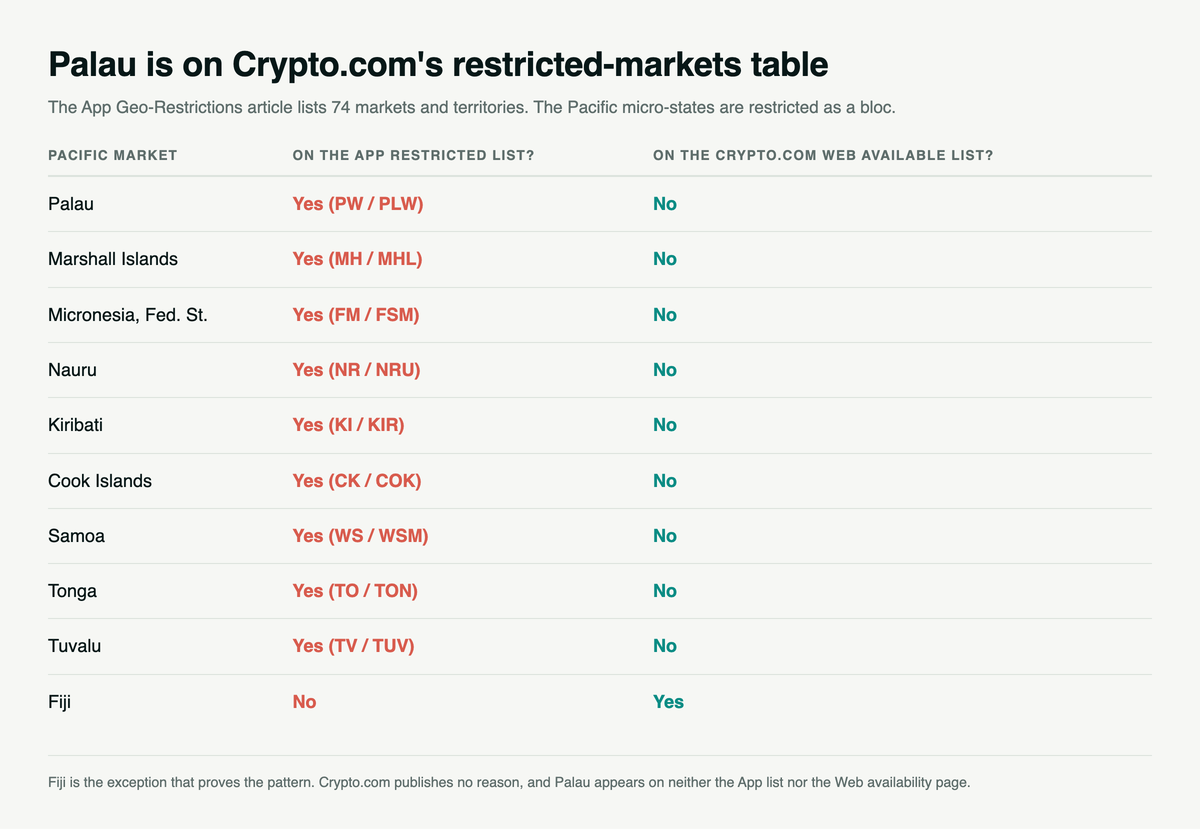
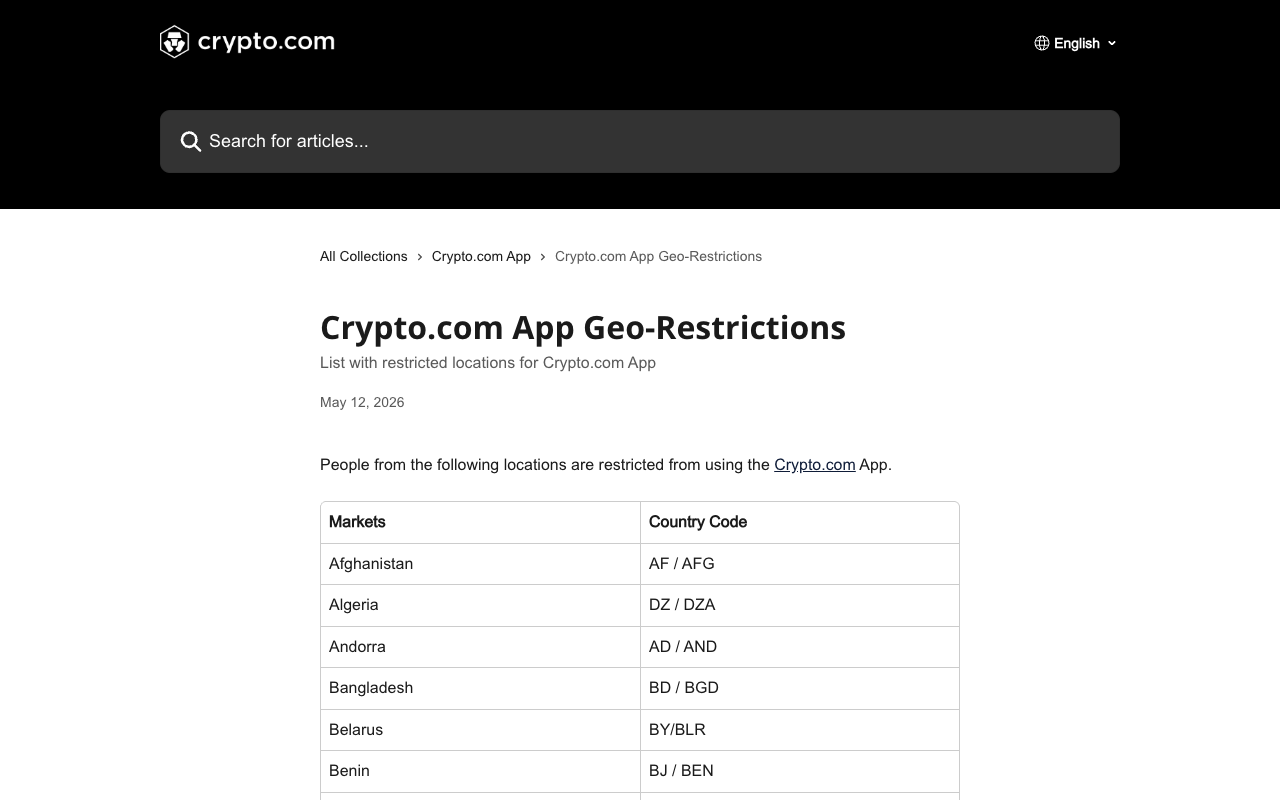
This is the finding that decides the page, and we have not seen it cited anywhere else. Crypto.com's App Geo-Restrictions article opens with a single sentence — "People from the following locations are restricted from using the Crypto.com App." — followed by a table of 74 markets and territories, plus New York State and a note covering occupied regions of Ukraine.
Palau is in that table, listed with the country code PW / PLW.
That matters more than it first appears. On Coinbase, Palau has its own row in the country table, and "National identity card" sits in it — which is the closest thing to a yes that any major exchange publishes for this card. At Crypto.com that route does not exist, because the market itself is blocked. And Palau is not alone.
| Pacific market | On Crypto.com's App restricted list? | On the Crypto.com Web available list? |
|---|---|---|
| Palau | Yes (PW / PLW) | No |
| Marshall Islands | Yes (MH / MHL) | No |
| Micronesia, Fed. St. | Yes (FM / FSM) | No |
| Nauru | Yes (NR / NRU) | No |
| Kiribati | Yes (KI / KIR) | No |
| Cook Islands | Yes (CK / COK) | No |
| Samoa | Yes (WS / WSM) | No |
| Tonga | Yes (TO / TON) | No |
| Tuvalu | Yes (TV / TUV) | No |
| Fiji | No | Yes |
The pattern is a regional one rather than anything aimed at digital residency: the Pacific micro-states are restricted as a bloc, and Fiji is the exception that proves it. Crypto.com does not publish a reason, and we will not invent one.
One precision worth keeping. That table is headed "Crypto.com App", so it is evidence about the App specifically. The Exchange and Web products publish their own availability lists, and Palau does not appear on those either — its Web availability page names Fiji among the supported regions and omits Palau entirely.
The document rule: passport first, national ID "usually"
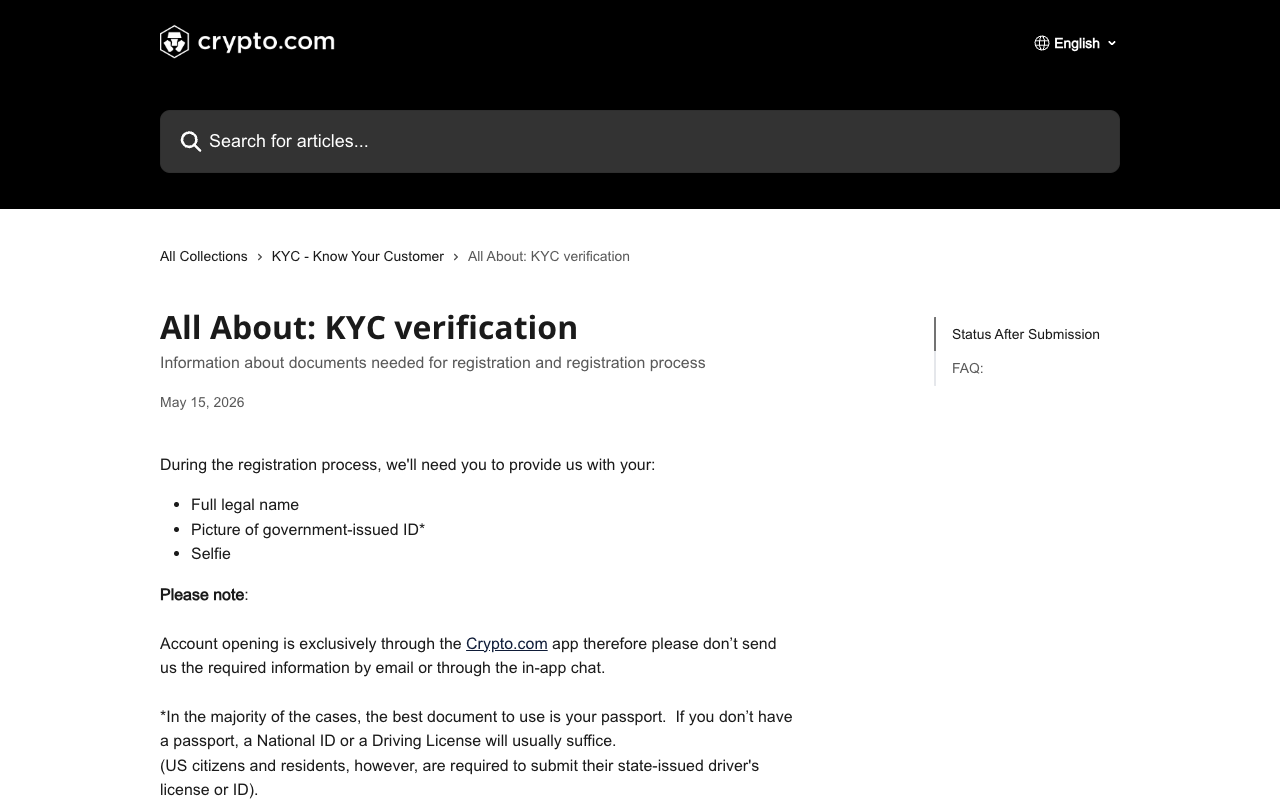
Set the market question aside and assume you live somewhere Crypto.com serves. You are now asking whether a Palau-issued card can go into the ID slot. Crypto.com answers that in one footnote, repeated across both help articles:
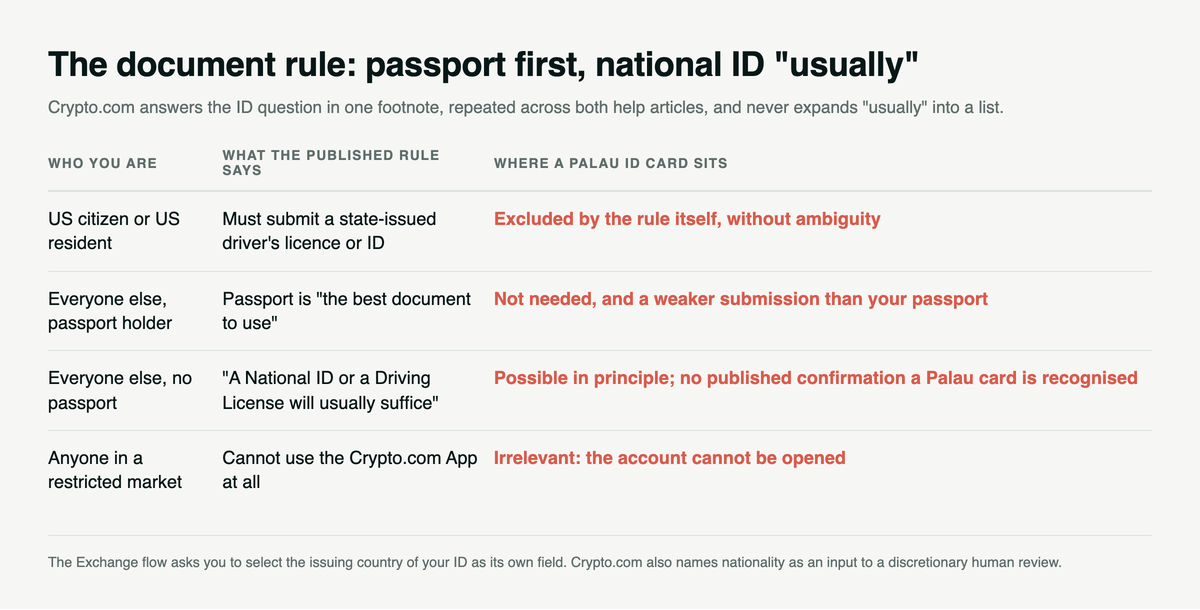
In the majority of the cases, the best document to use is your passport. If you don't have a passport, a National ID or a Driving License will usually suffice. (US citizens and residents, however, are required to submit their state-issued driver's license or ID).
"Usually" is doing a lot of work there, and Crypto.com never expands it into a list.
| Who you are | What Crypto.com's published rule says | Where a Palau ID card sits |
|---|---|---|
| US citizen or US resident | Must submit a state-issued driver's licence or ID | Excluded by the rule itself, without ambiguity |
| Everyone else, passport holder | Passport is "the best document to use" | Not needed, and a weaker submission than your passport |
| Everyone else, no passport | "A National ID or a Driving License will usually suffice" | Possible in principle; no published confirmation that a Palau card is recognised |
| Anyone in a restricted market | Cannot use the Crypto.com App at all | Irrelevant — the account cannot be opened |
The Exchange flow adds one useful detail the App article omits. Step 2 asks you to "Select the issuing country of your ID" and then the ID type, which means the issuing country is a field you fill in, separate from where you live. If Palau is not in that selector, the question ends there. If it is, you have still only reached the point where a human reviewer looks at the file.
Crypto.com is candid that the review is discretionary. It says a decision can take "anywhere from a few hours to a couple of business days, depending on many factors (e.g. your country of application, nationality, quality of the pictures, etc.)". Nationality is named as a review input, and a digital residency does not change yours — the same trap the country-of-residence field sets elsewhere.
Proof of address: the one list that names a government ID
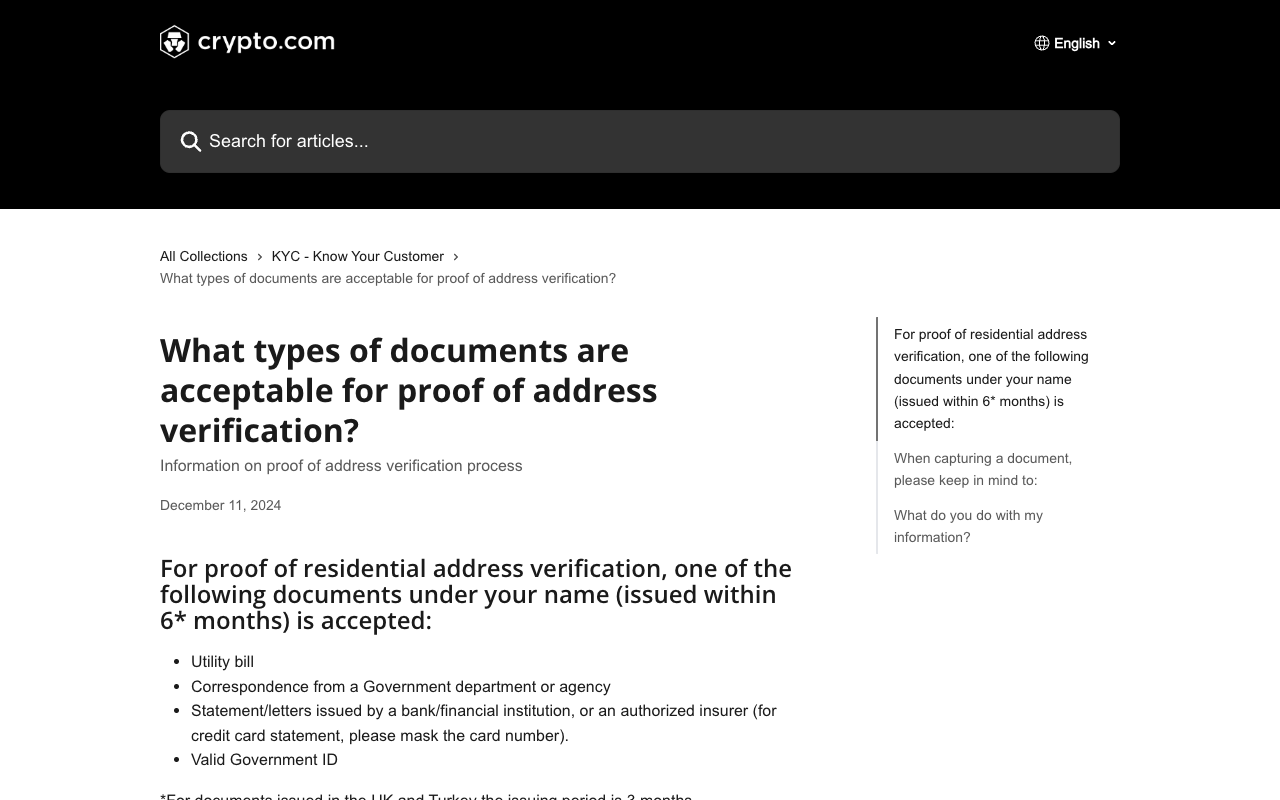
Here is where Crypto.com is genuinely different, and where a careless reader could talk themselves into a purchase. Most exchanges accept only bank statements, card statements and utility bills as proof of address. Crypto.com's published list has four entries, and the fourth is a government ID.
| Crypto.com's proof-of-address rule | Detail as published |
|---|---|
| Accepted documents | Utility bill; correspondence from a government department or agency; statement or letter from a bank, financial institution or authorised insurer; valid government ID |
| Whose name | The document must be "under your name" |
| What it must show | Your residential address — the page is headed "proof of residential address verification" |
| Recency | Issued within 6 months; 3 months for documents issued in the UK and Turkey |
| Capture rules | All four corners visible, portrait orientation, unaltered except for masking card or account numbers |
| Card statements | Card number must be masked |
So the category exists. The problem is that the card cannot fill it. Two published requirements block it, and either one is enough on its own: the document has to display your residential address, and it has to be six months old or newer. A ten-year Palau card bought in 2024 fails the second test in 2026 even if it somehow passed the first.
RNS is clear on the underlying point too. Its FAQs state that the mailing address service "is not a Proof of Address and may not satisfy specific verification requirements", and add that no refunds are issued over address-verification complaints. Our proof of address guide covers that in full, and the Palau mailing address page explains why a forwarding address is not where you live.
What is actually printed on a Palau ID card
It is worth being concrete about the document itself, because most of the argument on this topic happens without anyone checking what the card contains.
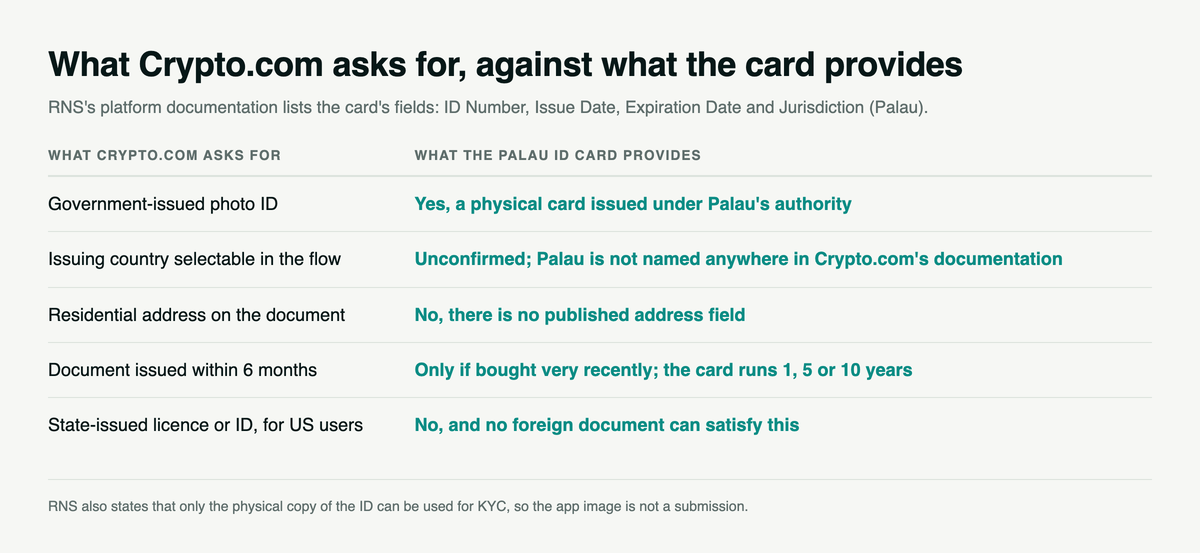
RNS's platform documentation lists the fields the ID carries: ID Number, Issue Date, Expiration Date and Jurisdiction (Palau), with optional issue-age and birth-gender attributes on the on-chain version. That is an identity credential, and it is a reasonable one. It is not an address document, and it was never built as one.
| What Crypto.com asks for | What the Palau ID card provides |
|---|---|
| Government-issued photo ID | Yes — a physical card issued under Palau's authority |
| Issuing country selectable in the flow | Unconfirmed; Palau is not named anywhere in Crypto.com's documentation |
| Residential address on the document | No — no address field is published |
| Document issued within 6 months | Only if bought very recently; the card runs 1, 5 or 10 years |
| State-issued licence or ID, for US users | No — and no foreign document can satisfy this |
RNS also states plainly that "Only the physical copy of your ID can be used for KYC", so the app image is not a submission. We cover that distinction on physical vs digital Palau ID for KYC. And on the bigger question, RNS is unambiguous: "Digital residency does not support pathways to citizenship or future Palau passports."
How Crypto.com compares with the venues we have checked
Crypto.com is not the strictest venue in this comparison. It is the least transparent one, which is a different problem and arguably a worse one for a buyer trying to make a decision in advance.
| Venue | How the document rule is published | Where a Palau ID card sits |
|---|---|---|
| Crypto.com | One sentence, plus a restricted-markets table | Palau is a restricted market; no published recognition of the card |
| Coinbase | Per signup country table, 218 rows | Depends on your row carrying "Foreign national ID" |
| Binance | Global document categories, region-dependent | Check current published categories for your region |
| Kraken | Published document types by verification tier | Verify against Kraken's own current list |
| OKX | Published document types by region | Verify against OKX's own current list |
| Kalshi | Two documents named: driver's licence or passport | Not on the list, no national-ID category at all |
The habit that survives every one of these pages is the same: read the platform's own published list before you buy anything to satisfy it. Our exchange KYC tracker keeps the comparison in one place so you are not re-reading six help centres.
What to check before you spend $288 to $2,339
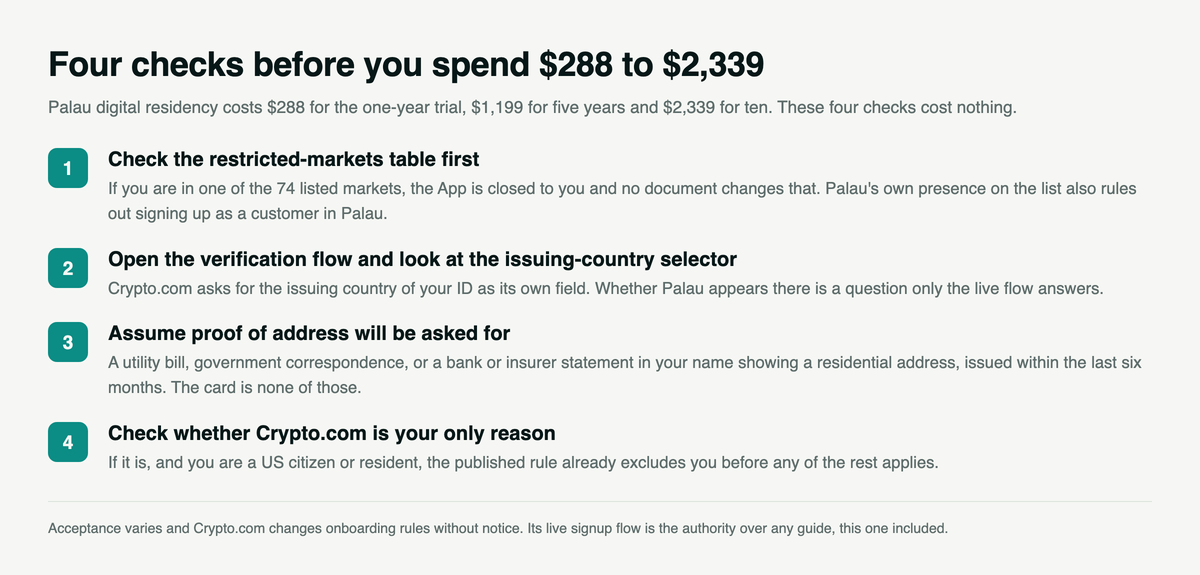
If Crypto.com is your reason for buying a Palau digital residency, four checks will settle it, and they cost nothing.
- Check the restricted-markets table first. If you are in one of the 74 listed markets, the App is closed to you and no document changes that. Palau's presence on that list also means signing up "as a customer in Palau" is not an available workaround.
- Open the verification flow and look at the issuing-country selector. Crypto.com asks for the issuing country of your ID as its own field. Whether Palau appears there is a question only the live flow answers.
- Assume proof of address will be asked for. You need a utility bill, government correspondence, or a bank or insurer statement in your name showing your residential address, issued within the last six months. The card is none of those.
- Check whether Crypto.com is your only reason. If it is, and you are a US citizen or resident, the published rule already excludes you — read Palau digital residency for US citizens before spending anything. The cost breakdown is worth a look either way.
Bottom line
Crypto.com never says "we do not accept Palau IDs", because Crypto.com barely says anything about documents at all. What it does publish is a restricted-markets table with Palau in it, a one-line document rule that puts your passport first and excludes foreign documents entirely for US users, and a proof-of-address list whose government-ID entry the card cannot satisfy on either the address requirement or the six-month recency rule.
Put together, that is the least promising picture of any major venue we have examined, and it is built entirely from Crypto.com's own pages rather than from anyone's summary. If you want the card for other reasons, fine. If you want it for Crypto.com, the published evidence does not support the purchase.
Related reading
- Palau ID for crypto KYC — the category answer across exchanges
- Does Coinbase accept Palau ID? — the venue that publishes a Palau row
- Palau ID supported exchanges — how to research acceptance yourself
- Palau ID proof of address — why an ID is not an address document
- Palau digital residency limitations — what the programme does not guarantee
- Palau passport vs digital residency — the distinction most guides get wrong
FAQ
Does Crypto.com accept a Palau ID in 2026?
Crypto.com publishes no rule naming Palau IDs either way. What it does publish is a restricted-markets table that includes Palau, and a document rule that puts your passport first and says a national ID "will usually suffice" for everyone except US citizens and residents, who must use a state-issued licence or ID. Nothing in its documentation confirms that a Palau digital residency card is recognised, and acceptance is never guaranteed.
Why is Palau on Crypto.com's restricted list?
Crypto.com does not publish a reason. Its App Geo-Restrictions page simply lists 74 markets and territories, plus New York State, under the line "People from the following locations are restricted from using the Crypto.com App". Palau appears there with the code PW / PLW, alongside nine other Pacific micro-states including the Marshall Islands, Micronesia, Nauru, Kiribati and Tonga.
Can I use a Palau ID as proof of address on Crypto.com?
No, in practice. Crypto.com's proof-of-address list does include "valid government ID", which is unusual, but the same page requires the document to be under your name, to show your residential address, and to have been issued within the last 6 months — 3 months for documents issued in the UK or Turkey. A Palau ID card carries no residential address, and a card bought more than six months ago fails the recency rule regardless.
What identity documents does Crypto.com accept?
Crypto.com names three categories and ranks them: a passport is "the best document to use", and failing that "a National ID or a Driving License will usually suffice". US citizens and residents are required to submit a state-issued driver's licence or ID. The Exchange flow additionally asks you to select the issuing country of your ID before the document type.
Does a Palau digital residency make me a resident of Palau for Crypto.com?
No. RNS describes the product as a government-issued identification card and states that digital residency does not support pathways to citizenship or future Palau passports. Crypto.com asks for your country separately from your document, that field should reflect where you actually live, and its own help pages name nationality as a factor in how an application is reviewed.
Is the Crypto.com App restriction the same as the Exchange and Web restrictions?
Not necessarily. The table we quote is headed "Crypto.com App Geo-Restrictions", so it is evidence about the App. The Exchange and Web products maintain separate availability lists, and Palau does not appear on the Web available-regions list either. Fiji is the only Pacific market that appears on Crypto.com's supported lists.
My Crypto.com verification keeps failing — is the document type the reason?
Not necessarily. Crypto.com's guidance covers image quality first: a well-lit environment, all four corners of the document visible, no reflections, portrait orientation, and a name typed exactly as it appears on the ID. It also notes that failing electronic ID verification twice routes you to a manual ID scan, and that you should contact in-app support if your status has not changed within three business days.
What should I do if Crypto.com will not take the card?
Use a document its published rule does list — your own country's passport, national ID or driving licence — and treat the Palau card as unrelated to that account. If Crypto.com was the only reason you were considering a digital residency, its restricted-markets table and its document rule are your answer, and buying the card will not change either one.