Does eToro Accept Palau ID? 2026 KYC Rules
eToro accepts any government-issued ID, so the Palau card clears that bar. Its proof-of-address rule is the one that stops you. We read the 2026 rules.
We may earn a commission if you apply through this link. This site is independent and is not the official RNS.ID or Palau government site.
Key takeaways
- eToro's document rule is the most permissive we have read. Its verification page says a passport is preferred, and then: "Alternatively, you can use a driving license or any other government-issued ID." There is no country list attached to that sentence, which makes eToro the opposite of Gemini, where a Palau card fails a published list test before a human sees it.
- The proof of address is where it actually breaks. eToro requires a separate POA document "no older than 3 months", from a list of eight document types — bank statements, utility bills, council tax, municipality letters. A Palau ID card carries no address field at all, and RNS says plainly that its mailing address "is not a Proof of Address".
- eToro has no Areas of Availability page. We went looking for the equivalent of Gemini's list and there isn't one. What eToro publishes instead is twelve regulated entities, and which one you get is decided by where you live — including a "rest of world" entity, eToro (Seychelles) Ltd, licence SD076.
- This is the venue Gemini handed its leavers to. Gemini closed every UK, EEA and Australian account on 6 April 2026 and partnered with eToro to move them, so a large share of people asking this question in 2026 arrived from a Gemini closure email.
- Two documents, two different jobs. The Palau card is plausibly usable for the identity half and cannot do the address half. Anyone selling it to you as an eToro solution is quoting one half of the requirement — and acceptance varies regardless, because eToro decides each account itself.
On this page
- Does eToro accept Palau ID? The short answer
- What eToro actually publishes about identity documents
- The proof of address is what stops a Palau ID, not the card
- eToro has no availability list — it has twelve entities
- Why Gemini's 2026 exit sends Palau ID buyers to eToro
- What is actually printed on a Palau ID card
- How eToro compares with the venues we have checked
- What to check before you spend $288 to $2,339
- Bottom line
- Related reading
- FAQ
Does eToro accept Palau ID? The short answer
Search does eToro accept Palau ID and you get nothing written about eToro. You get general Palau-KYC pages that name five crypto exchanges and stop, and you get citizenship-by-investment vendors who answer the question by recommending a $200,000 passport. Not one of them quotes eToro's own documentation, because not one of them has read it.

That gap matters more than usual here, because the decision costs real money. A Palau digital residency is $288 for the one-year trial, $1,199 for five years and $2,339 for ten, on RNS's published pricing, and a large share of buyers are buying it to clear exactly one verification screen. Getting this wrong is a four-figure mistake made on the strength of a forum post.
So we read eToro's verification page, its regulation page and its document rules, and the answer that came back is genuinely two-sided — which is rarer in this niche than either a yes or a no. eToro's identity rule is broad enough that a Palau card plausibly fits it. Its address rule is the one a Palau card cannot satisfy, and almost nobody discussing this has noticed that eToro asks for two documents rather than one.
Nothing here is legal, tax or financial advice, and acceptance varies: eToro verifies each account individually, changes its rules without notice, and its live signup flow is the authority over any guide, this one included.
What eToro actually publishes about identity documents
Gemini buries the decisive clause in an onboarding walkthrough. eToro does the opposite — it puts the whole rule on one customer-service page and keeps it short.
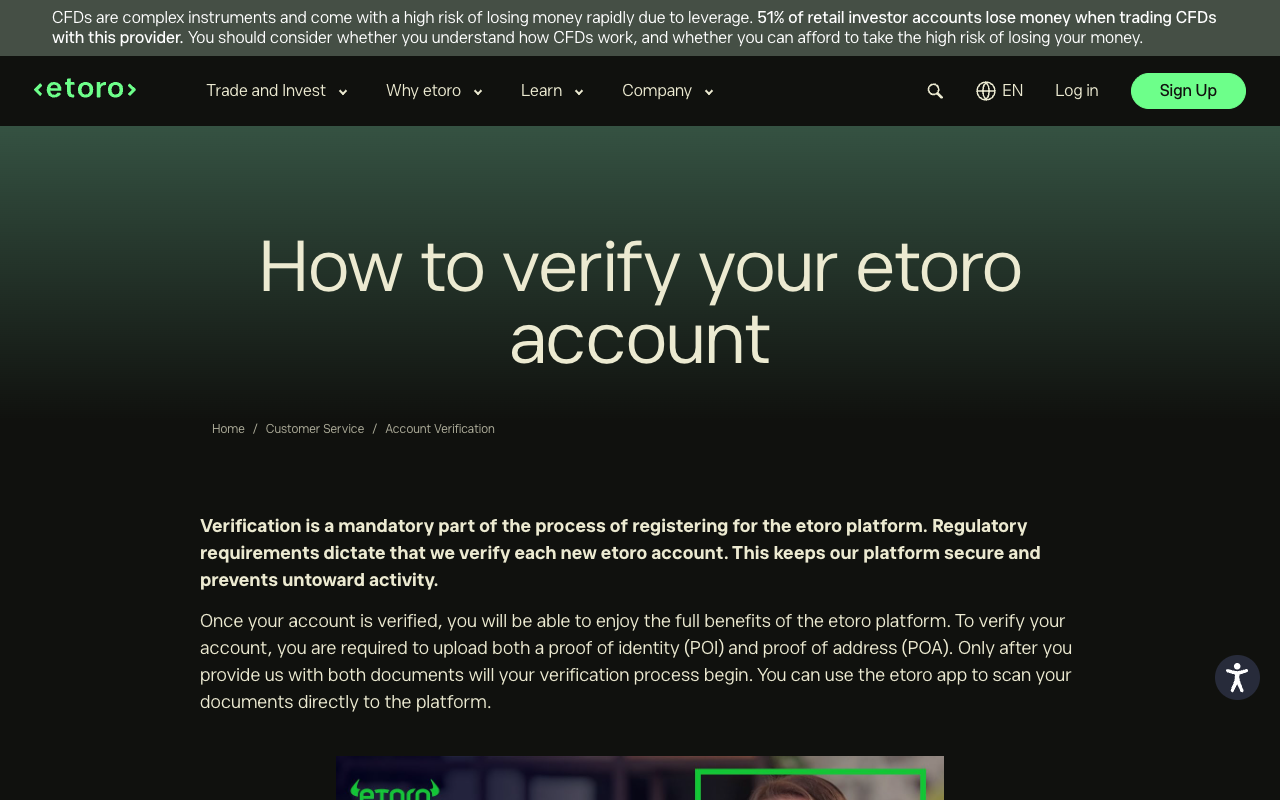
| eToro page | What it covers | What it actually gives you |
|---|---|---|
| How to verify your eToro account | POI and POA | The "any other government-issued ID" clause, the eight accepted address documents, and the 3-month rule |
| Regulation and License | Which entity serves you | Twelve named entities, their regulators and licence numbers |
The identity sentence is the one worth quoting in full, because its shape is unusual:
"A passport is the preferred proof of identity, as it is the document which will be quickest for the etoro team to process. Alternatively, you can use a driving license or any other government-issued ID."
Read that against Gemini's version — "National Identity Card from a Country within our AoA" — and the difference is the missing half of the sentence. Gemini ties the category to a published list. eToro does not tie it to anything. It also tells you what a document has to contain rather than where it has to come from: "your name, date of birth, a clear photograph, issue date, and if it has an expiry date, that should be visible as well."
A Palau ID card carries a name, a photograph, an issue date and an expiry date. On the face of eToro's published identity rule, it is a government-issued ID that contains the four required elements. That is as close to a yes as this site has been able to give on any venue — and it is still only half the requirement.
The proof of address is what stops a Palau ID, not the card
Here is the part every competing page misses. eToro does not ask for one document. It asks for two, and the second one is a proof of address, with its own list and its own freshness rule: "Your POA document should contain your full name, address and an issue date, which should be no older than 3 months."
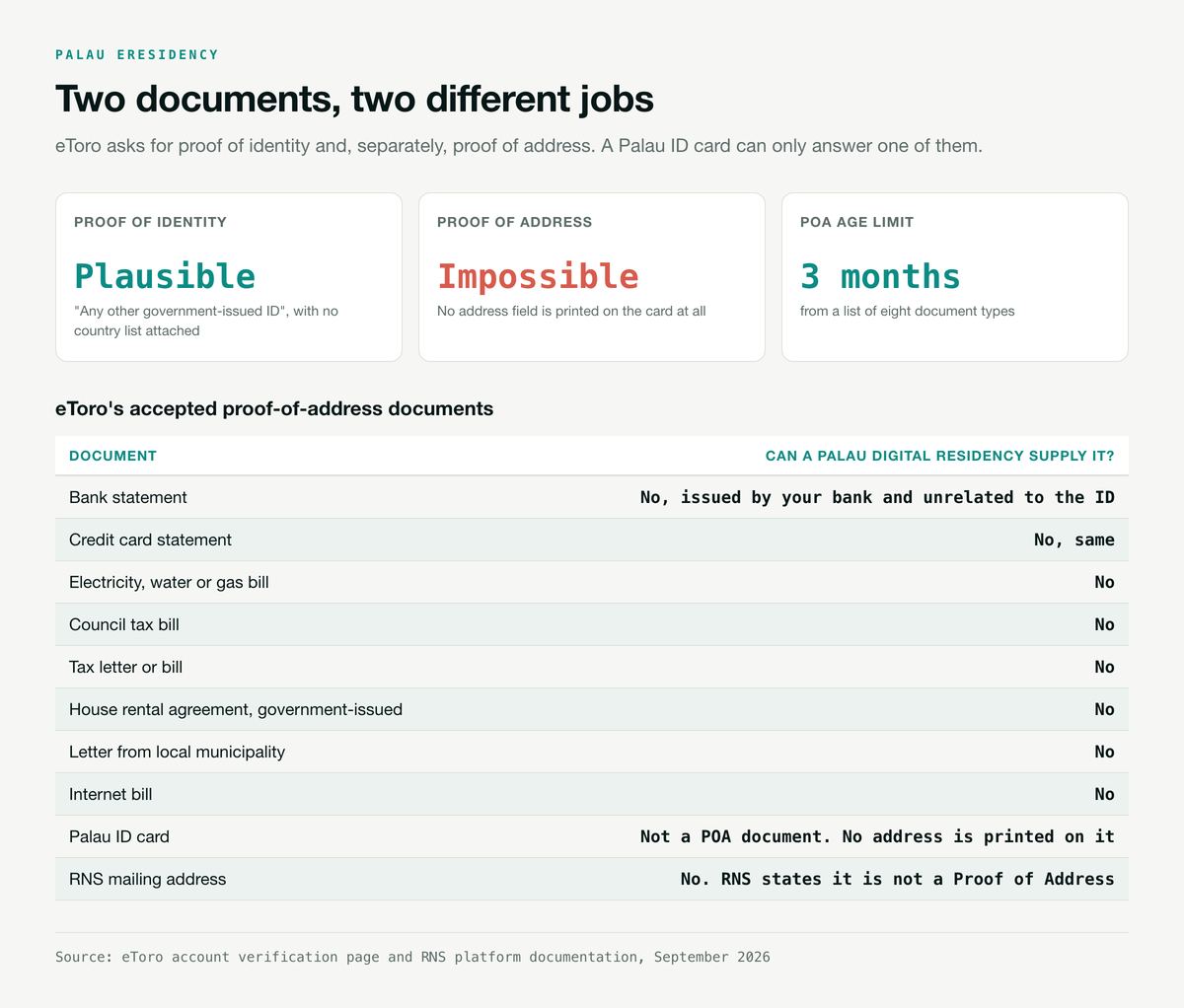
| eToro's accepted POA documents | Can a Palau digital residency supply it? |
|---|---|
| Bank statement | No — issued by your bank, unrelated to the ID |
| Credit card statement | No — same |
| Electricity, water or gas bill | No |
| Council tax bill | No |
| Tax letter or bill | No |
| House rental agreement (government-issued) | No |
| Letter from local municipality | No |
| Internet bill | No |
| Palau ID card | Not a POA document — no address is printed on it |
| RNS mailing address | No — RNS states it "is not a Proof of Address" |
Two independent things fail here, and it is worth keeping them apart. First, the card itself has no address field, which we set out below — so it could not be an address document even if eToro's list were open-ended. Second, the mailing address that RNS sells alongside the ID is explicitly disclaimed by RNS itself: it "is not a Proof of Address and may not satisfy specific verification requirements," and each platform decides separately whether to accept it.
This is the same trap we unpick in Palau ID proof of address and Palau mailing address, and eToro is an unusually clean illustration of it. The venue that is most likely to accept the card as identity is also a venue where the card gets you halfway and stops. Whatever address you give eToro, you will be documenting it with a bill or a bank statement from where you actually live.
eToro has no availability list — it has twelve entities
We went looking for eToro's equivalent of Gemini's Areas of Availability page, because that single list is what settled the Gemini question in a paragraph. It does not exist. eToro's help centre returns no canonical country list, the third-party "eToro supported countries" pages contradict each other, and eToro's own guidance is to check the signup flow.
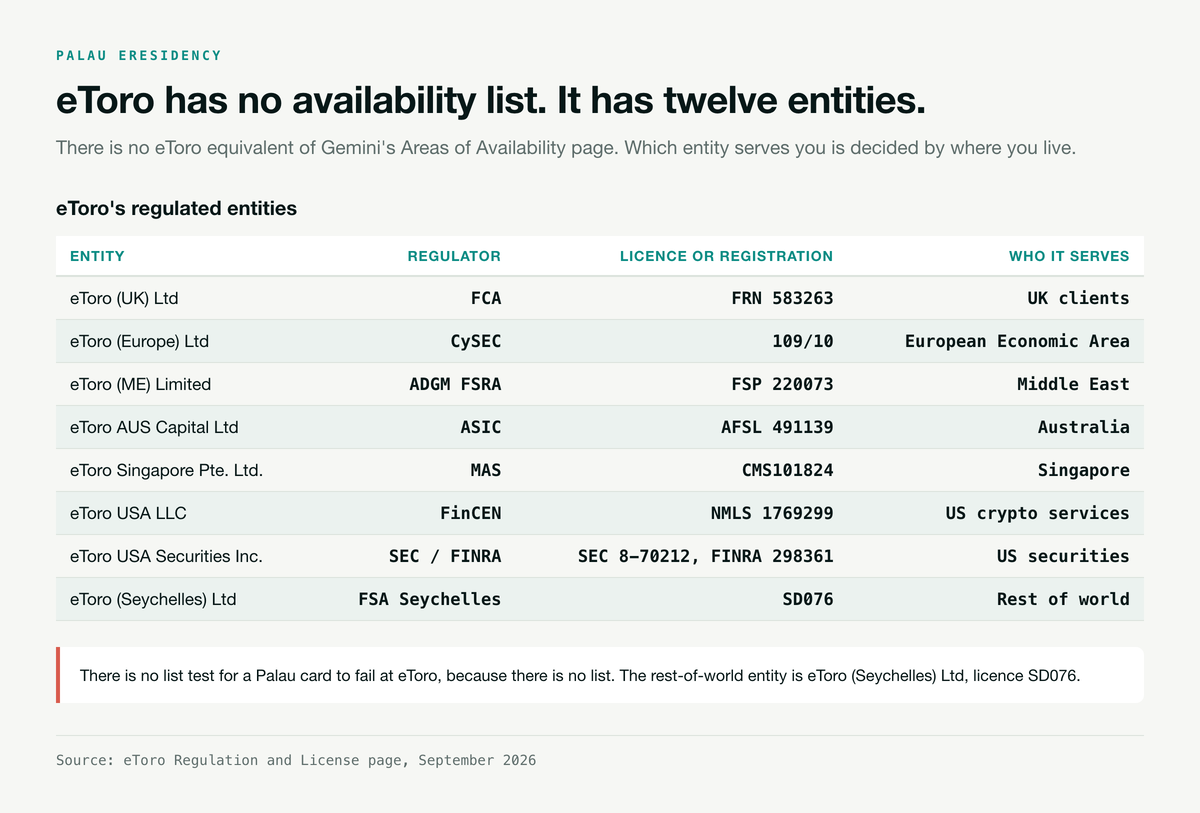
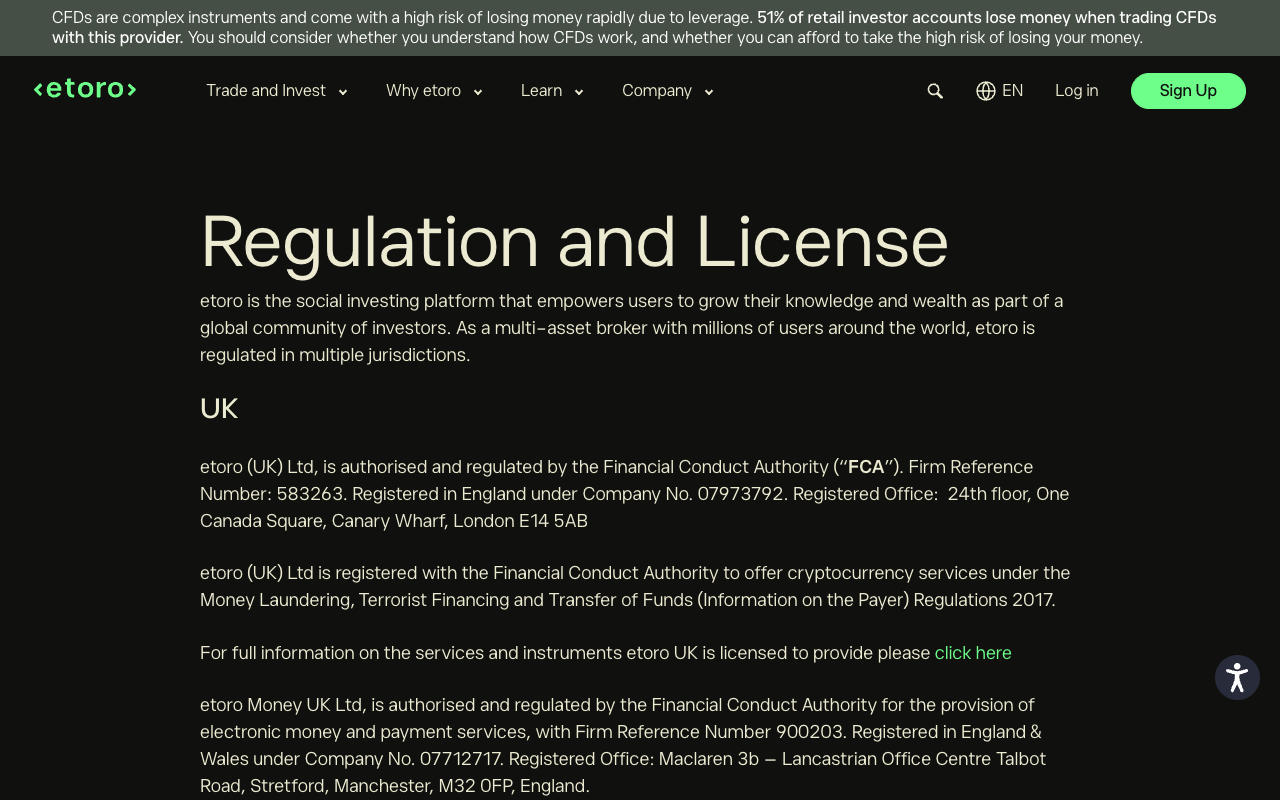
What eToro publishes instead is its regulatory structure, and that turns out to be more informative:
| Entity | Regulator | Licence / registration | Who it serves |
|---|---|---|---|
| eToro (UK) Ltd | FCA | FRN 583263 | UK clients |
| eToro (Europe) Ltd | CySEC | 109/10 | European Economic Area |
| eToro (ME) Limited | ADGM FSRA | FSP 220073 | Middle East |
| eToro AUS Capital Ltd | ASIC | AFSL 491139 | Australia |
| eToro Singapore Pte. Ltd. | MAS | CMS101824 | Singapore |
| eToro USA LLC | FinCEN | NMLS 1769299 | US crypto services |
| eToro USA Securities Inc. | SEC / FINRA | SEC 8-70212, FINRA 298361 | US securities |
| eToro (Seychelles) Ltd | FSA Seychelles | SD076 | Rest of world |
That last row is why eToro cannot be answered with a list test. There is a catch-all entity for jurisdictions the licensed entities do not cover, which is a fundamentally different architecture from Gemini's closed roster — and it means the question "is Palau on the list?" has no list to be on.
What it does not mean is that you can register as a resident of Palau. Entity assignment follows your country of residence, and eToro will let you change that country only against valid proof of a new address — which lands you back at the POA problem in the previous section. The Seychelles entity is a regulatory fallback for real residents of uncovered countries, not a door you open with a card.
Why Gemini's 2026 exit sends Palau ID buyers to eToro
There is a specific reason this question is being asked in 2026, and it is not organic curiosity about eToro's document policy.
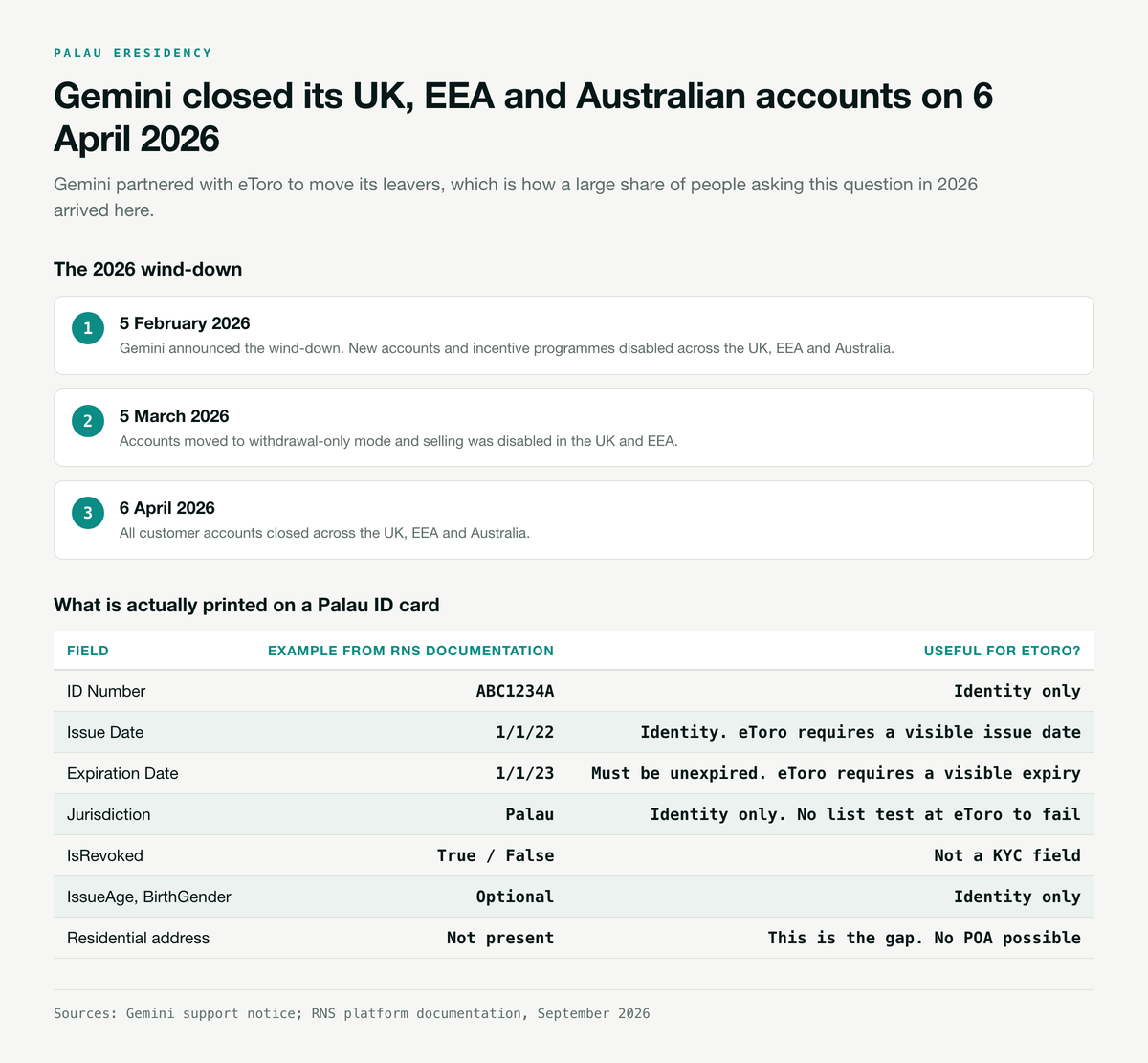
| Date | What happened | Who it affected |
|---|---|---|
| 5 February 2026 | Gemini announced the wind-down; new accounts and incentive programmes disabled | UK, EEA, Australia |
| 5 March 2026 | Accounts moved to withdrawal-only mode; selling disabled | UK, EEA |
| 6 April 2026 | All customer accounts closed | UK, EEA, Australia |
Gemini partnered with eToro to move departing customers, with signup incentives tied to transferred balances. So a European or Australian who had been using Gemini — possibly while researching whether a Palau card would help them there — was handed eToro as the replacement, and arrived asking the same question about a venue with completely different rules.
The answer changes with the venue, and it changes in the reader's favour on the identity half and against them on the address half. Our Gemini page covers why the card failed there on a published list test; that reasoning does not transfer to eToro at all, which is exactly the kind of assumption that costs people $1,199.
What is actually printed on a Palau ID card
Being concrete about the document settles most of the argument, because several claims made about this card online describe a card that does not exist. RNS's platform documentation lists the credential's properties:
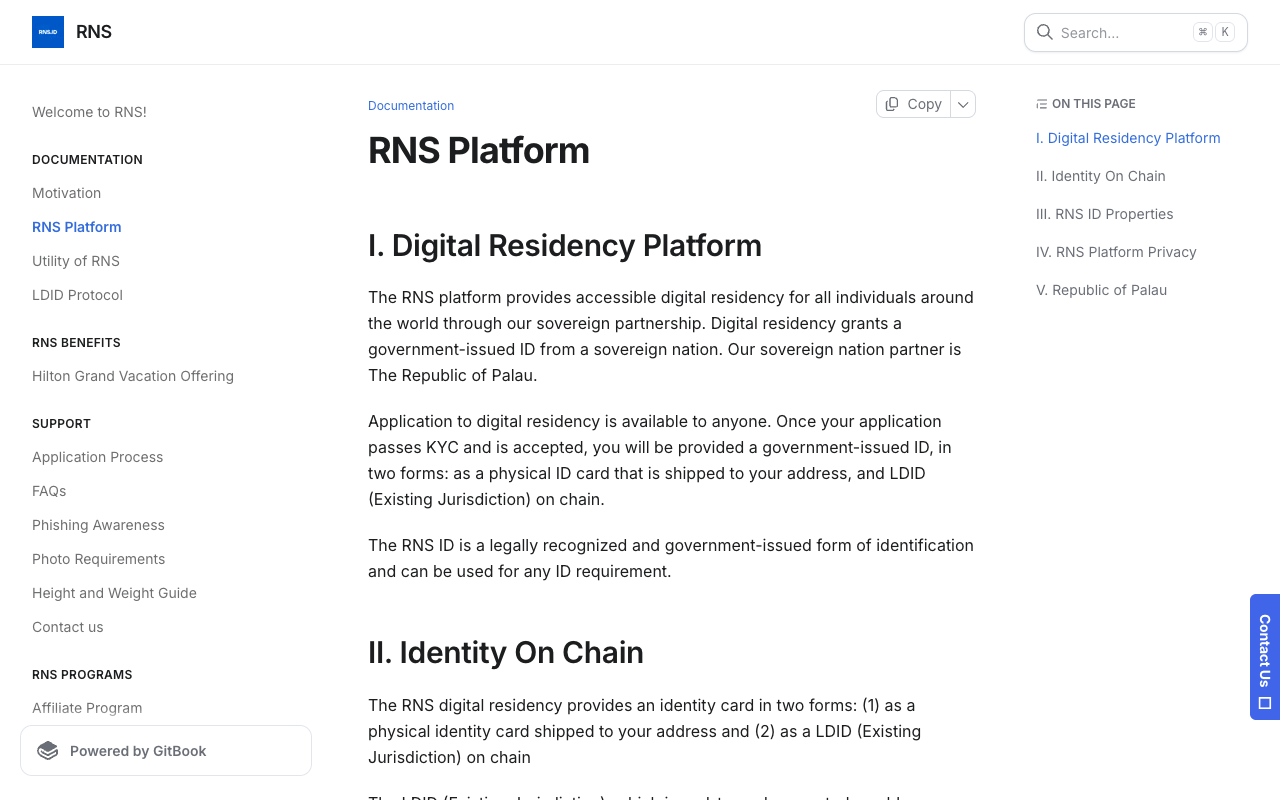
| Field | Example from RNS documentation | Useful for eToro? |
|---|---|---|
| ID Number | ABC1234A | Identity only |
| Issue Date | 1/1/22 | Identity — eToro requires a visible issue date |
| Expiration Date | 1/1/23 | Must be unexpired; eToro requires a visible expiry |
| Jurisdiction | Palau | Identity only — no list test at eToro to fail |
| IsRevoked | True / False | Not a KYC field |
| IssueAge, BirthGender | Optional | Identity only |
| Residential address | Not present | This is the gap — no POA possible |
The card does carry a name, a photograph, an issue date and an expiry date, which is the full set eToro's identity rule asks for. What it does not carry is an address, and that absence is structural rather than an oversight — RNS describes the credential as "a legally recognized and government-issued form of identification", not as a residence record.
RNS is careful elsewhere too, and worth quoting because the resellers are not: digital residency "does not support pathways to citizenship or future Palau passports", and the programme is open to all global citizens except North Korea, Iran, Syria, Cuba, Crimea and Sudan. RNS does say members have used the ID at "most of the crypto exchanges, banks/neobanks" — that is a report of member experience, not a commitment from eToro or anyone else.
How eToro compares with the venues we have checked
Ranked by how a Palau card actually fares, eToro sits at the permissive end — which is not the same as being a place the card solves your problem.
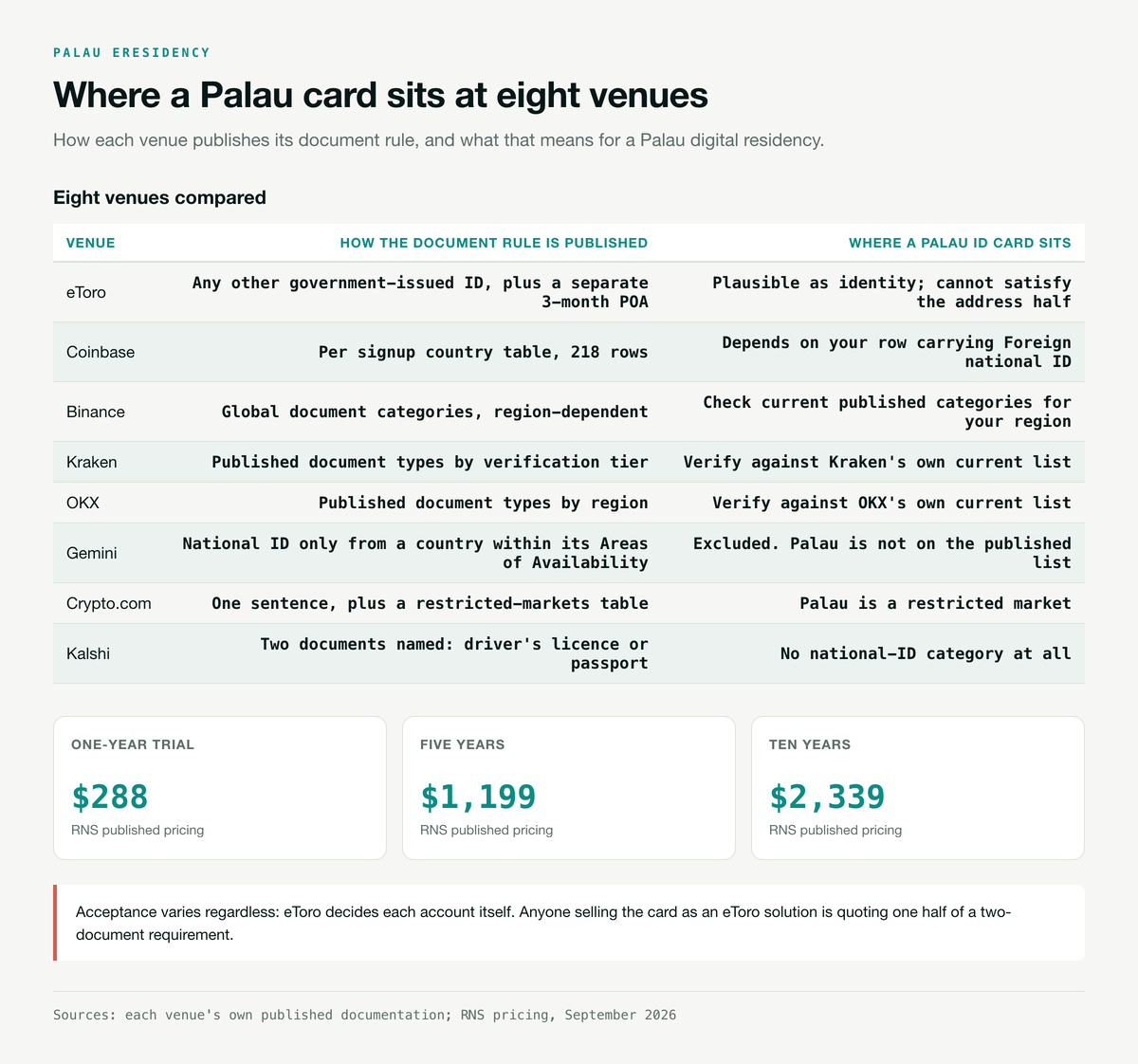
| Venue | How the document rule is published | Where a Palau ID card sits |
|---|---|---|
| eToro | "Any other government-issued ID", plus a separate 3-month POA | Plausible as identity; cannot satisfy the address half |
| Coinbase | Per signup country table, 218 rows | Depends on your row carrying "Foreign national ID" |
| Binance | Global document categories, region-dependent | Check current published categories for your region |
| Kraken | Published document types by verification tier | Verify against Kraken's own current list |
| OKX | Published document types by region | Verify against OKX's own current list |
| Gemini | National ID only "from a Country within our AoA" | Excluded — Palau is not on the published list |
| Crypto.com | One sentence, plus a restricted-markets table | Palau is a restricted market |
| Kalshi | Two documents named: driver's licence or passport | No national-ID category at all |
The pattern that survives all eight rows is the one worth taking away: read the venue's own published requirements, in full, before you buy anything to satisfy them. Half a requirement read carefully still fails. Our exchange KYC tracker keeps these side by side so you are not re-reading nine help centres, and Palau ID supported exchanges shows how to run the check yourself on a venue we have not covered.
What to check before you spend $288 to $2,339
Four free checks, about ten minutes, and they settle this before any money moves.
- Work out which document you are actually short of. If you have a passport or a national ID from where you live, eToro's identity half is already handled and a Palau card adds nothing. If identity is genuinely your gap, keep reading. If your gap is address, stop — no version of this card fixes that.
- Find a POA you can produce today. A bank statement, utility bill, council tax bill, tax letter, rental agreement, municipality letter or internet bill, issued within the last three months, in your name, with all four corners visible. eToro accepts screenshots of digital documents, so an online bank statement is fine.
- Check eToro is open where you live. There is no published list, so use the signup flow and see which entity you are routed to. If registration is blocked for your country, no document changes that.
- Check whether eToro is your only reason. If it is, keep the money. If it is one of several, the cost breakdown and what the programme does not do are the two pages to read before deciding.
Bottom line
eToro never says "we do not accept Palau IDs", and unlike Gemini it has published no list that would exclude one. Its identity rule is "any other government-issued ID" with four content requirements, and a Palau card meets all four on paper. That is the most favourable reading any venue's documentation has supported on this site.
Then the second document arrives. eToro wants a proof of address no older than three months, from a list of bills, statements and official letters, and a Palau ID has no address printed on it while RNS's own mailing address is explicitly disclaimed as a POA. So the honest answer is: the card may well clear eToro's identity check, it cannot clear the address check, and if identity was not your problem in the first place, it solves nothing you had. Acceptance varies and eToro decides each account on its own — but the published requirements are there to read, and reading both halves of them is free.
Related reading
- Palau ID for crypto KYC — the category answer across exchanges
- Does Gemini accept Palau ID? — the venue that excludes it by published list
- Does Coinbase accept Palau ID? — the venue that publishes a Palau row
- Palau ID proof of address — why an ID card is not an address document
- Palau mailing address — what RNS's address service is and is not
- Palau digital residency limitations — what the programme does not do
FAQ
Does eToro accept a Palau ID in 2026?
eToro publishes no rule naming Palau IDs either way. Its verification page accepts a passport, a driving licence or "any other government-issued ID" containing a name, date of birth, photograph, issue date and visible expiry — requirements a Palau card meets. But eToro also requires a separate proof of address, which a Palau ID cannot supply, and acceptance varies because eToro verifies each account individually.
Is Palau on eToro's list of supported countries?
eToro does not publish a single canonical country list, which is the main structural difference from Gemini. It publishes twelve regulated entities instead, assigned by country of residence, including eToro (Seychelles) Ltd under licence SD076 for the rest of the world. The practical test is whether eToro's signup flow accepts your country of residence.
What documents does eToro require to verify an account?
Two. A proof of identity — passport preferred, or a driving licence or other government-issued ID — and a proof of address dated within the last three months. Accepted address documents are bank and credit card statements, electricity, water, gas or internet bills, council tax bills, tax letters, government-issued rental agreements and letters from a local municipality.
Can I use a Palau ID as proof of address on eToro?
No. RNS's platform documentation lists the credential's fields as ID Number, Issue Date, Expiration Date, Jurisdiction and a revocation flag, with optional age and gender — there is no residential address on the card to read. RNS separately states that its mailing address service "is not a Proof of Address and may not satisfy specific verification requirements."
Why does eToro appear in Gemini closure emails?
Gemini closed all customer accounts in the UK, the European Economic Area and Australia on 6 April 2026, moving accounts to withdrawal-only on 5 March, and partnered with eToro to transfer departing customers with signup incentives. That is why people researching Gemini and a Palau ID in 2026 often end up asking the same question about eToro.
Does a Palau ID let me register with eToro as a resident of Palau?
Not in practice. eToro assigns you to a regulated entity based on your country of residence, and it will only change a registered country against valid proof of a new address — a document a Palau ID cannot provide. The catch-all Seychelles entity exists for real residents of countries the licensed entities do not cover, not as a route around residence.
If eToro is not the answer, what should I check next?
Check the venue you actually intend to use, against its own published requirements, before buying anything — and read all of them, not just the identity list. Our exchange KYC tracker collects what each venue publishes, and Palau ID supported exchanges explains how to run the check yourself. Treat any list of "exchanges that accept Palau ID" that cites no source as a starting point, not an answer.