Does Coinbase Accept Palau ID? 2026 KYC Rules
Coinbase publishes an accepted-document list per signup country. We read all 218 rows in 2026 to find where a Palau ID card fits, and where it does not.
We may earn a commission if you apply through this link. This site is independent and is not the official RNS.ID or Palau government site.

Key takeaways
- Coinbase does not publish one answer, it publishes 218 of them. Its identity verification page carries a table with a row for every signup country, and each row names the documents that country's customers may submit. The row that applies to you is the country you sign up from, not the country that issued your card.
- "Foreign national ID" is the bullet that decides it. We counted it in 112 of the 218 country rows, including the United Kingdom, Nigeria, Slovakia and Panama, and absent from Germany, Canada, Australia and India. If your signup country's row does not list it, a Palau ID card is not an option Coinbase offers you at all.
- Palau has its own row, and it reads "National identity card, Passport". Proof of address for that row is listed as "Not available" — so even the Palau path has no supported way to prove an address.
- In the EU and rest-of-world flows, Palau appears only under foreign passports. Coinbase lists Palau in "Foreign passports are accepted from these countries". A digital residency card is not a passport, and RNS states plainly that digital residency does not support a pathway to a Palau passport.
- Proof of address is the wall people hit second. Coinbase may ask for a bank statement, credit card statement or utility bill issued within the last 3 months, and a Palau ID is none of those.
On this page
- The short answer, and why "it depends" is the honest one
- Where Coinbase actually publishes its document rules
- Palau's own row in Coinbase's country table
- "Foreign national ID": the bullet that decides your case
- Why a Palau ID is not a Palau passport
- Proof of address is the second wall
- How Coinbase compares with the exchanges we have already checked
- What to check before you spend $288 to $2,339
- Bottom line
- Related reading
- FAQ
The short answer, and why "it depends" is the honest one
Every week someone asks us the same question in the same shape: does Coinbase accept Palau ID? The pages that rank for it answer with a flat yes or a flat no, and neither is right. We read Coinbase's own 2026 help documentation — the US table, the rest-of-world page and the EU page — and the rule it publishes is conditional in a way no summary captures.
The stakes are concrete. A Palau digital residency runs $288 for the one-year trial, $1,199 for five years and $2,339 for ten, per RNS's published pricing, and people buy it specifically to pass exchange KYC. Getting the conditional answer wrong costs real money.
Here is the promise: by the end of this page you will know which single row of Coinbase's table applies to you, what that row has to say for a Palau ID to be submittable, and what still stands in the way even when it does. We did this the slow way — we pulled Coinbase's full country table and counted the rows rather than trusting anyone's summary of it, including our own from last year.
Nothing here is legal, tax or financial advice, and acceptance varies. Coinbase changes onboarding rules without notice, and its live signup flow is the authority over any guide, this one included.
Where Coinbase actually publishes its document rules
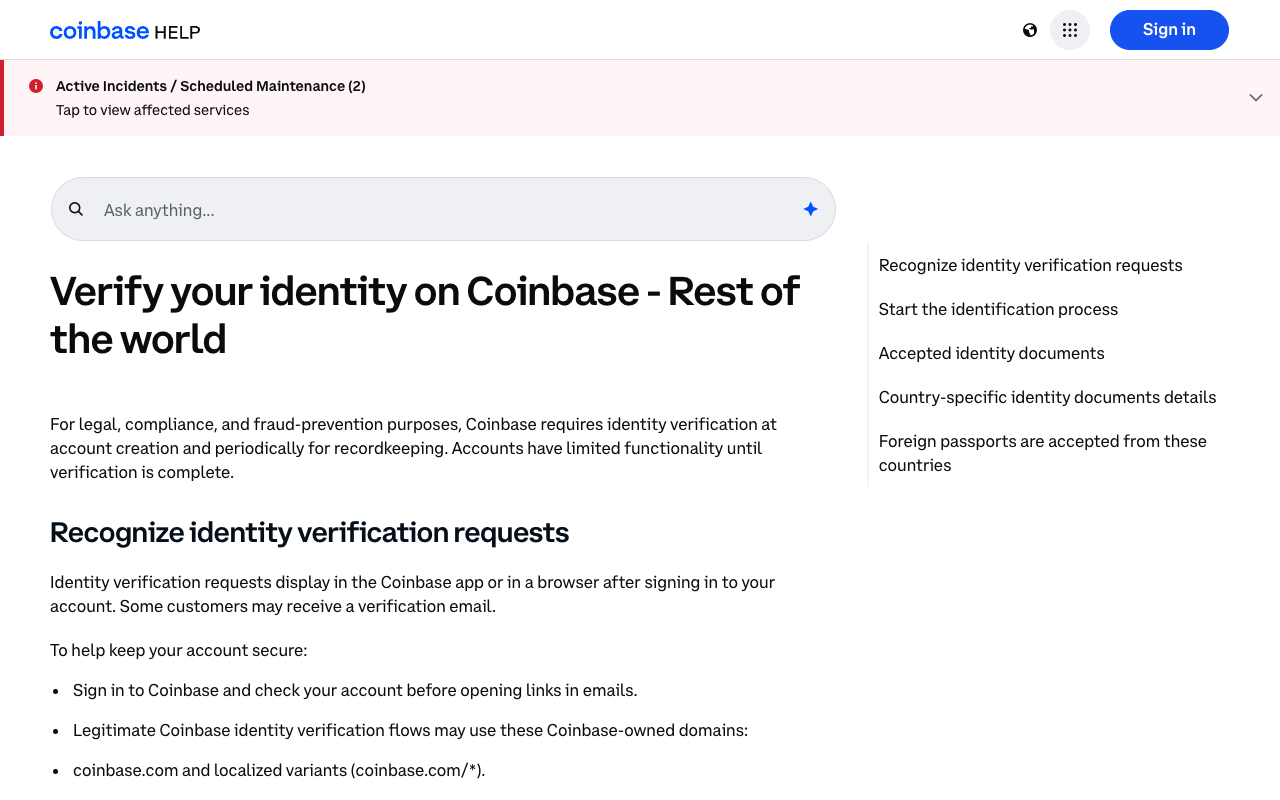
Most of the competing pages on this query cite nothing. That is the gap, because Coinbase publishes more detail than almost any other exchange we have looked at — it is just spread across three help articles that each serve a different signup region.
| Coinbase help page | Who it applies to | What it gives you |
|---|---|---|
| Verify your identity on Coinbase | The full country list | A row per signup country: supported identity documents and supported proof-of-address documents |
| Verify your identity — Rest of the world | Non-EU, non-US customers | The general document categories, plus the list of countries whose foreign passports are accepted |
| Verify your identity — EU customers | EU/EEA customers | EU-issued passport, licence or national ID, plus the same foreign-passport list |
| Identity document verification troubleshooting | Everyone | Why uploads fail, and the 30-minute wait between attempts |
The country table is the specific source and the one to trust when the pages disagree. Its header is worth reading twice: the first column is "Signup country or region", not "country that issued your ID". That single word — signup — is where most advice on this topic goes wrong.
Palau's own row in Coinbase's country table
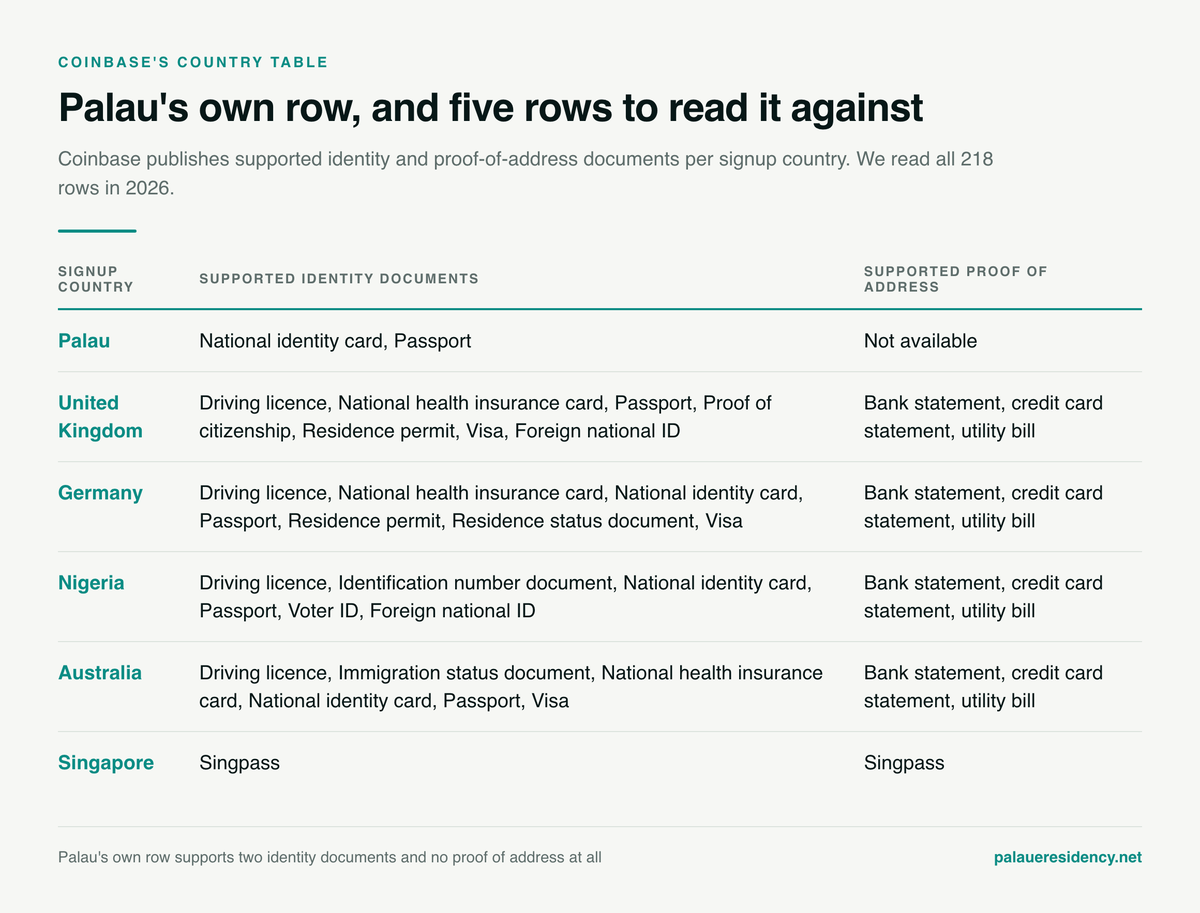
Palau does have a row. Here is what it contains, alongside a few rows we pulled for comparison.
| Signup country | Supported identity documents | Supported proof of address |
|---|---|---|
| Palau | National identity card, Passport | Not available |
| United Kingdom | Driving licence, National health insurance card, Passport, Proof of citizenship, Residence permit, Visa, Foreign national ID | Bank statement, credit card statement, utility bill |
| Germany | Driving licence, National health insurance card, National identity card, Passport, Residence permit, Residence status document, Visa | Bank statement, credit card statement, utility bill |
| Nigeria | Driving licence, Identification number document, National identity card, Passport, Voter ID, Foreign national ID | Bank statement, credit card statement, utility bill |
| Australia | Driving licence, Immigration status document, National health insurance card, National identity card, Passport, Visa | Bank statement, credit card statement, utility bill |
| Singapore | Singpass | Singpass |
Two things follow. First, if you sign up as a customer in Palau, a national identity card is on the list — which is the closest thing to a yes that Coinbase publishes. Second, that same row shows proof of address as "Not available", so the Palau path has no supported document for the address check if Coinbase asks for one.
The catch is that almost nobody reading this is signing up from Palau. Holding a Palau digital residency card does not make you a resident of Palau, it does not change where you live, and Coinbase asks for your country separately from your document. Whether Coinbase is even open to customers in Palau is a separate availability question from the document table, and one you should settle in the live signup flow rather than from any guide.
"Foreign national ID": the bullet that decides your case
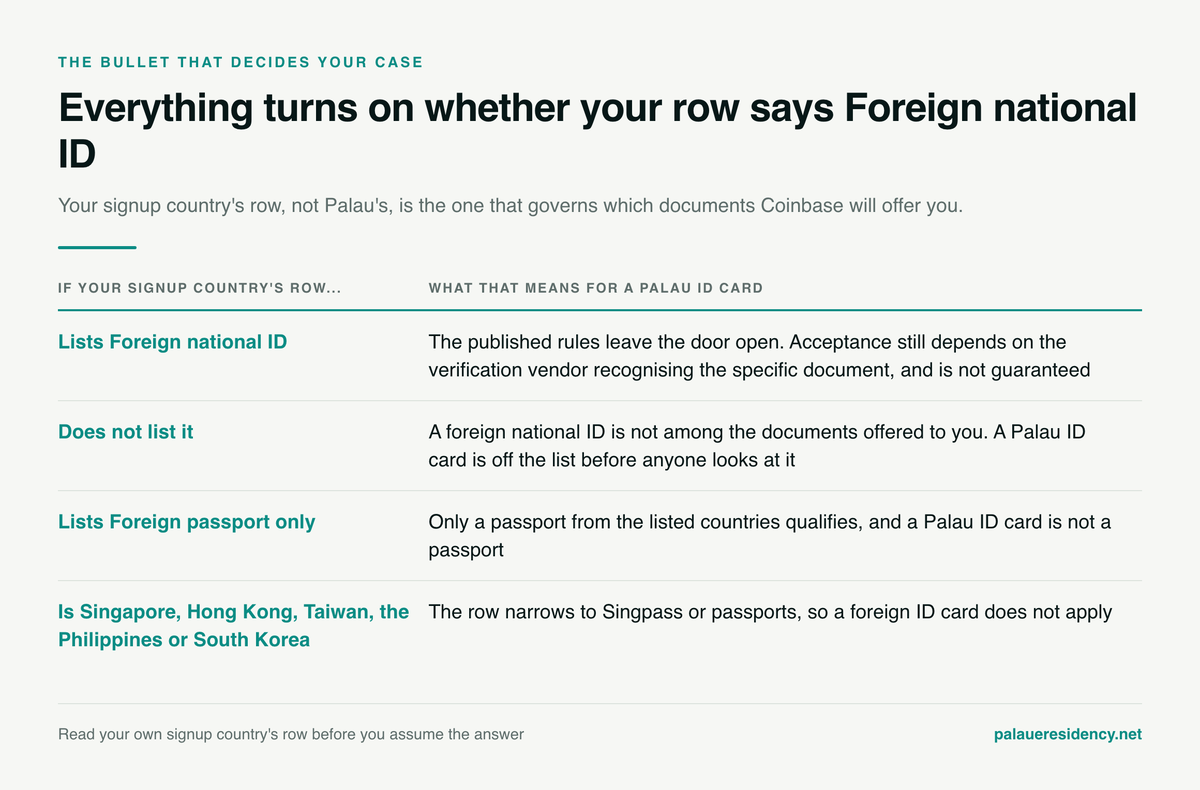
If you are signing up from your actual home country, a Palau ID is a foreign document. Coinbase handles that with a specific bullet, and it is not in every row.
We counted "Foreign national ID" in 112 of the 218 country rows in Coinbase's table. Roughly half. It is there for the United Kingdom, Nigeria, Slovakia and Panama. It is not there for Germany, Canada, Australia or India.
| If your signup country's row… | What that means for a Palau ID card |
|---|---|
| Lists "Foreign national ID" | Coinbase's published rules leave the door open. Acceptance still depends on its verification vendor recognising the specific document, and is not guaranteed |
| Does not list it | A foreign national ID is not among the documents Coinbase offers you. A Palau ID card is off the list before anyone looks at it |
| Lists "Foreign passport" only | Only a passport from the listed countries qualifies, and a Palau ID card is not a passport |
| Is Singapore, Hong Kong, Taiwan, the Philippines or South Korea | The row narrows to Singpass or passports, so a foreign ID card does not apply |
Slovakia's row adds a condition worth borrowing as a general test: "Other ID documents are only accepted if they indicate your nationality on file." Your nationality is not changed by a digital residency, which is the same trap the country-of-residence field sets on other platforms.
Read your own row before you read anything else. It takes a minute and it settles the question more reliably than any article can, including this one.
Why a Palau ID is not a Palau passport
This distinction does more work than anything else on this page, so it is worth being exact about it.
Coinbase's EU and rest-of-world pages both carry a list headed "Foreign passports are accepted from these countries", and Palau is on it, in the Oceania group alongside Fiji, Micronesia, the Marshall Islands and Nauru. It would be easy to read that as Coinbase accepting Palau documents. It is not — it is Coinbase accepting Palau passports.
RNS is unambiguous about which of the two it issues. Its FAQs describe the Palau ID as "a government-issued identification card that can be used for any purpose that requires legal proof of identity", and a Sovereignty-Backed Identification Card as "a legally valid identification card issued by a sovereign nation". On citizenship it is blunter still: "Digital residency does not support pathways to citizenship or future Palau passports."
So the foreign-passport list is a genuine route for someone holding a Palau passport, and no route at all for a digital resident. We cover the wider version of this in Palau passport vs digital residency, and it is the single most common misreading we see in this niche.
Proof of address is the second wall
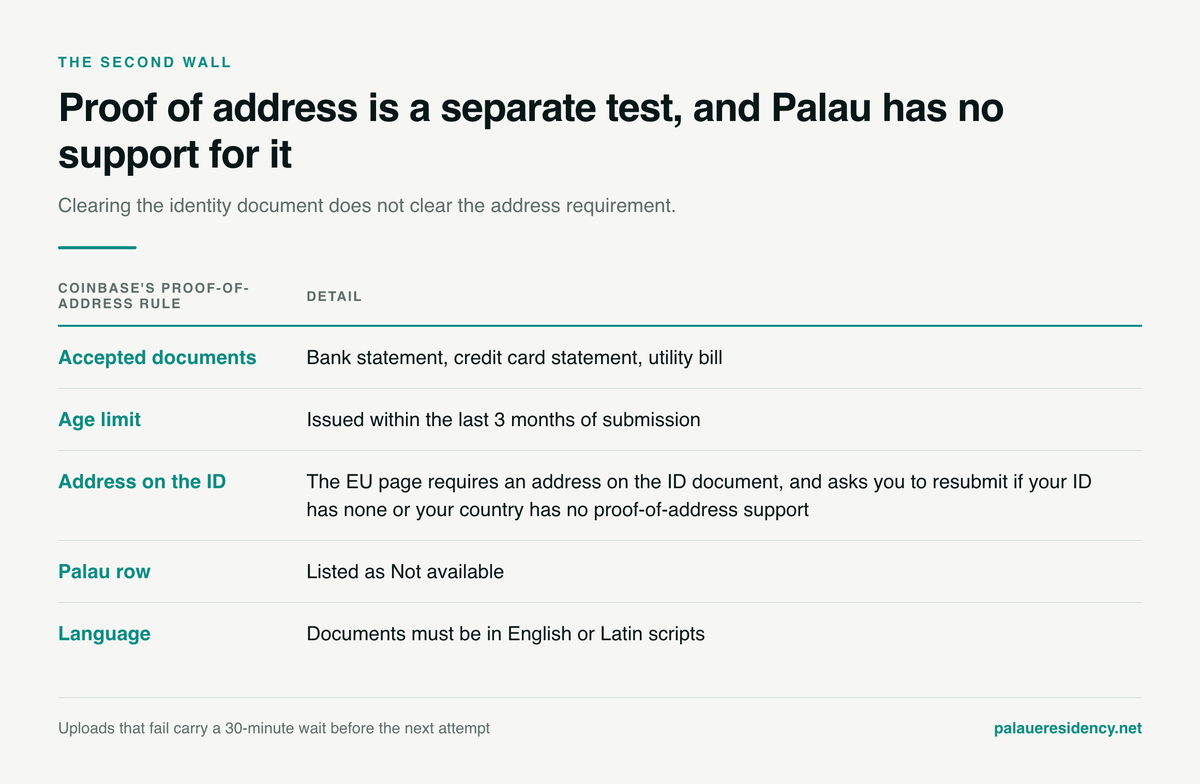
Clearing the ID check is not the end of onboarding. Coinbase says it may also ask for proof of address, and it is specific about what counts.
| Coinbase's proof-of-address rule | Detail |
|---|---|
| Accepted documents | Bank statement, credit card statement, utility bill |
| Age limit | Issued within the last 3 months of submission |
| Address on the ID | The EU page notes an address is required on the ID document, and asks you to resubmit if your ID has no address or your country has no proof-of-address support |
| Palau row | Listed as "Not available" |
| Language | Documents must be in English or Latin scripts |
A Palau ID card is not a bank statement, a card statement or a utility bill, so it cannot satisfy this check on any row. RNS does describe an "Adopt a Meter" utility-billing benefit among its planned features, but planned is not shipped, and we would not spend money on the strength of a roadmap. Our proof of address guide sets out what the card can and cannot do here.
The address question is also where a Palau mailing address gets people into trouble, because a forwarding address is not where you live.
How Coinbase compares with the exchanges we have already checked
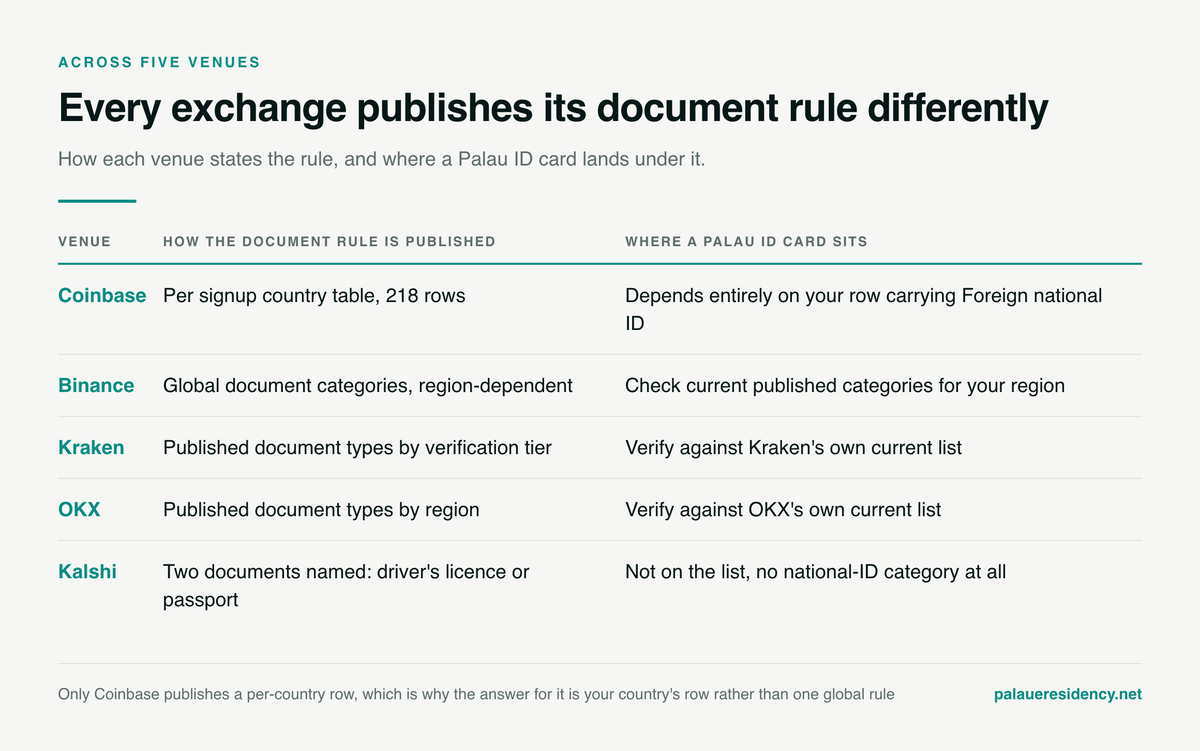
Coinbase is stricter in structure than most venues, though not in the way people assume. It is not that Coinbase bans national ID cards — it is that Coinbase decides per signup country instead of publishing one global list.
| Venue | How the document rule is published | Where a Palau ID card sits |
|---|---|---|
| Coinbase | Per signup country table, 218 rows | Depends entirely on your row carrying "Foreign national ID" |
| Binance | Global document categories, region-dependent | Check current published categories for your region |
| Kraken | Published document types by verification tier | Verify against Kraken's own current list |
| OKX | Published document types by region | Verify against OKX's own current list |
| Kalshi | Two documents named: driver's licence or passport | Not on the list, no national-ID category at all |
The pattern across all of them is the same: the published document list is the only thing worth reading, and a card's quality is irrelevant if the platform's list does not carry its category. Our exchange KYC tracker keeps this comparison in one place.
What to check before you spend $288 to $2,339
If Coinbase is your reason for buying a Palau digital residency, run these four checks first. They cost nothing and they take about ten minutes.
- Find your signup country's row in Coinbase's identity verification table and read the identity documents column. If "Foreign national ID" is absent, you have your answer and you can stop here.
- Check the proof-of-address column for the same row. If Coinbase asks and you have no bank statement, card statement or utility bill at your address, the ID does not solve that.
- Confirm what you would actually be buying. RNS issues an identification card, not a passport and not a change of residence. The cost breakdown is worth reading before you commit.
- Check whether Coinbase is your only reason. If it is, and your row does not list a foreign national ID, the card has no Coinbase use case — whatever it may be worth to you elsewhere.
US readers should also read Palau digital residency for US citizens, because the US position has its own considerations that sit outside Coinbase's document table.
Bottom line
Coinbase does not accept or reject Palau IDs as a class. It publishes a document list per signup country, and a Palau ID card is only ever submittable where that list carries "Foreign national ID" — about half the rows, and not the largest markets like Germany, Canada, Australia or India. Palau's own row does accept a national identity card, but it offers no supported proof of address, and signing up as a customer in Palau is not something digital residency makes true.
If you take one habit from this page, take this one: read the platform's own published document list for your own country before you buy any ID to satisfy it. It would prevent most of the disappointed messages that reach our inbox.
Related reading
- Palau ID for crypto KYC — the category answer across exchanges
- Palau ID for Coinbase, Kraken, OKX, Binance, Bybit and KuCoin — the multi-exchange overview
- Palau ID supported exchanges — how to research acceptance yourself
- Palau ID proof of address — why an ID is not an address document
- Physical vs digital Palau ID for KYC — which form you can actually upload
- Palau digital residency limitations — what the programme does not guarantee
FAQ
Does Coinbase accept a Palau ID in 2026?
It depends on the country you sign up from. Coinbase publishes a table with a row per signup country, and a Palau ID card can only be submitted where that row lists "Foreign national ID" — we counted that bullet in 112 of the 218 rows. Where it is absent, a foreign national ID is not a document Coinbase offers you. Acceptance is never guaranteed even where the category exists.
What identity documents does Coinbase accept?
Coinbase's general categories are driver's licence, passport and national ID card, plus foreign driver's licence, foreign passport and foreign ID card from supported countries. The specifics narrow by signup country in Coinbase's own table, and some rows are much shorter — Singapore's row lists only Singpass, and Hong Kong, Taiwan, the Philippines and South Korea are limited to passports.
Is Palau in Coinbase's country list?
Yes. Palau has its own row listing a national identity card and a passport as supported identity documents, with proof of address shown as "Not available". Palau also appears in the "Foreign passports are accepted from these countries" list on the EU and rest-of-world pages, which covers passports rather than ID cards.
Can I use a Palau ID as proof of address on Coinbase?
No. Coinbase names bank statements, credit card statements and utility bills issued within the last 3 months as its proof-of-address documents. An identification card is not one of them, and Palau's own row shows no supported proof-of-address document at all.
Does a Palau digital residency make me a Palau resident for Coinbase?
No. RNS describes the product as an identification card, and states that digital residency does not support pathways to citizenship or Palau passports. Coinbase asks for your signup country separately from your document, and that field should reflect where you actually live.
Why is Palau on Coinbase's foreign passport list if the ID card is not accepted?
Because that list is about passports. Coinbase's EU and rest-of-world pages both head it "Foreign passports are accepted from these countries", and Palau sits in the Oceania group. A Palau passport is a citizenship document that digital residency does not lead to, so the list does not apply to a digital residency card.
My Coinbase ID upload keeps failing — is that because of the document type?
Not necessarily. Coinbase's troubleshooting guidance covers image quality problems: use the latest mobile app or Chrome, allow camera access, use indirect natural light to avoid glare, place the ID on a plain background, and wait at least 30 minutes between attempts. It also says the document must be valid, fully visible, and show your legal name, date of birth, address or country, and document number.
What should I do if my country's row does not list a foreign national ID?
Use a document your row does list — typically your own country's passport, driving licence or national ID card. If Coinbase is the only reason you were considering a Palau digital residency, that row is your answer, and buying the card will not change it. Check the published list before you spend anything.