Does Gate.io Accept Palau ID? 2026 KYC Rules
Does Gate.io accept Palau ID? Gate names no rule either way, but residence and address decide it, not the card. We read Gate's own 2026 KYC pages.
We may earn a commission if you apply through this link. This site is independent and is not the official RNS.ID or Palau government site.
Key takeaways
- Gate's published document rule is broad and carries no country list. Its verification guide asks for "a valid identity document in your own name, such as a passport, ID card, or driver's license", and the app version adds that accepted documents "may vary by region". Neither page names Palau, for or against.
- The field that decides is residence, not the document. Gate's app flow collects your residence and your nationality as two separate answers before it looks at any ID, and section 2.5 of the User Agreement restricts 35 named locations — "but are not limited to" — from the global platform. Palau is not on that list; where you actually live may be.
- There is a second stage almost nobody writing about this mentions. After identity, Gate runs address verification, optional but required for "compliance requirements, limit increases, or account security reviews". A Palau ID card carries no address field at all, and RNS states its mailing address "is not a Proof of Address".
- The pages ranking for this question say opposite things, and neither cites Gate. One says Gate "accepts the full spread of Palauan identification"; a citizenship-by-investment vendor says the route stopped working in 2025 and you should buy a passport instead. Both argue from user reports and a tweet.
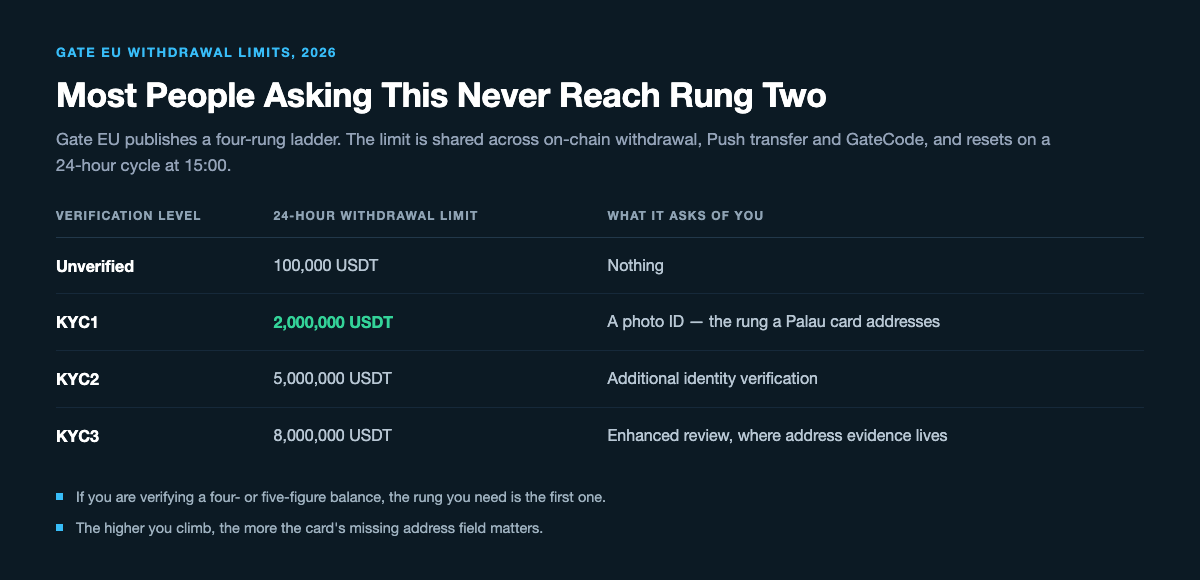
- Verification is a ladder, not a gate. Gate EU publishes 24-hour withdrawal limits of 100,000 USDT unverified, 2,000,000 at KYC1, 5,000,000 at KYC2 and 8,000,000 at KYC3 — so "did it pass KYC?" is not one question, and acceptance varies because Gate reviews each account itself.
On this page
- Does Gate accept Palau ID? The short answer
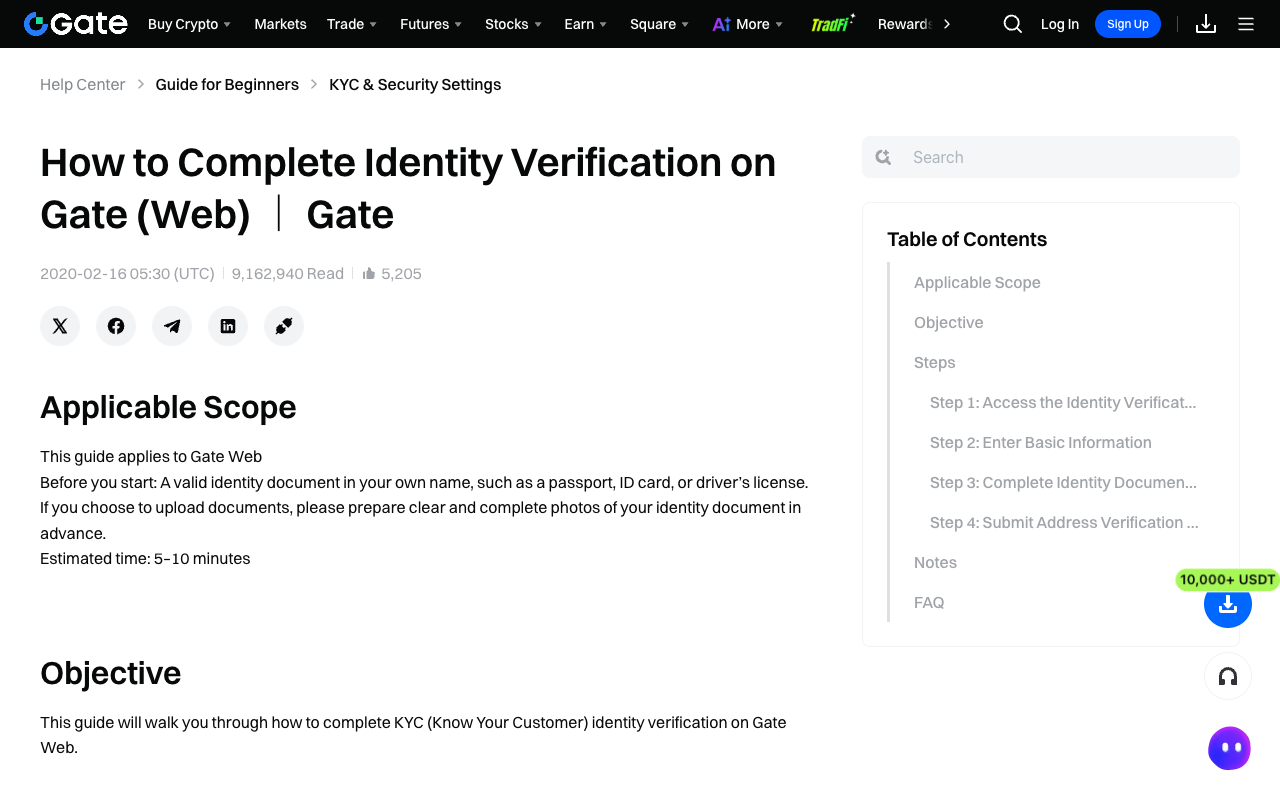
- What Gate actually publishes about identity documents
- Residence, not nationality, is the field that decides
- The address stage nobody mentions
- Gate's KYC ladder: what each level unlocks
- Why two pages ranking for this question disagree
- What is actually printed on a Palau ID card
- How Gate compares with the venues we have checked
- What to check before you spend $288 to $2,339
- Bottom line
- Related reading
- FAQ
Does Gate accept Palau ID? The short answer
Search does Gate.io accept Palau ID and the first page of results holds nothing that has read Gate's documentation. There is a citizenship-by-investment vendor whose answer is a second passport, a comparison page whose answer is "users report it works", a YouTube walkthrough, and two Medium posts filed under "KYC loophole". Gate's own help centre is there too, and nobody quoting it.
So we read it: the web verification guide, the app guide, the EU KYC page, the withdrawal-limit table and section 2.5 of the User Agreement. The answer is not a yes or a no, because Gate does not ask one question. It asks three, in order, and the Palau card is relevant to only one of them.
That distinction is worth real money. A Palau digital residency costs $288 for the one-year trial, $1,199 for five years and $2,339 for ten, on RNS's published pricing, and a large share of buyers are buying it to clear a single verification screen. Buying a document to answer a question the platform was not asking is the most common way to waste that money.
Nothing here is legal, tax or financial advice, and acceptance varies: Gate verifies each account individually, changes its rules without notice, and its live verification flow is the authority over any guide, this one included.

What Gate actually publishes about identity documents
Gate keeps its rules in several places, and they are not identical. That is the first thing worth knowing, because a page that quotes one of them is quoting a third of the policy.
| Gate page | What it covers | What it actually gives you |
|---|---|---|
| About Identity Verification (KYC) Procedures | Web verification | The document wording, the file rules, and address verification as a separate step |
| Identity Verification on the app | App verification | The field order — residence, nationality, ID type — and the "may vary by region" clause |
| Gate EU KYC guide | The EU entity | A separate European rulebook with its own tiers |
| User Agreement §2.5 | Restricted Locations | The 35 named locations, and the words "but are not limited to" |
The identity sentence is the one to quote in full, because its shape decides the question:
"A valid identity document in your own name, such as a passport, ID card, or driver's license."
There is no country qualifier on that sentence. Compare Gemini's version — "National Identity Card from a Country within our AoA" — where the category is tied to a published list and a Palau card fails before a human sees it. Gate's wording is closer to eToro's "any other government-issued ID": open at the category level, decided elsewhere.
The app page adds the caveat that matters: accepted documents "may vary by region", and the file must be "clear, complete, unobstructed, free of reflections, watermarks, stains, or smudges", between 10 KB and 4 MB, in JPG or PNG. RNS states that "Only the physical copy of your ID can be used for KYC", so the digital download you receive first is not the thing to photograph.
Residence, not nationality, is the field that decides
Here is the detail that reorganises the whole question, and it comes from Gate's own description of its app flow. Before you choose a document type, the flow asks for your residence and your nationality — two separate fields. The document answers the second. Nothing you upload answers the first.
Section 2.5 of the User Agreement is where that first answer is tested:
"The Restricted Locations include but are not limited to the United States of America, Mainland China, Singapore, Canada, France, Germany, Hong Kong, Malaysia, Malta, Cuba, Iran, North Korea, Sudan, Crimea Region, Spain, Luhansk, Donetsk, Netherlands, UK, Myanmar, Venezuela, Uzbekistan, Austria, India, Indonesia, Japan, Argentina, Cambodia, The United Arab Emirates, Thailand, South Korea, Republic of the Philippines, Pakistan, Vietnam, Russia and so on."
| Question Gate asks | What answers it | Can a Palau ID help? |
|---|---|---|
| Where do you reside? | Your declared country of residence, tested against §2.5 | No — the card is a document, not a residence |
| What is your nationality? | The issuing jurisdiction of your document | Partly — the card's jurisdiction is Palau |
| Can you evidence that identity? | Photo ID meeting the file rules, plus face recognition | Plausibly — this is the half the card is built for |
| Can you evidence that address? | A separate address verification stage | No — no address is printed on the card |
Two things follow, and they pull in opposite directions. Palau is not a restricted location on Gate's list, which is more than Crypto.com can say — there, Palau sits in the restricted-markets table. But Gate's list is open-ended ("but are not limited to", "and so on"), and it names locations, not nationalities. If you live in one of those 35 places, a Palauan document does not move you out of it, and declaring a residence you do not have is a different act from presenting a real ID.
The list also reads oddly until you notice the entity structure behind it. Malta is on it, and Gate's European arm is licensed in Malta: Gate Technology Ltd, announced on 1 October 2025 as having "obtained a MiCA License under the regulation and supervision of MFSA, to provide exchange and custody services", now passporting across Europe. The consistent reading is that such markets are excluded from the global platform because a regional entity serves them separately — which is why Gate EU keeps its own help pages and limits. No Gate page states that mapping outright, so treat it as implied structure, not a published rule.
The address stage nobody mentions
Every competing page treats Gate KYC as one upload. Gate's own web guide describes two stages, and the second one is where a Palau card runs out of information. Address verification is described as optional — "Completing it can increase your account privileges" — but Gate reserves the right to require it for "compliance requirements, limit increases, or account security reviews".
| What address verification needs | Can a Palau digital residency supply it? |
|---|---|
| A residential address you can evidence | No — the ID card carries no address field |
| A document tying your name to that address | No — RNS's card is an identity credential |
| The RNS mailing address as a substitute | No — RNS states it "is not a Proof of Address and may not satisfy specific verification requirements" |
| An address matching your declared residence | No — this comes from where you live, not from any card |
RNS is unusually clear here, and worth quoting because the resellers are not. The mailing address is "provided entirely by our third-party partner, Pacific Mail Hub", and RNS itself disclaims it as proof of address, leaving each platform to decide separately. That is the trap we unpick in Palau ID proof of address and Palau mailing address, and Gate illustrates it cleanly because the address stage is conditional. You may never be asked. If a limit increase or a security review does ask, no version of this card answers it.
So the honest shape of the answer: the card is aimed at stage one, has nothing for stage two, and cannot touch the residence question that precedes both.
Gate's KYC ladder: what each level unlocks
Treating verification as pass-or-fail also misreads it. Gate EU publishes a ladder, and the numbers make the point that most people asking this question are nowhere near the limits that force the higher rungs.
| Verification level | 24-hour withdrawal limit (Gate EU, 2026) |
|---|---|
| Unverified | 100,000 USDT |
| KYC1 | 2,000,000 USDT |
| KYC2 | 5,000,000 USDT |
| KYC3 | 8,000,000 USDT |
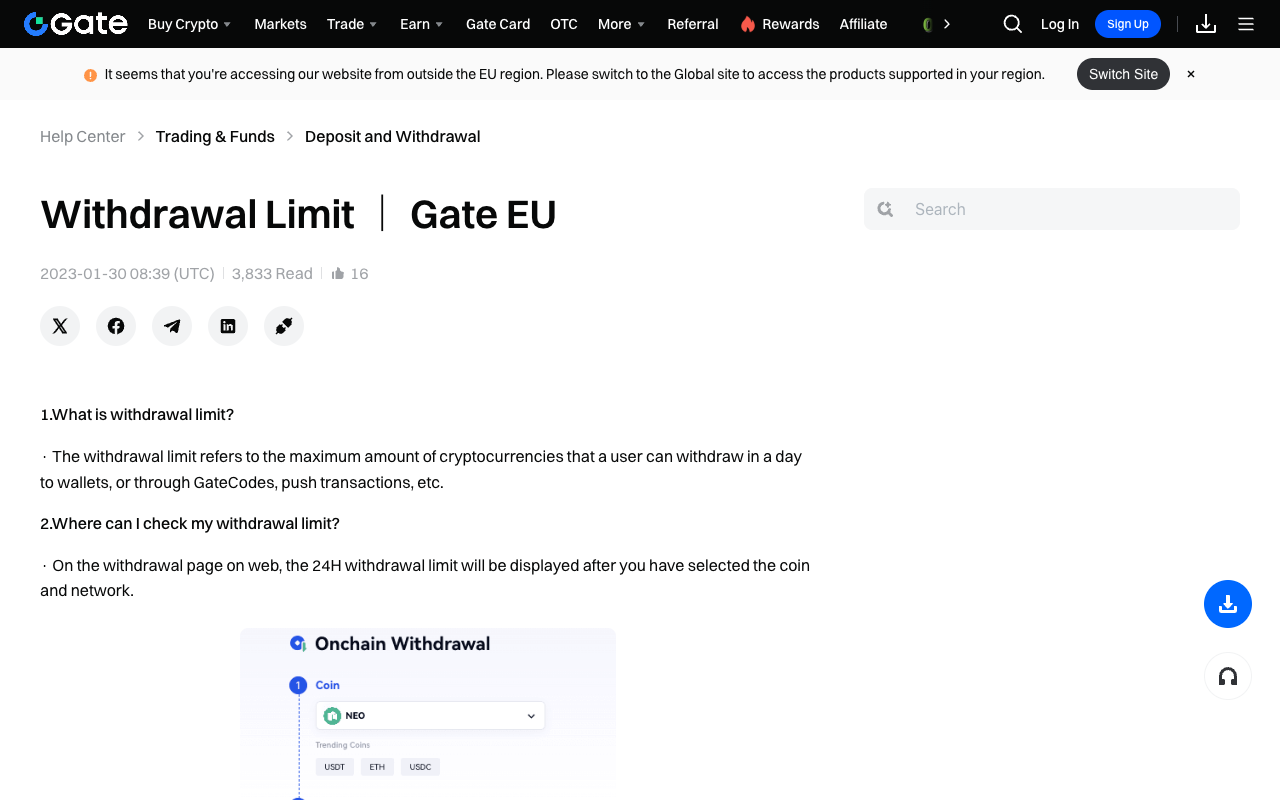
The limit "is shared by all withdrawal channels (on-chain withdrawal, Push transfer, and GateCode)" and runs on a 24-hour cycle reset at 15:00. Gate EU describes KYC2 as "additional identity verification".
Read that ladder against your own account. If you are verifying a four- or five-figure balance, the rung you need is the first one — the rung a photo ID addresses. The rungs above it are where enhanced review and address evidence live, so the higher you climb, the more the card's missing address field matters. Timings differ by page too: the web guide says automatic review "within a few minutes", extending to "1 business day", while the app guide says manual review "could take up to 24-48 hours".
Why two pages ranking for this question disagree
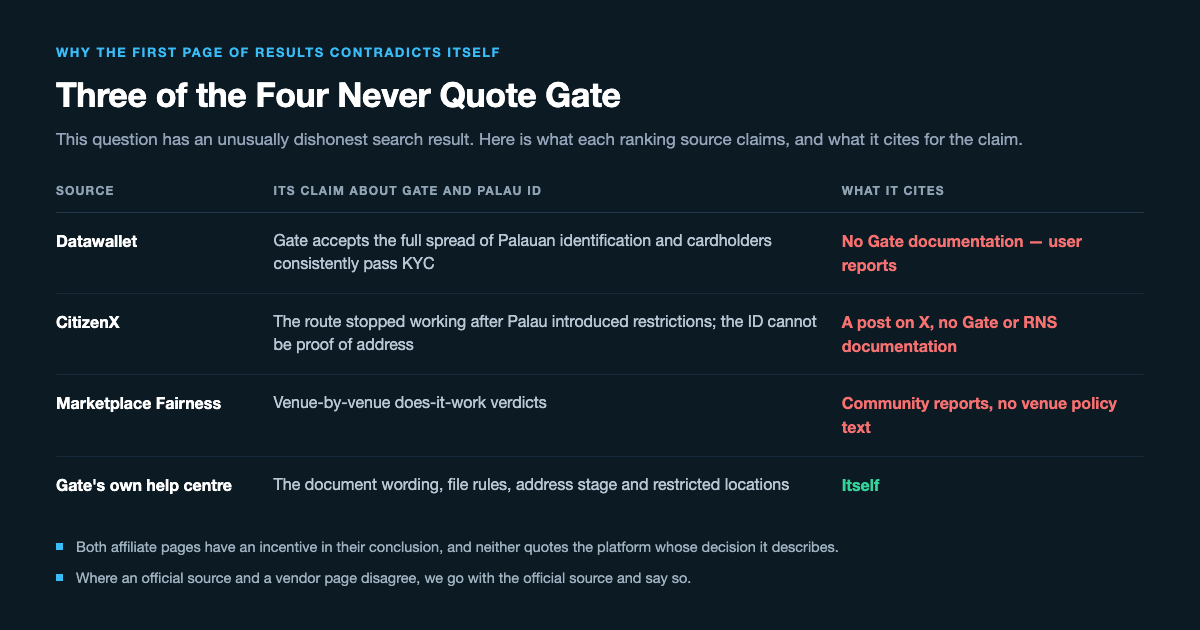
This question has an unusually dishonest search result, and it is worth showing the working rather than just asserting it.
| Source | Its claim about Gate and Palau ID | What it cites |
|---|---|---|
| Datawallet, "Best Crypto Exchanges in Palau" | Gate "accepts the full spread of Palauan identification" and cardholders "consistently report passing its KYC" | No Gate documentation — user reports |
| CitizenX, "Palau ID KYC alternatives for Gate.io" | The route stopped working after Palau introduced restrictions, and the ID cannot be a proof of address | A post on X, no Gate or RNS documentation |
| Marketplace Fairness (Binance, Bybit versions) | Venue-by-venue "does it work" verdicts from user reports | Community reports, no venue policy text |
| Gate's own help centre | The document wording, the file rules, the address stage, the restricted locations | Itself |
Both affiliate pages have an incentive in their conclusion — one sends you to an exchange, the other to a second passport — and neither quotes the platform whose decision it is describing. The CitizenX claim is not baseless on the address point: RNS says the same thing about its own mailing address. But "Palau introduced restrictions on the program for US citizens" is not what RNS's current FAQ says. That FAQ opens the programme to "all global citizens with the exception of North Korea, Iran, Syria, Cuba, Crimea and Sudan", and the United States is not among them — which is what our page for US citizens reports. Where an official source and a vendor page disagree, we go with the official source and say so.
What nobody on that first page does is separate the three questions Gate asks. That is the difference between "does it work?" and knowing what you are buying.
What is actually printed on a Palau ID card
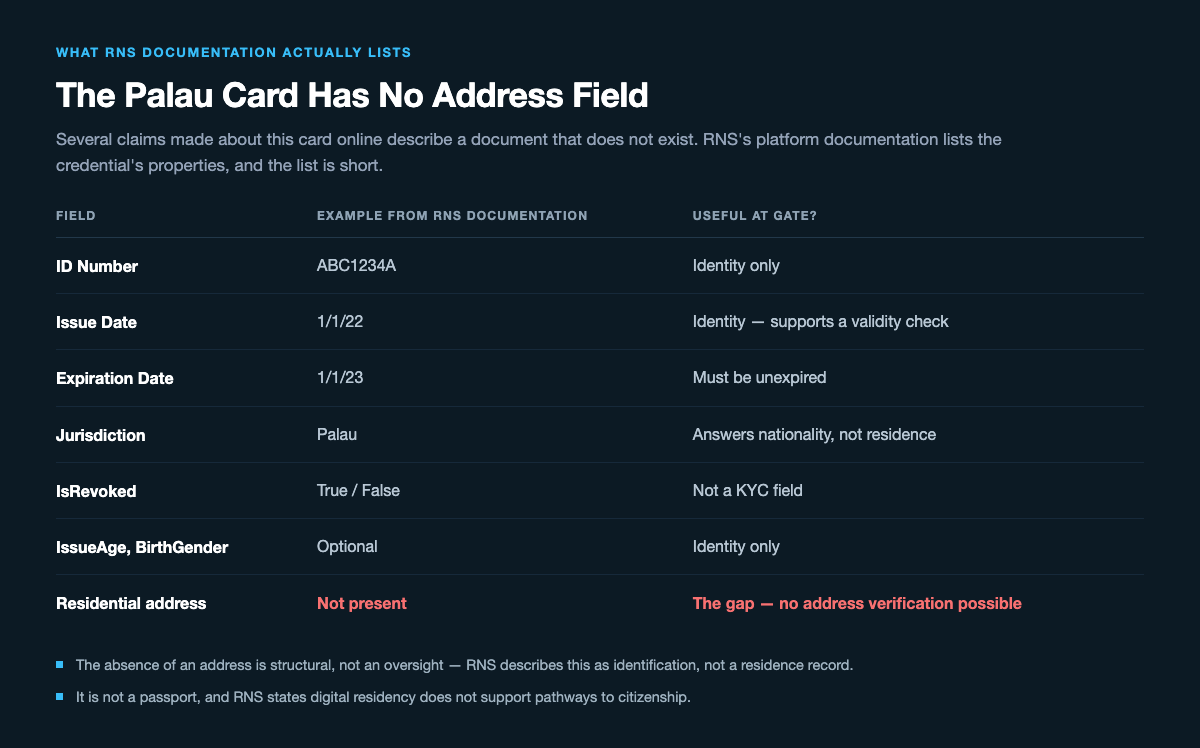
Several claims made about this card online describe a document that does not exist. RNS's platform documentation lists the credential's properties, and the list is short:
| Field | Example from RNS documentation | Useful at Gate? |
|---|---|---|
| ID Number | ABC1234A | Identity only |
| Issue Date | 1/1/22 | Identity — supports a validity check |
| Expiration Date | 1/1/23 | Must be unexpired |
| Jurisdiction | Palau | Answers nationality, not residence |
| IsRevoked | True / False | Not a KYC field |
| IssueAge, BirthGender | Optional | Identity only |
| Residential address | Not present | The gap — no address verification possible |
The card carries a name, a photograph, an issue date and an expiry date — the set a photo-ID rule normally asks for. The absence of an address is structural rather than an oversight: RNS describes the credential as a government-issued form of identification, not a residence record, and states that digital residency "does not support pathways to citizenship or future Palau passports". It is not a passport and not a citizenship path, whatever a reseller implies.
RNS does say members have used the ID for KYC at "most of the crypto exchanges, banks/neobanks, and non-bank payment provider". That is a report of member experience, not a commitment from Gate or anyone else.
How Gate compares with the venues we have checked
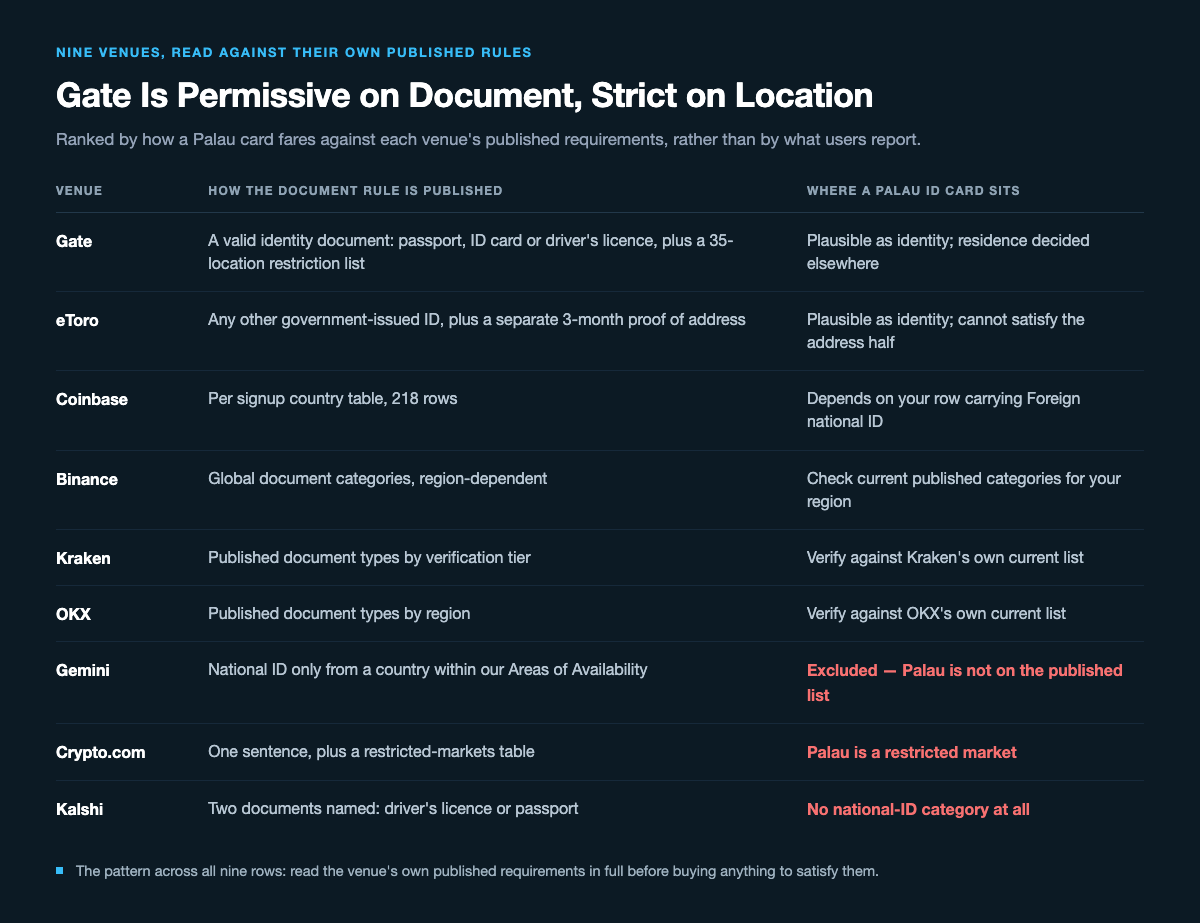
Ranked by how a Palau card fares against each venue's published rules, Gate sits at the permissive end of the document question and the strict end of the location question.
| Venue | How the document rule is published | Where a Palau ID card sits |
|---|---|---|
| Gate | "A valid identity document… passport, ID card, or driver's license", plus a 35-location restriction list | Plausible as identity; residence and address are decided elsewhere |
| eToro | "Any other government-issued ID", plus a separate 3-month POA | Plausible as identity; cannot satisfy the address half |
| Coinbase | Per signup country table, 218 rows | Depends on your row carrying "Foreign national ID" |
| Binance | Global document categories, region-dependent | Check current published categories for your region |
| Kraken | Published document types by verification tier | Verify against Kraken's own current list |
| OKX | Published document types by region | Verify against OKX's own current list |
| Gemini | National ID only "from a Country within our AoA" | Excluded — Palau is not on the published list |
| Crypto.com | One sentence, plus a restricted-markets table | Palau is a restricted market |
| Kalshi | Two documents named: driver's licence or passport | No national-ID category at all |
The pattern across all nine rows: read the venue's own published requirements in full before buying anything to satisfy them. Our exchange KYC tracker keeps these side by side, and Palau ID supported exchanges shows how to run the check yourself on a venue we have not covered.
What to check before you spend $288 to $2,339
Four free checks, about ten minutes, and they settle this before any money moves.
- Check your residence first, not your document. Read section 2.5 of Gate's User Agreement and find the country you actually live in. If it is there, stop — no identity document changes a location rule, and the list is explicitly not exhaustive.
- Work out which document you are short of. If you hold a passport or a national ID from where you live, Gate's identity wording is already satisfied and a Palau card adds nothing. If identity is genuinely your gap, it is the one stage where the card is on topic.
- Assume the address stage will come. It is conditional at Gate, not absent. Decide now what you would upload if a limit increase or a security review asked, because it will not be this card.
- Check whether Gate is your only reason. If it is, keep the money until you have read the cost breakdown and what the programme does not do. If it is one of several, the documents checklist is the next page.
Bottom line
Gate never says "we do not accept Palau IDs", and unlike Gemini it publishes no document list that would exclude one. Its identity rule names a passport, an ID card or a driver's licence with no country qualifier, and a Palau card is a government-issued photo ID with an issue date and an expiry — which is why reports of it clearing stage one are plausible rather than fantastical.
Then the other two questions arrive. Gate asks where you live before it asks what you hold, and tests that answer against 35 named locations and an open-ended "and so on". It reserves a second, address-based stage that a card with no address field cannot serve. Neither is solved by a document, and neither is mentioned by the pages ranking for this question. Acceptance varies and Gate decides each account itself — but the published requirements are free to read, which is more than either side of this argument has done.
Related reading
- Palau ID for crypto KYC — the category answer across exchanges
- Does eToro accept Palau ID? — the other venue with open document wording
- Does Gemini accept Palau ID? — the venue that excludes it by published list
- Palau ID proof of address — why an ID card is not an address document
- Palau ID exchange KYC tracker — every venue we have checked, side by side
- Palau digital residency limitations — what the programme does not do
FAQ
Does Gate.io accept a Palau ID in 2026?
Gate publishes no rule naming Palau IDs either way. Its verification guide asks for "a valid identity document in your own name, such as a passport, ID card, or driver's license", with no country qualifier, and a Palau card is a government-issued photo ID with an issue and expiry date. But Gate also asks for your country of residence before it looks at any document, and runs a separate address-verification stage a Palau card cannot serve. Acceptance varies, because Gate reviews each account itself.
Is Palau on Gate's restricted countries list?
No. Section 2.5 of Gate's User Agreement names 35 Restricted Locations, including the United States, Mainland China, Singapore, Canada, the UK, Japan and much of Western Europe, and Palau is not among them. Two cautions: the clause says the list "include[s] but [is] not limited to" those locations, and it restricts locations, meaning where you reside — not the jurisdiction that issued your document.
Can I use a Palau ID as proof of address on Gate?
No. RNS's platform documentation lists the credential's fields as ID Number, Issue Date, Expiration Date, Jurisdiction and a revocation flag, with optional age and gender — no residential address is printed on the card. RNS separately states that its mailing address service "is not a Proof of Address and may not satisfy specific verification requirements", so it is not a substitute either.
How long does Gate KYC take?
Gate's pages give different answers, which is worth knowing before you worry. The web verification guide says the system usually completes automatic review "within a few minutes after submission" and that it "may take up to 1 business day" in some cases; the app guide says manual review "could take up to 24-48 hours". Timing varies by region and by whether your submission is routed to a human.
What is the difference between KYC1, KYC2 and KYC3 at Gate?
They are limit bands rather than different documents. Gate EU publishes 24-hour withdrawal limits of 100,000 USDT unverified, 2,000,000 USDT at KYC1, 5,000,000 USDT at KYC2 and 8,000,000 USDT at KYC3, shared across on-chain withdrawal, Push transfer and GateCode, resetting at 15:00. Gate EU describes KYC2 as "additional identity verification"; the higher rungs are where enhanced review and address evidence become relevant.
Why do some pages say Gate stopped accepting Palau IDs in 2025?
That claim comes from a citizenship-by-investment vendor citing a post on X, not Gate or RNS documentation, and it is bundled with an assertion that Palau restricted the programme for US citizens. RNS's current FAQ says the programme is open to "all global citizens with the exception of North Korea, Iran, Syria, Cuba, Crimea and Sudan", and the United States is not on that list. The address half of the same claim is accurate, and RNS says so itself.
If Gate is not the answer, what should I check next?
Check the venue you actually intend to use, against its own published requirements, and read all of them rather than the identity list alone. Our exchange KYC tracker collects what each venue publishes, and Palau ID supported exchanges explains how to run the check yourself. Treat any list of "exchanges that accept Palau ID" that cites no source as a starting point, not an answer.