Palau Digital Residency for Canadian Citizens 2026
What Palau digital residency does and does not do in Canada in 2026: the CRA residential-ties test, crypto reporting, exchange access, and claims to skip.
We may earn a commission if you apply through this link. This site is independent and is not the official RNS.ID or Palau government site.
Key takeaways

- A Palau ID does not move where a Canadian pays tax, and Canada does not decide residency on a day count. The CRA's test turns on "significant residential ties" — a home in Canada, a spouse or common-law partner in Canada, dependants in Canada. There is no general 183-day rule for leaving; the 183-day threshold applies to people entering Canada without ties.
- Keep the ties and you stay a factual resident, which means you "continue to pay tax on your world income" as though you had never left. A card issued elsewhere is not one of the inputs.
- RNS publishes no fixed list of eligible nationalities, so no page can tell you a Canadian is eligible. Its own wording is that it "checks current country and compliance restrictions" and that the "restricted-country list is maintained by the service and can change".
- The exchange problem Canadians actually have is not an ID problem. Binance announced its withdrawal from Canada in May 2023, citing new Canadian Securities Administrators guidance — a decision about the Canadian market, not about which card a user holds. RNS says plainly that "third-party acceptance is not guaranteed".
- Canada's crypto reporting start date has moved, and most pages still quote the old one. The framework was deferred to 1 January 2027, which makes calendar 2027 the first reporting year — not 2026, as articles written earlier in the year still say.
On this page
- Palau digital residency in Canada: what actually changes
- Can a Canadian apply? What RNS actually publishes
- The "0% tax" claim, and the step it skips
- How Canadian tax residency is actually decided
- What the CRA does with your crypto, and what changes in 2027
- The exchange question is about residency, not your ID
- Your Canadian passport already handles the travel part
- Who Palau digital residency suits in Canada, and who should skip it
- Related reading
- FAQ
Palau digital residency in Canada: what actually changes
You are a Canadian, you have read that a Palau ID buys you an offshore identity, a 0% tax position and access to exchanges that stopped serving Canada, and those three claims are doing very different amounts of work. The stakes are a four-figure decision — the tiers our cost page recorded run from $288 for one year to $2,339 for ten — set against a CRA residency test that does not care what is in your wallet, and an exchange market that closed to Canadians for reasons no identity document touches. We read RNS's own documentation alongside the CRA's residency, factual-resident and crypto-asset guidance and the Government of Canada's Palau travel advice on 7 November 2026, and the gap between the marketing and what either government publishes is the whole subject of this page.
This is not the programme lying in its own documentation. RNS.ID is the authorised service provider for a real government scheme — Palau's own Digital Residency Office says so — and its docs are noticeably more careful than the blogs summarising them. The careless claims live downstream, and for Canadian readers they have a particular flavour, because Canada really did lose major exchanges and a card really does look like the fix.
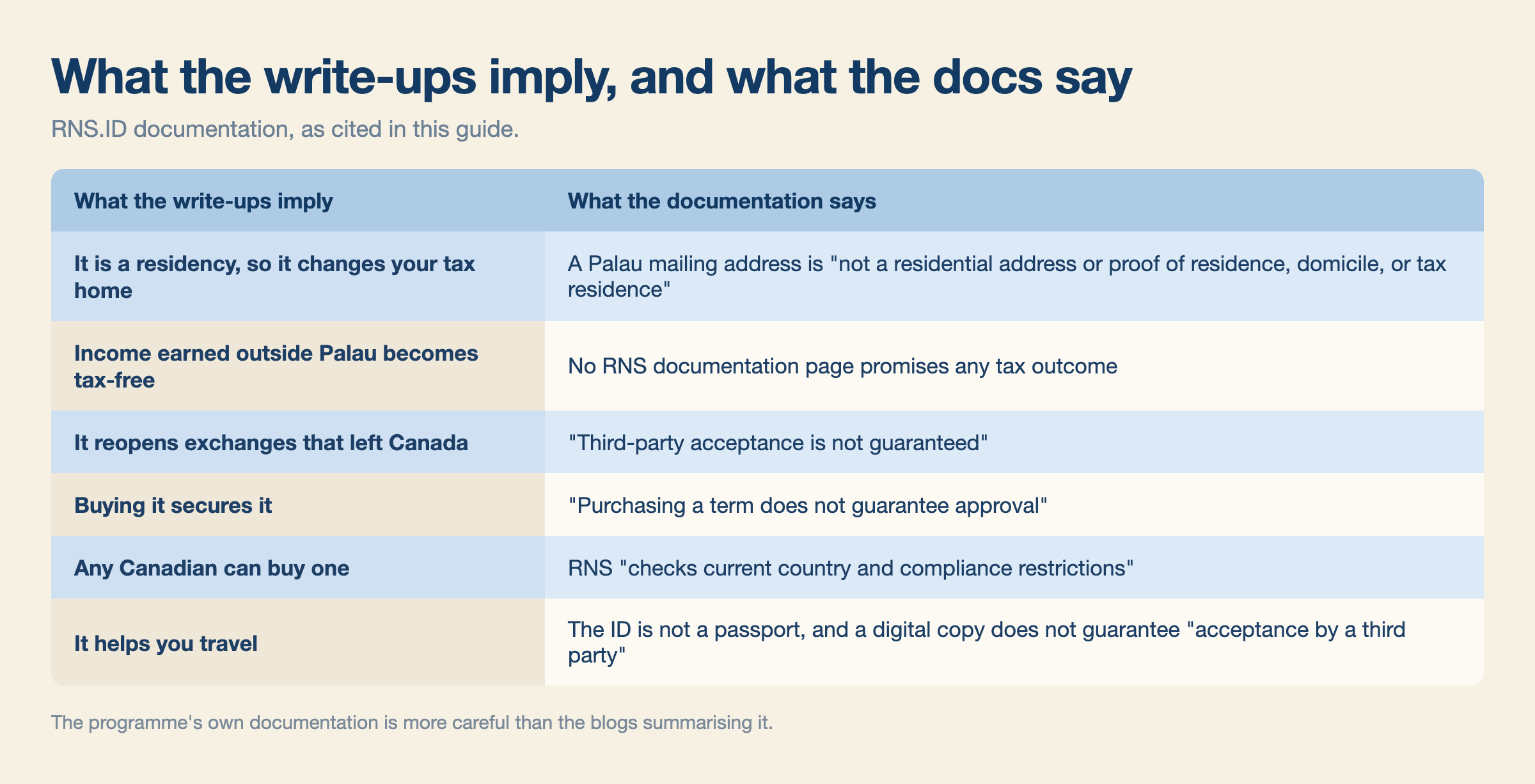
| What the write-ups imply | What the documentation says |
|---|---|
| It is a residency, so it changes your tax home | A Palau mailing address is "not a residential address or proof of residence, domicile, or tax residence" |
| Income earned outside Palau becomes tax-free | No RNS documentation page promises any tax outcome |
| It reopens exchanges that left Canada | "Third-party acceptance is not guaranteed" |
| Buying it secures it | "Purchasing a term does not guarantee approval" |
| Any Canadian can buy one | RNS "checks current country and compliance restrictions" |
| It helps you travel | The ID is not a passport, and a digital copy does not guarantee "acceptance by a third party" |
Read the first three rows as the reason this page exists. The rest of it works through each in order, with the Canadian side sourced to canada.ca rather than to anybody's summary of it. For the general version of the argument, our limitations page covers what the programme does not guarantee for anyone.
Can a Canadian apply? What RNS actually publishes
Here is the honest answer: RNS does not publish a static list of eligible nationalities, so no page — including this one — can tell you that a Canadian citizen is eligible. Its eligibility documentation says it "checks current country and compliance restrictions", that the "restricted-country list is maintained by the service and can change", and it directs you to the list shown in the product rather than to a copied one.
That is a deliberate design, and the correct one for a compliance screen. It also means every third-party page quoting a country count — 138 countries, 150-plus countries — is quoting a snapshot of a list that is not published and has moved. Treat those numbers as history, not as eligibility.
What the docs are specific about is the material you must supply.
| What you need | RNS's requirement |
|---|---|
| Identity document | "An original, valid government-issued identity document accepted by the verification flow" |
| Which documents count | "The verification interface determines which document types are accepted for your country or region" |
| Portrait | "A recent, clear portrait for the ID card" — separate from the live facial verification |
| Account | An eligible RNS.ID account |
| Payment | "Payment starts the application" — it does not finish it |
| Approval | "Passing checkout does not replace identity verification or government approval" |
For a Canadian applicant that list is unremarkable: a current Canadian passport satisfies the first row comfortably. The screen you cannot see in advance is the compliance one, and the only place its current state exists is the checkout. Our supported countries page tracks what has been observable about exclusions over time.
The "0% tax" claim, and the step it skips
This is the sentence that sells the programme, and it is worth splitting in two, because one half is plausible and the other is a non sequitur.
The plausible half is about Palau. Whether Palau taxes income earned elsewhere is a question about Palauan law, and this page does not answer it, because we have not verified it against a primary Palauan source and will not assert it from a marketing page. The non sequitur is the jump from there to your return. A statement about what Palau charges only reaches your bill if Palau is where you are taxed — and holding an identity card is not what decides that.
The better-hedged competitor pages half-admit this. One corporate-services page markets "Digital Residency & 0% Tax" in its title and then concedes, well down the page, that the figure applies "at the Palau level" and that the ID is "not an automatic tax-residence certificate". Both qualifications are correct. They also dismantle the headline, which is the part that gets shared, and neither that page nor the personal-experience guides ranking beside it says a word about how Canadian rules treat the position. Our tax guide makes the general case; the next section makes the Canadian one.
How Canadian tax residency is actually decided
This is where the Canadian answer diverges from the advice written for other countries, and it is the thing to understand before spending anything. Canadians read a great deal of residency advice built around spending fewer than 183 days somewhere. That is not how the CRA's test works for someone leaving Canada.
The CRA's guidance on determining your residency status puts the weight on ties, not days: the most important factor is "whether or not you maintain or establish significant residential ties with Canada".
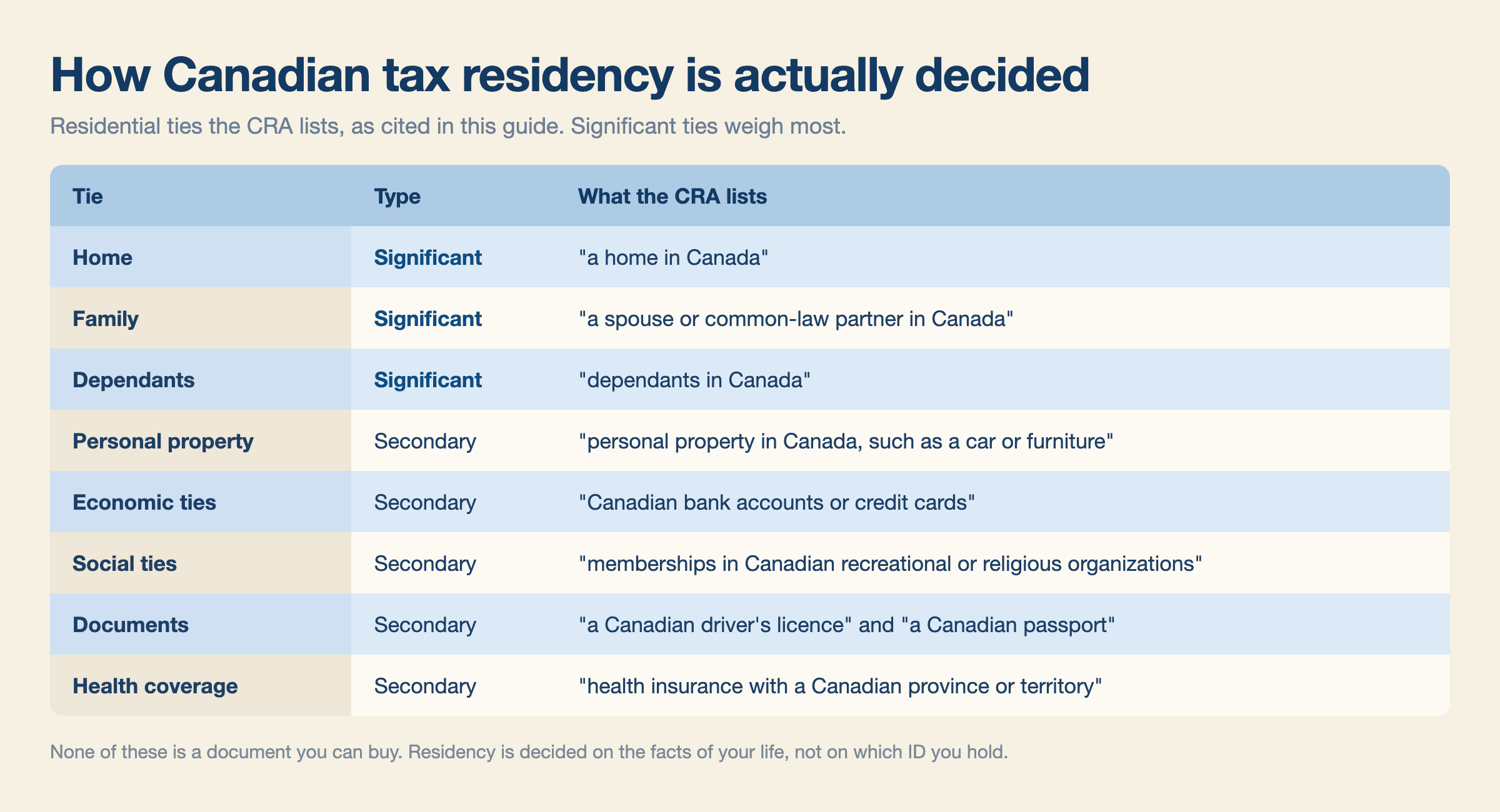
| Tie | Type | What the CRA lists |
|---|---|---|
| Home | Significant | "a home in Canada" |
| Family | Significant | "a spouse or common-law partner in Canada" |
| Dependants | Significant | "dependants in Canada" |
| Personal property | Secondary | "personal property in Canada, such as a car or furniture" |
| Economic ties | Secondary | "Canadian bank accounts or credit cards" |
| Social ties | Secondary | "memberships in Canadian recreational or religious organizations" |
| Documents | Secondary | "a Canadian driver's licence" and "a Canadian passport" |
| Health coverage | Secondary | "health insurance with a Canadian province or territory" |
Three things follow, and none of them involves a card. First, there is no general 183-day exit rule. The 183-day threshold appears in the CRA's guidance for people who have not established significant ties but "stayed in Canada for 183 or more days in the year" — a deemed-resident test for arrivals, not a safe harbour for departures. Second, keeping the ties keeps the residency. The CRA's factual residents page is explicit that if you "keep significant residential ties in Canada while living or travelling outside the country", you must "report all income you receive from sources inside and outside Canada for the year". Third, treaties can override the result — someone treated as resident in a treaty country may be a deemed non-resident — and Palau is not a treaty partner doing that work here.
Notice what is absent from the entire test: any mention of a foreign identity document. Severing Canadian residency is a question of where your home, family and ties are. It is slow, personal and expensive, and a $288 card is not a shortcut through it. Our risks page covers what happens when people treat it as one.
What the CRA does with your crypto, and what changes in 2027
For most people buying a Palau ID the real subject is crypto, so it is worth being precise about what the CRA already does. Its crypto-asset guidance starts from the point that "cryptocurrency is not government-issued currency", which makes paying with it "a barter transaction for income tax purposes".
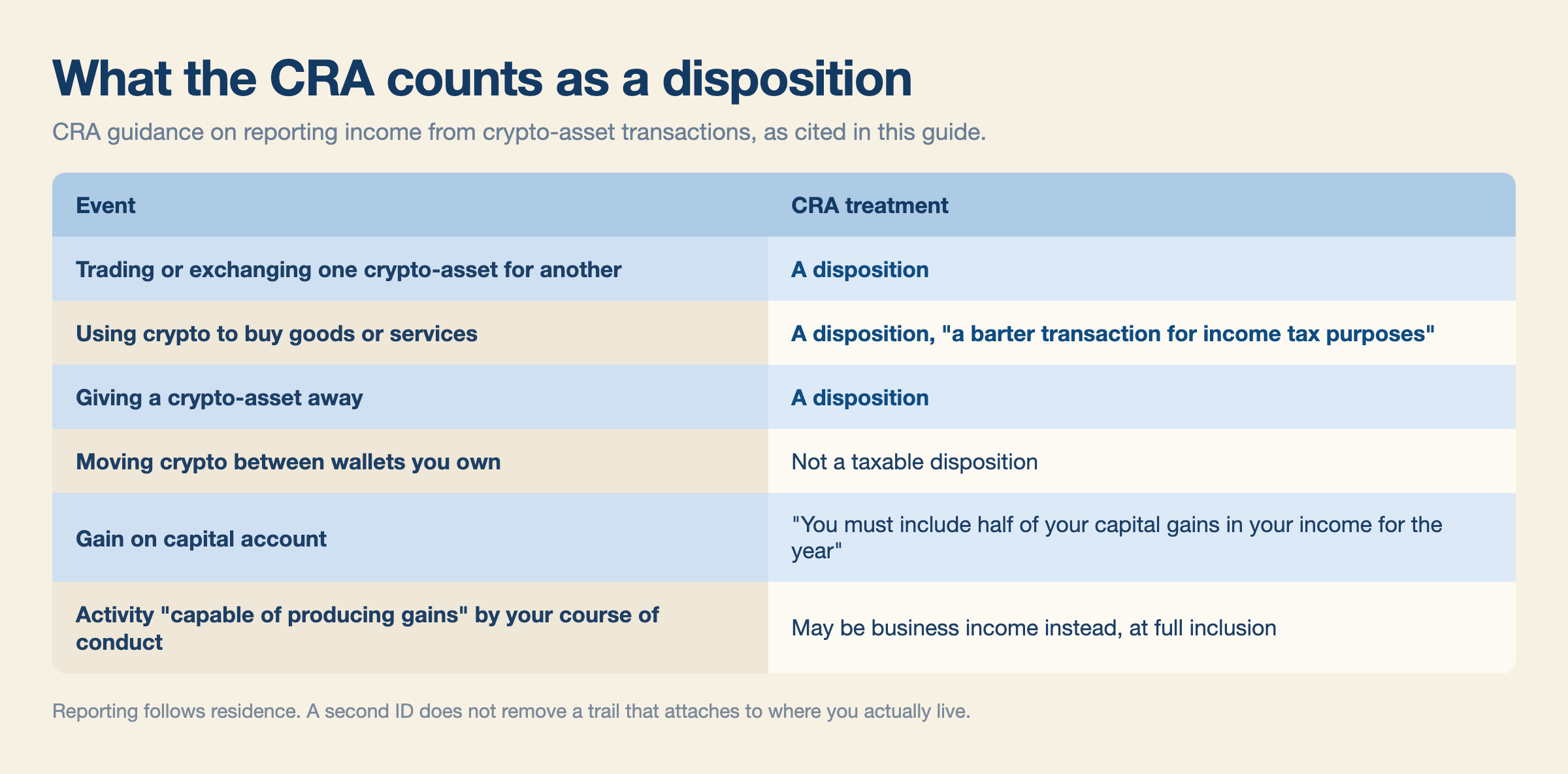
| Event | CRA treatment |
|---|---|
| Trading or exchanging one crypto-asset for another | A disposition |
| Using crypto to buy goods or services | A disposition — "a barter transaction for income tax purposes" |
| Giving a crypto-asset away | A disposition |
| Moving crypto between wallets you own | Not a taxable disposition |
| Gain on capital account | "You must include half of your capital gains … in your income for the year" |
| Activity "capable of producing gains" by your course of conduct | May be business income instead, at full inclusion |
The duty is unambiguous: "as a crypto-asset user, you must report business income (or losses) or capital gains (or losses) from dispositions". That obligation attaches to you as a Canadian resident and has nothing to do with which document verified your account.
The reporting side is where this page can save you from a date that is now wrong. Canada is implementing the OECD's Crypto-Asset Reporting Framework, which obliges service providers — not individuals — to collect and report user data. Finance Canada released draft legislative proposals in August 2025, and the application date was subsequently deferred to 1 January 2027, carried in the Budget 2025 implementation legislation. On that timetable calendar 2027 is the first reporting year, with the first provider returns falling due in spring 2028.
Two honest caveats. We could not confirm royal assent from a primary source, so treat those dates as proposed rather than settled. And secondary sources still disagree: a large number of pages written earlier in 2026 describe collection as having begun on 1 January 2026, which was the original plan before the deferral. Either way the direction is one-way, and our CARF page covers the wider framework. Compare the UK, where the equivalent collection duty did start on 1 January 2026 — our UK citizens page works through that regime.
The exchange question is about residency, not your ID
This is the claim that sells Palau IDs to Canadians specifically, and it misreads what happened to the Canadian market. Canadians did lose access to major platforms. Binance announced on 12 May 2023 that it was withdrawing from Canada, saying new Canadian Securities Administrators guidance on stablecoins and investor limits had made the market "no longer tenable", and Canadian users were told to close positions by 30 September that year. It had already left Ontario earlier, in 2022.
Read what kind of decision that was. A platform withdrawing from a jurisdiction is deciding which market it will serve, not which identity documents it accepts. The gate is where you reside and whether the platform is registered to serve people there — so a card issued by a third country does not reopen it.
| What people hope the ID does | What actually gates access |
|---|---|
| Satisfies verification where you were refused | Some platforms accept the card; "third-party acceptance is not guaranteed" |
| Reopens a platform that exited Canada | Nothing in a card changes a platform's market decision |
| Changes the residency you declare | Your residency is a fact about you, not about your document |
| Removes a reporting trail | Reporting follows residence; see the section above |
| Replaces a registered platform | Canadian regulators maintain registration regimes and publish registered platforms |
There is also a practical warning worth stating plainly, because the "workaround" framing invites it. Declaring a residency that is not yours on a financial platform is a misrepresentation, and the exposure is yours — frozen balances, closed accounts and failed withdrawals, with no recourse to the issuer, which guarantees none of this. Our KYC loophole page sets out why that framing fails in 2026, and the exchange KYC tracker records acceptance platform by platform instead of promising it.
Your Canadian passport already handles the travel part
For a Canadian passport holder the travel case mostly dissolves on inspection. The Government of Canada's Palau travel advice is short and specific.
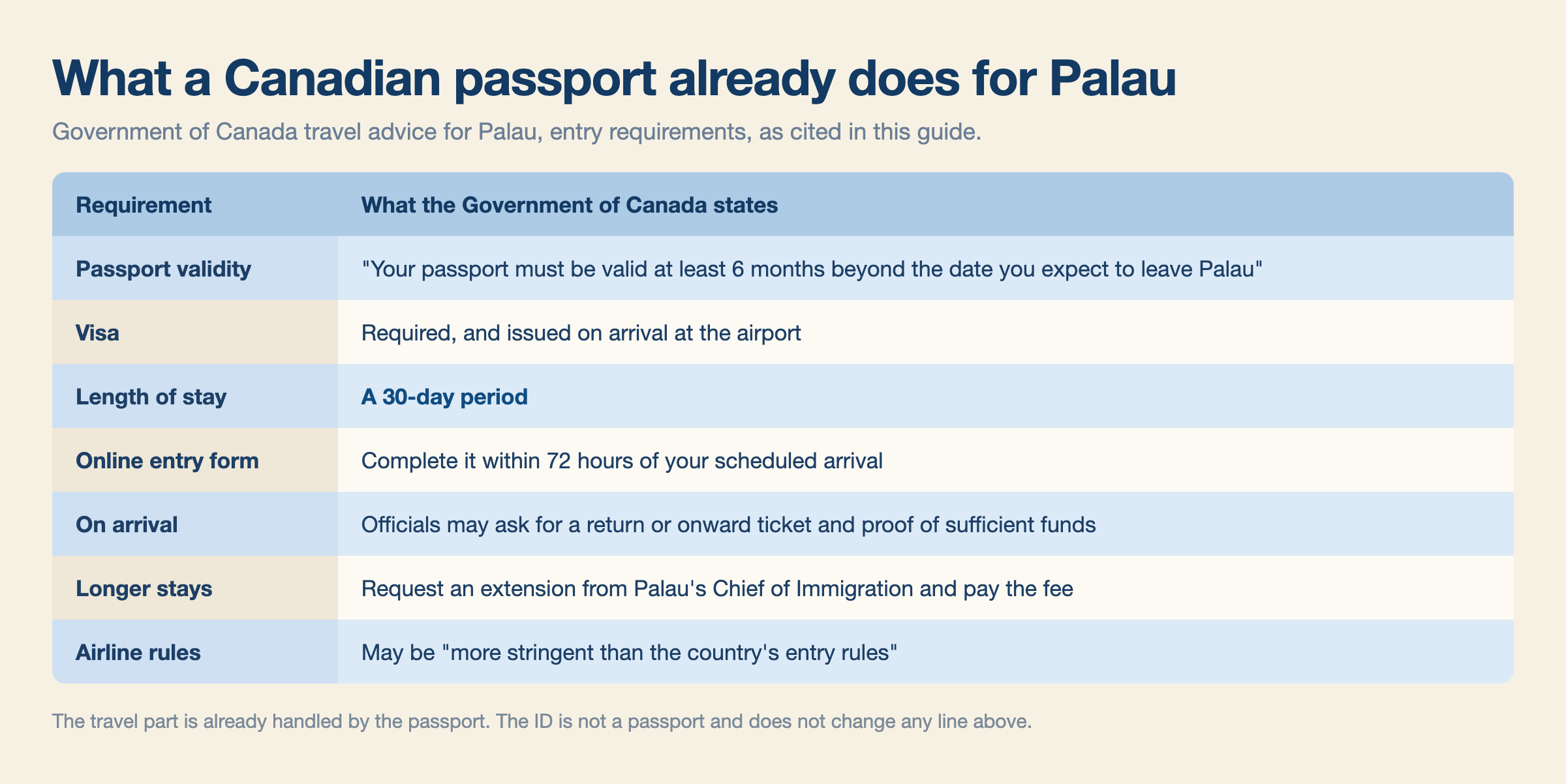
| Requirement | What the Government of Canada states |
|---|---|
| Passport validity | "Your passport must be valid at least 6 months beyond the date you expect to leave Palau" |
| Visa | Required, and issued on arrival at the airport |
| Length of stay | A 30-day period |
| Online entry form | Complete it within 72 hours of your scheduled arrival |
| On arrival | Officials may ask for a return or onward ticket and proof of sufficient funds |
| Longer stays | Request an extension from Palau's Chief of Immigration and pay the fee |
| Airline rules | May be "more stringent than the country's entry rules" |
A Palau digital residency card adds nothing to that list, and RNS does not claim it does — a digital copy does not guarantee "acceptance by a third party", and the card is not a travel document. Our travel page works through the 2026 rules in more detail, and the separate question of extending a stay is covered on our visa extension page.
Who Palau digital residency suits in Canada, and who should skip it
The card has real uses, and they are narrower and more specific than "offshore residency". It is a government-issued photo ID that some platforms accept, obtainable without visiting the issuing country, which is genuinely useful if your existing documents are the problem. It is not a tax instrument, not an exchange key and not a travel document.
| Option | Listed price | Validity |
|---|---|---|
| Trial | $288 | 1 year |
| Regular | $1,199 | 5 years |
| Ultimate | $2,339 | 10 years |
Those are the tiers our cost page recorded, and RNS states that current terms and prices are intentionally not fixed in its documentation, pointing to the checkout instead. Treat the table as indicative and confirm the price before paying.
Skip it if your reason for buying is a lower Canadian tax bill, a tax residence, a second passport, or a way back onto a platform that left Canada. The first three are not what the product is, and the fourth is a market decision no card reverses. Consider it if you want a government-issued ID as a documented identity option, you have read the limitations and the risks, and you are treating the fee as the cost of an identity document rather than an investment. If you are weighing the programme itself rather than the Canadian angle, is RNS.ID legit? is the better starting page.
Related reading
- Palau digital residency for US citizens — the same questions under US rules
- Palau digital residency for UK citizens — where the reporting duty already started
- Palau digital residency tax guide — why the ID is not a tax position
- CARF crypto reporting and a Palau ID — the wider reporting framework
- Palau ID KYC loophole — why the workaround framing fails
- Palau digital residency cost — the 1, 5 and 10 year options
- Is RNS.ID legit? — who runs the programme, under what authority
FAQ
Can Canadian citizens get Palau digital residency?
RNS does not publish a fixed list of eligible nationalities, so there is no documented yes to quote. Its eligibility page says it "checks current country and compliance restrictions" and that the "restricted-country list is maintained by the service and can change", directing you to the list shown in the product. A current Canadian passport meets the document requirement; the compliance screen is only visible at checkout.
Does a Palau ID change my Canadian tax residency?
No. The CRA decides residency on residential ties — a home, a spouse or common-law partner, and dependants in Canada, supported by secondary ties such as bank accounts, a driver's licence or provincial health coverage. Holding a foreign identity card is not an input to any of that, and RNS's own documentation says a Palau mailing address is "not a residential address or proof of residence, domicile, or tax residence".
Is there a 183-day rule for leaving Canada?
Not in the way it is usually described. The CRA's 183-day threshold applies to people who have not established significant residential ties but stayed in Canada for 183 or more days in the year, which can make them deemed residents. For someone leaving Canada, the question is whether significant ties are maintained, not how many days were spent abroad.
Do I still pay Canadian tax if I hold Palau digital residency?
If you remain a factual resident, yes. The CRA states that someone who keeps significant residential ties while living or travelling outside the country must report all income received from sources inside and outside Canada for the year. The card does not move you out of that category, and tax treaties, not identity documents, are what change the analysis.
Will a Palau ID get me back onto Binance in Canada?
No, because that is not what closed the door. Binance announced its withdrawal from the Canadian market in May 2023, citing new Canadian Securities Administrators guidance on stablecoins and investor limits — a decision about serving Canada, not about accepted documents. RNS does not promise acceptance either, stating that "third-party acceptance is not guaranteed". Check any specific platform's current rules before buying anything.
Does the CRA see my crypto if I verify with a Palau ID?
The reporting trail follows residence, not the card you showed. You are already required to report business income or capital gains from dispositions of crypto-assets, and Canada's implementation of the Crypto-Asset Reporting Framework would put collection and reporting duties on service providers from a proposed start of 1 January 2027, making 2027 the first reporting year. Those dates are proposals and should be checked before you rely on them.
Does Palau digital residency let me live in or move to Palau?
No. It is an identity product rather than an immigration status, and any right to enter or stay in Palau is decided by Palau's own authorities under their rules. As a Canadian you can already visit for a 30-day period with a visa issued on arrival, and longer stays require an extension from Palau's Chief of Immigration.
Is Palau digital residency worth it for a Canadian?
It depends entirely on what you expect from it. As a government-issued photo ID that some platforms accept and that you can obtain remotely, it may be worth the listed fee. As a route to a lower Canadian tax bill, a tax residence, a second passport or restored access to an exchange that left Canada, it is not — and none of those outcomes appears anywhere in RNS's own documentation.