Palau Digital Residency for Indian Citizens 2026
What Palau digital residency does and does not do for an Indian citizen in 2026: the deemed-residency rule, crypto tax, LRS limits, and claims to skip.
We may earn a commission if you apply through this link. This site is independent and is not the official RNS.ID or Palau government site.
Key takeaways
- A Palau digital residency card is not an input to any Indian residency test. Indian residency turns on days and income: 182 days in the tax year, or 60 days in the year plus 365 days across the preceding four. An ID card appears in neither test.
- India has a rule that specifically catches the person this card is marketed to. An Indian citizen with more than Rs 15 lakh of income other than foreign-source income, who is "not liable to tax in any other country by reason of domicile, residence or similar criteria", is a deemed resident — and the Income Tax Department says stay in India is "insignificant" in that scenario. Buying a Palau ID does not make you liable to tax in Palau, so it cannot switch this off.
- From 1 April 2026 the governing law changed, and the rule survived. The department says residency for tax years before that date stays under section 6 of the Income Tax Act, 1961, and that section 6 of the Income Tax Act, 2025 applies to tax years beginning on or after it. The deemed-residency provision is section 6(7) of the new Act.
- RNS does not publish a list of eligible nationalities, so "can an Indian apply" has no documented yes. Its own wording is that the "restricted-country list is maintained by the service and can change", and that "purchasing a term does not guarantee approval."
- The card changes nothing about what India already taxes on your crypto. Transfers of virtual digital assets are taxed at a flat 30% with only the cost of acquisition deductible, losses cannot be set off or carried forward, and 1% TDS applies under section 194S on payments to a resident.
On this page
- Palau digital residency in India: what actually changes
- Can an Indian citizen apply? What RNS actually publishes
- The "0% tax" claim, and the step it skips
- How Indian tax residency is actually decided
- The deemed-residency rule that catches this card's buyer
- Paying for it from India: the LRS ceiling
- What India already taxes on your crypto, ID or no ID
- Exchange and bank acceptance is about residency, not your ID
- Your Indian passport, Palau travel, and who should skip this
Palau digital residency in India: what actually changes

Short answer: your mailing options, and nothing that a tax officer in India would recognise.
I went looking for an India-specific account of this card and could not find one. The guides that rank for it are written for a general audience — they explain the application flow and the price tiers, and when they reach tax they say "your home country rules still apply" and stop. For an Indian reader that is the sentence where the article should have started, because India's residency rules are unusually hard to escape and unusually specific about citizens.
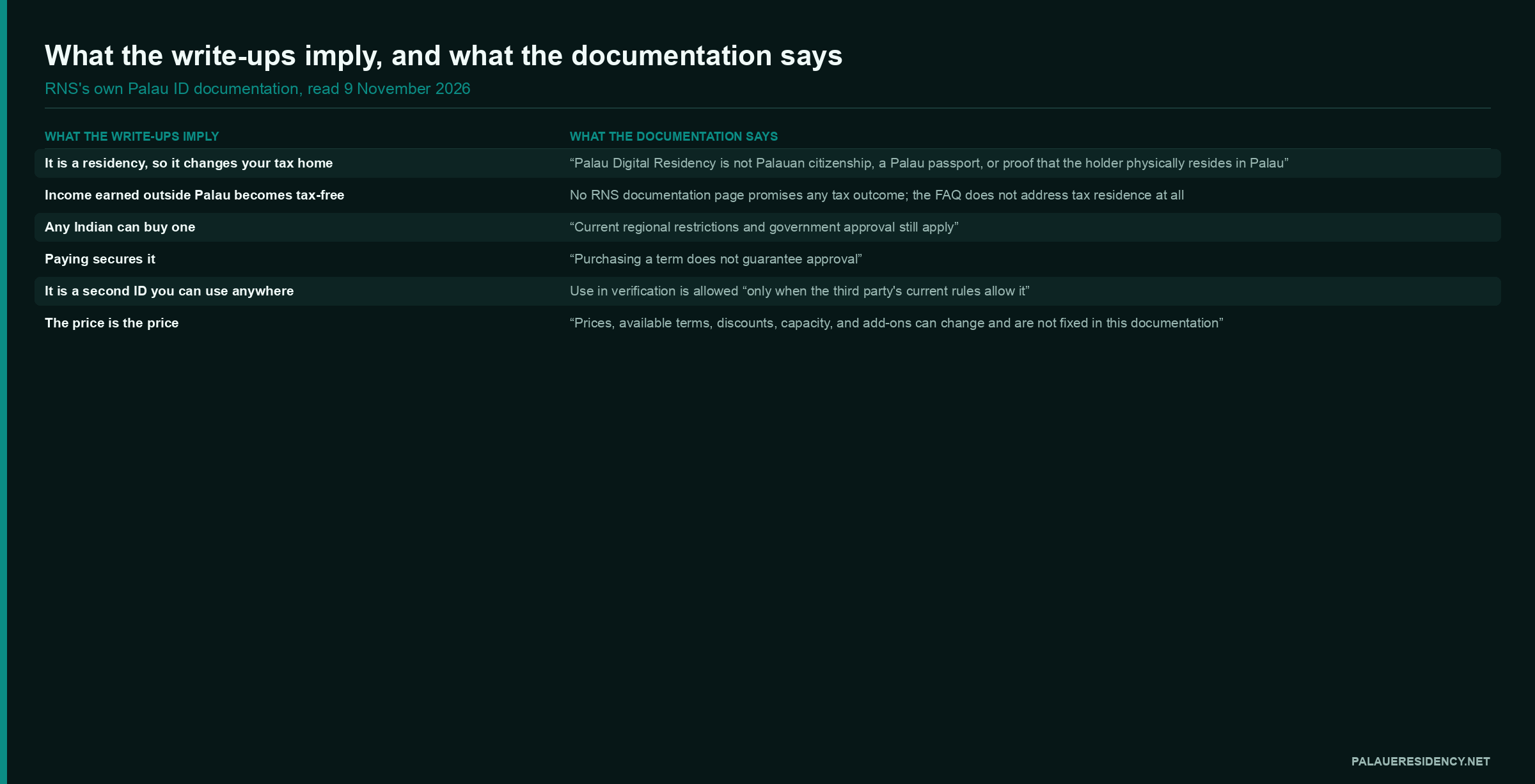
So here is the comparison the write-ups skip. On the left, what the marketing around Palau digital residency implies. On the right, what RNS's own documentation actually says.
| What the write-ups imply | What the documentation says |
|---|---|
| It is a residency, so it changes your tax home | "Palau Digital Residency is not Palauan citizenship, a Palau passport, or proof that the holder physically resides in Palau" |
| Income earned outside Palau becomes tax-free | No RNS documentation page promises any tax outcome; the FAQ does not address tax residence at all |
| Any Indian can buy one | "Current regional restrictions and government approval still apply" |
| Paying secures it | "Purchasing a term does not guarantee approval" |
| It is a second ID you can use anywhere | Use in verification is allowed "only when the third party's current rules allow it" |
| The price is the price | "Prices, available terms, discounts, capacity, and add-ons can change and are not fixed in this documentation" |
Every quote in that right-hand column is from RNS's own docs, read on 9 November 2026. Note what is missing: there is no tax claim anywhere in it to argue with. The tax story is something the resellers added.
Can an Indian citizen apply? What RNS actually publishes
There is no published list of eligible nationalities, which means there is no documented yes for India and no documented no either.
What the eligibility page says is procedural. An applicant "must be able to use an eligible RNS.ID account" and "complete the required identity and compliance checks", and "current regional restrictions and government approval still apply." On countries specifically: "RNS.ID checks current country and compliance restrictions", the "restricted-country list is maintained by the service and can change", and you should "review the list shown in the product."
India does not appear on the restriction lists this site has tracked, which name North Korea, Iran, Syria, Cuba, Crimea, and Sudan. That is an absence of evidence rather than a confirmation — the only list that binds is the one rendered at checkout for your account.
On documents, the requirement is an original: "prepare an original, valid government-issued identity document accepted by the verification flow", and "use the original document, not a photocopy, screenshot, or picture of a copy." An Indian passport satisfies the document requirement on its face. The application also "requests personal details and a deliverable physical address" — a real address that can receive a card, which for most Indian applicants is simply their own.
Two sentences are worth reading twice before you pay, because they are the ones that decide whether your money comes back. "Passing checkout does not replace identity verification or government approval", and "purchasing a term does not guarantee approval." RNS's support FAQ states that all orders are final and nonrefundable. Our cost breakdown has the current tiers and the reprint fee.
The "0% tax" claim, and the step it skips
The line you see repeated is that Palau charges 0% on income earned outside Palau, so a Palau residency makes your foreign income tax-free. The second half does not follow from the first, and the gap between them is the whole article.
A country's domestic rate only matters once that country has the right to tax you, which happens when you are tax-resident there. This card does not make you tax-resident in Palau. RNS's documentation says it is not proof that the holder physically resides in Palau, and the FAQ makes no tax claim at all. There is no step in the application where Palau assesses your residency for tax purposes, because that is not what is being sold.
So the sequence is: Palau's rate is irrelevant to you, and India's rules continue to apply exactly as they did before the card arrived. Our tax guide makes the same point in general terms; what follows is the India-specific version. None of this is tax advice — the point is only that the ID is not a position you can take.
How Indian tax residency is actually decided
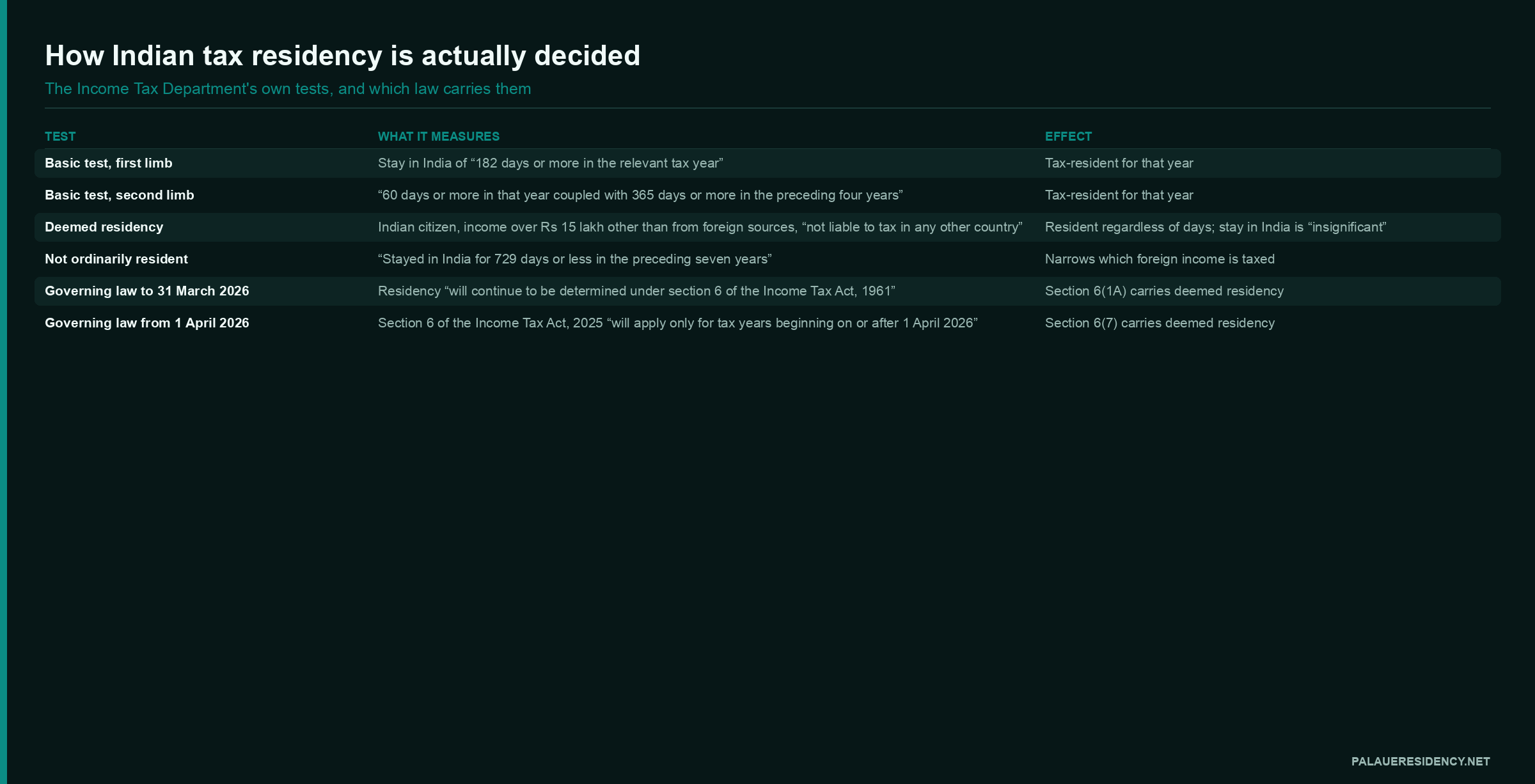
By counting. The Income Tax Department's own non-resident FAQs set out two tests, and neither one has a field for an identity document.
| Test | What it measures | Effect |
|---|---|---|
| Basic test, first limb | Stay in India of "182 days or more in the relevant tax year" | Tax-resident for that year |
| Basic test, second limb | "60 days or more in that year coupled with 365 days or more in the preceding four years" | Tax-resident for that year |
| Deemed residency | Indian citizen, income over Rs 15 lakh other than from foreign sources, "not liable to tax in any other country" | Resident regardless of days; stay in India is "insignificant" |
| Not ordinarily resident | "Stayed in India for 729 days or less in the preceding seven years" | Narrows which foreign income is taxed |
| Governing law to 31 March 2026 | Residency "will continue to be determined under section 6 of the Income Tax Act, 1961" | Section 6(1A) carries deemed residency |
| Governing law from 1 April 2026 | Section 6 of the Income Tax Act, 2025 "will apply only for tax years beginning on or after 1 April 2026" | Section 6(7) carries deemed residency |
The handover in those last two rows is the live 2026 story. India replaced the 1961 Act with the Income Tax Act, 2025 for tax years beginning on or after 1 April 2026, and the department's guidance maps the old provisions onto the new numbering: the basic test stays at section 6, not-ordinarily-resident moves from section 6(6) to section 6(13), and deemed residency moves from section 6(1A) to section 6(7). The numbers changed. The tests did not.
Which is the quiet answer to the question most people arrive with. If you were hoping a Palau ID would move you out of Indian residency, there was never a mechanism for it to use.
The deemed-residency rule that catches this card's buyer
This is the section I would read first, because the rule reads as though it were drafted with this exact purchase in mind.
Deemed residency applies to an Indian citizen — not a foreign national, not an OCI holder — whose total income other than income from foreign sources exceeds Rs 15 lakh, and who is "not liable to tax in any other country by reason of domicile, residence or similar criteria." The department is explicit that days do not save you here: in that scenario, stay in India is "insignificant".
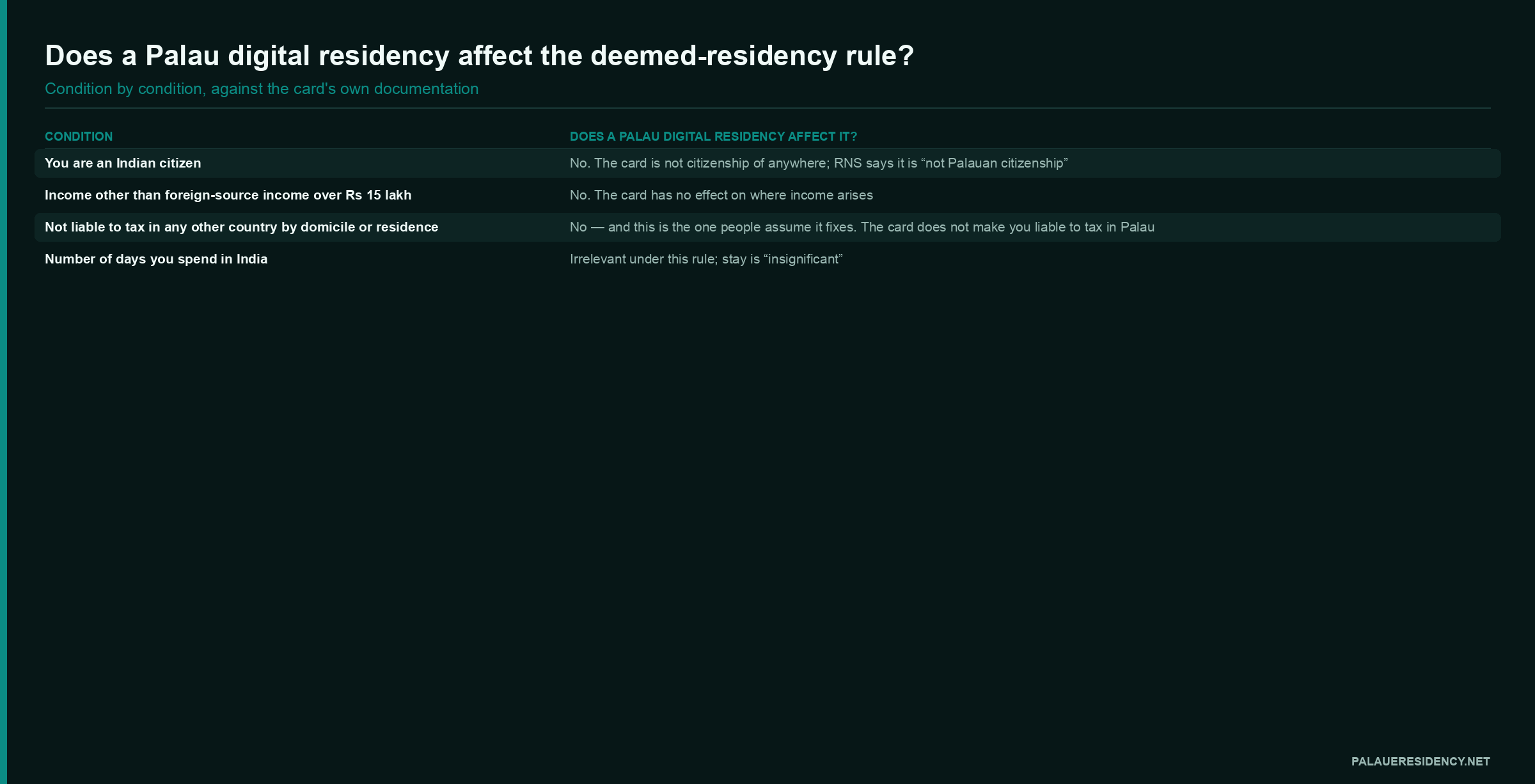
Read the trigger condition against what the card does.
| Condition | Does a Palau digital residency affect it? |
|---|---|
| You are an Indian citizen | No. The card is not citizenship of anywhere; RNS says it is "not Palauan citizenship" |
| Income other than foreign-source income over Rs 15 lakh | No. The card has no effect on where income arises |
| Not liable to tax in any other country by domicile or residence | No — and this is the one people assume it fixes. The card does not make you liable to tax in Palau |
| Number of days you spend in India | Irrelevant under this rule; stay is "insignificant" |
The third row is the whole trap. The rule's escape hatch is being taxable somewhere else, and a product that explicitly is not proof of residence cannot put you inside another country's tax net. An Indian citizen who gives up Indian residency, earns over Rs 15 lakh from India, and lands nowhere taxable is pulled back in by statute — and a card in a drawer does not change the analysis.
Whether a deemed resident then falls into not-ordinarily-resident treatment, which narrows what foreign income India taxes, is a separate question with its own 729-day test. That one is worth an hour with a chartered accountant. It is not worth $288 to an ID vendor.
Paying for it from India: the LRS ceiling
If you are resident in India, buying this card is an outward remittance, and that puts it under the Reserve Bank's Liberalised Remittance Scheme.
The RBI's FAQ says "all resident individuals, including minors, are allowed to freely remit up to USD 2,50,000 per financial year", on an April-to-March basis. A card at a few hundred dollars sits nowhere near that ceiling, so the limit is not your problem. Three details are more likely to matter.
| LRS point | What the RBI FAQ says |
|---|---|
| Annual limit | "Up to USD 2,50,000 per financial year" for resident individuals |
| Period | Financial year, "(April – March)" |
| Minors | Included; a minor's declaration "must be countersigned by the minor's natural guardian" |
| Entities | "The Scheme is not available to corporates, partnership firms, HUF, Trusts etc." |
| Who counts as resident | A person "residing in India for more than one hundred and eighty-two days during the course of the preceding financial year", with exclusions |
The entity row rules out an obvious idea: you cannot route this through your company as a neat business expense under LRS, because the scheme is for individuals. The last row is a reminder that "resident" under FEMA and "resident" under the Income-tax Act are different definitions that happen to share a number, and you can be one without being the other.
Tax collected at source on LRS remittances is the part I would not take from a blog. The threshold has moved more than once in recent budgets and the figures in circulation disagree, so check the current rate with your bank at the point of remittance rather than trusting a number in an article — including this one.
What India already taxes on your crypto, ID or no ID
Most people reading about Palau IDs got here through an exchange verification wall, so this is the section that decides whether the card does anything useful for you. On tax, it does nothing at all.
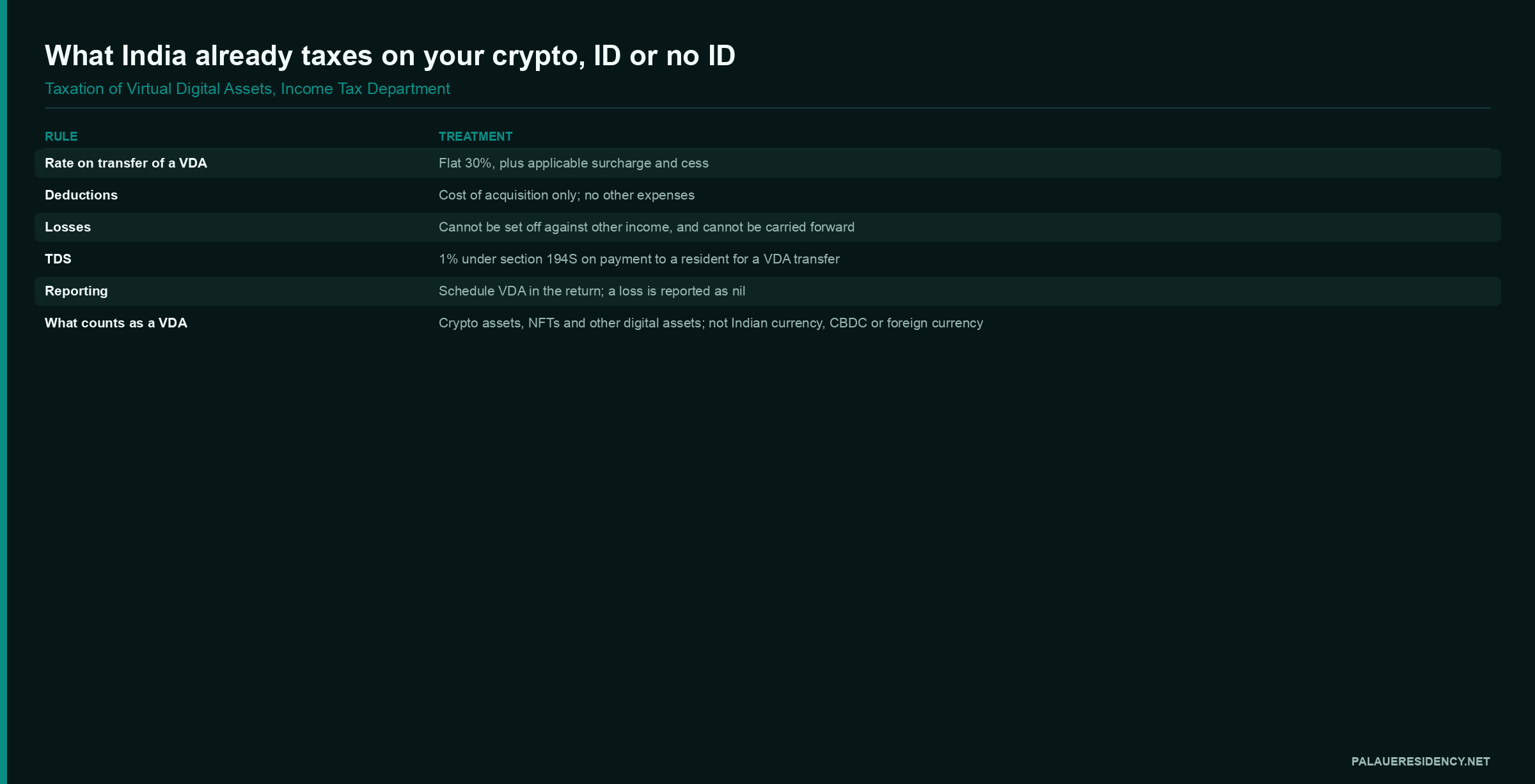
India's regime for virtual digital assets, as the Income Tax Department sets it out, is deliberately unforgiving.
| Rule | Treatment |
|---|---|
| Rate on transfer of a VDA | Flat 30%, plus applicable surcharge and cess |
| Deductions | Cost of acquisition only; no other expenses |
| Losses | Cannot be set off against other income, and cannot be carried forward |
| TDS | 1% under section 194S on payment to a resident for a VDA transfer |
| Reporting | Schedule VDA in the return; a loss is reported as nil |
| What counts as a VDA | Crypto assets, NFTs and other digital assets; not Indian currency, CBDC or foreign currency |
Not one line of that depends on which document you verified with. The 30% rate and the 1% TDS attach to the transaction and to your residency, and your residency is decided by the tests in the section above.
On the reporting side, two dates are worth separating because commentary runs them together. India's domestic obligation on crypto-asset reporting entities was introduced in the 2025 budget and runs from 1 April 2026. The international piece is later: a finance ministry official told Business Standard that India will implement the OECD's Crypto-Asset Reporting Framework from 1 April 2027. The section numbering of the domestic provision under the new Act is reported inconsistently across professional commentary, and I could not confirm it against an official notification, so I am not quoting a number for it. Our CARF explainer covers the framework itself, and the India-relevant crypto tax page the domestic side.
The direction is the same either way: more of your activity becomes visible to the department over the next two filing cycles, not less, and a foreign ID does not sit outside that.
Exchange and bank acceptance is about residency, not your ID
The pitch that lands hardest on Indian crypto users is that a Palau ID reopens exchanges that have restricted them. Treat that as unproven, because RNS does not claim it.
Its documentation says the ID can be used in third-party verification "only when the third party's current rules allow it", and that "issuance of the ID does not require a third party to approve a KYC or verification request." On the digital copy specifically: "downloading the PDF does not establish permission to use it in a particular verification process." That is a vendor declining to promise acceptance, which is the honest position and also the one that should set your expectations.
The mechanism matters. Platforms gate on your country of residence, assessed from the address, phone number, IP and tax details you give them — not solely on which document you upload. Swapping the document does not change the residency you declared, and declaring a residency you do not have is a problem of a different order. Acceptance varies by platform and changes without notice; our exchange KYC tracker records what each one currently does, and the crypto KYC guide explains why only the physical copy is accepted in most flows that accept it at all.
Your Indian passport, Palau travel, and who should skip this
If part of the appeal is visiting Palau, your passport is doing that work, not the card.
Palau's official airport guidance for arrivals is nationality-neutral on documents: "all visitors must have a valid passport not less than 6 months from date of expiration", a Palau Entry Form submitted "within 72 hours or less prior to your arrival time", and "proof of return arrangements (e-ticket receipt or a printed e-ticket confirmation)." The UK and US foreign ministries both describe Palau as admitting their nationals for up to 30 days without a pre-arranged visa.
For an Indian passport specifically, the third-party visa trackers contradict each other — some say visa-free, some say visa on arrival, and the fees quoted range from nothing to $50. I am not going to pick a winner among them. Confirm it with Palau's Bureau of Immigration or your airline before booking, and treat any single-source figure with suspicion. The separate claim that digital residents get extended stays has its own complications, which we cover in the visa extension guide; the card is not a travel document in any case, as the passport comparison sets out.
So who should actually buy one in India? A narrow group. If you want a second government-issued photo ID for non-critical verification, like a numbered membership or a low-stakes platform, and you are comfortable that it may be refused, the trial tier is a cheap experiment. If you are buying it to change your tax position, to get back onto an exchange that has restricted Indian users, or as a step toward living somewhere else, the documentation does not support any of those and the deemed-residency rule actively works against the first. Read the limitations and risks pages before you decide.
Related reading
- Palau digital residency for US citizens — the same questions under US rules
- Palau digital residency for UK citizens — HMRC residence and the UK reporting regime
- Palau digital residency for Canadian citizens — the CRA residential-ties test
- Palau digital residency tax guide — why the ID is not a tax position
- Palau digital residency limitations — what it does not guarantee
- Supported and restricted countries — how the country list actually works
- Is RNS.ID legit? — who runs the programme, under what authority
FAQ
Can Indian citizens get Palau digital residency?
RNS does not publish a list of eligible nationalities, so there is no documented yes to quote. Its eligibility page says only that "current regional restrictions and government approval still apply" and that the "restricted-country list is maintained by the service and can change", directing you to the list shown in the product. An Indian passport meets the original-document requirement; the compliance screen is only visible at checkout.
Does a Palau ID change my Indian tax residency?
No. Indian residency is decided by days in India and by income, under section 6 of the Income Tax Act, 2025 for tax years beginning on or after 1 April 2026. An identity document is not an input to any of those tests, and RNS's documentation says the ID is not proof that the holder physically resides in Palau.
What is the Rs 15 lakh deemed-residency rule?
It treats an Indian citizen as resident if their income other than income from foreign sources exceeds Rs 15 lakh and they are "not liable to tax in any other country by reason of domicile, residence or similar criteria." The Income Tax Department says stay in India is "insignificant" in that scenario. It sat in section 6(1A) of the 1961 Act and now sits in section 6(7) of the Income Tax Act, 2025.
Can a Palau digital residency make me liable to tax in Palau and avoid that rule?
There is nothing in RNS's documentation to support it. The ID is not proof of physical residence in Palau, no page claims any tax outcome, and no part of the application assesses you for Palau tax residency. Treating a card as a tax position is the specific mistake this rule is designed to catch, and it is a question for a chartered accountant rather than for an ID vendor.
Do I still pay 30% tax on crypto if I hold a Palau ID?
Yes, if you are tax-resident in India. The 30% rate on transfers of virtual digital assets, the restriction to cost of acquisition, the ban on setting off or carrying forward losses, and the 1% TDS under section 194S all attach to the transaction and your residency, not to the document you verified with.
Will Indian crypto exchanges accept a Palau ID for KYC?
Assume not unless the platform says so. RNS's own position is that the ID works in third-party verification "only when the third party's current rules allow it", and that issuance "does not require a third party to approve a KYC or verification request." Acceptance varies by platform and changes without notice.
Does buying the card count against my LRS limit?
If you are resident in India under FEMA, yes — it is an outward remittance under the Liberalised Remittance Scheme, which the RBI caps at USD 2,50,000 per financial year for resident individuals. A card costs a tiny fraction of that. Confirm the current tax collected at source position with your bank at the time you remit.
Does Palau digital residency let me live in or move to Palau?
No. RNS states that it is "not Palauan citizenship, a Palau passport, or proof that the holder physically resides in Palau", and its documentation tells you to check the requirements of the relevant government or organisation before relying on the ID for travel, immigration, residence or address evidence. Visiting Palau is handled by your passport under the ordinary visitor rules.