Palau Digital Residency for Nigerian Citizens 2026
What Palau digital residency does and does not do for a Nigerian in 2026: the six-limb residency test, TIN and NIN crypto reporting, and CARF from 2028.
We may earn a commission if you apply through this link. This site is independent and is not the official RNS.ID or Palau government site.

Key takeaways
- Palau digital residency changes nothing in Nigeria's residency test, and that test is what changed in 2026. The Nigeria Tax Act 2025 commenced 1 January 2026 and makes you a resident individual if any one of six limbs applies — domicile, a permanent place for your domestic use, habitual abode, substantial economic and immediate family ties, 183 days, or diplomatic service. To be non-resident you must fail all six at once.
- A Palau ID appears in none of those six limbs. It is an identity document, and RNS says plainly that it is "not Palauan citizenship, a Palau passport, or proof that the holder physically resides in Palau." Nothing in the application assesses you for Palau tax.
- Section 12 taxes a Nigerian resident's worldwide income in terms that leave no room for a card. Income of a resident is "chargeable to tax in Nigeria wherever they arise, and whether or not the income, profits or gains have been brought into or received in Nigeria."
- Nigerian crypto onboarding now runs on your Tax ID and your NIN. A VASP's monthly return must carry "the name, address, telephone number, email address and Tax ID of the customer including the national identification number of the customer if he is an individual." A foreign ID produces neither number.
- Nigeria is in the OECD's 2028 CARF group. The Global Forum's list, last updated 14 September 2026, puts Nigeria among the 27 jurisdictions undertaking first exchanges by 2028, with 46 jurisdictions going first in 2027.
On this page
- What Palau digital residency changes for a Nigerian in 2026
- Can a Nigerian apply for Palau digital residency?
- Nigeria's residency test has six limbs, and you must fail all six
- The "tax-free Palau" claim meets section 12
- Nigerian crypto onboarding now asks for your TIN and NIN
- CARF: Nigeria is in the 2028 exchange group
- Where the card is useful, and who should skip it
What Palau digital residency changes for a Nigerian in 2026
Your choice of identity document, and nothing a Nigerian tax officer is obliged to care about.
That matters more this year than last, because the rules on the Nigerian side moved: a new Act commenced on 1 January 2026 with a six-limb residency test, and crypto providers now file returns carrying your Tax ID and your NIN. I read both Acts in their gazette form and the issuer's own documentation for this piece, and the card appears in neither statute.
I also went looking for a Nigeria-specific account of this product and could not find one. The pages that rank for Palau digital residency are migration-firm guides that never mention Nigeria; the pages that rank for Nigeria's 2026 tax reform never mention a digital residency product. Readers sitting between the two get a "loophole" blog post or nothing, which is the gap this article closes.
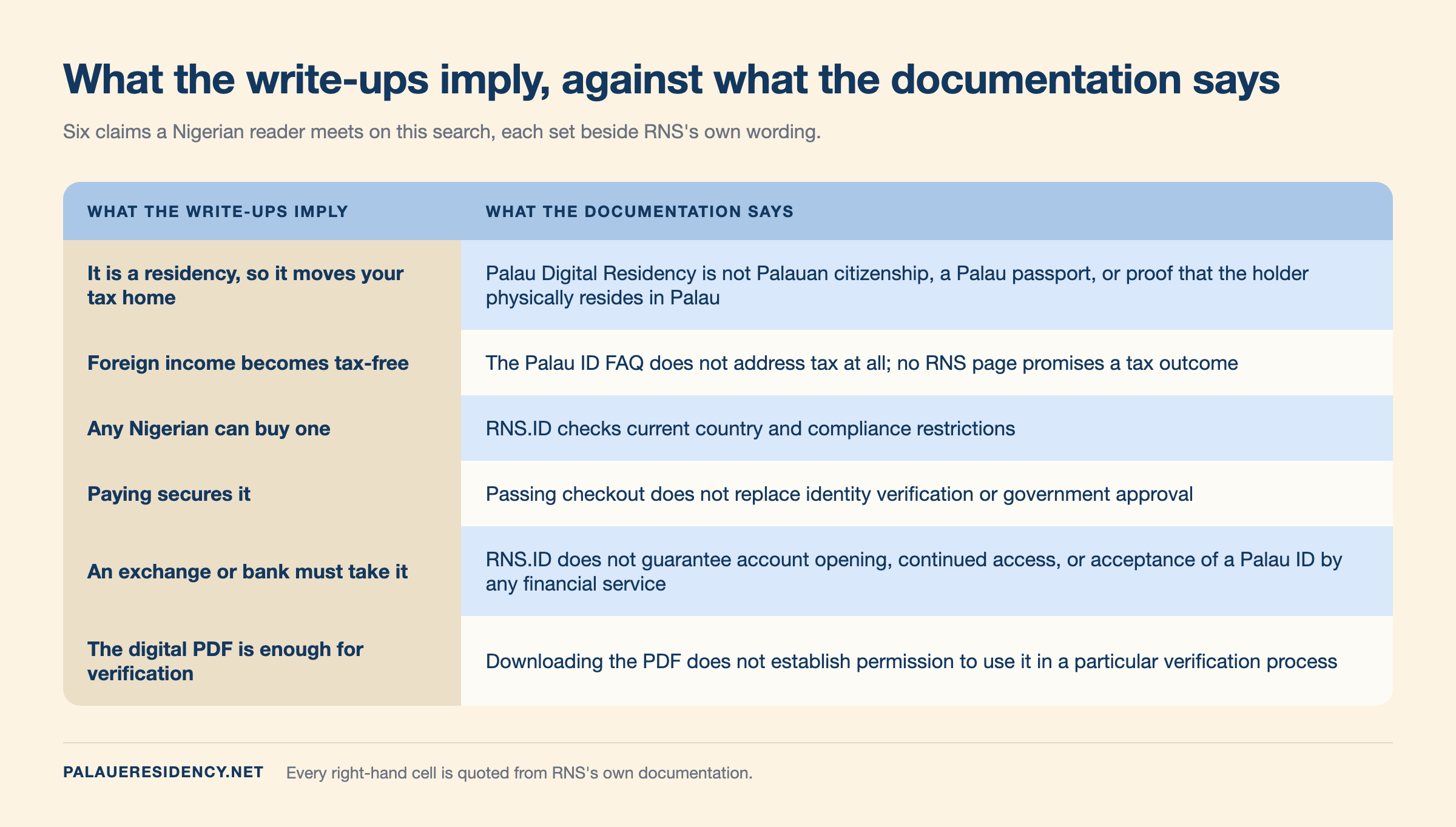
So here is the comparison both sides skip. On the left, what the resale write-ups imply. On the right, what RNS's own documentation says, read on 13 November 2026.
| What the write-ups imply | What the documentation says |
|---|---|
| It is a residency, so it moves your tax home | "Palau Digital Residency is not Palauan citizenship, a Palau passport, or proof that the holder physically resides in Palau" |
| Foreign income becomes tax-free | The Palau ID FAQ does not address tax at all; no RNS page promises a tax outcome |
| Any Nigerian can buy one | "RNS.ID checks current country and compliance restrictions" |
| Paying secures it | "Passing checkout does not replace identity verification or government approval" |
| An exchange or bank must take it | "RNS.ID does not guarantee account opening, continued access, or acceptance of a Palau ID by any financial service" |
| The digital PDF is enough for verification | "Downloading the PDF does not establish permission to use it in a particular verification process" |
Notice what is missing from the right-hand column: there is no tax claim in it to argue with. The tax story was added by resellers, not by the issuer, and our tax guide makes the same point in general terms. None of what follows is tax advice.
Can a Nigerian apply for Palau digital residency?
There is no published list of eligible nationalities, so there is no documented yes for Nigeria and no documented no either.
The eligibility page is procedural rather than geographic. An applicant "must be able to use an eligible RNS.ID account", the "verification interface determines which document types are accepted for your country or region", and current regional restrictions and government approval still apply. On countries it says only that "RNS.ID checks current country and compliance restrictions" and that the "restricted-country list is maintained by the service and can change".
Nigeria does not appear on the restriction lists this site has tracked, which name North Korea, Iran, Syria, Cuba, Crimea and Sudan — see our supported countries page. Treat that as an absence of evidence, not a confirmation: the only list that binds you is the one rendered at checkout for your own account.
| Step | What RNS says | What it means for a Nigerian applicant |
|---|---|---|
| Identity document | Use an original document, not a photocopy or screenshot, and not expired | A valid Nigerian passport meets this on its face |
| Document types | "The verification interface determines which document types are accepted for your country or region" | What the form accepts for Nigeria is only visible in the form |
| Address | "The Validate Address action does not guarantee that an external provider or carrier verified deliverability" | Check recipient, postcode, phone and customs fields yourself |
| Country screening | "The restricted-country list is maintained by the service and can change" | Only checkout shows the list that applies to you |
| Payment | "Passing checkout does not replace identity verification or government approval" | Paying starts the process rather than finishing it |
| Approval | "Purchasing a term does not guarantee approval" | No published refund guarantee against a refusal |
Two of those rows decide whether your money comes back, so read them twice before paying. Our cost breakdown covers the tiers, and re-check any figure at checkout because RNS deliberately does not hard-code prices in its docs.
Nigeria's residency test has six limbs, and you must fail all six
This is the part that makes 2026 different, and most of the relocation content written for Nigerians has not caught up with it.
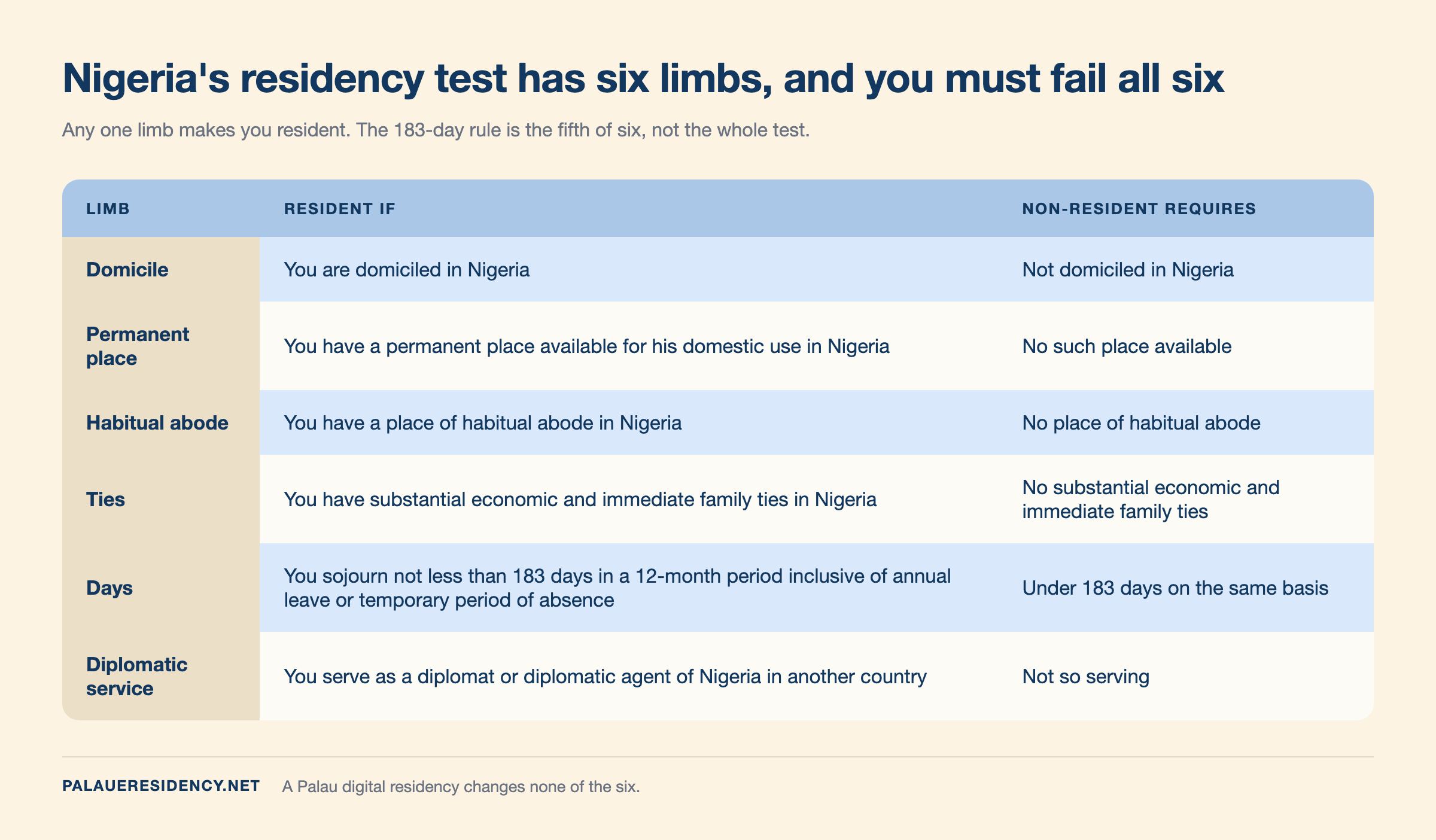
The Nigeria Tax Act 2025 — Act No. 7 of 2025, commencement date 1 January 2026 on its face — defines a "resident individual" as someone who, in any year of assessment, satisfies any one of six limbs. The definition of "non-resident individual" is the mirror image, and its limbs are joined by "and": you have to clear every one of them simultaneously. PwC's summary reads the statute the same way.
| Limb | Resident if… | Non-resident requires |
|---|---|---|
| Domicile | You are "domiciled in Nigeria" | Not domiciled in Nigeria |
| Permanent place | You have "a permanent place available for his domestic use in Nigeria" | No such place available |
| Habitual abode | You have a "place of habitual abode in Nigeria" | No place of habitual abode |
| Ties | You have "substantial economic and immediate family ties in Nigeria" | No substantial economic and immediate family ties |
| Days | You sojourn "not less than 183 days in a 12-month period inclusive of annual leave or temporary period of absence" | Under 183 days on the same basis |
| Diplomatic service | You serve "as a diplomat or diplomatic agent of Nigeria in another country" | Not so serving |
Read the fourth row again, because it is the one that defeats the card. A Lagos flat your family lives in, a Nigerian company you still draw from, or a spouse and children resident in Nigeria can keep you inside the net on a passport stamp count of nearly zero. An identity document issued by Palau does not appear in any of the six limbs, and no amount of it changes the facts the limbs measure.
That is also why "the 183-day rule" framing is misleading in 2026: 183 days is one limb out of six, not the test.
The "tax-free Palau" claim meets section 12
The pitch is that Palau does not tax income earned outside Palau, so a Palau residency makes your foreign income tax-free. The second half does not follow from the first, and a Nigerian resident runs into section 12 long before Palau's rates matter.
Section 12 of the Act is one sentence and it is unusually blunt: the income, gains or profits of an individual who is a resident of Nigeria "are deemed to accrue in Nigeria and are chargeable to tax in Nigeria wherever they arise, and whether or not the income, profits or gains have been brought into or received in Nigeria." There is no remittance escape and no foreign-ID exception in it.
A country's domestic rate only matters once that country has the right to tax you, which requires tax residence there. This card does not create Palau tax residence — RNS says it is not proof the holder physically resides in Palau, and no step in the application assesses you for Palau tax. Palau is also not the zero-tax jurisdiction the pitch implies; our CARF guide sets out what the Global Forum's peer review actually records about Palau's own residence test and wage tax.
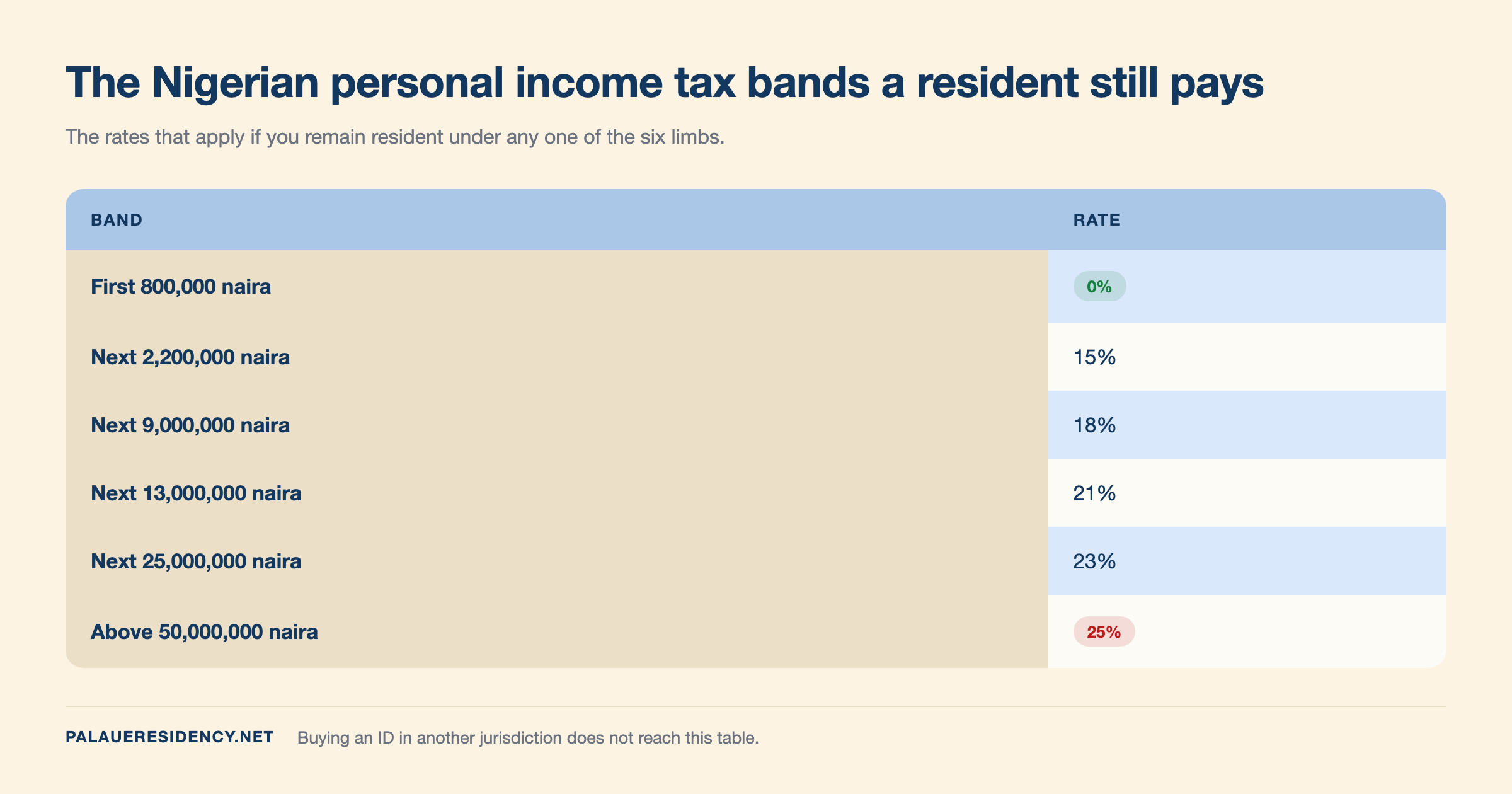
So the Nigerian bands apply exactly as they did before the card arrived. The Fourth Schedule rates, applied to taxable income after the relief allowance and exemptions in section 30, are:
| Band | Rate |
|---|---|
| First ₦800,000 | 0% |
| Next ₦2,200,000 | 15% |
| Next ₦9,000,000 | 18% |
| Next ₦13,000,000 | 21% |
| Next ₦25,000,000 | 23% |
| Above ₦50,000,000 | 25% |
Employment income has its own hook in section 13: it is deemed derived from Nigeria where the employee is a resident of Nigeria, or where duties are performed wholly or partly in Nigeria and the pay is "not duly liable to tax in the employee's country of tax residence."
Nigerian crypto onboarding now asks for your TIN and NIN
This is where most Nigerians actually meet the card, so it deserves the statute rather than a forum summary.
The Nigeria Tax Administration Act 2025 — Act No. 5 of 2025 — makes a virtual asset service provider file a return on top of its ordinary returns. Section 25(2) sets out the fields, and one of them is the whole answer to "will a Palau ID get me through Nigerian KYC".
| Return field (section 25(2)) | What it asks for |
|---|---|
| (a) | A description of the virtual asset service provided during the month |
| (b) | The date of the transaction |
| (c) | The type and value of the virtual assets involved |
| (d) | The sales value of the virtual assets |
| (e) | "The name, address, telephone number, email address and Tax ID of the customer including the national identification number of the customer if he is an individual" |
| (g) | Name, address, telephone and email of any counterparty |
| (h) | Any other particulars the relevant tax authority prescribes |
A Palau ID is not a Nigerian Tax ID and it is not a NIN, so it cannot satisfy field (e) for a provider operating in Nigeria. The Fifth Schedule adds the rest of the scaffolding: a VASP must register with the tax authority, "shall obtain a license from the Securities and Exchange Commission before commencement of business", collect "personal identification details (name, address, national ID, etc.)", report large or suspicious transactions to the Service and the NFIU, flag suspicious activity to the NFIU within 48 hours, and keep customer transaction and identification data "for at least seven years after the date of the last transaction."
Offshore venues are a different question, and an honest one: Nigerian law does not reach a foreign exchange's filing, which is exactly the gap the "KYC loophole" posts sell into. What it does not survive is the next section. Acceptance also varies by venue and changes without notice — our exchange KYC guide tracks where the card has actually been seen to work, and the honest default is to assume no until a platform says yes in writing.
CARF: Nigeria is in the 2028 exchange group
The identity you show at onboarding and the jurisdiction your data is reported to are two different things, and the second one is settled for Nigeria.
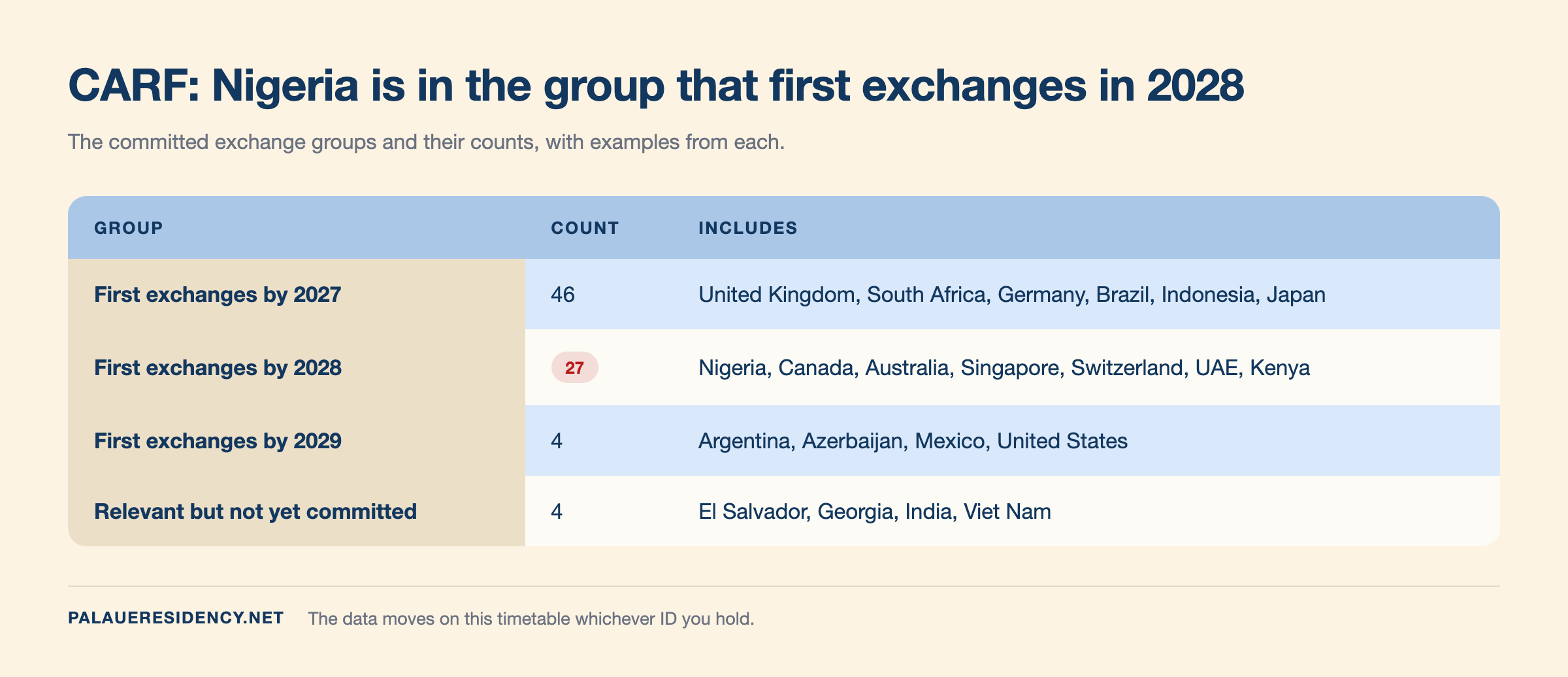
The OECD Global Forum's CARF commitment list, last updated 14 September 2026, names Nigeria in the group undertaking first exchanges by 2028. Crypto-asset reporting routes by the jurisdiction where the account holder is tax resident, self-certified at onboarding — not by which ID card was photographed.
| Group | Count | Includes |
|---|---|---|
| First exchanges by 2027 | 46 | United Kingdom, South Africa, Germany, Brazil, Indonesia, Japan |
| First exchanges by 2028 | 27 | Nigeria, Canada, Australia, Singapore, Switzerland, UAE, Kenya |
| First exchanges by 2029 | 4 | Argentina, Azerbaijan, Mexico, United States |
| Relevant but not yet committed | 4 | El Salvador, Georgia, India, Viet Nam |
Two consequences follow. A self-certification that names a tax residence you do not have is a false declaration, with or without a supporting card. And a Palau ID cannot make you tax resident in Palau for CARF purposes any more than it can for section 12, because the issuer says it is not evidence of residing there.
Where the card is useful, and who should skip it
Skip it if any of these describe you:
- You want out of the Nigerian net. The exit runs through the six limbs — where you are domiciled, what home is available to you, your economic and family ties, your days. A card is not in that list.
- You want to clear KYC at a Nigerian provider. Field (e) of the section 25 return wants a Tax ID and a NIN.
- You are hoping it fixes a failed verification offshore. RNS's own position is that issuance "does not require a third party to approve a KYC or verification request" — read our risks page before paying.
- You expect it to help you travel or relocate. It is not a passport, and RNS tells you to "review the requirements of the relevant government or organization before relying on the ID for travel".
Where it can be worth the money is narrower and more honest: a second, government-issued photo ID with a deliverable physical card, for someone who already accepts that it changes no tax position, creates no residence anywhere, and carries no guarantee of acceptance. On that basis it is a real product — just not the one the loophole posts are selling.
Related reading
- Palau digital residency for South African citizens — the SARS exit file and the certificate this card cannot produce
- Palau digital residency for Indian citizens — the deemed-residency rule
- Palau digital residency for UK citizens — HMRC residence and the UK reporting regime
- CARF crypto reporting and a Palau ID — where the data actually goes
- Palau digital residency limitations — what it does not guarantee
- Is RNS.ID legit? — who runs the programme, under what authority
FAQ
Can Nigerian citizens get Palau digital residency?
RNS publishes no list of eligible nationalities, so there is no documented yes to quote. Its eligibility page says only that "RNS.ID checks current country and compliance restrictions" and that the "restricted-country list is maintained by the service and can change". A Nigerian passport meets the original-document requirement on its face; the screening that matters is only visible at checkout for your own account.
Does a Palau ID change my Nigerian tax residency?
No. The Nigeria Tax Act 2025 makes you a resident individual if any one of six limbs applies — domicile, a permanent place available for your domestic use, habitual abode, substantial economic and immediate family ties, 183 days in a 12-month period, or Nigerian diplomatic service. An identity document is not an input to any of them, and RNS says the card is not proof that the holder physically resides in Palau.
Is the 183-day rule still how Nigerian residency works in 2026?
Not on its own. Since the Act commenced on 1 January 2026, 183 days is one limb of six, and non-residence requires you to fail all six simultaneously. Ties, domicile, habitual abode and an available permanent home can each keep you resident on a day count close to zero, which is why advice written around a pure day count is now incomplete.
Will a Palau ID let me skip TIN and NIN on a Nigerian crypto platform?
No. Section 25(2)(e) of the Nigeria Tax Administration Act 2025 requires a VASP's return to carry the customer's Tax ID "including the national identification number of the customer if he is an individual". A Palau ID is neither number, so it cannot satisfy that field for a provider operating in Nigeria, and the Fifth Schedule separately requires VASPs to collect national ID details and keep them for at least seven years.
Does Nigeria report crypto accounts under CARF?
Nigeria is committed to it. The OECD Global Forum's commitment list, last updated 14 September 2026, places Nigeria among the 27 jurisdictions undertaking first exchanges by 2028. Reporting routes by the account holder's self-certified tax residence rather than by the ID shown at onboarding, so the card does not change which jurisdiction receives a report.
Does holding a Palau ID make my foreign income tax-free in Nigeria?
No. Section 12 charges a Nigerian resident's income to Nigerian tax "wherever they arise, and whether or not the income, profits or gains have been brought into or received in Nigeria". Palau's domestic rates only become relevant if you are tax resident in Palau, and this card does not create that residence. This is general information and not tax advice — take Nigerian advice on your own facts.
What are the Nigerian income tax rates for 2026?
The Fourth Schedule taxes income after the relief allowance and exemptions at 0% on the first ₦800,000, 15% on the next ₦2,200,000, 18% on the next ₦9,000,000, 21% on the next ₦13,000,000, 23% on the next ₦25,000,000, and 25% above ₦50,000,000. Those bands apply to a resident individual's worldwide income under section 12.
Can I use a Palau ID for KYC on a crypto exchange as a Nigerian?
Assume not unless the platform says so. RNS's position is that the ID works in third-party verification "only when the third party's current rules allow it", that issuance "does not require a third party to approve a KYC or verification request", and that it does not guarantee "account opening, continued access, or acceptance of a Palau ID by any financial service". Acceptance varies by venue and changes without notice.