Palau Visa Extension for Digital Residents: 2026 Rules
Palau issues a 30-day visa on arrival. A regulation lets digital residents extend 90 days twice, but a Palau statute says otherwise. Read both first.
We may earn a commission if you apply through this link. This site is independent and is not the official RNS.ID or Palau government site.
Key takeaways
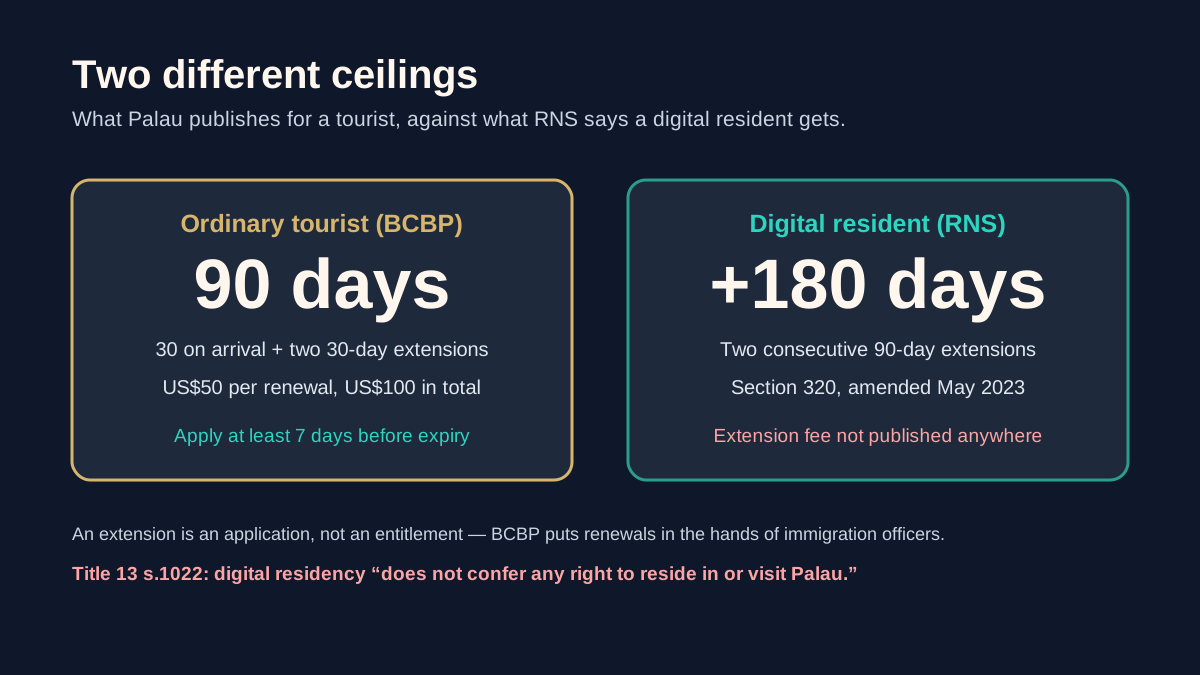
- Palau's Bureau of Customs and Border Protection publishes a 30-day tourist visa on arrival, extendable twice by 30 days each at US$50 per extension — a 90-day ceiling for an ordinary visitor.
- RNS says digital residents get an additional 180 days through two consecutive 90-day extensions, which traces to Section 320 of the Immigration Regulations, amended in May 2023.
- Title 13, Section 1022 of the Palau National Code says digital residency "does not confer any right to reside in or visit Palau." A sitting Palauan senator wrote to the President in November 2025 arguing the regulation contradicts that statute.
- RNS describes the two 90-day extensions as available "each entry"; the reporting on Section 320 describes them as each calendar year. Those are not the same rule, and nobody has reconciled them publicly.
- Your nationality decides your starting allowance before any of this applies — US, FSM and Marshall Islands citizens already get a year, so the extension is worth nothing to them.
The short answer: 30 days, then it depends
People buy a Palau ID for KYC. A smaller group buys it for a stay: the pitch is that digital residents can remain in Palau far longer than an ordinary tourist, which matters if you are chasing a day count for tax purposes. Before you build travel around that, know that the Palau visa extension for digital residents rests on a regulation that a Palauan senator has publicly asked the executive to fix.
That is not a rumour off a forum. It is a November 2025 letter from the Senate Floor Leader to the President, reported by Palau's own newspaper, and it names both the regulation and the statute it is said to conflict with. We read the immigration bureau's published rules and RNS's own wording side by side, and they do not describe the same entitlement.
This page sets out what each source actually says, where they disagree, and what to confirm before you book anything.
What Palau publishes for ordinary tourists
Start with the baseline, because the extension only makes sense against it. The Bureau of Customs and Border Protection (BCBP) is the Palau government body that runs immigration, and its published immigration page is the primary source here.
| Rule | What BCBP publishes |
|---|---|
| Tourist / business visa | Valid 30 days on arrival |
| Extensions | Two additional 30-day periods |
| Extension fee | US$50 per renewal |
| When to apply | At least seven days before your current visa expires |
| Where to apply | Division of Immigration |
| Passport validity | At least six months at time of entry |
| Return ticket | Required unless exempt |
| Funds | Proof of sufficient support for the length of the visit |
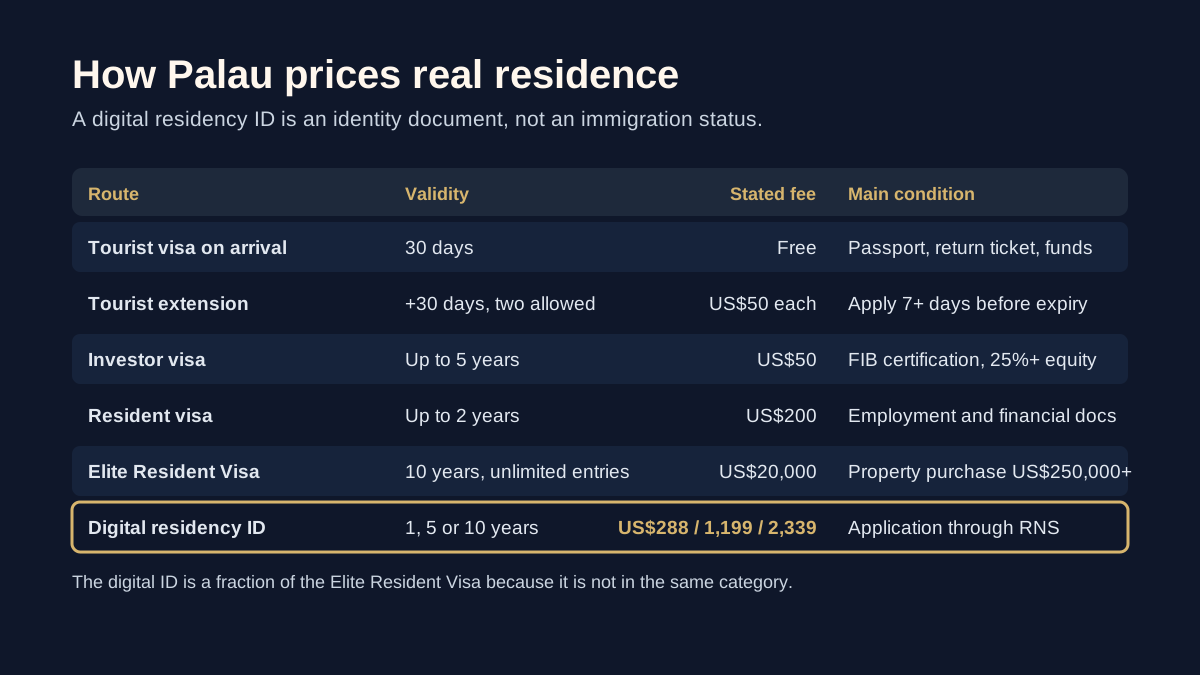
So the ordinary ceiling is 90 days: 30 on arrival plus two paid 30-day extensions, for US$100 in extension fees. BCBP also lists longer-stay routes that have nothing to do with digital residency — an investor visa tied to a Foreign Investment Board certification and at least a 25% equity interest, a resident visa granted at the Director's discretion, and an Elite Resident Visa. Those are the statutory long-stay categories, and the fees tell you how Palau prices real residence.
| Route | Validity | Stated fee | Main condition |
|---|---|---|---|
| Tourist visa on arrival | 30 days | Free on arrival | Passport, return ticket, funds |
| Tourist extension | +30 days each, two allowed | US$50 each | Apply 7+ days before expiry |
| Investor visa | Up to 5 years | US$50 issuance | FIB certification, 25%+ equity |
| Resident visa | Up to 2 years | US$200 | Employment and financial documentation |
| Elite Resident Visa | 10 years, unlimited entries | US$20,000 initial | Property purchase of US$250,000+ |
| Digital residency ID | 1, 5 or 10 years | US$288 / US$1,199 / US$2,339 | Application through RNS |
Notice the gap. A digital residency ID costs a fraction of the Elite Resident Visa, and it is not in the same category — it is an identity document, not an immigration status. Our Palau digital residency limitations page covers where that line sits generally; this page is about the one place the line has been blurred.
The digital-resident extension, and where it comes from
RNS's FAQ states that "an additional 180 days of stay in Palau is now possible for digital residents," through "new regulations allowing digital residents to extend their tourist visas for up to two consecutive 90-day periods each entry, after the initial visa expires." Its guidance is that you present the Palau ID card when applying for the extension.
The instrument behind that is Section 320 of Palau's Immigration Regulations, amended and approved in May 2023, which permits digital residents up to two consecutive 90-day extensions of their tourist visas. We could not retrieve the regulation document itself — the Palau government site blocked our request — so the wording above is as reported by Island Times in November 2025, corroborated by the standard public summary of Palau's visa policy.
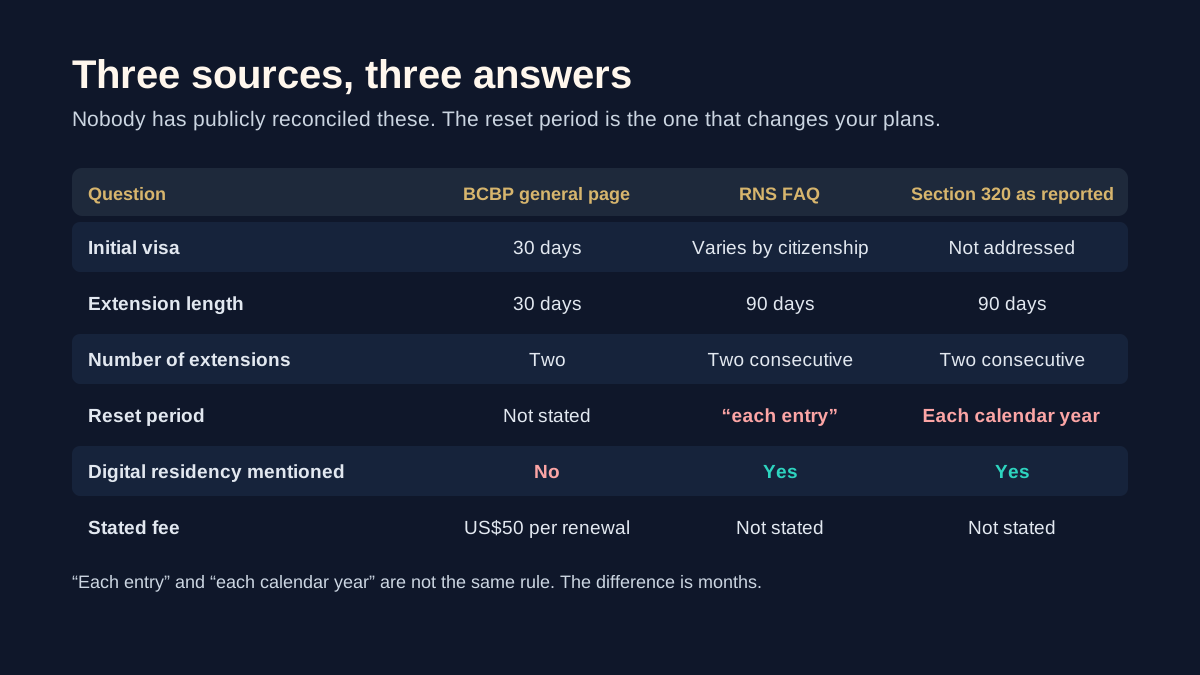
Here is the part worth slowing down for. RNS says "each entry." The reporting on Section 320 says each calendar year. Under one reading, you could leave, return, and start a fresh pair of 90-day extensions. Under the other, you get one pair per year no matter how many times you fly in. That is a difference of months, and it is the single most consequential detail for anyone planning around this.
| Question | BCBP general page | RNS FAQ | Section 320 as reported |
|---|---|---|---|
| Initial visa | 30 days | Varies by citizenship | Not addressed |
| Extension length | 30 days | 90 days | 90 days |
| Number of extensions | Two | Two consecutive | Two consecutive |
| Reset period | Not stated | "each entry" | Each calendar year |
| Digital residency mentioned | No | Yes | Yes |
| Stated fee | US$50 per renewal | Not stated | Not stated |
The BCBP page does not mention digital residency at all. That is not proof the extension does not exist — a general tourist page would not necessarily carry a special category — but it does mean the counter staff you meet are working from rules you have not read.
The statutory conflict nobody selling the ID mentions
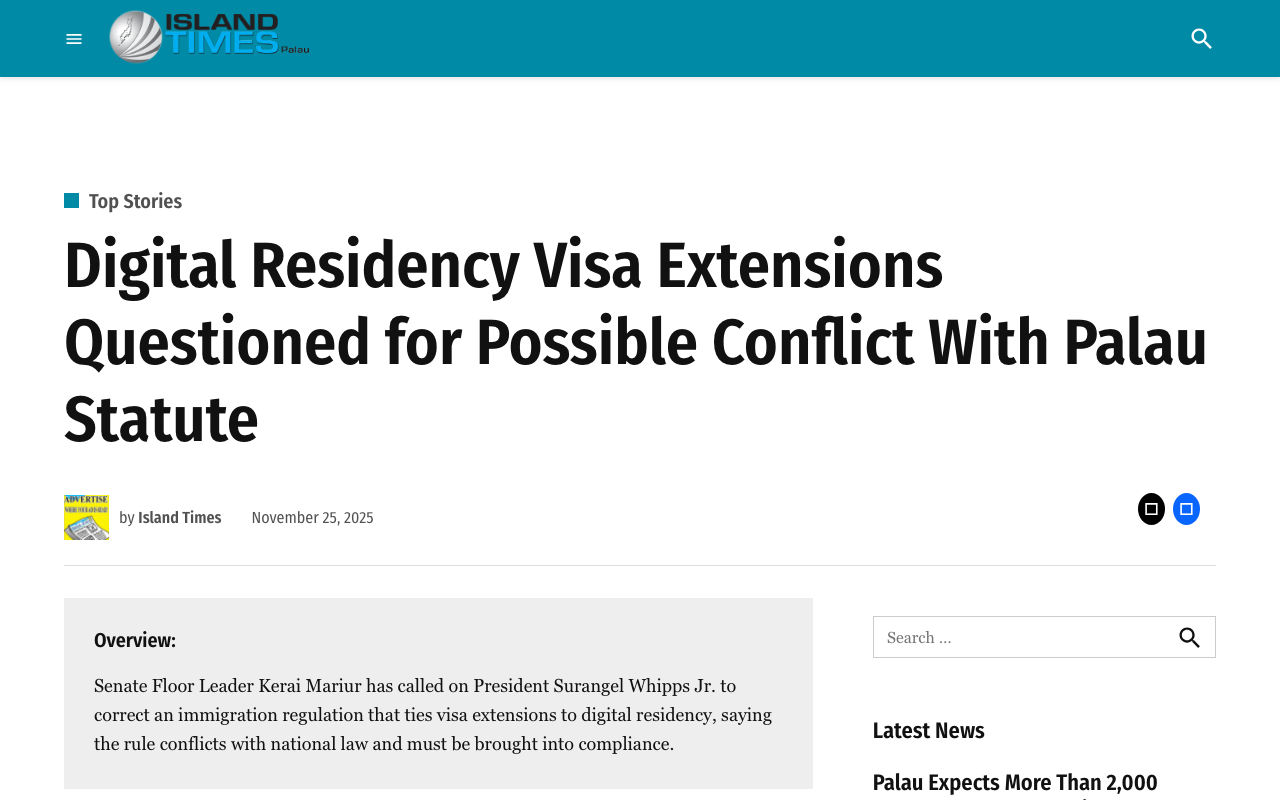
In November 2025, Senate Floor Leader Kerai Mariur wrote to President Surangel Whipps Jr. asking him to address what Mariur described as a clear mismatch between Palau's immigration law and the regulation granting these extensions.
His argument, as reported: Title 13, Section 1022 of the Palau National Code states that digital residency "does not confer any right to reside in or visit Palau." By making a visa benefit conditional on digital residency status, Section 320 extends something the statute does not authorise. Mariur urged the executive branch to correct the discrepancy expeditiously.
We found no published response from the administration, and no evidence the regulation has been repealed or amended since. So as of this writing the extension appears to remain in force while an unresolved question hangs over its legal basis. Two things follow, and they point in opposite directions:
- The extension is not a marketing invention. It sits in a real regulation and a Palauan legislator took it seriously enough to write to the President about it.
- It is also not a durable entitlement. A regulation challenged as exceeding its statute is exactly the kind of provision that gets narrowed or withdrawn, and a 10-year ID does not lock in a rule that changes next year.
If you are weighing whether the program is credible in general, is RNS.ID legit goes through what the official documents do and do not establish.
Your nationality decides the starting number
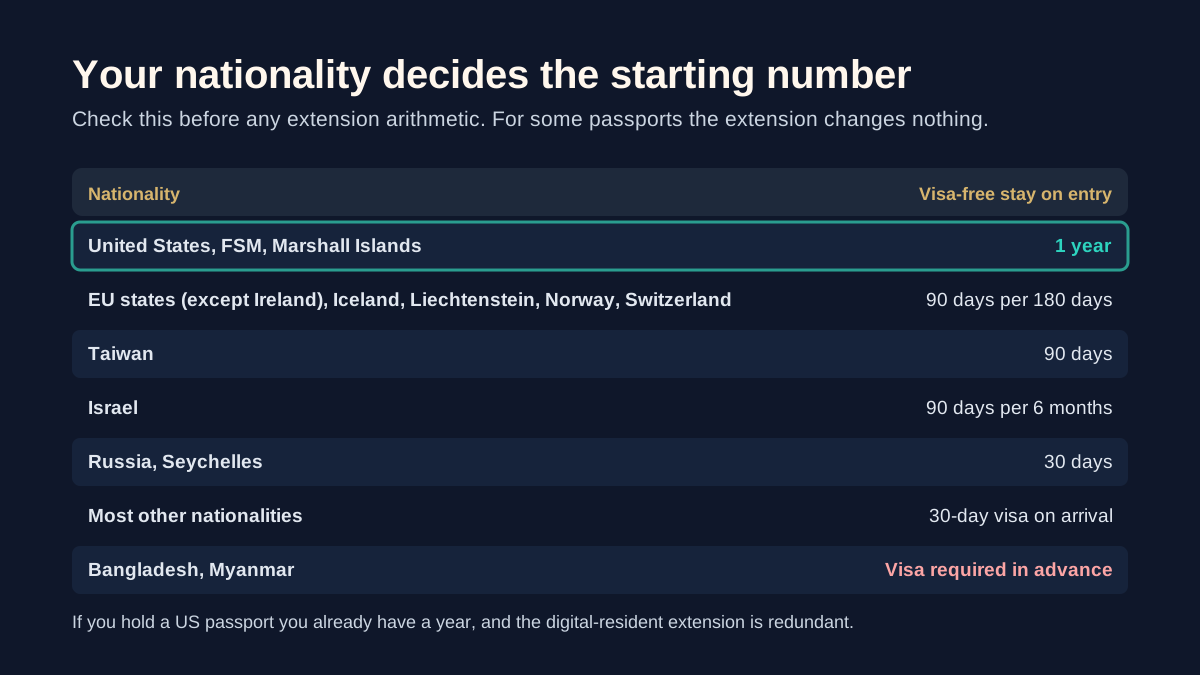
Before any extension arithmetic, check what your passport already gets you. Palau's visa-free arrangements vary widely, and for a large group of readers the extension changes nothing at all.
| Nationality | Visa-free stay on entry |
|---|---|
| United States, FSM, Marshall Islands | 1 year |
| EU member states (except Ireland), Iceland, Liechtenstein, Norway, Switzerland | 90 days per 180 days |
| Taiwan | 90 days |
| Israel | 90 days per 6 months |
| Russia, Seychelles | 30 days |
| Most other nationalities | 30-day visa on arrival |
| Bangladesh, Myanmar | Visa required in advance |
This table is drawn from the standard public summary of Palau's visa policy rather than from BCBP's own page, so treat it as a starting point and confirm your own nationality with BCBP or a Palau consulate.
The practical reading: if you hold a US passport you already have a year, and the digital-resident extension is redundant. Palau digital residency for US citizens covers the other reasons US applicants look at this. For a European on 90 days per 180, the extension is where the maths gets interesting — and where the "each entry" versus "each year" ambiguity bites hardest.
What a long stay actually costs
Assume for a moment the extension works as RNS describes. Here is what a stay in Palau costs in fees alone, ignoring flights, accommodation and the US$100 Pristine Paradise Environmental Fee that has been built into every international airline ticket to Palau since 1 January 2018.
| Scenario | Days in Palau | ID cost | Extension fees | Notes |
|---|---|---|---|---|
| Ordinary tourist, no ID | 30 | — | — | Visa on arrival |
| Ordinary tourist, both extensions | 90 | — | US$100 | Two 30-day renewals at US$50 |
| Digital resident, 1-year ID | 30 + up to 180 | US$288 | Not published | Fee for a 90-day extension is not stated anywhere we could find |
| Digital resident, 10-year ID | Same per trip | US$2,339 | Not published | Locks in a price, not a rule |
Two honest gaps in that table. Nobody publishes the fee for a 90-day digital-resident extension — BCBP's US$50 figure attaches to the ordinary 30-day renewal, and neither RNS nor the reporting on Section 320 states a price. And the "up to 180" line assumes the extensions are granted; an extension is an application, not an entitlement, and BCBP's own wording puts renewals in the hands of immigration officers.
Budget for a long stay the way you would for any trip where the paperwork might not go your way: a refundable onward ticket, and cover that does not assume you stay put. Travel medical cover such as SafetyWing is built for people with no fixed country of residence, which describes most people reading this. That is a sponsored link and we may earn a commission at no cost to you. It is travel medical insurance rather than a domestic health plan, it is unrelated to RNS and to your ID application, and it will not help with an immigration decision — read the exclusions in digital nomad health insurance before relying on it.
The tax framing, and why it is the weakest reason to buy
The reason the number 180 keeps appearing is that many countries use a day count somewhere around half a year in their residence tests. The public summary of Palau's visa policy is explicit that the digital-resident extensions are intended to help visitors meet a substantial-presence threshold of more than 180 days.
Be careful here, and this is not tax advice. Days in a country and tax residence in that country are different things. Most tax systems that use a day count also apply tie-breaker rules — permanent home, centre of vital interests, habitual abode — and your existing country of residence does not release you because you spent months elsewhere. Nor does holding a Palau ID make you a Palau tax resident; RNS does not claim it does, and Palau digital residency tax and Palau crypto tax go through what the program does and does not change.
Buying a 10-year ID as the foundation of a tax position that depends on a contested regulation is the wrong order of operations. Get advice on your own country's exit rules first; the ID is the cheap part.
What to confirm before you book
| Check | Where | Why it matters |
|---|---|---|
| Your nationality's visa-free allowance | BCBP or a Palau consulate | Decides whether you need the extension at all |
| Whether Section 320 is still in force | Division of Immigration, in writing | It was formally questioned in November 2025 |
| "Each entry" or each calendar year | Division of Immigration, in writing | Months of difference in your plan |
| The fee for a 90-day extension | Division of Immigration | Not published by any source we found |
| Passport validity of six months plus | Your passport | Refusal at check-in otherwise |
| Return or onward ticket | Your booking | BCBP lists it as a requirement |
| Palau Entry Form and the Palau Pledge | palautravel.pw, and on arrival | Both are conditions of entry |
Ask by email and keep the reply. An officer's answer in writing is worth more than any affiliate page, this one included.
Bottom line
Palau's published tourist rule is 30 days plus two 30-day extensions at US$50 each. A May 2023 regulation gives digital residents something considerably better — two consecutive 90-day extensions — and a Palauan senator has argued in public that the regulation grants a benefit the statute forbids. Nothing we can find shows that question resolved.
Treat the stay extension as a possible bonus on an identity product, never as the reason to buy one. If the extension is what you actually want, confirm it directly with Palau's Division of Immigration before you spend anything, and remember that digital residency is not a citizenship path and not a Palau passport. If KYC is your real goal, the start here guide is the better entry point.
Related reading
- Palau digital residency and visa-free countries
- Palau digital residency benefits
- Palau digital residency limitations
- Palau digital residency cost
- Palau digital nomad residency
- Does Palau digital residency give citizenship?
FAQ
How long can you stay in Palau as a tourist?
BCBP publishes a 30-day tourist visa issued on arrival, extendable for two further 30-day periods at US$50 each, giving a 90-day ceiling. Extensions must be applied for at the Division of Immigration at least seven days before the current visa expires. Several nationalities start from a longer visa-free allowance instead.
Does a Palau ID let me stay in Palau longer?
RNS says digital residents can extend a tourist visa for up to two consecutive 90-day periods, an additional 180 days, presenting the Palau ID card when applying. That traces to Section 320 of the Immigration Regulations, amended in May 2023. It is an application decided by immigration officers, not an automatic right, and its legal basis has been formally questioned.
What is the conflict with Palau law?
Title 13, Section 1022 of the Palau National Code states that digital residency does not confer any right to reside in or visit Palau. In November 2025 Senate Floor Leader Kerai Mariur wrote to President Surangel Whipps Jr. arguing that Section 320 contradicts that statute by tying a visa benefit to digital residency status. We found no published resolution.
Is the extension per entry or per year?
The two sources disagree. RNS's FAQ describes two consecutive 90-day periods "each entry," while the reporting on Section 320 describes up to two consecutive 90-day extensions each calendar year. Confirm which applies with Palau's Division of Immigration in writing before planning multiple trips.
Does Palau digital residency make me a Palau tax resident?
No, and RNS does not claim it does. Digital residency is an identity product. Spending days in a country is only one input into a residence test, and your existing country of residence applies its own rules and tie-breakers. This is not tax advice — take professional advice for your own situation.
Do US citizens need this extension?
No. United States citizens, along with citizens of the Federated States of Micronesia and the Marshall Islands, can already stay in Palau for a year without a visa, so a 90-day extension adds nothing. If you hold one of those passports, judge the ID on its identity uses instead.
What does it cost to stay in Palau long term?
Ordinary extension fees are US$50 per 30-day renewal, and every international airline ticket into Palau has included a US$100 Pristine Paradise Environmental Fee since 1 January 2018. The fee for a 90-day digital-resident extension is not published by any source we could find. Palau's statutory long-stay routes are priced very differently — the Elite Resident Visa carries a US$20,000 initial fee and a property purchase of US$250,000 or more.
Do I still need my passport?
Yes. RNS states that one still needs to bring a passport, and BCBP requires a passport valid for at least six months at entry plus a return ticket unless exempt. The Palau ID is not a travel document and does not replace a passport at any border, including Palau's.