Palau ID KYC Loophole: Why It Fails in 2026
The Palau ID KYC loophole is sold as a way past exchange country bans. We read the issuer's own docs, Kraken's terms and a CFTC filing. It does not hold.
We may earn a commission if you apply through this link. This site is independent and is not the official RNS.ID or Palau government site.

Key takeaways
- The Palau ID KYC loophole fails at the first gate, not the document gate. Every version of it answers the question "will a platform read this card?" when the thing that locked you out was your country of residence, which is checked before any document is uploaded. Nothing in your wallet changes that field.
- The issuer disagrees with the pitch in writing. RNS's own documentation lists "universal third-party acceptance" under not a promised outcome, and states that "whether any organization accepts an identity document is determined by that organization and its rules."
- The terms you click past make the attempt a breach. Kraken's Global Terms require you to "provide accurate, complete, truthful, and updated information", list providing "false, inaccurate, or misleading information" as a prohibited action, and reserve the right to "suspend, restrict, or delete your account" "at any time and without liability or prior notice to you".
- Geo-evasion has already been litigated, and the exchange lost. The CFTC's 27 March 2023 complaint alleges Binance "instructed Binance's U.S. customers to access the trading facility through a virtual private network", and by November 2023 the firm had pleaded guilty in a resolution the Justice Department valued at over $4 billion.
- The second wall is address, not identity. A Palau Mailing address is, in the issuer's words, "a mailing address, not a residential address or proof of residence, domicile, or tax residence" — so the tier that unlocks fiat and higher limits usually stays shut even on platforms that read the card.
On this page
- What the "Palau ID KYC loophole" actually claims
- Three walls stand between you and the account, and the card touches one
- The issuer says the quiet part out loud
- What an exchange's terms say about residence and truthful answers
- What happened the last time geo-evasion reached a courtroom
- The proof-of-address wall the loophole posts skip
- Forged Palau IDs made life harder for the genuine ones
- What a Palau ID is good for once the KYC loophole is off the table
- Related reading
- FAQ
What the "Palau ID KYC loophole" actually claims
Search the phrase and you will find the same article written five times: somebody buys a Palau digital residency card, photographs it on three exchanges, and reports that it worked. The stakes are not small — the card runs into four figures for the multi-year terms, the orders are final, and the accounts people open with it hold their own money. The palau id kyc loophole claim deserves to be tested against documents rather than anecdotes, so we went and read the issuer's documentation, one major exchange's terms of service in full, and the regulatory filings about the last platform that helped users route around country controls.
The claim has a precise shape, and stating it precisely is most of the work. It is not "a Palau ID is a useful identity document" — that is defensible and this site argues it. It is the stronger claim: that holding one changes which platforms may serve you.
| What the posts claim | What the claim depends on | Does the card affect it? |
|---|---|---|
| "I can verify on exchanges that don't accept my country" | The platform's country eligibility rules | No |
| "I'm a digital resident of Palau now" | Where you legally reside | No — the issuer says so explicitly |
| "It's a loophole, and not illegal" | The platform's terms, plus your own law | No — the terms are a contract you signed |
| "It passed KYC on three exchanges" | One vendor's document library, one tier, one date | Partly, and that is the whole truthful part |
The last row is the honest one, and it is much narrower than it sounds. Our vendor-library comparison found that the identity-verification companies behind these platforms do not even agree on whether the document exists. A card that reads on one platform today is not a key; it is one data point.
Three walls stand between you and the account, and the card touches one
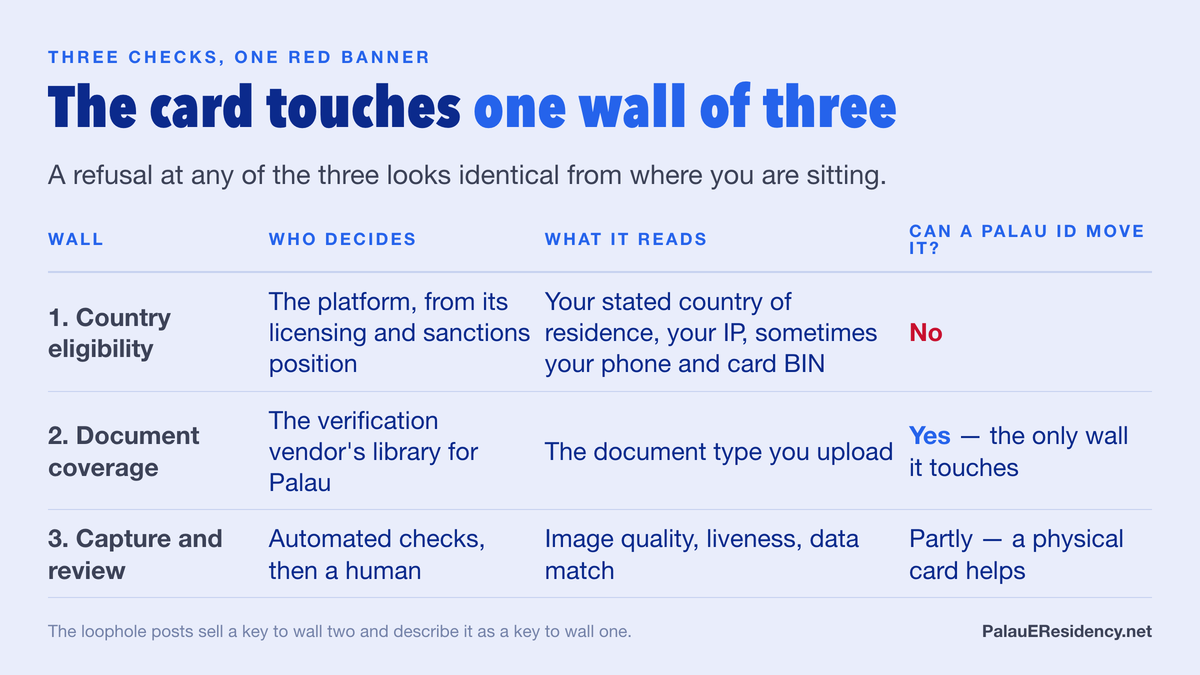
Every acceptance report online collapses three separate checks into one word, "KYC", and that collapse is what makes the loophole sound plausible. A platform decides whether it may serve someone in your country. Its verification vendor decides whether it can read your document at all. Then the capture itself either passes or does not. A refusal at any of the three produces the same red banner.
| Wall | Who decides | What it reads | Can a Palau ID move it? |
|---|---|---|---|
| 1. Country eligibility | The platform, from its licensing and sanctions position | Your stated country of residence, your IP, sometimes your phone and card BIN | No |
| 2. Document coverage | The verification vendor's library for Palau | The document type you upload | Yes — this is the only wall it touches |
| 3. Capture and review | Automated checks, then a human | Image quality, liveness, data match | Partly — a physical card helps |
Sumsub, the vendor that onboards applicants into the Palau programme itself, draws the same line in its support documentation: it "does not define which data or documents are required, which regions are supported", because "the company you're verifying for decides which specific document types and countries are accepted." Capability and permission are two different settings, held by two different parties.
So the loophole posts are selling a key to wall two and describing it as a key to wall one. If your problem was ever "this platform does not serve residents of my country", a better document is not the answer, and we work through the per-platform detail in the exchange KYC tracker.
The issuer says the quiet part out loud
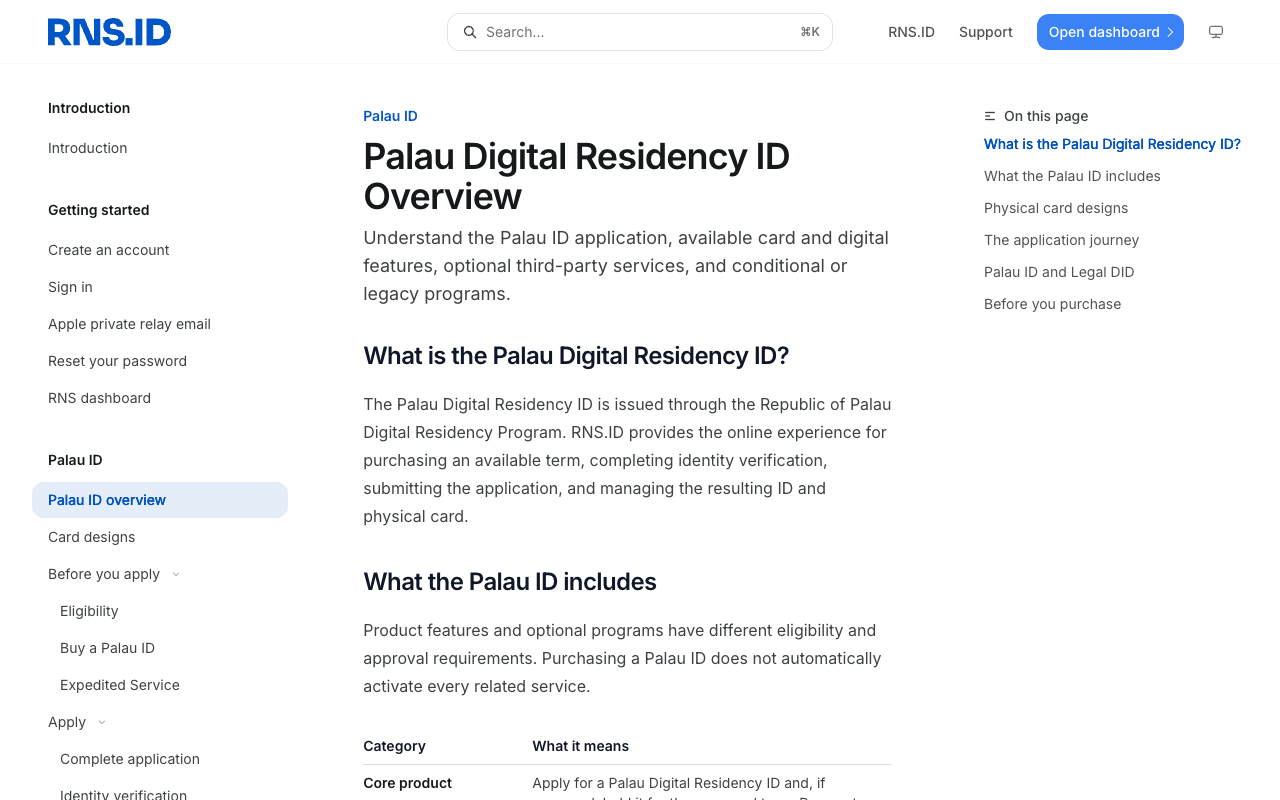
The most striking thing about the loophole genre is that none of it cites the programme's own documentation, which contradicts it in plain language. RNS's Palau ID overview describes the credential as "a government-issued identity product" issued "through the Republic of Palau Digital Residency Program" — and then spends a section on what it is not.
| What RNS's documentation states | Where |
|---|---|
| "Palau Digital Residency is not the same as citizenship, a passport, or physical residency in Palau." | Palau ID overview |
| "Whether any organization accepts an identity document is determined by that organization and its rules." | Palau ID overview |
| "Universal third-party acceptance" — listed under not a promised outcome | Palau ID overview |
| "Downloading a copy does not establish permission for a verification use or guarantee acceptance." | Palau ID overview |
| "Payment starts the application." Identity verification, screening, "video verification when required, internal review" and government review still apply. | Support FAQs |
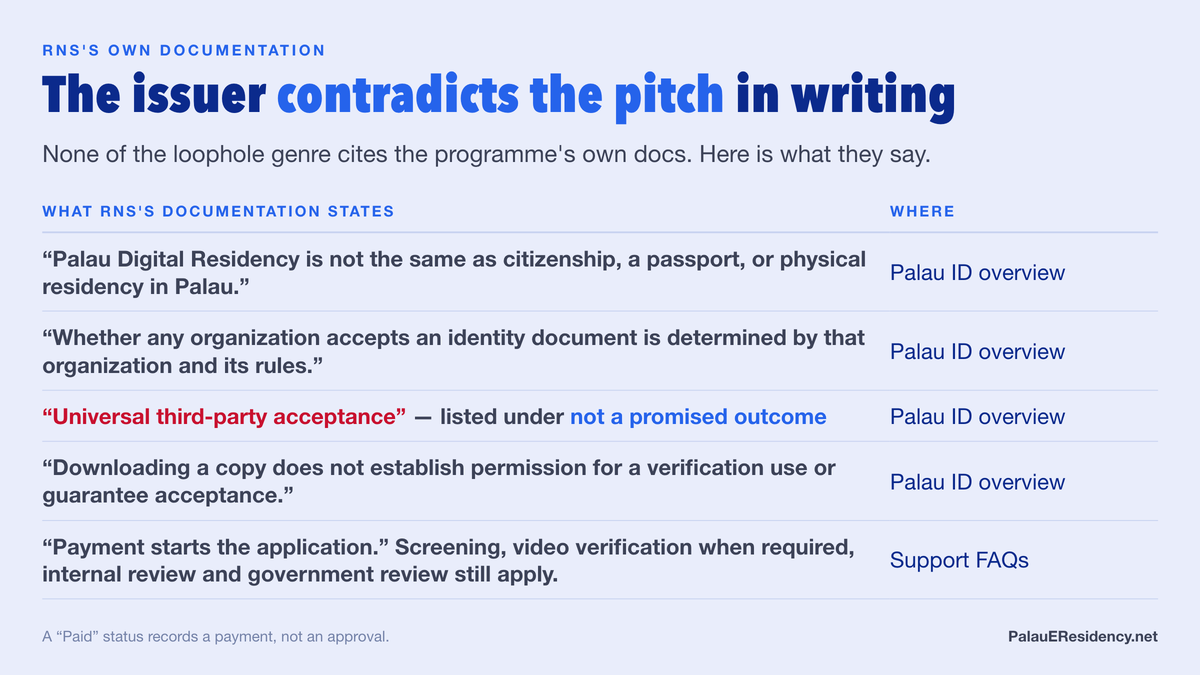
Read those together and the pitch collapses from the inside. The issuer is not promising that platforms will take the card; it is promising a card. A "Paid" status in your account records a payment, not an approval, and the application timeline is the part people underestimate.
That is also why we treat acceptance claims as perishable. The Reddit due-diligence guide exists because a post saying "it worked on Bybit in 2024" is evidence about one tier of one account on one date, and our limitations page lists what the programme has never claimed to do. If you want the pricing picture before any of this, note that RNS's docs now deliberately do not hard-code "current terms, prices, availability, discounts, and add-ons" — our cost breakdown records the figures we last verified and tells you to confirm at checkout.
What an exchange's terms say about residence and truthful answers
This is the document nobody in the genre reads, and it is the one that decides what happens to your balance. We read Kraken's Global Terms of Service because it is public, long-standing and representative; most large platforms carry equivalent clauses.
| Clause | What it says | Section |
|---|---|---|
| Eligibility | You must "not be located in, under the control of, or resident in" a restricted jurisdiction, or "any jurisdiction where we may have restricted use of any services" | 1 |
| Ongoing duty | "If you stop meeting the Conditions, you must immediately notify us" | 1 |
| Your activities | You must "provide accurate, complete, truthful, and updated information" | 1 |
| Restrictions | Prohibited action: "provide false, inaccurate, or misleading information" | 9 |
| Suspension | "We can, at any time and without liability or prior notice to you" "suspend, restrict, or terminate your access", "suspend, restrict, or delete your account", and "reject any Deposit, Withdrawal, Trade, or other transaction" | 15 |
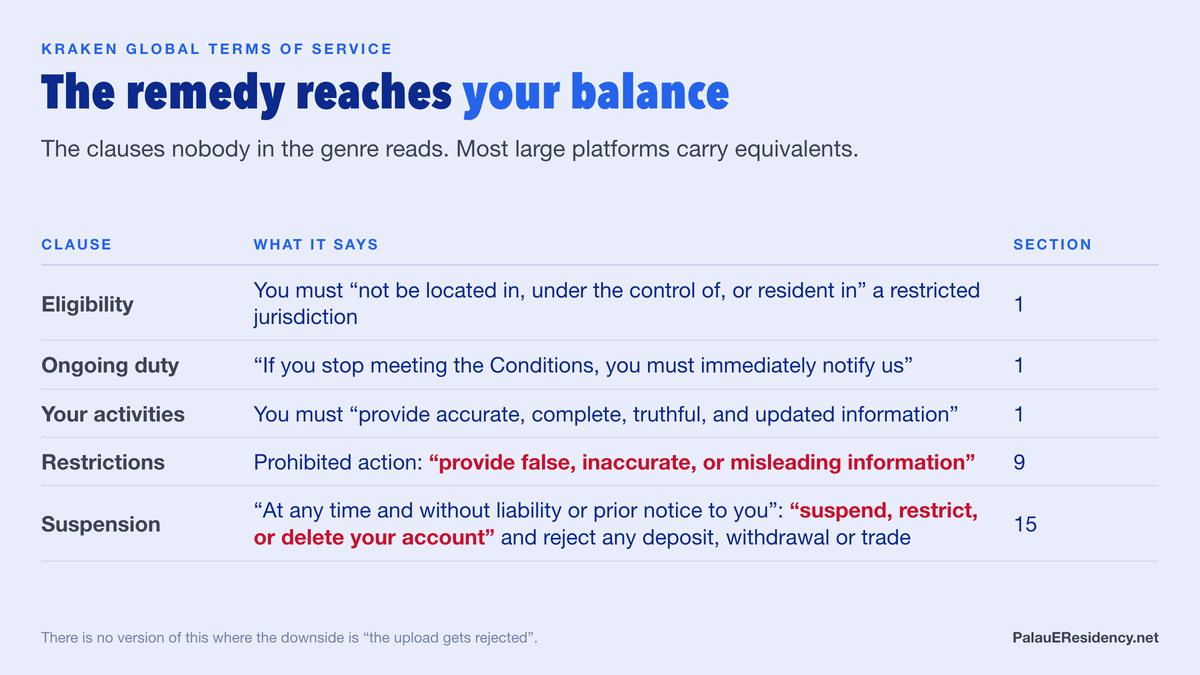
Put the loophole next to that table. The attempt requires answering a residence question in a way the platform would not accept if it understood it — which is the prohibited action in section 9 — and the remedy the platform reserves is the one that reaches your funds, without notice and without liability. There is no version of this where the downside is "the upload gets rejected".
Note what is not in dispute here. Picking the document category that accurately describes a card you genuinely hold is not deception; that is just filling in a form, and our physical versus digital guide covers how to do it properly. Telling a platform you reside somewhere you do not is a different act, and the terms treat it differently.
What happened the last time geo-evasion reached a courtroom
The loophole posts describe this as a grey area. The regulators have been less equivocal, and the record is public — the CFTC's March 2023 complaint and the Justice Department's November 2023 resolution are both published in full.
| Date | What happened | Source |
|---|---|---|
| 27 March 2023 | CFTC sues Binance, alleging it "instructed its customers – in particular its commercially valuable U.S.-based VIP customers" "on the best methods for evading Binance's compliance controls" | Release 8680-23 |
| Same filing | Alleges a policy that "instructed Binance's U.S. customers to access the trading facility through a virtual private network", and that staff promoted "creative means" to help customers circumvent controls | Release 8680-23 |
| Same filing | Enforcement official Gretchen Lowe: "Binance's compliance efforts have been a sham" | Release 8680-23 |
| 7 November 2023 | CFTC records the Binance action as the first time it charged defendants with "willfully evading or attempting to evade provisions of the Commodity Exchange Act" | Release 8822-23 |
| 21 November 2023 | Binance and its chief executive plead guilty; the Justice Department announces a resolution it values at over $4 billion | DOJ press release |
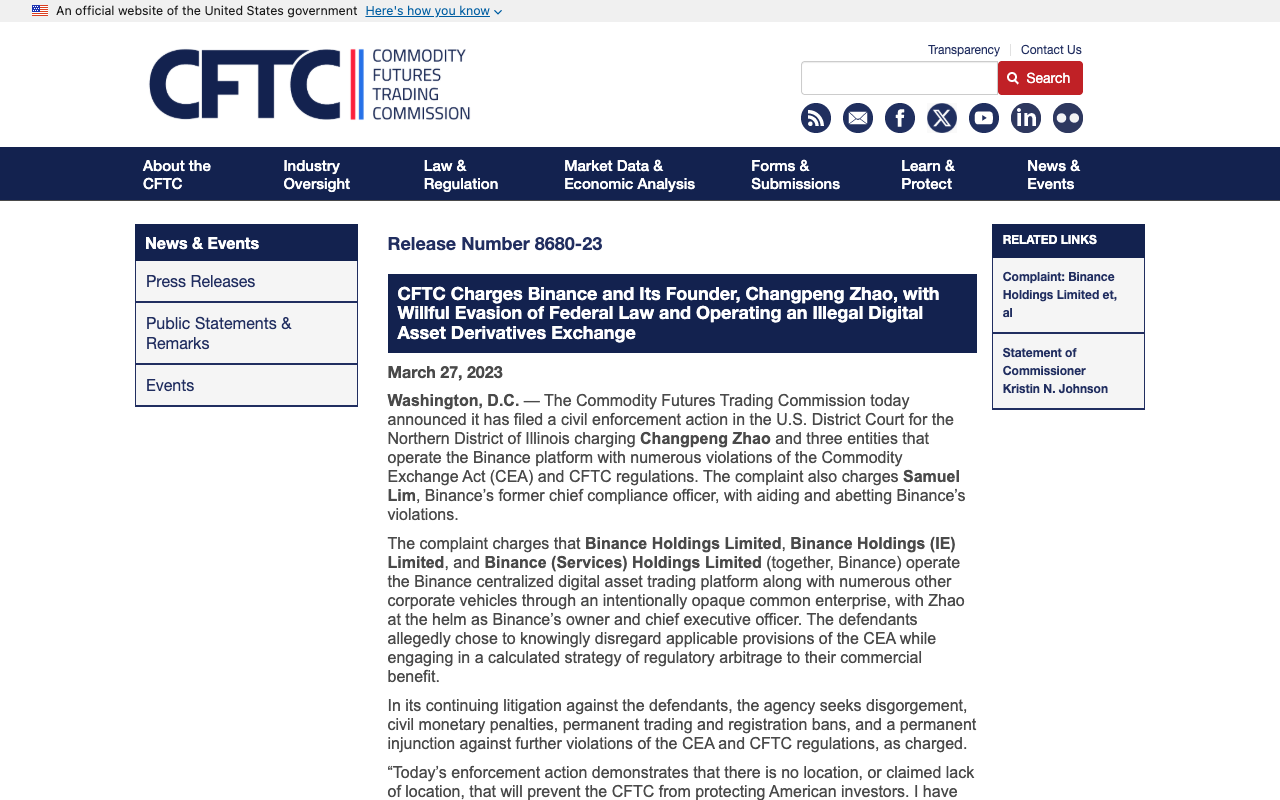
Two things follow for an individual, and neither is a legal opinion — this is not legal advice, and a lawyer in your jurisdiction is the person to ask. First, the conduct at the centre of that case is the conduct the loophole posts recommend, described from the platform's side. Second, every large exchange watched that happen, which is why residence controls have tightened since rather than loosened: the MiCA write-up traces the same hardening in the EU. The Polymarket VPN page makes the matching argument for prediction markets.
The proof-of-address wall the loophole posts skip
Even on a platform that reads the card, verification rarely stops at identity. The tier that matters — fiat rails, higher limits, derivatives — usually asks for proof of address, and this is where the mechanics defeat the plan quietly.
| What the platform asks for | What a Palau digital resident has | Outcome |
|---|---|---|
| Government ID | The Palau ID card, if the vendor reads it | May pass |
| Residential address document | A Palau Mailing address, if purchased | Generally refused |
| Utility bill or bank statement at that address | None — no utilities, no local bank | Not available |
| Tax residence declaration | Unchanged by the programme | Must match reality |
RNS is explicit about the middle rows. A Palau Mailing address is "a mailing address, not a residential address or proof of residence, domicile, or tax residence". One of the few first-hand loophole write-ups we read concedes the same point in passing — it notes that the PO box limits which verification level the exchanges will grant — and then recommends the approach anyway.
Our proof-of-address guide and mailing-address page set out what the service does and does not evidence, and the tax guide covers why a declaration you cannot support is the worst of the three failures. A half-verified account that cannot withdraw to a bank is not a win.
Forged Palau IDs made life harder for the genuine ones
There is a second-order cost that the 2024-vintage posts could not have anticipated, and it lands on honest cardholders. On 24 October 2025 RNS announced measures against "counterfeit Palauan IDs used to bypass know-your-customer (KYC) procedures" — the loophole framing having attracted exactly the traffic you would expect.
| Announced measure | Effect on a genuine holder |
|---|---|
| Integration with global fraud blacklists | More cross-checking of your record |
| Secondary verification processes | Extra steps, longer waits |
| Fraudulent records added to a global fraud database | Nothing, unless you are in it |
| Permanent bans for confirmed forgers, details shared for automated identification | Nothing directly |
| Evidence referred for criminal prosecution | A reminder of which side of the line forgery sits on |
| An official API for KYC vendors to check numbers, issue dates and photos | Potentially the one real improvement |
That API is the interesting promise, because the whole acceptance problem is a verifiability problem: vendors cannot easily check a document they have no reference data for. A year on, we could find no public reference for it, which is worth knowing before you plan around it. The crackdown was reported by Phemex and KuCoin on the same day.
What a Palau ID is good for once the KYC loophole is off the table
Dropping the loophole does not make the card worthless. It makes it an ordinary identity document with a specific, narrower set of uses — which is how the issuer describes it and how the people who are happy with theirs actually use it.
| Use case | Realistic? | Where we cover it |
|---|---|---|
| A second accepted ID on platforms that already serve your country | Often | Supported exchanges |
| An identity document when your passport is away for renewal | Often | Palau ID card |
| Getting past a country ban | No | This page |
| Proof of address, domicile or tax residence | No | Proof of address |
| Citizenship, a passport, or the right to live in Palau | No | Benefits |
| Visa-free travel | No | Travel rules |
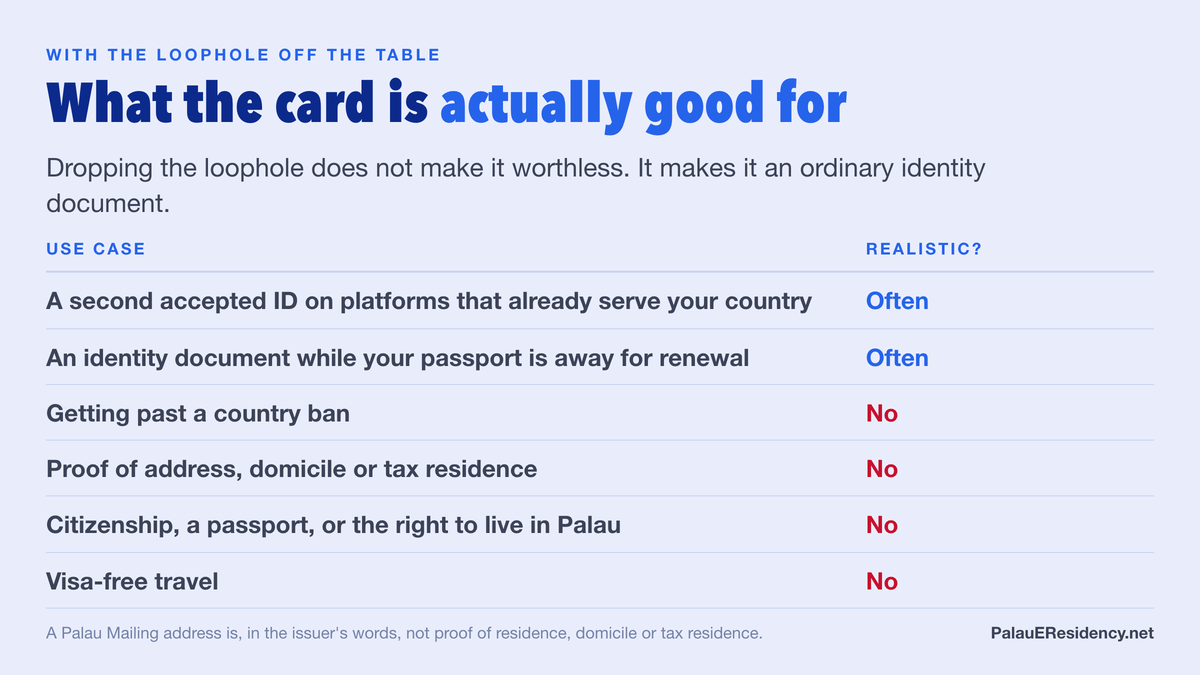
The honest alternative to the loophole is unglamorous: use platforms licensed to serve where you live, and read a platform's documentation before you spend anything on a document for it. If you are weighing the purchase on its real merits, start here walks through whether the programme fits at all, and the US citizens page handles the case the loophole genre is really aimed at.
Related reading
- Palau ID verification: which KYC vendors read it — the seven published document libraries, compared
- Palau ID exchange KYC tracker — the per-platform index
- Polymarket VPN risk: why bypass advice is unsafe — the same argument for prediction markets
- Palau digital residency limitations — what the programme never claimed
- Palau ID proof of address — the second wall, in detail
- Does Binance accept Palau ID? — the most-asked platform question
FAQ
Is the Palau ID KYC loophole real?
No, not as described. The card can sometimes satisfy a platform's document check, which is real and narrow. It cannot change the country-eligibility check that locks most people out in the first place, because that check reads where you reside and is applied before any document is uploaded. RNS's own documentation lists "universal third-party acceptance" as something it does not promise.
Is using a Palau ID for crypto KYC illegal?
Holding and presenting a genuine Palau ID is not the issue; misrepresenting your country of residence to a platform is a different act. Kraken's Global Terms list providing "false, inaccurate, or misleading information" as a prohibited action and reserve the right to suspend or delete accounts without notice. Whether anything beyond a contract breach applies depends on your jurisdiction, and that is a question for a lawyer there rather than for this site.
Will an exchange close my account if it finds out?
It reserves the right to. Section 15 of Kraken's Global Terms says it can "at any time and without liability or prior notice to you" "suspend, restrict, or terminate your access", "suspend, restrict, or delete your account" and "reject any Deposit, Withdrawal, Trade, or other transaction". Equivalent clauses are standard across large platforms, which is why the realistic downside involves funds rather than a failed upload.
Does a Palau digital residency change where I am tax resident?
No. The programme issues an identity credential; it does not move your residence, and RNS states that a Palau Mailing address is "a mailing address, not a residential address or proof of residence, domicile, or tax residence". Nothing here is tax advice — our tax guide explains why a declaration you cannot support is a worse outcome than a rejected ID.
Why do people report that it worked?
Because it sometimes does, at the document wall, on a platform that already served their country, at a verification tier that did not ask for proof of address. The posts we read named three or four exchanges, cited no platform documentation, and were published in 2024 with no follow-up. A single acceptance tells you about one vendor's library on one date, which is why we track platforms individually rather than collecting anecdotes.
Does a Palau ID help with proof of address?
No, and this is the wall most plans hit second. There are no utilities, no local bank statements and no residential address attached to the programme, and the issuer describes its mailing service in exactly those terms. Platforms that ask for address evidence before granting fiat rails or higher limits will generally still refuse.
What changed after the counterfeit crackdown?
On 24 October 2025 RNS announced measures against counterfeit Palauan IDs "used to bypass know-your-customer (KYC) procedures", including integration with global fraud blacklists, secondary verification, permanent bans for confirmed forgers and referral of evidence for prosecution. It also promised an official API letting KYC vendors check document numbers, issue dates and photos; we could find no public reference for that API a year later.