Palau Digital Residency for Filipino Citizens 2026
What Palau digital residency does and does not do for a Filipino in 2026: section 22(E) non-residency, AMLA document checks, the PhilID mandate, and CARF.
We may earn a commission if you apply through this link. This site is independent and is not the official RNS.ID or Palau government site.
Key takeaways
- Palau digital residency moves no Philippine tax position, because section 23(A) of the Tax Code charges "a citizen of the Philippines residing therein" on "all income derived from sources within and without the Philippines." Nothing in that sentence turns on which identity cards you own.
- The Philippines does let a citizen out of the worldwide net — and the exit has never required a card. Section 22(E)(1) asks you to establish "to the satisfaction of the Commissioner the fact of his physical presence abroad with a definite intention to reside therein," and 22(E)(5) asks you to "submit proof." A card that gives you no right to live in Palau supplies neither limb.
- The money at stake is domestic, not offshore. The schedule in force since 1 January 2023 tops out at ₱2,202,500 plus 35% above ₱8,000,000, while a purely self-employed Filipino under the ₱3,000,000 VAT threshold can elect 8% on gross receipts above ₱250,000 — an election that costs nothing and beats any foreign ID.
- Philippine onboarding is a documents problem. AMLA section 9(a) requires a covered person to "establish and record the true identity of its clients based on official documents," and the SEC's CASP circulars — MC No. 4 and MC No. 5, series of 2025, effective 5 July 2025 — reach platforms "local or foreign" that serve persons in the Philippines.
- One ID in the Philippines is legally mandated acceptance, and it is free. Under R.A. 11055 section 12, private entities "are likewise mandated to accept the PhilID or PSN as valid proof of identity." RNS's own documentation says downloading its ID does not "guarantee acceptance by a third party."

On this page
- What Palau digital residency changes for a Filipino in 2026
- Can Filipino citizens apply for Palau digital residency?
- Section 22(E) is the only way out of the Philippine net
- What a resident Filipino actually pays in 2026
- Philippine crypto onboarding is a documents problem
- The PhilID already does the job this card is sold for
- CARF by 2028, and no CRS at all
- Where the card is useful, and who should skip it
What Palau digital residency changes for a Filipino in 2026
Your choice of photo ID. Not your tax residence, not your access to a Philippine exchange, and not your reporting exposure.
We went looking for a page written for Filipinos on this and found none. The first page of results is still the 2022 launch coverage, a row of visa-aggregator stubs quoting prices from two years ago, and one "Palau digital nomad tax guide" that tells you the programme lets you benefit from Palau's territorial tax system — while elsewhere on the same page admitting the status creates no tax residence. Both halves cannot be true, and for a Filipino reader the expensive half is the first one.
So we did it the other way round: we read the Philippine statutes that decide each question, then asked what the card can do against them. That means section 22(E) and section 23 of the Tax Code for residence, the rate schedule in the TRAIN Act for what residence costs, section 9 of the Anti-Money Laundering Act for what an exchange must collect, R.A. 11055 for which ID the law forces private firms to take, and the OECD's own commitment lists for what gets reported about you and when.
The answer is consistent across all five, and it is narrower than the pitch: a Palau ID is a second government-issued photo ID with a deliverable physical card, and in the Philippines it competes against a national ID that the law obliges private entities to accept. That is a hard competition to win at $288 and up.
Can Filipino citizens apply for Palau digital residency?
Almost certainly yes, and RNS does not publish a list that lets us promise it.
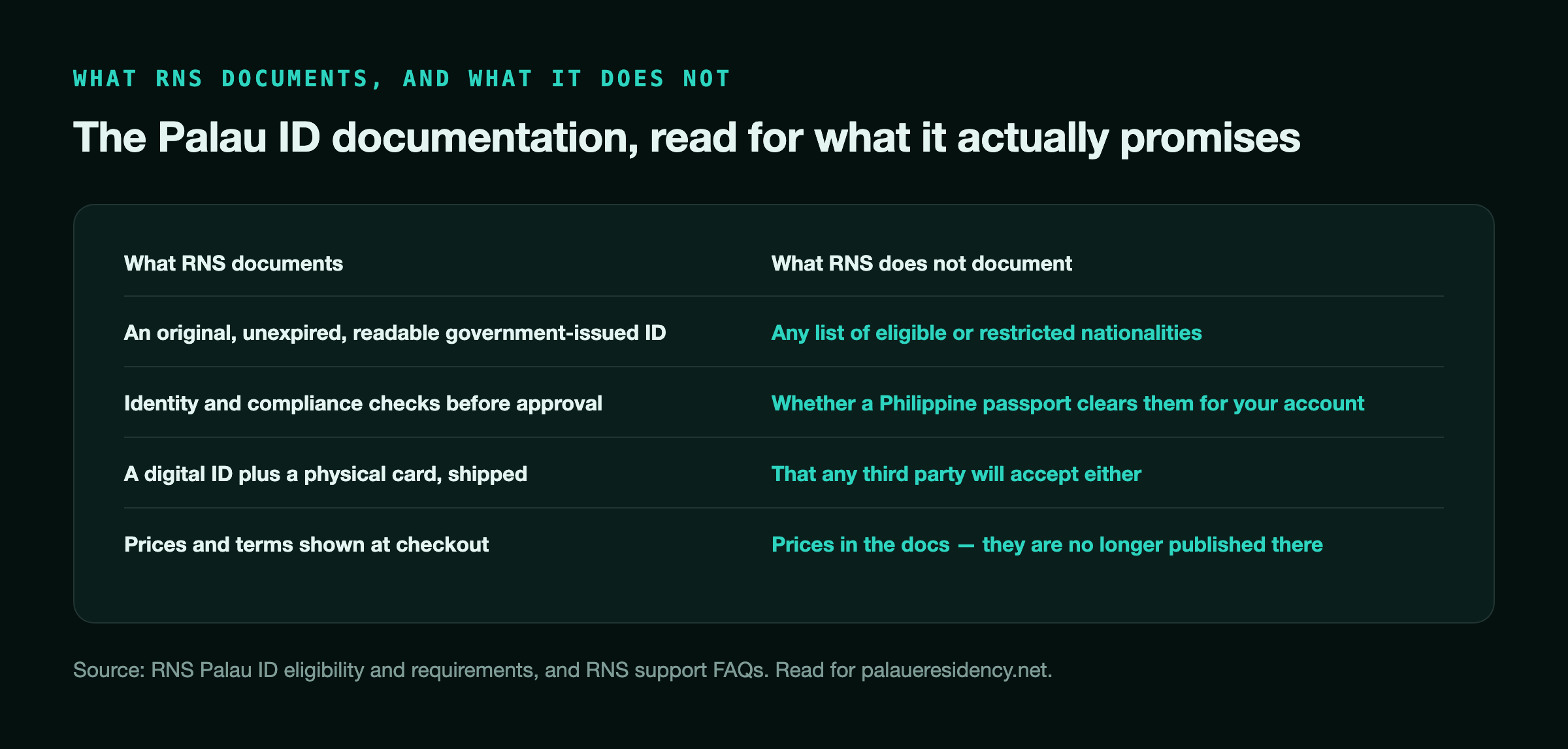
Its eligibility page asks you to "prepare an original, valid government-issued identity document accepted by the verification flow" — unexpired, original, readable, not a screenshot — and says the verification interface decides which document types it accepts "for your country or region." A Philippine passport is a government-issued identity document on its face. What we cannot see from outside is the screening: RNS says it "checks current country and compliance restrictions" and that the restricted-country list "is maintained by the service and can change." The only place that list is visible is your own checkout.
| What RNS documents | What RNS does not document |
|---|---|
| An original, unexpired, readable government-issued ID | Any list of eligible or restricted nationalities |
| Identity and compliance checks before approval | Whether a Philippine passport clears them for your account |
| A digital ID plus a physical card, shipped | That any third party will accept either |
| Prices and terms shown at checkout | Prices in the docs — they are no longer published there |
That last row changed recently and is worth knowing before you budget. Our cost page records the three tiers as listed in June 2026 — $288 for one year, $1,199 for five, $2,339 for ten — but RNS's support FAQs now say prices and terms are deliberately not fixed in the documentation and that the checkout shows what applies to your product and account. Price the thing at checkout, not from a blog, including ours.
For scale: the programme's own 2026 annual report puts it at 70,946 applications, 68,867 approved and more than 47,000 active residents, which we break down on our programme statistics page. This is a real product with real volume. The question is what it does for you.
Section 22(E) is the only way out of the Philippine net
Here is where the Philippines differs from most countries in this series, and the difference cuts against the card rather than for it.
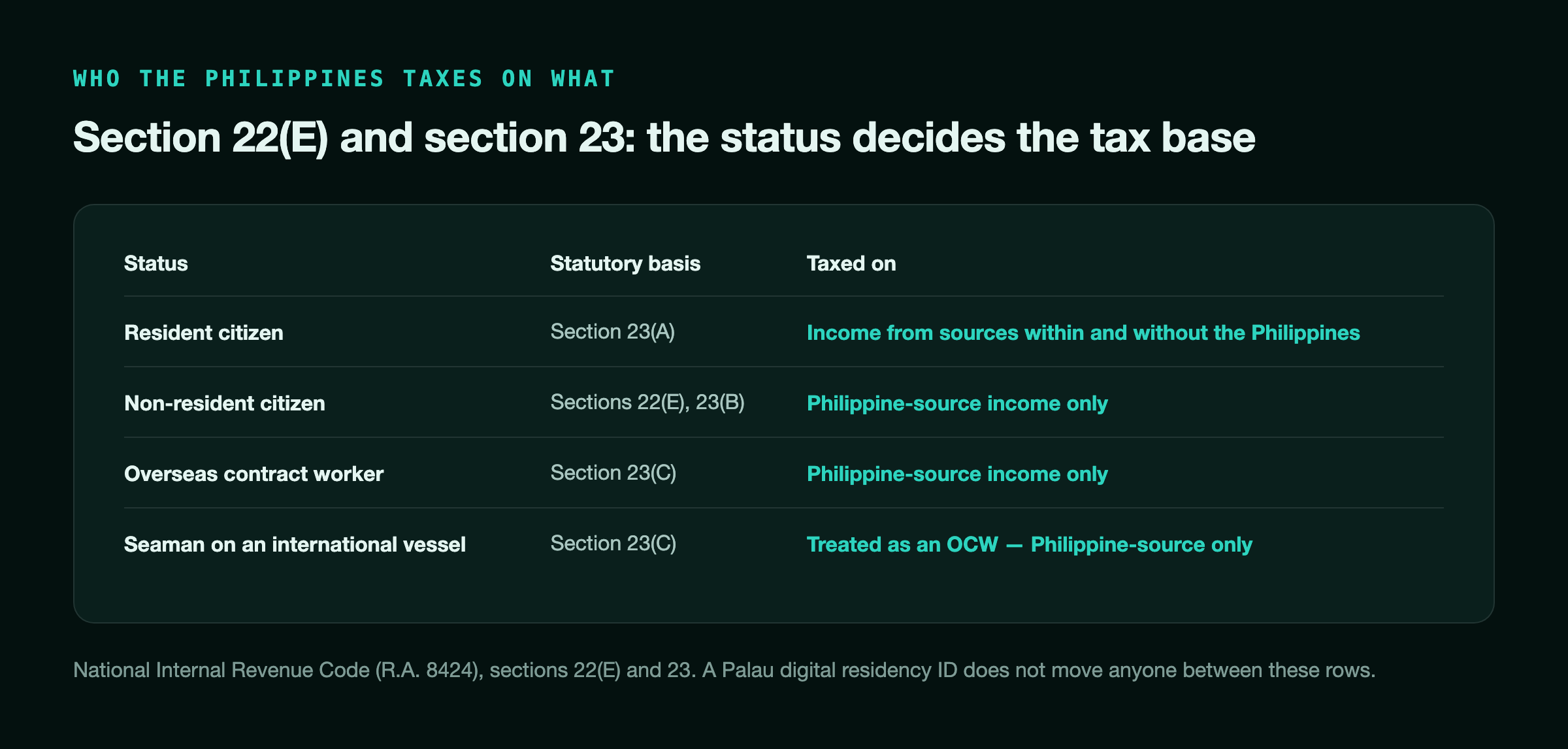
Pakistan and India have catch-all clauses that pull a wandering citizen back in. The Philippines does not. Section 23(B) says plainly that "a nonresident citizen is taxable only on income derived from sources within the Philippines," and section 23(C) extends the same treatment to "an individual citizen of the Philippines who is working and deriving income from abroad as an overseas contract worker," with seamen on vessels "engaged exclusively in international trade" treated as OCWs. For millions of Filipinos, worldwide taxation genuinely ends.
What buys that treatment is set out in section 22(E), and all four of its routes are made of facts about where you physically are:
| Status | Statutory basis | Taxed on |
|---|---|---|
| Resident citizen | Section 23(A) | Income from sources within and without the Philippines |
| Non-resident citizen | Sections 22(E), 23(B) | Philippine-source income only |
| Overseas contract worker | Section 23(C) | Philippine-source income only |
| Seaman on an international vessel | Section 23(C) | Treated as an OCW — Philippine-source only |
Route (1) is physical presence abroad "with a definite intention to reside therein," established to the Commissioner's satisfaction. Route (2) is leaving during the taxable year "to reside abroad, either as an immigrant or for employment on a permanent basis." Route (3) is work abroad whose "employment thereat requires him to be physically present abroad most of the time during the taxable year." Route (4) covers the year you come home. And section 22(E)(5) adds the part the loophole posts never quote: "the taxpayer shall submit proof to the Commissioner to show his intention of leaving the Philippines to reside permanently abroad."
Read those together and the card's problem is structural. Palau digital residency is identification, not abode — RNS describes it as a digital residency identity with a physical card, and the mailing address sold alongside it is explicitly not proof of residence. It does not put you in Palau, it does not entitle you to live in Palau, and it produces no evidence of an intention to reside in Palau that would survive a question from the Commissioner. Meanwhile the Filipino who actually does move abroad qualifies under 22(E) without buying anything at all. The card is neither necessary nor sufficient for the only exit that exists, which is a poor place for a $1,199 product to sit.
What a resident Filipino actually pays in 2026
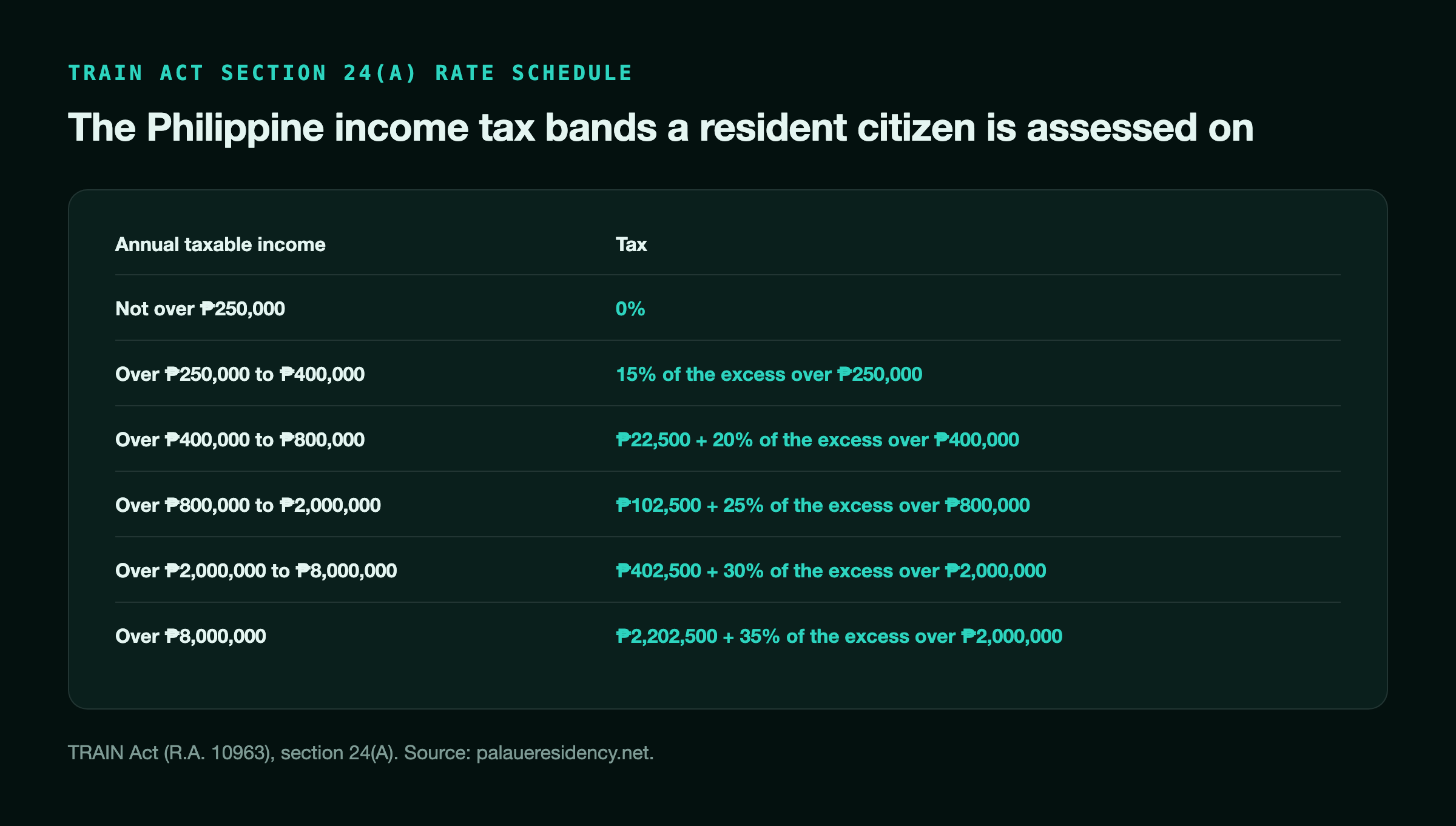
This is why the pitch sells, so it is worth seeing the real numbers rather than the ones on a sales page.
The schedule inserted by the TRAIN Act and in force since 1 January 2023 is this:
| Annual taxable income | Tax |
|---|---|
| Not over ₱250,000 | 0% |
| Over ₱250,000 to ₱400,000 | 15% of the excess over ₱250,000 |
| Over ₱400,000 to ₱800,000 | ₱22,500 + 20% of the excess over ₱400,000 |
| Over ₱800,000 to ₱2,000,000 | ₱102,500 + 25% of the excess over ₱800,000 |
| Over ₱2,000,000 to ₱8,000,000 | ₱402,500 + 30% of the excess over ₱2,000,000 |
| Over ₱8,000,000 | ₱2,202,500 + 35% of the excess over ₱8,000,000 |
For the freelancer this site is usually read by, the number that matters is the one below it. A purely self-employed individual or professional whose gross receipts stay under the ₱3,000,000 VAT threshold may elect 8% on gross sales, receipts and other non-operating income above ₱250,000, in lieu of both the graduated rates and the percentage tax. That election is domestic, free, reversible annually, and larger than anything a foreign identity card can achieve.
Crypto sits in an awkward gap. The Bureau of Internal Revenue has issued no crypto-specific revenue regulation, so Philippine tax commentary applies the general rules: trading as a business is ordinary income at the rates above, and an investment holding falls under the capital-asset provisions. We are flagging that as the professional consensus rather than a published rule, because it is not one. This is general information and not tax advice — take Philippine advice on your own facts, and read our Palau crypto tax page for how the Palau side of that is usually misread.
Philippine crypto onboarding is a documents problem
The second thing the card is sold for is clearing verification. Philippine rules make that a question about documents and sources of funds, not about how many IDs you hold.
Section 9(a) of the Anti-Money Laundering Act is the floor: covered persons "shall establish and record the true identity of its clients based on official documents" and "shall maintain a system of verifying the true identity of their clients." Section 9(b) then requires the identification records to be kept for five years. Nothing there says a foreign ID is unacceptable — and nothing there says anyone has to take it.
Above that floor sits the 2025 crypto framework. The SEC issued MC No. 4, series of 2025 (the CASP Rules) and MC No. 5, series of 2025 (the CASP Guidelines) on 30 May 2025, with both effective 5 July 2025; a Philippine law firm's summary of them records the SEC's position, in an advisory of 14 August 2025, that they apply to "all entities, local or foreign, that offer crypto-asset services to persons in the Philippines," with offshore platforms expected to operate through an SEC-registered Philippine corporation. Section 7 of the Guidelines requires a CASP to refuse unsuitable customers, and unauthorised operation carries escalating fines and, under R.A. 11765, imprisonment of one to five years for a wilful violation. We cite the firm's summary because the SEC's own PDFs refuse non-browser clients with an HTTP 403; the circular numbers and dates are consistent across every secondary source we checked.
| What onboarding asks for | Can a Palau ID answer it? |
|---|---|
| True identity on official documents (AMLA s9(a)) | Partly — it is one official document among several |
| Address verification | No. RNS says the Palau mailing address is not proof of residence |
| Source of funds and wealth | No |
| Suitability under CASP Guidelines s7 | No — the platform decides |
| Acceptance of the document itself | No. RNS does not "guarantee acceptance by a third party" |
Four of those five rows are not identity questions at all, which is the honest reason a second card so often fails to unstick a verification. Our crypto KYC guide and the KYC loophole page go through what actually moves a stuck application.
The PhilID already does the job this card is sold for
This is the argument that applies to Filipinos and almost nobody else in this series, and it is the one we would want read first.
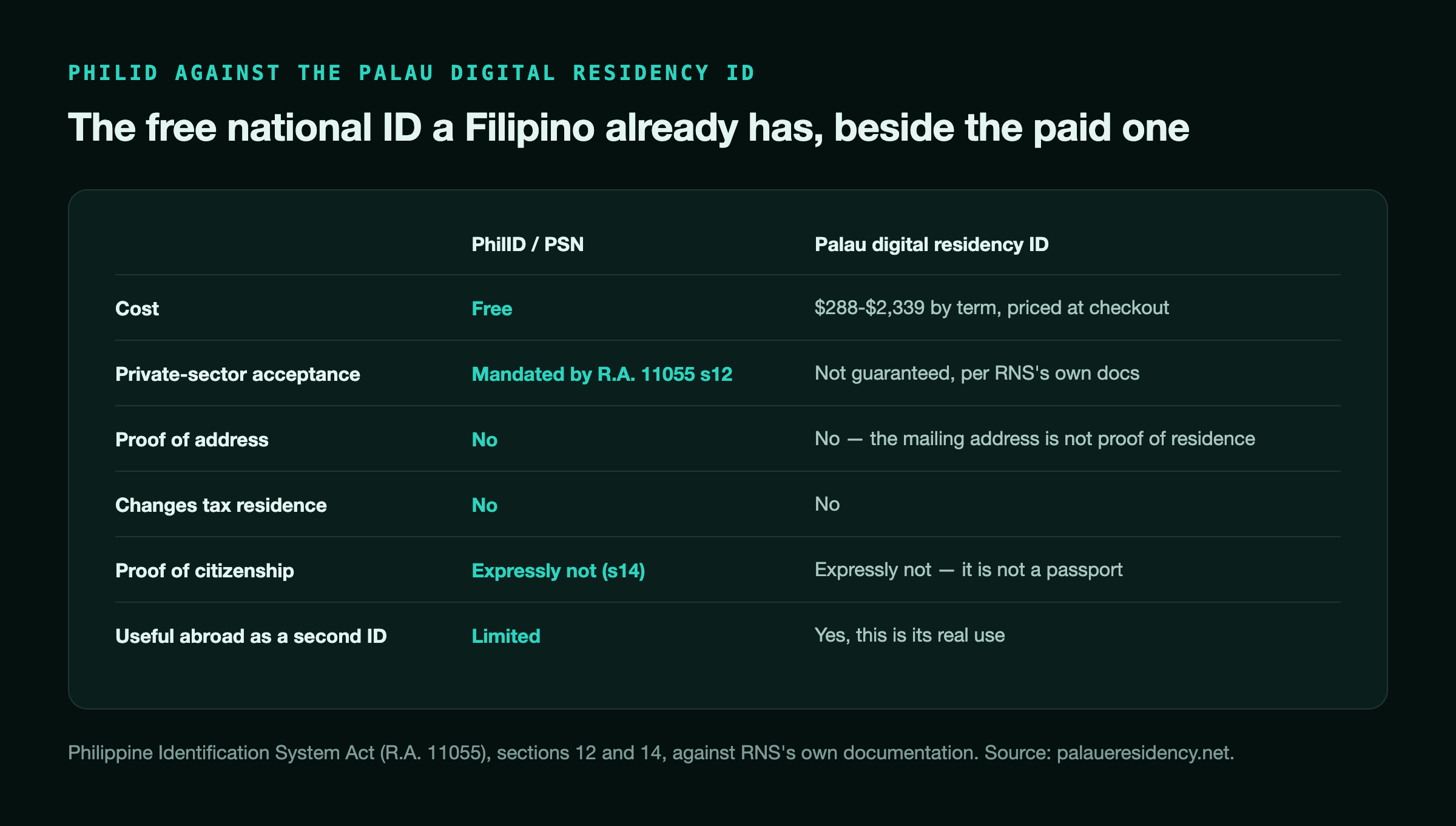
The Philippine Identification System Act makes the national ID uniquely strong as proof of identity. Section 6(a) says the PhilSys Number, "in print, electronic or any other form, subject to authentication, shall be accepted as sufficient proof of identity." Section 12 carries it into the private sector: private entities "are likewise mandated to accept the PhilID or PSN as valid proof of identity," on the same terms as government transactions. Section 13 says the PhilID "shall be honored and accepted, subject to authentication." Section 14 keeps it honest in the other direction — issuance is not to be treated as proof of citizenship, and proof of identity is not proof of eligibility for benefits.
| PhilID / PSN | Palau digital residency ID | |
|---|---|---|
| Cost | Free | $288-$2,339 by term, priced at checkout |
| Private-sector acceptance | Mandated by R.A. 11055 s12 | Not guaranteed, per RNS's own docs |
| Proof of address | No | No — the mailing address is not proof of residence |
| Changes tax residence | No | No |
| Proof of citizenship | Expressly not (s14) | Expressly not — it is not a passport |
| Useful abroad as a second ID | Limited | Yes, this is its real use |
Read the two columns together and the case for buying narrows to one honest sentence: the Palau card is worth considering as a second, foreign, government-issued photo ID with a physical card you can hold — for someone who already has the PhilID for domestic use and wants something else in the drawer. Every other column is a draw or a loss.
CARF by 2028, and no CRS at all
The privacy argument deserves its own section, because the Philippines sits in an unusual position and both halves of it get misreported.
On crypto, the Philippines has committed. The OECD Global Forum's CARF commitment list, last updated 14 September 2026, names 46 jurisdictions for first exchanges by 2027, 27 for 2028 — the Philippines among them — and 4 for 2029, with El Salvador, Georgia, India and Viet Nam identified as relevant but not yet committed. So automatic exchange of crypto-account information involving the Philippines is on a published timetable, not a rumour.
On bank accounts, it has not. The CRS Multilateral Competent Authority Agreement signatory list, status 30 October 2026, runs to 127 jurisdictions — and the Philippines is not one of them. Pakistan, Panama, Papua New Guinea and Peru are all there; the entry between Panama and Peru is Papua New Guinea.
| Framework | Philippine status | Source date |
|---|---|---|
| CARF (crypto accounts) | Committed, first exchanges by 2028 | OECD list, 14 September 2026 |
| CRS (financial accounts) | Not a signatory of the 127 | OECD list, 30 October 2026 |
That asymmetry is the opposite of what the loophole posts assume. A Filipino's crypto holdings at a reporting provider are scheduled to be exchanged automatically before their ordinary foreign bank accounts are, and the thing that decides whether a report is made is where the account is and what the provider is obliged to do — not the nationality printed on the card used to open it. Our CARF explainer sets out what a reporting crypto-asset service provider actually collects.
Where the card is useful, and who should skip it
Skip it if any of these is your reason for buying:
- You want out of Philippine worldwide taxation. The exit is section 22(E) and it is made of presence abroad plus proof of intention. A card is neither, and the people who qualify do it without one.
- You want a cheaper domestic tax outcome. The 8% election under the VAT threshold is the real lever, and it is free.
- You want to clear KYC at a Philippine platform. Address, source of funds and suitability are three of the five things asked, and no ID answers them. Read our risks page before paying for a final-sale product on this theory.
- You want privacy from reporting. The Philippines is on the CARF timetable for 2028.
- You want to travel on it. It is not a passport — see can you travel with a Palau ID.
Where it earns its price is narrow and real: a second, foreign, government-issued photo ID, with a physical card, for someone who already accepts that it creates no residence, moves no tax position and compels no acceptance anywhere. In the Philippines that case is tighter than almost anywhere else in this series, because the free national ID is the one document private firms are ordered by statute to take. If you still want it after reading that, read is RNS.ID legit first, then buy the one-year tier and test your own acceptance before committing to five.
Related reading
- Palau digital residency for Indian citizens — the deemed-residency rule that works the other way
- Palau digital residency for Pakistani citizens — a catch-all clause with no Philippine equivalent
- Palau digital residency for Nigerian citizens — a six-limb residency test and TIN/NIN onboarding
- Palau digital residency limitations — what the programme does not guarantee
- Palau ID KYC loophole — why the shortcut fails in 2026
- Is RNS.ID legit? — who runs the programme, under what authority
FAQ
Can Filipino citizens get Palau digital residency?
RNS publishes no list of eligible nationalities, so there is no documented yes to quote. Its eligibility page says only that it "checks current country and compliance restrictions" and that the restricted-country list "is maintained by the service and can change." A Philippine passport meets the identity-document requirement on its face; the screening is visible only at your own checkout.
Does a Palau ID change my Philippine tax residency?
No. Section 23(A) of the Tax Code taxes a citizen residing in the Philippines on income from sources "within and without the Philippines," and the only exit is section 22(E), which turns on physical presence abroad with a definite intention to reside there, proved to the Commissioner. A card supplies neither.
Can a Filipino stop being taxed on worldwide income?
Yes, but by moving, not by buying. Section 23(B) taxes a non-resident citizen only on Philippine-source income, and section 23(C) does the same for an overseas contract worker, with seamen on vessels engaged exclusively in international trade treated as OCWs. Section 22(E)(5) requires you to submit proof of your intention to reside permanently abroad.
Will a Palau ID help me pass KYC on a Philippine exchange?
Not by itself. Section 9(a) of the Anti-Money Laundering Act requires a covered person to establish and record true identity "based on official documents," and the SEC's 2025 CASP Guidelines require a provider to refuse unsuitable customers. Address, source of funds and suitability are not identity questions, and RNS says its ID does not "guarantee acceptance by a third party."
Is the PhilID better than a Palau ID in the Philippines?
For domestic use, yes, and the gap is legal rather than a matter of opinion. R.A. 11055 section 12 mandates private entities to accept the PhilID or PSN as valid proof of identity, and section 6(a) makes the PSN sufficient proof of identity subject to authentication. The Palau card has no comparable mandate anywhere.
Does the Philippines report crypto accounts under CARF?
It is committed to. The OECD Global Forum's commitment list, last updated 14 September 2026, places the Philippines in the group undertaking first CARF exchanges by 2028, alongside 26 other jurisdictions. That is a published timetable for automatic exchange, not a proposal.
Is the Philippines part of the CRS for bank accounts?
Not as of the latest list. The CRS Multilateral Competent Authority Agreement signatory list, status 30 October 2026, contains 127 jurisdictions and the Philippines is not among them. Crypto reporting is therefore scheduled to reach the Philippines before ordinary financial-account reporting does.
How is crypto taxed in the Philippines in 2026?
There is no crypto-specific revenue regulation from the Bureau of Internal Revenue, so the general rules apply: crypto traded as a business is ordinary income under the graduated rates reaching 35% above ₱8,000,000, while an investment holding falls under the capital-asset provisions. Treatment therefore depends on your facts, and this is general information rather than tax advice.