Palau Digital Residency for UK Citizens 2026
What Palau digital residency does and does not do for a UK citizen in 2026: HMRC residence rules, the new crypto reporting regime, and claims to ignore.
We may earn a commission if you apply through this link. This site is independent and is not the official RNS.ID or Palau government site.
Key takeaways
- Nothing about Palau digital residency for UK citizens changes where you pay tax. UK residence is decided by day counts and ties under HMRC's residence rules — 183 days in a tax year, a UK-only home for 91 consecutive days, or full-time UK work across 365 days each make you automatically resident. An ID card is not an input to any of those tests.
- RNS does not publish a fixed eligible-country list, so "can a Briton apply" has no documented yes. Its own wording is that applicants "must satisfy the eligibility rules shown during purchase and verification", and that the "restricted-country list is maintained by the service and can change".
- Since 1 January 2026 your UK crypto provider has to collect more than an ID. For a UK-resident user it must collect a National Insurance number or Unique Taxpayer Reference — not a foreign ID number — with the first report due 31 May 2027 and penalties of up to £300 per user.
- The "0% tax on income earned outside Palau" line is not in RNS's documentation. What the docs do say is that a Palau mailing address "is not proof of residence, domicile, or tax residence", and that the ID is "not Palauan citizenship, a Palau passport, or proof that the holder physically resides in Palau".
- Your British passport already does the travel part. British nationals can visit Palau for up to 30 days with no pre-arranged visa, on a passport valid 6 months beyond arrival with 2 blank pages. The ID is not a travel document.
On this page
- Palau digital residency for UK citizens: what actually changes
- Can a UK citizen apply? What RNS actually publishes
- The claim to be careful with: "0% tax on income earned outside Palau"
- How UK tax residency is actually decided
- From 1 January 2026, your provider collects more than an ID
- Will a UK exchange or bank accept the card?
- "Residency" is the wrong word for the travel question
- Who it still suits, and who should skip it
- Related reading
- FAQ
Palau digital residency for UK citizens: what actually changes

You are a British passport holder, you have read that a Palau ID buys you an offshore identity and a 0% tax position, and the two claims are doing very different amounts of work. The stakes are a four-figure decision — the programme is listed at $288 for one year and $2,339 for ten — against a UK residence test you cannot opt out of by buying a card, and a crypto reporting regime that went live on 1 January 2026 while most Palau write-ups were still being indexed. We read RNS's own documentation alongside the GOV.UK pages on residence, cryptoasset data collection and Palau entry requirements on 5 November 2026, and the gap between what the marketing implies and what either government publishes is the whole subject of this page.
This is not the programme being dishonest in its own docs. RNS.ID is the authorised service provider for a real government scheme — Palau's own Digital Residency Office says so — and its documentation is noticeably more careful than the blogs summarising it. The careless claims live downstream.
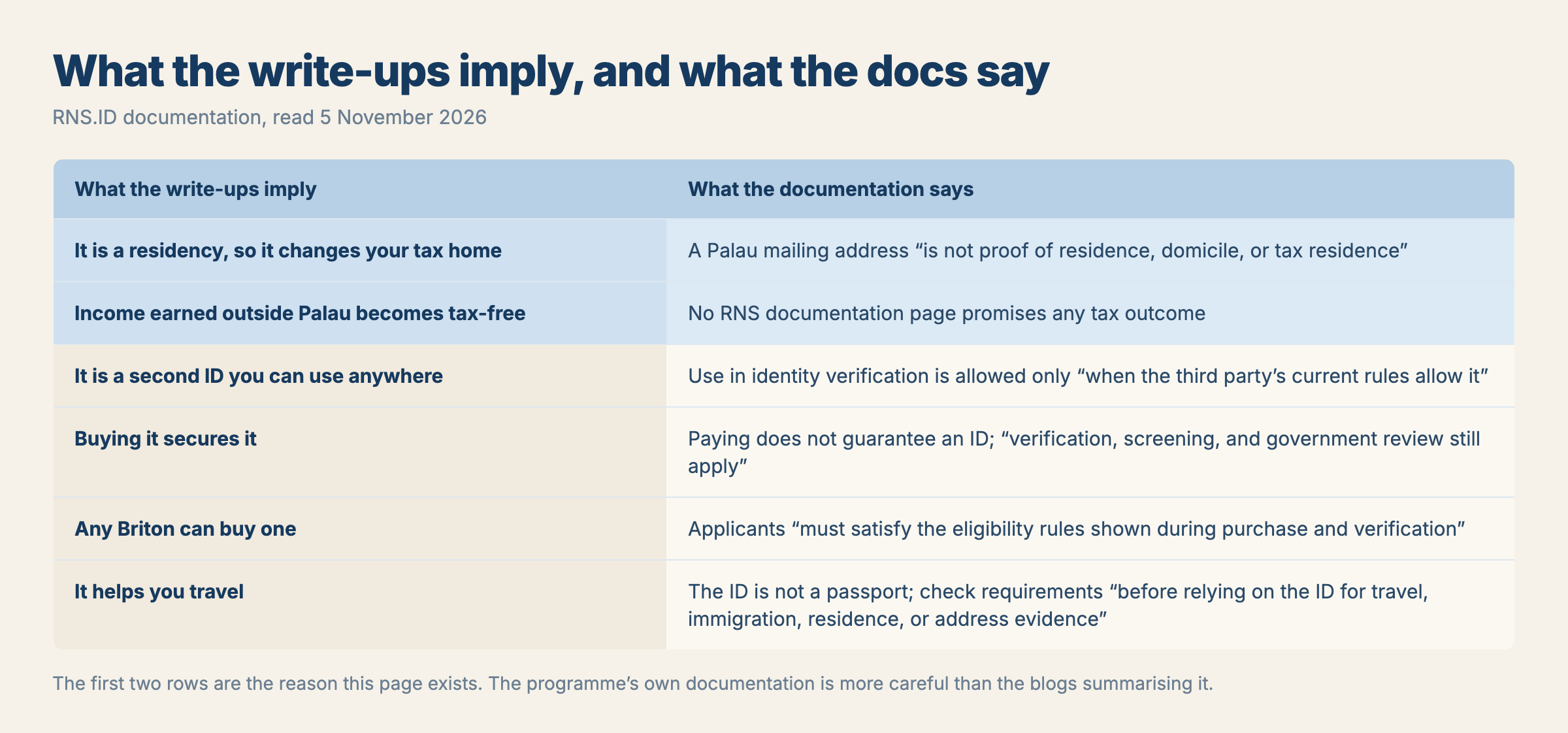
| What the write-ups imply | What the documentation says |
|---|---|
| It is a residency, so it changes your tax home | A Palau mailing address "is not proof of residence, domicile, or tax residence" |
| Income earned outside Palau becomes tax-free | No RNS documentation page promises any tax outcome |
| It is a second ID you can use anywhere | Use in identity verification is allowed only "when the third party's current rules allow it" |
| Buying it secures it | Paying does not guarantee an ID; "verification, screening, and government review still apply" |
| Any Briton can buy one | Applicants "must satisfy the eligibility rules shown during purchase and verification" |
| It helps you travel | The ID is not a passport; check requirements "before relying on the ID for travel, immigration, residence, or address evidence" |
Read the first two rows as the reason this page exists. The rest of it works through each in order, with the UK side sourced to GOV.UK rather than to anybody's summary of it. For the general version of this argument, our limitations page covers what the programme does not guarantee for anyone.
Can a UK citizen apply? What RNS actually publishes
Here is the honest answer: RNS does not publish a static list of eligible nationalities, so no page — including this one — can tell you that a British citizen is eligible. Its eligibility documentation says it "checks current country and compliance restrictions", that the "restricted-country list is maintained by the service and can change", and it explicitly directs you to review the list shown in the product rather than relying on a copied one.
That is a deliberate design, and it is the correct one for a compliance screen. It also means every third-party page quoting a country count — 138 countries, 151 countries — is quoting a snapshot of a list that is not published and has moved. Treat those numbers as history, not eligibility.
What the docs are specific about is the material you must supply.
| What you need | RNS's requirement |
|---|---|
| Identity document | "An original, valid government-issued identity document accepted by the verification flow" |
| Document condition | "Use the original document, not a photocopy, screenshot, or picture of a copy" — details readable, not expired |
| Portrait | "A recent, clear portrait for the ID card" |
| Account | An RNS.ID account "with an email address you can access" |
| Eligibility | Satisfy "the eligibility rules shown during purchase and verification" |
For a UK applicant that list is unremarkable — a current British passport satisfies the first row comfortably. The screen you cannot see in advance is the compliance one, and the only place its current state exists is the checkout. Our supported countries page tracks what has been observable about exclusions over time.
The claim to be careful with: "0% tax on income earned outside Palau"
This is the sentence that sells the programme to British readers, and it is worth separating into its two halves, because one is plausible and the other is a non sequitur.
The plausible half is about Palau. Whether Palau taxes income earned elsewhere is a question about Palauan law, and this page does not answer it, because we have not verified it against a primary Palauan source and will not assert it from a blog. The non sequitur is the jump from there to your bill. A statement about what Palau charges is only relevant to you if Palau is where you are taxed — and holding an identity card is not what decides that.
One widely-cited guide, denationalize.me, makes the leap explicit: it concedes that a digital ID "is not a tax residence in the strict sense" and then suggests its benefits can be used to "simulate" one. That page is from 2023, frames everything through German rules, and contains no tables or primary sourcing. Taking it as UK guidance is the error this page is trying to interrupt.
RNS's own documentation declines the claim twice over. A Palau mailing address "is not proof of residence, domicile, or tax residence". The ID is "not Palauan citizenship, a Palau passport, or proof that the holder physically resides in Palau". Nothing in the docs promises a tax outcome of any kind, which is the single most reassuring thing about them — a vendor claiming otherwise would be a reason to walk away. Our tax guide and crypto tax page go further into why this distinction matters before you buy.
How UK tax residency is actually decided
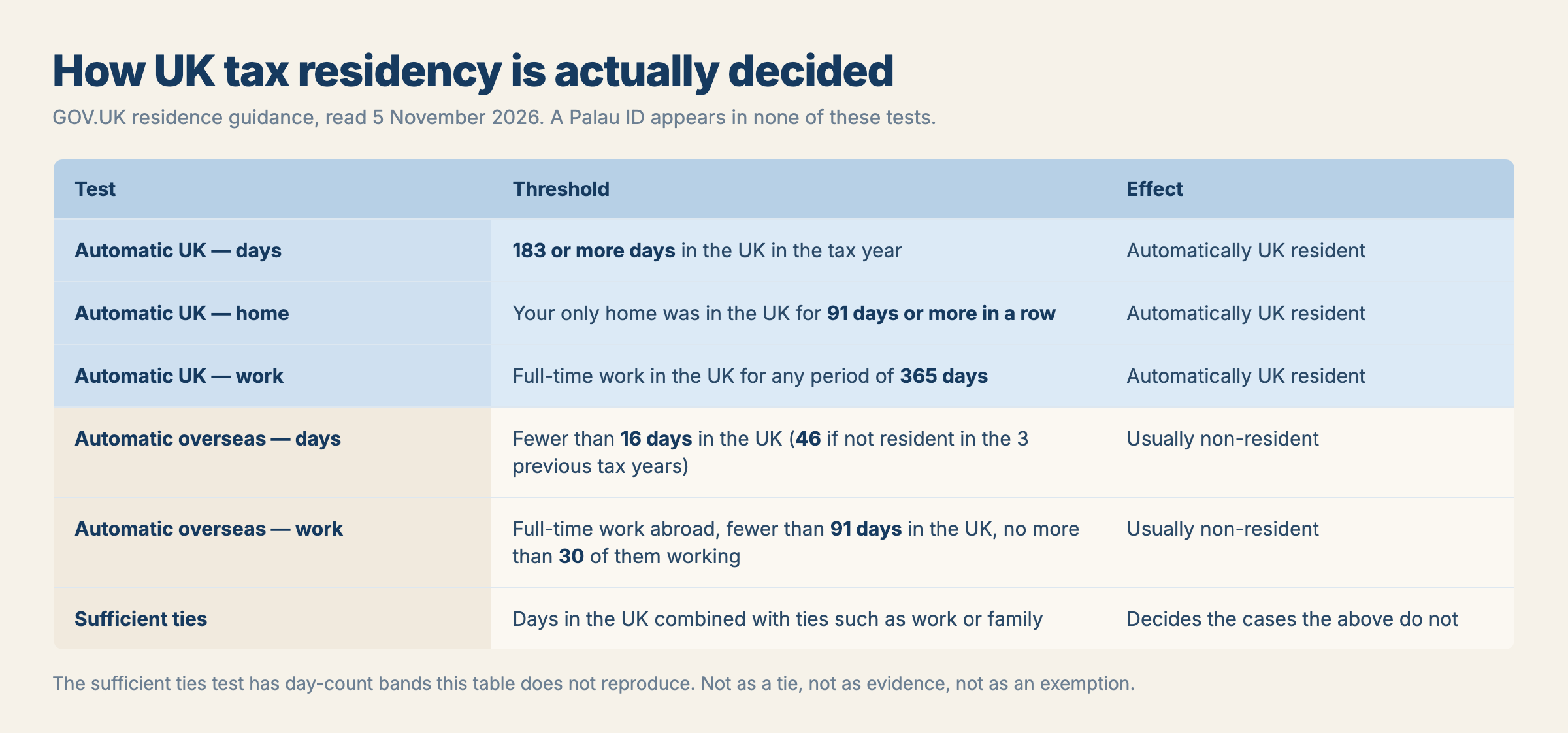
Your UK position is decided by presence and ties, tested afresh every tax year. GOV.UK's framing is that you are UK resident only if both of these hold: you meet one or more of the automatic UK tests or the sufficient ties test, and you meet none of the automatic overseas tests. Otherwise you are non-resident.
The numbers are published and they are the thing a card cannot touch.
| Test | Threshold | Effect |
|---|---|---|
| Automatic UK — days | 183 or more days in the UK in the tax year | Automatically UK resident |
| Automatic UK — home | Your only home was in the UK for 91 days or more in a row | Automatically UK resident |
| Automatic UK — work | Full-time work in the UK for any period of 365 days | Automatically UK resident |
| Automatic overseas — days | Fewer than 16 days in the UK (46 if not resident in the 3 previous tax years) | Usually non-resident |
| Automatic overseas — work | Full-time work abroad, fewer than 91 days in the UK, no more than 30 of them working | Usually non-resident |
| Sufficient ties | Days in the UK combined with ties such as work or family | Decides the cases the above do not |
Two consequences follow, and neither involves Palau. If you are UK resident you "normally pay UK tax on all your income, whether it's from the UK or abroad". If you are non-resident you do not pay UK tax on foreign income. A Palau ID appears nowhere in that determination — not as a tie, not as evidence, not as an exemption. Someone who has genuinely left the UK is non-resident with or without the card; someone spending 200 days a year in London is resident with or without it.
The full rules are longer than the summary above — the sufficient ties test in particular has day-count bands this table does not reproduce — so read GOV.UK's residence guidance and take advice on your own facts. What you should not do is treat a purchase as a planning step.
From 1 January 2026, your provider collects more than an ID
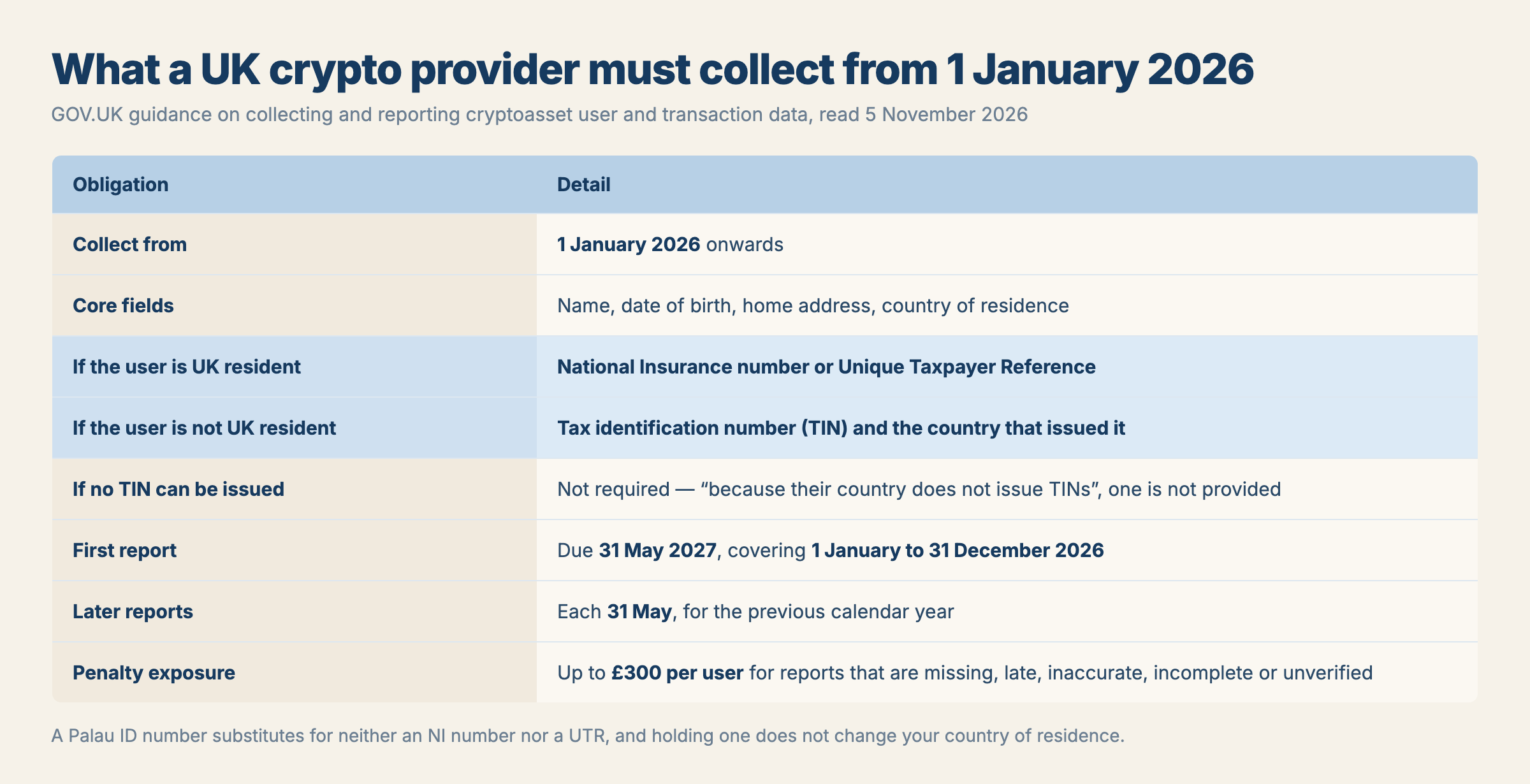
This is the part no competing page covers, and it is the one that has actually changed this year. UK cryptoasset service providers now operate under reporting rules that oblige them to collect identifying data on their users, and the collection obligation runs from 1 January 2026.
What they must collect is specific, and the detail that matters here is the tax number.
| Obligation | Detail |
|---|---|
| Collect from | 1 January 2026 onwards |
| Core fields | Name, date of birth, home address, country of residence |
| If the user is UK resident | National Insurance number or Unique Taxpayer Reference |
| If the user is not UK resident | Tax identification number (TIN) and the country that issued it |
| If no TIN can be issued | Not required — "because their country does not issue TINs", one is not provided |
| First report | Due 31 May 2027, covering 1 January to 31 December 2026 |
| Later reports | Each 31 May, for the previous calendar year |
| Penalty exposure | Up to £300 per user for reports that are missing, late, inaccurate, incomplete or unverified |
Follow the logic through for a UK-resident holder. The provider needs your country of residence and, because that is the UK, your NI number or UTR. A Palau ID number is not a substitute for either, and presenting a Palau card does not make the UK stop being your country of residence — the residence tests above decide that. The £300-per-user penalty also sits on the provider, which is precisely why a firm has no incentive to accept a document that leaves its reporting file incomplete.
So the 2026 change runs opposite to the pitch: the regime is built to attach your crypto activity to a tax identity, and a second ID does not detach it. Our CARF reporting page covers where a Palau ID does and does not fit the wider framework.
Will a UK exchange or bank accept the card?
Sometimes, and nobody can promise it — least of all the issuer. RNS's documentation is blunt: it "does not guarantee account opening, continued access, or acceptance of a Palau ID by any financial service", and even downloading the digital copy "does not establish permission to use it in a particular verification process". Acceptance is the receiving firm's decision, taken under its own obligations.
For UK crypto firms those obligations sit under the money laundering regulations the FCA supervises, which is why acceptance tends to be narrower than the marketing suggests rather than broader. A firm weighing an unfamiliar foreign ID against a £300-per-user reporting exposure has an obvious default.
The practical approach is the one our exchange KYC tracker is built around: check the specific platform's current accepted-document list before you buy anything, not after. Acceptance also moves — the EU's position shifted considerably once MiCA bedded in, which our MiCA page traces — so a report of acceptance from last year is not a basis for a purchase this year.
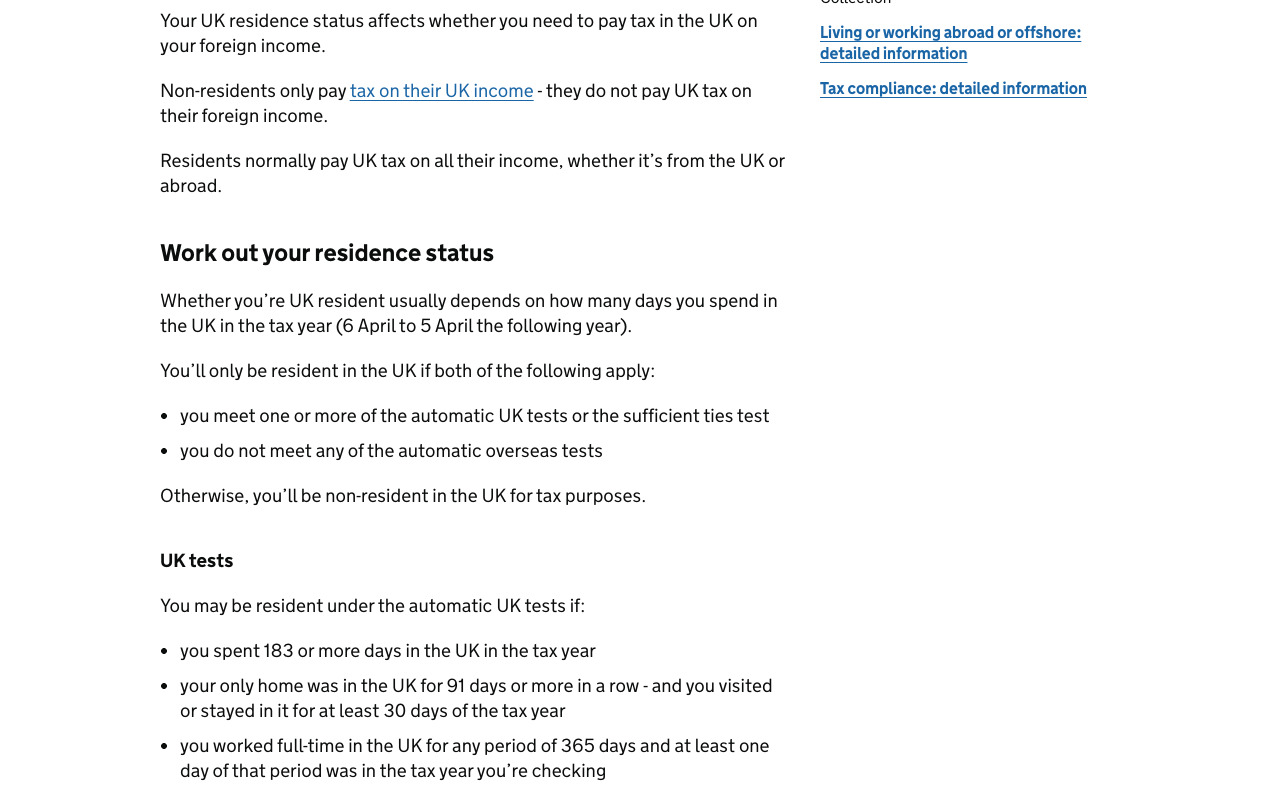
GOV.UK residence guidance as published, captured 5 November 2026.
"Residency" is the wrong word for the travel question
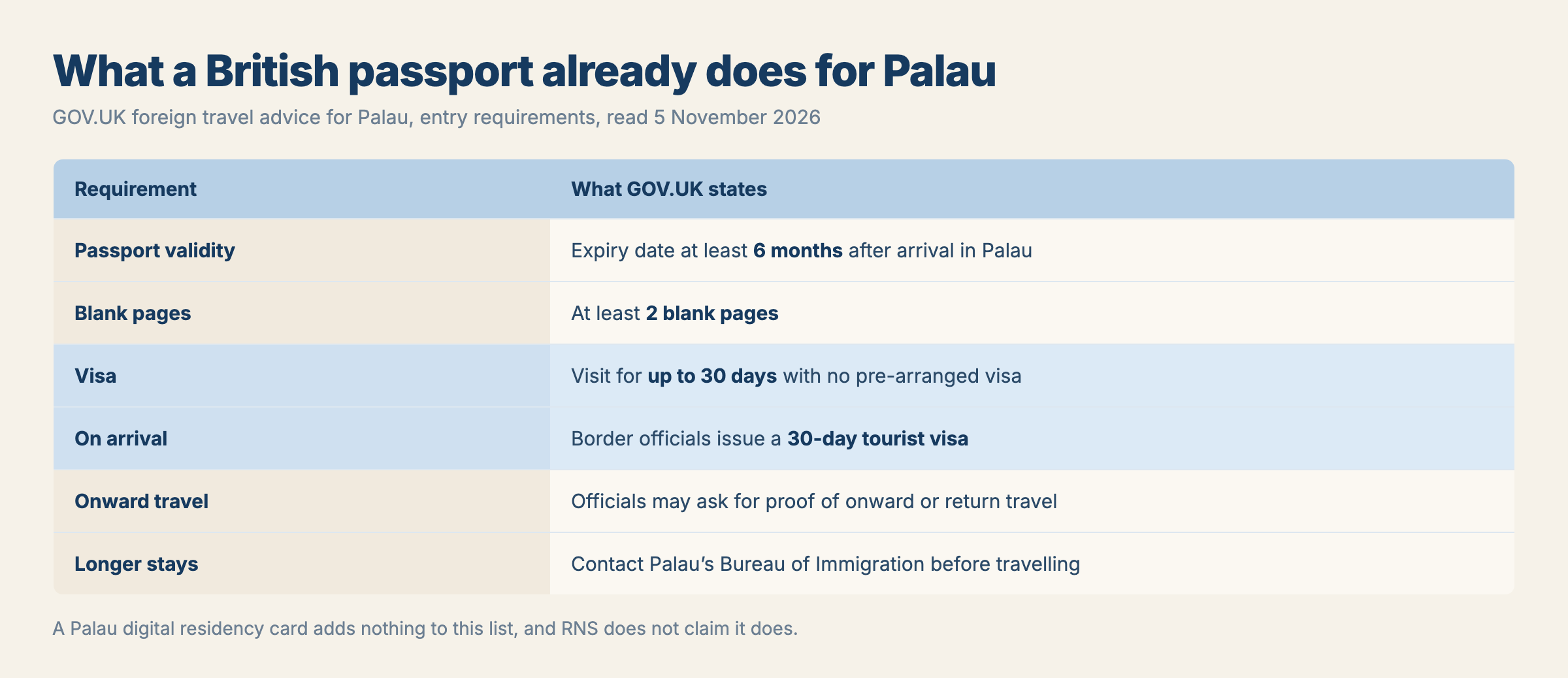
For a British passport holder the travel case mostly dissolves on inspection, because the UK passport already covers it. GOV.UK's Palau entry requirements are short.
| Requirement | What GOV.UK states |
|---|---|
| Passport validity | Expiry date at least 6 months after arrival in Palau |
| Blank pages | At least 2 blank pages |
| Visa | Visit for up to 30 days with no pre-arranged visa |
| On arrival | Border officials issue a 30-day tourist visa |
| Onward travel | Officials may ask for proof of onward or return travel |
| Longer stays | Contact Palau's Bureau of Immigration before travelling |
A Palau digital residency card adds nothing to that list, and RNS does not claim it does: the ID is not a passport, and its docs tell you to check the relevant authority's requirements "before relying on the ID for travel, immigration, residence, or address evidence". The programme is an identity product, not an immigration status — our travel page works through the 2026 rules in more detail, and the separate question of extending a stay is covered in our visa extension page.
Who it still suits, and who should skip it
The card has real uses, and they are narrower and more specific than "offshore residency". It is a government-issued photo ID that some platforms accept, obtainable without visiting the issuing country, which is genuinely useful if your existing documents are the problem. It is not a tax instrument and it is not a travel document.
| Option | Listed price | Validity |
|---|---|---|
| Trial | $288 | 1 year |
| Regular | $1,199 | 5 years |
| Ultimate | $2,339 | 10 years |
Those are the three tiers our cost page recorded, and an independent 2026 programme guide lists the same figures — but note that RNS states current terms and prices are "intentionally not hard-coded in these docs" and points to the checkout instead. Treat the table as indicative and confirm the price before paying.
Skip it if your reason for buying is a lower UK tax bill, a tax residence, a second passport, visa-free travel you do not already have, or a way around a specific exchange's verification. The first four are not what the product is, and the fifth is a question only that exchange's current document list can answer. Consider it if you want a government-issued ID as a documented identity option, you have read the limitations and risks, and you are treating the fee as the cost of an identity document rather than an investment. If you are weighing the programme itself rather than the UK angle, is RNS.ID legit? is the better starting page.
Related reading
- Palau digital residency for US citizens — the same questions under US rules
- Palau digital residency tax guide — why the ID is not a tax position
- CARF crypto reporting and a Palau ID — the wider reporting framework
- Palau ID exchange KYC tracker — acceptance, platform by platform
- Palau digital residency limitations — what it does not guarantee
- Palau digital residency cost — the 1, 5 and 10 year options
- Is RNS.ID legit? — who runs the programme, under what authority
FAQ
Can UK citizens get Palau digital residency?
RNS does not publish a fixed list of eligible nationalities, so there is no documented yes to quote. Its eligibility page says applicants "must satisfy the eligibility rules shown during purchase and verification" and that the "restricted-country list is maintained by the service and can change", directing you to the list shown in the product. A current British passport meets the document requirement; the compliance screen is only visible at checkout.
Does a Palau ID change my UK tax residency?
No. UK residence is decided by the automatic UK tests, the automatic overseas tests and the sufficient ties test — day counts, homes, work and family ties. Holding a foreign identity card is not an input to any of them, and RNS's own documentation says a Palau mailing address "is not proof of residence, domicile, or tax residence".
Do I still pay UK tax if I have Palau digital residency?
If you are UK resident under those tests, you "normally pay UK tax on all your income, whether it's from the UK or abroad", exactly as before. If you are non-resident, you do not pay UK tax on foreign income — again, exactly as before. The card does not move you between those two states. Take advice on your own facts rather than from any ID product's marketing.
Will UK crypto exchanges accept a Palau ID for KYC?
Some platforms accept it and many do not, and the issuer explicitly does not promise it: RNS "does not guarantee account opening, continued access, or acceptance of a Palau ID by any financial service". Each firm applies its own rules under the money laundering regulations the FCA supervises. Check the specific platform's current accepted-document list before buying anything.
Does HMRC see my crypto if I hold a Palau ID?
The reporting rules work from residence, not from which card you show. Since 1 January 2026 UK cryptoasset providers must collect your name, date of birth, home address and country of residence, plus your National Insurance number or Unique Taxpayer Reference if you are UK resident. A Palau ID number does not replace either, and the first provider reports are due by 31 May 2027 covering calendar year 2026.
Does Palau digital residency let me live in or move to Palau?
No. RNS's documentation states the ID is "not Palauan citizenship, a Palau passport, or proof that the holder physically resides in Palau". It is an identity product rather than an immigration status, and any right to stay in Palau is decided by Palau's immigration authorities under their own rules.
Do British nationals need a visa for Palau?
Not for a short visit. GOV.UK says you can visit Palau for up to 30 days without a pre-arranged visa, and border officials issue a 30-day tourist visa on arrival. Your passport needs an expiry date at least 6 months after arrival and at least 2 blank pages, and officials may ask for proof of onward or return travel. Contact Palau's Bureau of Immigration before travelling if you expect to stay longer.
Is Palau digital residency worth it for a UK resident?
It depends entirely on what you expect from it. As a government-issued photo ID that some platforms accept and that you can obtain remotely, it may be worth the listed fee. As a route to a lower UK tax bill, a tax residence, a second passport or guaranteed exchange access, it is not — and none of those outcomes appears anywhere in RNS's own documentation.