Can You Travel With a Palau ID? The 2026 Rules
Can you travel with a Palau ID? Not for boarding or a border. TSA lists one foreign document, the EU logs travel documents, Spain names three in law.
We may earn a commission if you apply through this link. This site is independent and is not the official RNS.ID or Palau government site.
Key takeaways
- RNS advertises the card for exactly three travel moments — its homepage reads "ID verification for: check-in, boarding, rental" — and the published rules governing all three name documents the card is not. Read 2026-10-10.
- At a US checkpoint the list is 17 items long and one of them is foreign. TSA accepts a "Foreign government-issued passport" and, separately, a Canadian provincial driving licence. There is no line for a foreign residency card, and since 1 February 2026 a passenger without acceptable ID can pay $45 for TSA ConfirmID instead — a fallback, not an acceptance.
- The EU external border now records the document itself. The Entry/Exit System has been fully operational since 10 April 2026 across 29 countries, and what it registers is "travel document data" plus fingerprints and a facial image. A card that is not a travel document has nothing to enrol.
- One country wrote the accepted document types into law, and there are three of them. Spain's Real Decreto 933/2021 makes hotels record "DNI, pasaporte, TIE" for every traveller — and applies the same register to car-rental firms.
- The honest exception is Palau itself. Everywhere else, you still need your passport, and the card is not a passport.
On this page
- Can you travel with a Palau ID? The short answer
- RNS advertises "check-in, boarding, rental" — then disclaims it
- Boarding a flight in the US: one foreign document on the list
- Can you travel with a Palau ID into the Schengen area?
- Hotel check-in: Spain wrote the document types into law
- Car rental: the counter asks for a driving licence
- Where the card does do something at a border
- How to check any desk yourself, before you pay
- Bottom line
- Related reading
- FAQ
Can you travel with a Palau ID? The short answer

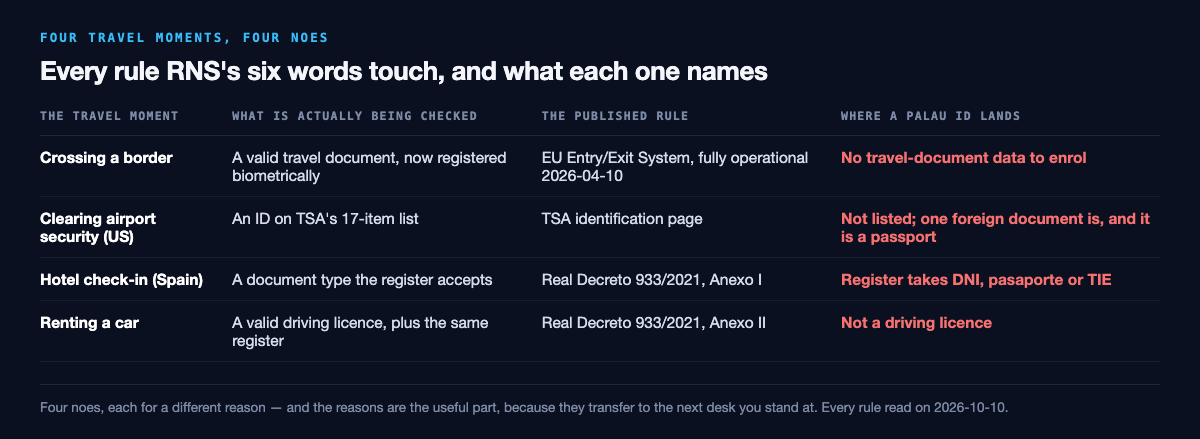
Can you travel with a Palau ID? Not as a travel document, and not as the identity document at a boarding gate, a passport booth or a Spanish hotel desk. We went looking for a published rule anywhere that lists a foreign digital-residency card among accepted documents and found none. What we found instead were three public lists, in three legal systems, each naming what it will take and not naming this.
Travel is where the card is marketed hardest. RNS's own homepage puts the claim in six words — "ID verification for: check-in, boarding, rental" — and the evidence beneath them is a member quote saying the card was "already used for taking flights multiple times." We read every rule those three words touch on 2026-10-10.
| The travel moment | What is actually being checked | The published rule | Where a Palau ID lands |
|---|---|---|---|
| Crossing a border | A valid travel document, now registered biometrically | EU Entry/Exit System, fully operational 2026-04-10 | No travel-document data to enrol |
| Clearing airport security (US) | An ID on TSA's 17-item list | TSA identification page | Not listed; one foreign document is, and it is a passport |
| Hotel check-in (Spain) | A document type the register accepts | Real Decreto 933/2021, Anexo I | Register takes DNI, pasaporte or TIE |
| Renting a car | A valid driving licence, plus the same register | Real Decreto 933/2021, Anexo II | Not a driving licence |
Four moments, four noes, and each for a different reason. The reasons are the useful part, because they transfer to the next desk you stand at.
RNS advertises "check-in, boarding, rental" — then disclaims it
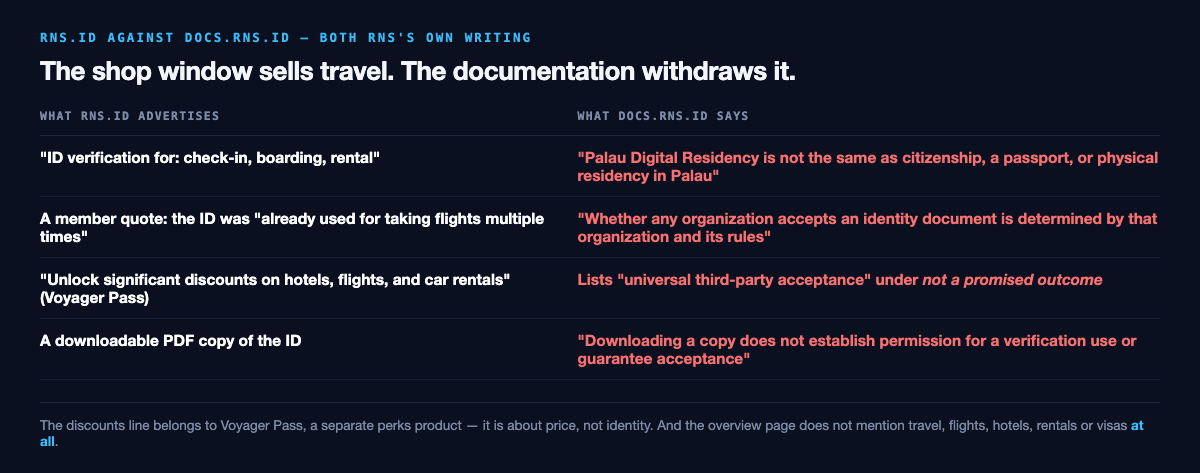
Set the two RNS surfaces side by side and the gap is plain. The homepage sells travel verification. The documentation, which is also RNS's own writing and is the thing a careful buyer should read first, withdraws almost every part of it.
| What rns.id advertises | What docs.rns.id says |
|---|---|
| "ID verification for: check-in, boarding, rental" | "Palau Digital Residency is not the same as citizenship, a passport, or physical residency in Palau" |
| A member quote: the ID was "already used for taking flights multiple times" | "Whether any organization accepts an identity document is determined by that organization and its rules" |
| "Unlock significant discounts on hotels, flights, and car rentals" (Voyager Pass) | Lists "universal third-party acceptance" under not a promised outcome |
| A downloadable PDF copy of the ID | "Downloading a copy does not establish permission for a verification use or guarantee acceptance" |
Two details in that table deserve pulling out. The first is that the discounts line belongs to Voyager Pass, a separate perks product — it is about price, not about identity, and it is easy to read as though an airline had agreed to something. The second is that the overview page does not mention travel, flights, hotels, rentals or visas among the card's uses at all. The document that describes what you are buying is silent on the use the shop window leads with.
So the strongest claim RNS makes about boarding a plane is a testimonial, and the strongest claim it makes about hotels is a discount. Neither is a rule, and a desk agent applies rules. We set out the underlying distinction in Palau passport vs digital residency; the short version is that a passport is a document a state issues to assert your nationality to another state, and this card is not a passport.
One further wrinkle that bites specifically at a physical desk: RNS's own position is that only the physical card carries verification weight, not the PDF, which we go through in physical vs digital Palau ID KYC. A gate agent will not be looking at your phone.
Boarding a flight in the US: one foreign document on the list
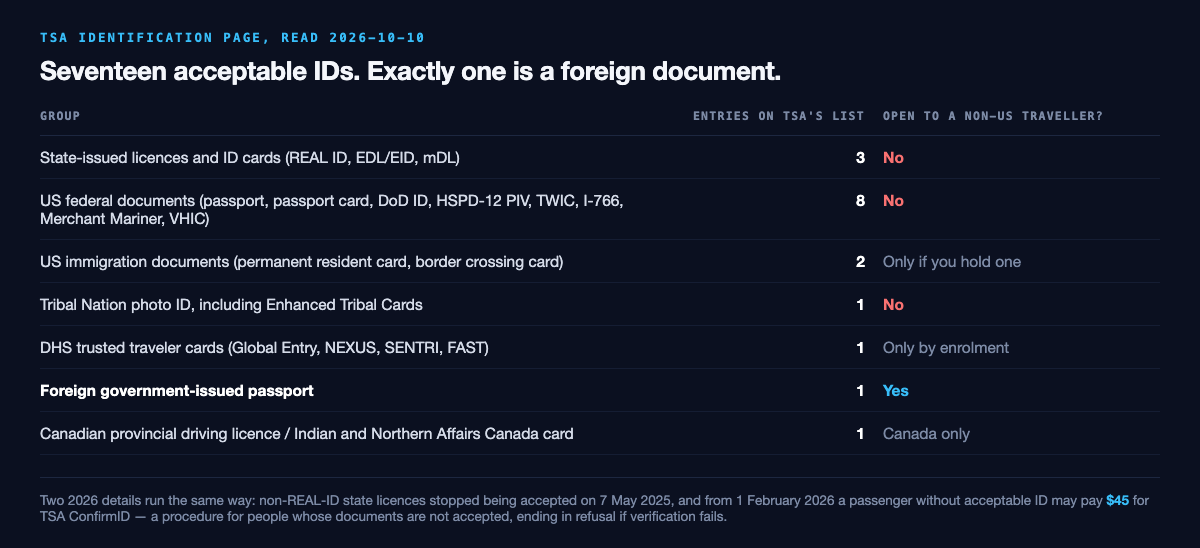
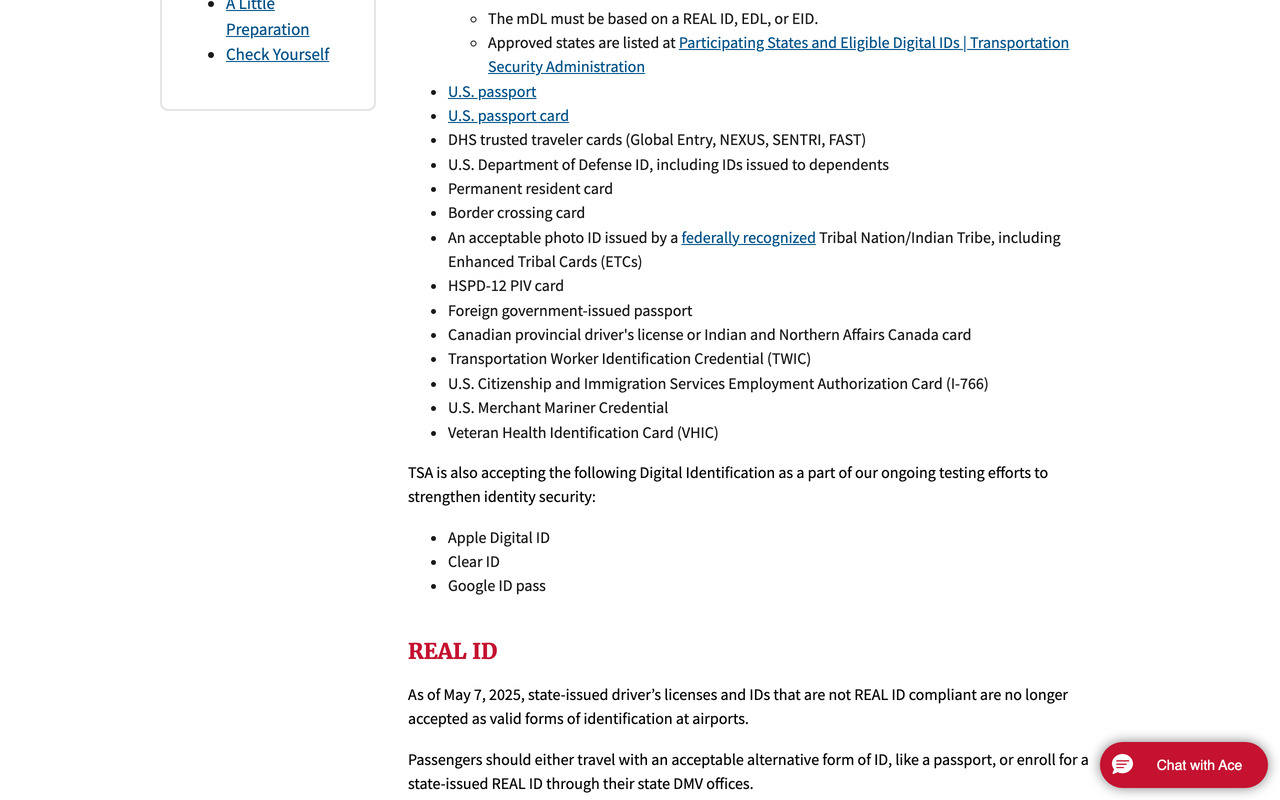
TSA publishes the list, which makes this the cleanest test here. We read it on 2026-10-10. It runs to 17 acceptable forms of identification for passengers aged 18 and over, and exactly one of them is a foreign document.
| Group | Entries on TSA's list | Open to a non-US traveller? |
|---|---|---|
| State-issued licences and ID cards (REAL ID, EDL/EID, mDL) | 3 | No |
| US federal documents (passport, passport card, DoD ID, HSPD-12 PIV, TWIC, I-766, Merchant Mariner, VHIC) | 8 | No |
| US immigration documents (permanent resident card, border crossing card) | 2 | Only if you hold one |
| Tribal Nation photo ID, including Enhanced Tribal Cards | 1 | No |
| DHS trusted traveler cards (Global Entry, NEXUS, SENTRI, FAST) | 1 | Only by enrolment |
| Foreign government-issued passport | 1 | Yes |
| Canadian provincial driving licence / Indian and Northern Affairs Canada card | 1 | Canada only |
Read the sixth row. The single door TSA leaves open to a visitor is a passport, and digital residency does not produce one. There is no row for a foreign identity card, a foreign residency card or a foreign driving licence outside Canada — which is worth noticing, because a traveller inclined to argue "it is a government-issued ID" is arguing against a list that already distinguishes between government-issued documents and accepts a narrow set of them.
Two 2026 details sharpen this further, and both run the wrong way for the card. TSA states that "as of May 7, 2025, state-issued driver's licenses and IDs that are not REAL ID compliant are no longer accepted" — the direction of travel at US checkpoints is fewer accepted documents, not more. And from 1 February 2026, a passenger who cannot present an acceptable ID may "pay a $45 fee to use TSA ConfirmID," after which TSA attempts to verify identity; if it cannot, the passenger "will not be allowed to enter the screening checkpoint."
That fee is sometimes read as a loophole. It is the opposite: it is the procedure for people whose documents are not accepted, it costs money, it is discretionary, and it ends in a refusal if verification fails. Needing it is the definition of not having acceptable ID.
Can you travel with a Palau ID into the Schengen area?
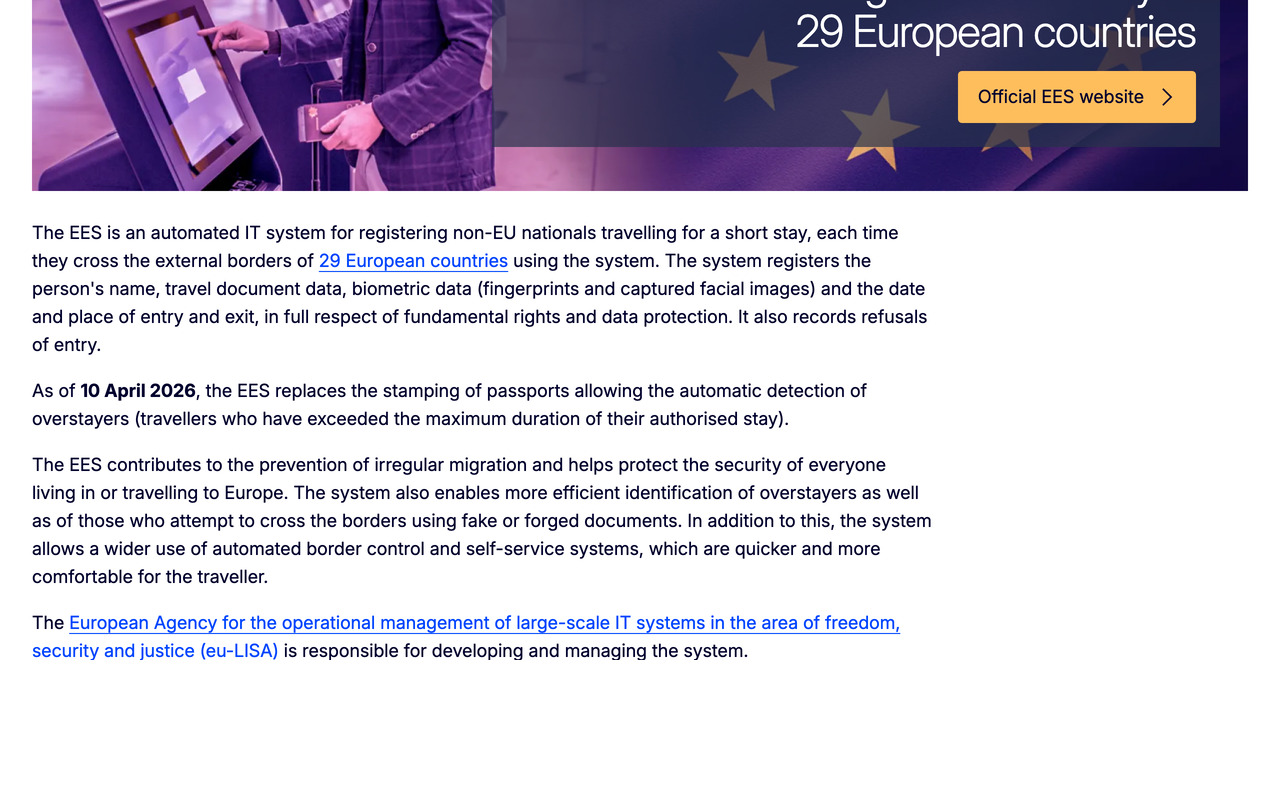
Can you travel with a Palau ID across an EU external border? No, and since April the mechanism makes the answer harder to fudge rather than easier. The European Commission describes the Entry/Exit System as "an automated IT system for registering non-EU nationals travelling for a short stay," running across 29 European countries.
| Entry/Exit System fact | Detail |
|---|---|
| What it registers | Name, travel document data, biometric data (fingerprints and captured facial images) |
| Also recorded | Date and place of entry and exit; refusals of entry |
| Countries using it | 29 |
| Progressive start | 12 October 2025 |
| Fully operational | 10 April 2026 |
The operative phrase is travel document data. Border registration is now keyed to the document, biometrically linked to the holder, and the record follows you across every subsequent crossing. A card that no state recognises as a travel document is not a weaker version of a passport in that system; it is absent from it. There is nothing for a booth to scan and nothing for the file to be opened against.
Be exact about what this does and does not prove. EES does not single Palau out, and nothing in the Commission's material mentions digital residency — the point is structural. The system assumes every short-stay traveller arrives holding a travel document, because the law it implements requires one. A second card adds nothing to a check already decided by the passport in your hand. Which countries that passport opens is a separate question, covered in Palau digital residency visa-free countries.
Hotel check-in: Spain wrote the document types into law
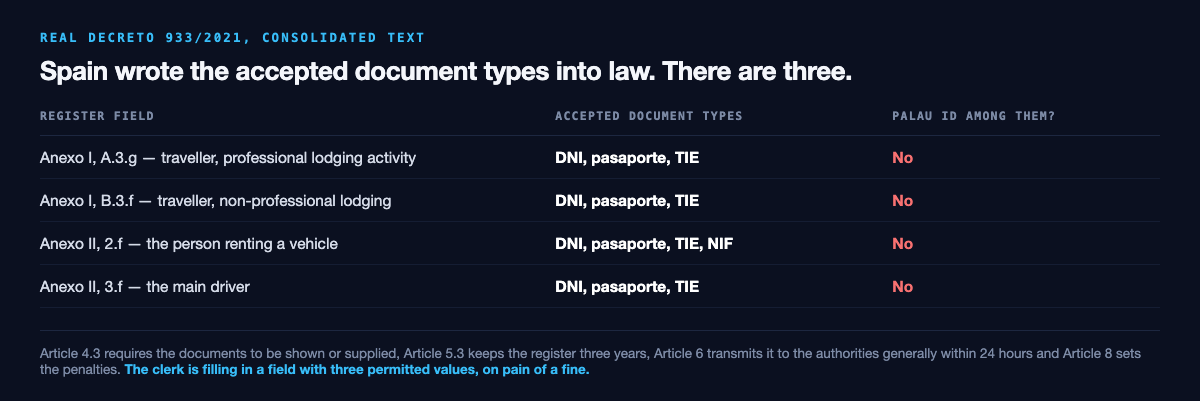
Hotels are where the marketing claim sounds most plausible, because hotel desks really do take ID cards. So we picked the jurisdiction that leaves least to the clerk's judgement. Spain's Real Decreto 933/2021 obliges lodging businesses to keep a register of travellers and transmit it to the authorities, and its annexes specify the field values.
| Register field (Real Decreto 933/2021) | Accepted document types | Palau ID among them? |
|---|---|---|
| Anexo I, A.3.g — traveller, professional lodging activity | "Tipo de documento (DNI, pasaporte, TIE)" | No |
| Anexo I, B.3.f — traveller, non-professional lodging | "Tipo de documento (DNI, pasaporte, TIE)" | No |
| Anexo II, 2.f — the person renting a vehicle | "Tipo de documento (DNI, pasaporte, TIE, NIF)" | No |
| Anexo II, 3.f — the main driver | "Tipo de documento (DNI, pasaporte, TIE)" | No |
Three document types for a traveller: the Spanish national ID, a passport, and the TIE — the foreigner's identity card Spain itself issues to residents. A Palau digital residency card is none of the three, and the register has no free-text alternative for a fourth.
The decree does not stop at the list. Article 4.3 requires the establishment to check that the data it records match "los documentos o sistemas que acrediten la identidad de las personas," which users "habrán de ser exhibidos o facilitados" — shown or supplied. Article 5.1 requires the register itself, Article 5.3 requires it kept for three years, Article 6 requires transmission to the authorities, generally within 24 hours, and Article 8 sets the penalties. The consolidated text records publication on 27 October 2021 and entry into force on 27 April 2022, with the communication obligations applying from 2 January 2023.
That chain is why the front-desk answer is firm in a way a chat with a receptionist would not suggest. The clerk is not deciding whether your card looks real. They are filling in a field with three permitted values, on pain of a fine, and sending it to the police. Acceptance varies between countries and chains — many hotels outside Europe will photocopy whatever you hand them — but a system built this way will not improvise, and nothing about holding a second card improves your position at it.
Car rental: the counter asks for a driving licence
"Rental" is the third word in RNS's claim and the quickest to dispose of, because the document a rental counter needs most is one the card does not even resemble.
| What a rental counter asks for | Can a Palau digital residency ID supply it? |
|---|---|
| A valid driving licence in the renter's name | No — it is an identity card, not a licence |
| An International Driving Permit, where the licence is not in Latin script | No — an IDP is issued against your licence |
| A payment card in the renter's name | No |
| In Spain, a register entry of type DNI, pasaporte, TIE or NIF | No |
| A proof-of-address document, where asked | No — see below |
Nothing in RNS's documentation claims the card is a driving licence, and it is not sold as one. The claim is narrower than it looks: the word "rental" sits in a line about ID verification, and at a rental counter identity verification is the second check, after the licence. Failing the first makes the second moot.
The address question is the one readers get wrong, usually because the RNS mailing address is bundled nearby. RNS is explicit that Palau Mailing "is not proof of residence," and we have gone through the consequences in Palau ID as proof of address and the Palau mailing address. Putting an address you do not live at on a rental agreement is a worse outcome than being turned away.
Where the card does do something at a border
A page that only says no is not much use, so here is the one place a published rule points the other way — and it is in Palau.
Palau's own immigration process is the one context where the programme is the issuing state's own product rather than a foreign document somebody has to interpret. Digital residents are commonly pointed to a stay extension once they are in the country — a Palau Bureau of Immigration decision under Palau's rules, with the detail and caveats on one page: Palau visa extension for digital residents. You still arrive and clear entry on your passport, and the extension stays at the authority's discretion rather than being something the card entitles you to.
Away from the border, the real use cases are the ones this site tracks week by week, and they are verification desks rather than travel desks — chiefly crypto platform onboarding, where the answer is venue-by-venue and mostly negative at regulated European venues. The Palau ID for crypto KYC cluster is the place to start, and Palau digital residency limitations is the honest inventory of what the card is not: among other things, not a passport.
If what you actually want from a travel document is cover while you are moving, that is an insurance question rather than an identity one. SafetyWing sells nomad travel medical cover that does not care which cards you hold. That is a sponsored link and we may earn a commission at no cost to you. It is not a substitute for a passport, and it has no bearing on an RNS application.
How to check any desk yourself, before you pay
The method matters more than our four verdicts, because the desk you care about may not be one we checked. Every answer above came from a public page, and each took one search.
| Step | What to look for | Where it lives |
|---|---|---|
| 1. Name the check | Border crossing, security screening, commercial check-in or licence check | Decide this first; the rules differ |
| 2. Find the list | The accepted-document list of the body that runs that check | Regulator, interior ministry, or the airline's own conditions of carriage |
| 3. Read your row | Find the entry your document would be filed under | A missing row is a no, not a maybe |
| 4. Check the date | When was the page last updated, and does it predate 2026? | Page footer or revision note |
| 5. Treat anecdotes as anecdotes | A forum report of a card working is one clerk, one day | Not a rule, and not repeatable |
Step 5 is the one that costs people money. Almost everything written about this card online is a report of what happened to somebody once, and a successful one-off tells you nothing about the next desk: TSA's list did not change because a card was waved through somewhere, and Spain's register still has three permitted values. If you are weighing the purchase rather than a specific trip, start here and read the cost page first.
Bottom line
Can you travel with a Palau ID? No, on four separate published grounds, which is a stronger answer than the usual "check with your provider." TSA's checkpoint list has 17 entries and one foreign document on it, and it is a passport. The EU's Entry/Exit System, fully operational since 10 April 2026 across 29 countries, registers travel-document data the card does not have. Spain's Real Decreto 933/2021 allows hotels three document types for a traveller, and this is not one of them. And a rental counter wants a driving licence first, which the card is not.
What is worth carrying away is the asymmetry between the two RNS surfaces. The homepage sells "ID verification for: check-in, boarding, rental"; the documentation says the programme "is not the same as citizenship, a passport, or physical residency in Palau" and lists "universal third-party acceptance" among outcomes it does not promise. Both statements are RNS's own, and only one of them is a rule.
Payment does not guarantee approval, acceptance varies by organisation, platform and government rules change without notice, and nothing here is legal, immigration, tax or financial advice. For every trip outside Palau you will still need your passport — re-check the live pages for your own route before you book.
Related reading
- Start here — what the programme is, in order, before you buy
- Palau digital residency limitations — the full inventory of what the card does not do
- Palau passport vs digital residency — why the two are different kinds of document
- Palau digital residency visa-free countries — which passport opens which border
- Palau visa extension for digital residents — the one border process where the card features
- Palau digital residency benefits — the claims, assessed one at a time
FAQ
Can you travel with a Palau ID instead of a passport?
No. A Palau digital residency card is not a travel document, and RNS states in its own documentation that the programme "is not the same as citizenship, a passport, or physical residency in Palau." Border crossings are decided on a travel document — the EU's Entry/Exit System, fully operational since 10 April 2026, registers "travel document data" together with fingerprints and a facial image. You will still need your passport for every trip outside Palau.
Will TSA accept a Palau ID at airport security?
No. TSA's identification page lists 17 acceptable forms of ID for adult passengers, and the only foreign document among them is a "Foreign government-issued passport" (plus, separately, a Canadian provincial driving licence). There is no entry for a foreign identity or residency card. Since 1 February 2026 a passenger without acceptable ID can pay a $45 fee for TSA ConfirmID, but that is a verification attempt for people whose documents are not accepted, and it ends in refusal if identity cannot be verified.
Can I check into a hotel with a Palau ID?
Not reliably, and in some countries not at all. Spain's Real Decreto 933/2021 requires lodging businesses to register each traveller with a document type of "DNI, pasaporte, TIE" and to transmit the register to the authorities, so there is no field a Palau card fits. Outside Europe some hotels will accept whatever photo ID you present as a courtesy, but acceptance varies entirely by property and country, and no rule obliges anyone to take it.
RNS says the ID works for check-in, boarding and rental. Is that wrong?
The homepage line reads "ID verification for: check-in, boarding, rental," and the support offered for it is a member testimonial rather than a policy from any airline, hotel or rental firm. RNS's own documentation is more cautious: it says that "whether any organization accepts an identity document is determined by that organization and its rules" and lists "universal third-party acceptance" among outcomes it does not promise. Treat the homepage as marketing and the documentation as the terms.
Can I rent a car with a Palau ID?
No, because the first document a rental counter needs is a valid driving licence, and the card is not one. Identity verification at a counter comes after the licence check, so failing the licence check settles it. In Spain the same Real Decreto 933/2021 register applies to vehicle-rental companies, with document types of "DNI, pasaporte, TIE, NIF" for the renter.
Does a Palau ID help at the Palau border?
Only inside Palau's own process, and not for entry. You arrive and clear immigration on your passport. Digital residents are commonly pointed to a tourist-stay extension that the Palau Bureau of Immigration decides under its own rules, which we cover on the visa extension page with its caveats. It is a discretionary decision by an authority, not an entitlement attached to the card.
Is the PDF copy of the Palau ID enough at a desk?
No. RNS says that "downloading a copy does not establish permission for a verification use or guarantee acceptance," and its position elsewhere is that the physical card is what carries weight. A gate agent or front desk is checking a physical document against a list of permitted types, so a file on a phone is the weaker version of something already not on the list.