Does Bitvavo Accept Palau ID? Its 2026 Table Says No
Does Bitvavo accept Palau ID? No. Its 2026 document table refuses every non-EEA ID card and passport, and Palau sits outside the SEPA residence zone.
We may earn a commission if you apply through this link. This site is independent and is not the official RNS.ID or Palau government site.
Key takeaways
- Bitvavo publishes a four-column document table, and the "Non-EEA countries" column is empty. All five rows — plastic driving licence, paper ID booklet, plastic ID card, passport, residence permit — read Not accepted. Read on 2026-10-08; the page was last updated 2026-09-29.
- A Palau ID card is a non-EEA plastic ID card, so it has no row to be uploaded into. Bitvavo states its reasoning in one sentence: "Documents issued outside the EEA, Switzerland, or the United Kingdom are not supported."
- Palau also fails the separate residency test. Bitvavo only onboards residents of the SEPA zone and lists 24 countries. Palau is not one of them, and the help centre says plainly that "it's not possible to create an account from countries outside this region."
- This is the venue where the usual escape hatch also closes. At most exchanges a passport rescues an unlisted nationality. In Bitvavo's non-EEA column a passport is refused too — so even a genuine Palau passport, which digital residency does not produce, would not clear verification.
- Then there is a third layer nobody writes about: MiCA's personal identification number. Bitvavo must now hold a regulatory identifier built from your nationality plus an official document number. A Palau card changes neither of the inputs.
On this page
- Does Bitvavo accept Palau ID? The short answer
- Bitvavo asks two separate questions
- Palau is not in the SEPA zone, so there is no account to open
- The accepted-documents table, in full
- Even a Palau passport would not clear it
- What MiCA's personal identification number keys on
- Proof of address, and the mailing-address trap
- Why the search results answer this wrongly
- If you already hold a verified Bitvavo account
- Bottom line
- Related reading
- FAQ
Does Bitvavo accept Palau ID? The short answer
Does Bitvavo accept Palau ID? No — and unusually, Bitvavo says so itself rather than leaving you to infer it. We went looking for the fudge we normally find at this point: a document class accepted in general but missing from one country's row, which is what turned up at MoonPay, or sixteen policy cells with no slot for the card, which is what we found at Bitpanda. Bitvavo is blunter than both. It prints one column headed Non-EEA countries and marks every document type in it Not accepted.
That is worth knowing precisely because Bitvavo is not a marginal venue. It is the largest euro spot exchange in Europe, authorised as a crypto-asset service provider under Regulation (EU) 2023/1114 by the Dutch regulator, the AFM, in June 2025 — a licence that passports its services across the EU plus Norway, Iceland and Liechtenstein. If a second identity card were going to open a regulated European account, this is one of the first places people would try.
We read Bitvavo's five relevant help-centre articles on 2026-10-08. They were last updated between 2026-08-12 and 2026-10-01, so this is current policy rather than an archived page, and the answer is consistent across all five.
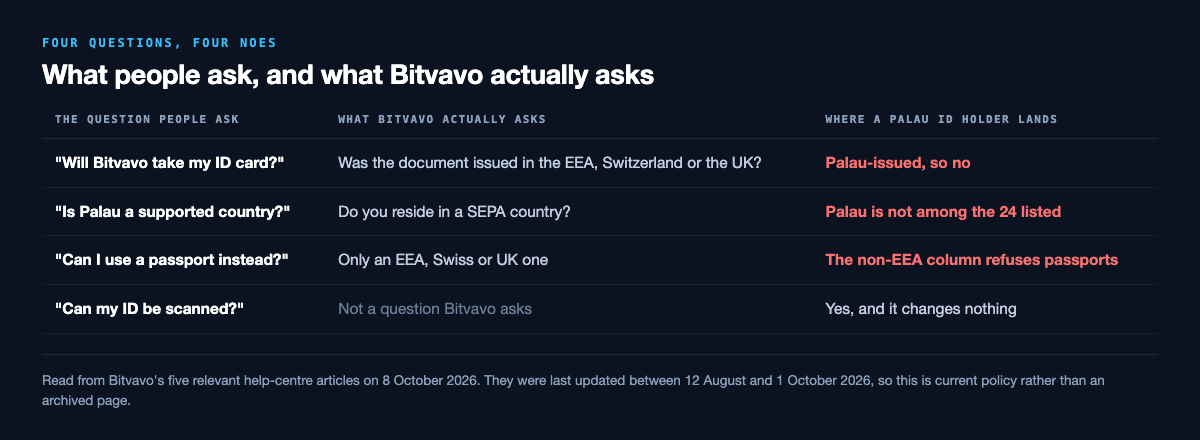
| The question people ask | What Bitvavo actually asks | Where a Palau ID holder lands |
|---|---|---|
| "Will Bitvavo take my ID card?" | Was the document issued in the EEA, Switzerland or the UK? | Palau-issued, so no |
| "Is Palau a supported country?" | Do you reside in a SEPA country? | Palau is not among the 24 listed |
| "Can I use a passport instead?" | Only an EEA, Swiss or UK one | No — the non-EEA column refuses passports |
| "Can my ID be scanned?" | Not a question Bitvavo asks | Yes, and it changes nothing |
Four questions, four noes. The rest of this page is the evidence, because the useful part is not the verdict — it is the method, which transfers to the next venue you check.

Bitvavo asks two separate questions
Most writing about Palau ID collapses exchange onboarding into a single question: will they take my document? Bitvavo splits it into two, and the split is the whole reason the answer is so firm.
The first question is where you live, and it decides whether an account can exist at all. The second is where your document was issued, and it decides whether that account can be verified. They are governed by different help-centre articles with different lists, and you have to pass both.
This is the same structure we reached from the regulatory side in Palau ID and EU crypto exchanges under MiCA: an authorised European venue asks where you live before it asks what you can show. A Palau digital residency card is an answer to neither question. It is not a residence — RNS says in its own documentation that Palau Digital Residency "is not the same as citizenship, a passport, or physical residency in Palau" — and it is not an EEA-issued document.
The practical consequence is that moving does not help. Relocating to Portugal fixes the residency axis and leaves the document axis exactly where it was, because the card is still Palau-issued. There is no combination of residence and Palau ID that clears both tests.
Palau is not in the SEPA zone, so there is no account to open
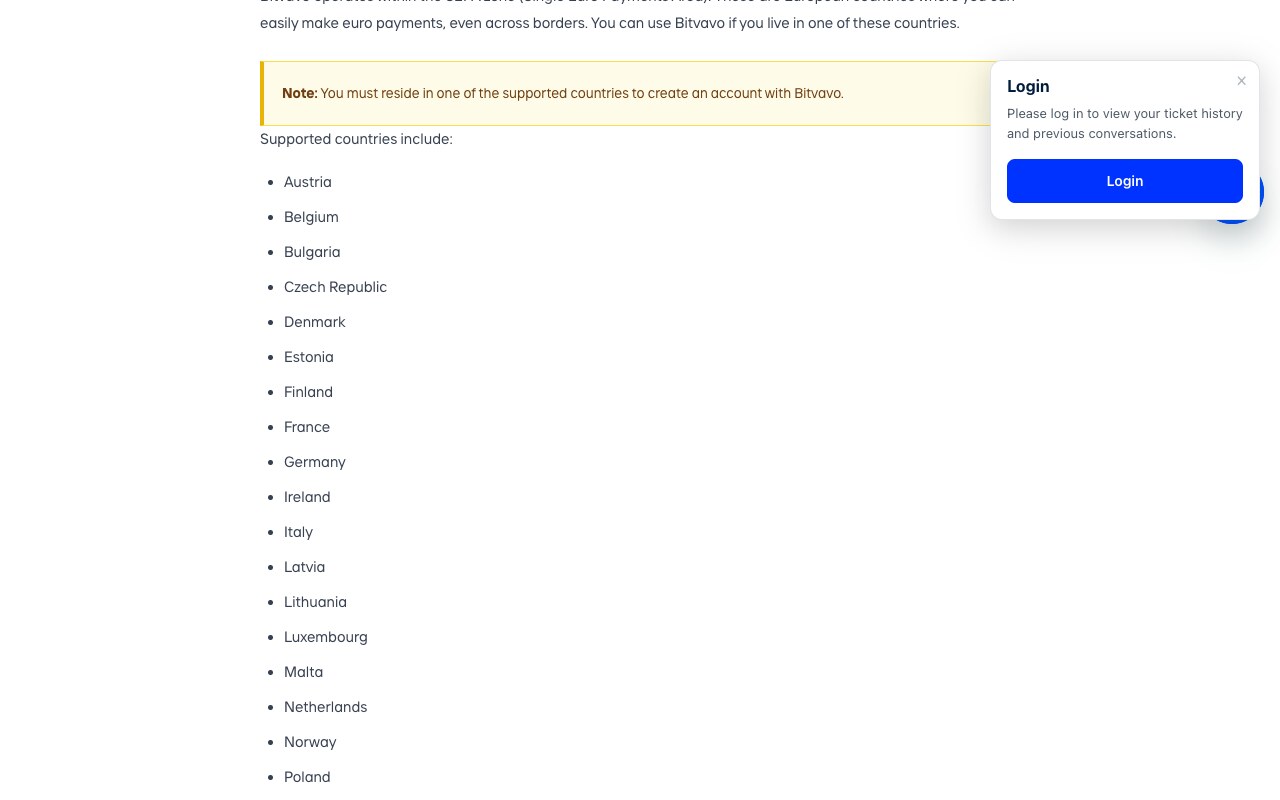
Bitvavo's countries article, updated 2026-10-01, opens with the constraint: it "operates within the SEPA zone," the Single Euro Payments Area, and adds a note in bold type of its own — "You must reside in one of the supported countries to create an account with Bitvavo."
Then it lists them. We counted 24, and a second tier of 13 overseas regions that may register with a condition attached.
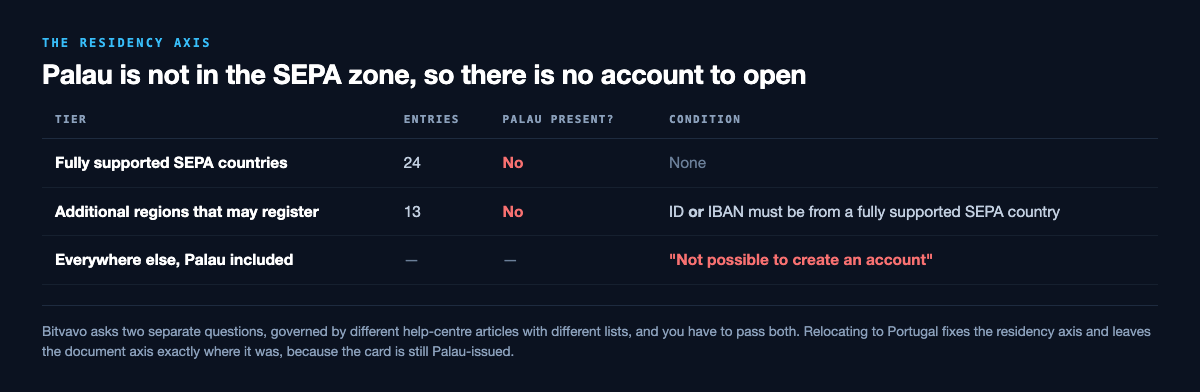
| Tier | Entries | Palau present? | Condition |
|---|---|---|---|
| Fully supported SEPA countries | 24 | No | None |
| Additional regions that may register | 13 | No | ID or IBAN must be from a fully supported SEPA country |
| Everywhere else, Palau included | — | — | "Not possible to create an account" |
The 24 are Austria, Belgium, Bulgaria, Czech Republic, Denmark, Estonia, Finland, France, Germany, Ireland, Italy, Latvia, Lithuania, Luxembourg, Malta, Netherlands, Norway, Poland, Portugal, Romania, Slovakia, Slovenia, Spain and Sweden. The 13 additional regions are Guadeloupe, French Guiana, Martinique, Mayotte, Réunion, the Canary Islands, the Azores, Madeira, Curaçao, Sint Maarten, Bonaire, Sint Eustatius and Aruba — French, Spanish, Portuguese and Dutch territories, every one of them tied to a SEPA member state. Nothing in the Pacific appears anywhere.
One honest caveat about that list, because we would rather flag it than smooth it over: Bitvavo writes "Supported countries include," and the 24 are narrower than the SEPA zone the article describes. Greece, Croatia, Cyprus, Hungary, Iceland, Liechtenstein and Switzerland are SEPA participants and are absent from it. So treat 24 as indicative and check the live page for your own country — but the absence that matters here is not borderline. Palau is not a SEPA participant under any reading, and Bitvavo's own FAQ closes it: "At this time, Bitvavo only supports users who reside within the SEPA zone. It's not possible to create an account from countries outside this region."
Note also what the second tier asks for, because it is the clearest statement of the two-axis rule on the whole site: an ID or IBAN from a fully supported SEPA country. A Palau card satisfies neither half of that or.
The accepted-documents table, in full
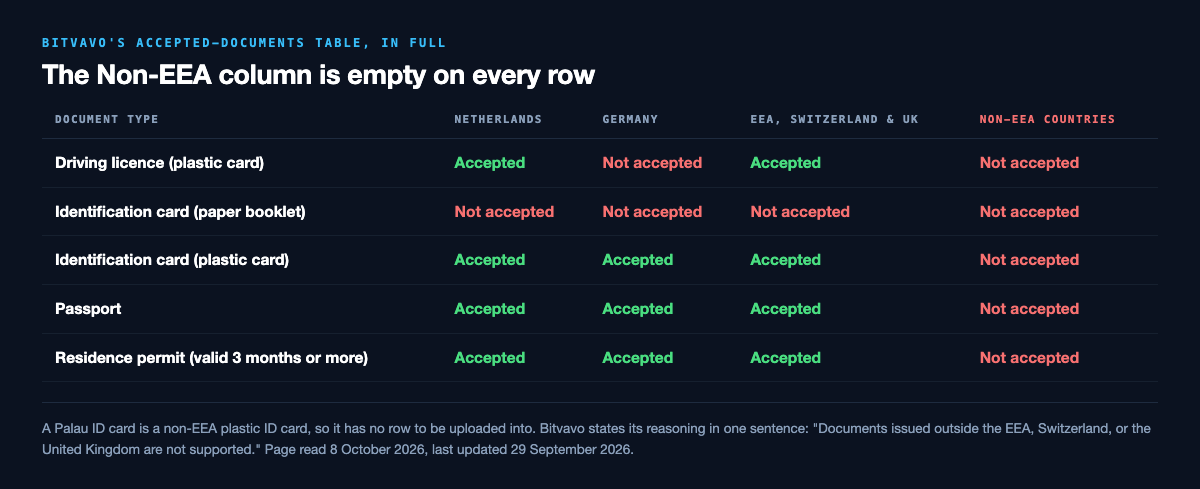
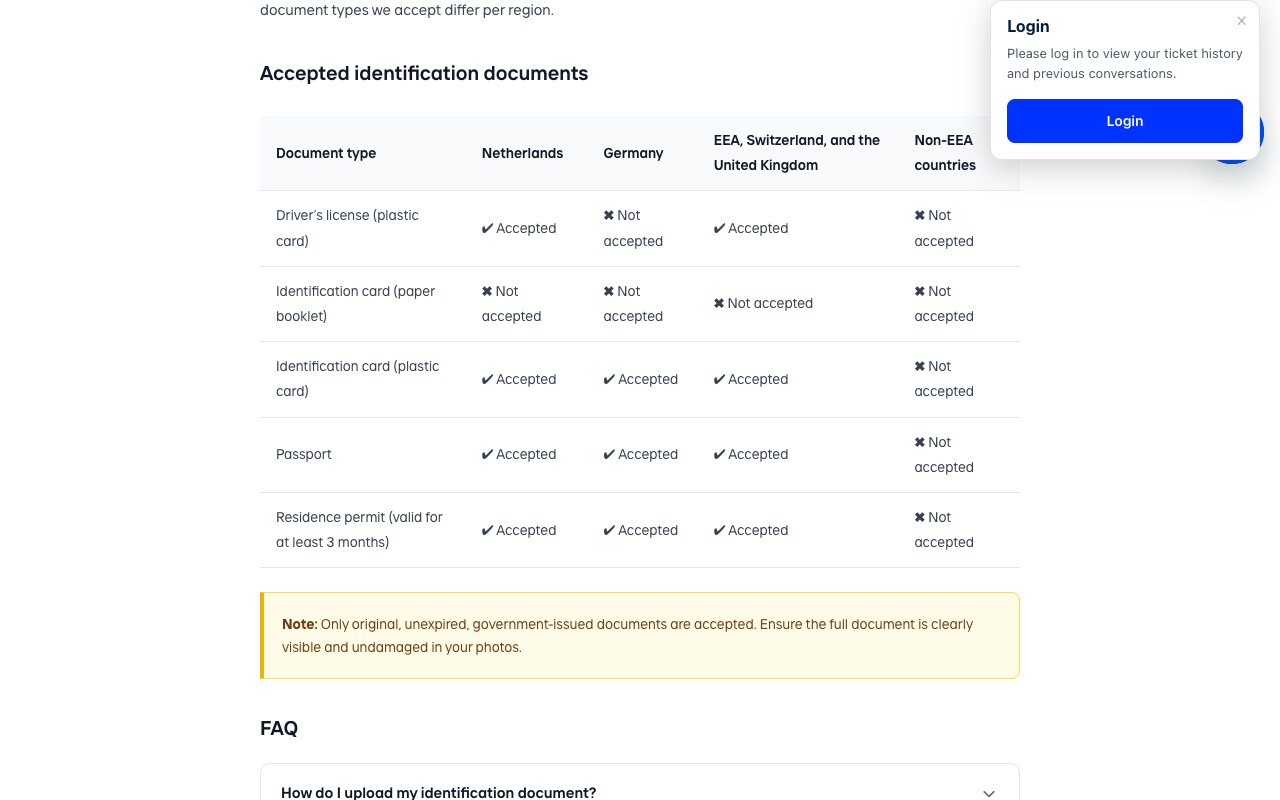
Here is the page we think nobody has transcribed, and it is the reason this article exists. Bitvavo's accepted-documents article, updated 2026-09-29, prints a matrix of five document types against four jurisdictions. We have reproduced it exactly.
| Document type | Netherlands | Germany | EEA, Switzerland & UK | Non-EEA countries |
|---|---|---|---|---|
| Driving licence (plastic card) | Accepted | Not accepted | Accepted | Not accepted |
| Identification card (paper booklet) | Not accepted | Not accepted | Not accepted | Not accepted |
| Identification card (plastic card) | Accepted | Accepted | Accepted | Not accepted |
| Passport | Accepted | Accepted | Accepted | Not accepted |
| Residence permit (valid ≥ 3 months) | Accepted | Accepted | Accepted | Not accepted |
Read down the last column. Five document types, five refusals. This is the only venue in our series where the non-domestic column contains no accepted document at all, and Bitvavo explains why in its own FAQ rather than making you guess: "We can only accept documents that meet European regulatory requirements. Documents issued outside the EEA, Switzerland, or the United Kingdom are not supported."
A Palau digital residency ID is a plastic, government-issued card from a country outside the EEA. It lands in row three of the last column, which is a refusal. The surrounding conditions do not help either — Bitvavo adds that "only original, unexpired, government-issued documents are accepted," and separately that residence permits "from non-EEA countries are not accepted," which closes the one door a reader might hope the card could be argued through.
It is worth seeing what the other three columns are for, because that explains the shape rather than just the outcome. They cover an EU resident holding a document from elsewhere in the EEA, Switzerland or the UK — a Spanish citizen living in Germany, say. The columns accommodate document mobility inside Europe. There is none for document mobility into Europe, and that is a design decision rather than an oversight someone will patch.
Even a Palau passport would not clear it
At almost every venue we have checked, the published rules leave one exit: when a nationality is unlisted, a passport from that nationality is usually still acceptable. Bitpanda's UK entity offers exactly that. It is the reason a certain kind of post ends by telling readers the card is a stepping stone toward something better.
Bitvavo removes that exit. Its non-EEA column refuses passports alongside everything else, which inverts the normal advice.
| Venue | Unlisted nationality's route in | Palau outcome |
|---|---|---|
| Bitpanda (UK and other-jurisdictions entities) | Passport | Would work with a Palau passport; digital residency is not one |
| Bitvavo | None — passports from non-EEA countries refused | Closed even with a Palau passport |
So the distinction that usually matters most on this site — card versus passport — collapses here into irrelevance. Both fail for the same stated reason. We would not overstate it: this does not make Bitvavo stricter in some general sense, only that it drew its document perimeter at the EEA and declined to make exceptions by document class.
Digital residency does not produce a Palau passport in any case. RNS lists "guaranteed approval, access to a bank or exchange, universal third-party acceptance" among outcomes it does not promise, and we set out the difference in Palau passport vs digital residency. The point here is narrower: if you were treating the card as a first step toward a document that would verify, Bitvavo shows the second step does not exist at every venue either.
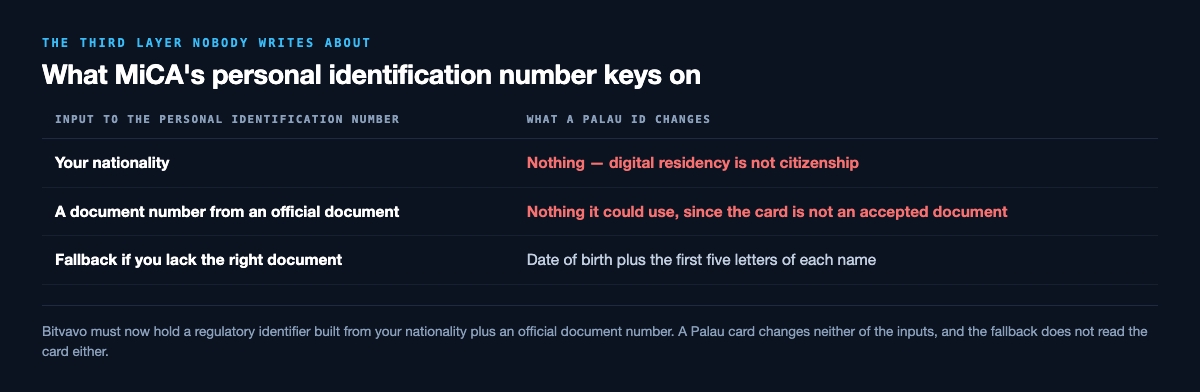
What MiCA's personal identification number keys on
This is the layer no competing page mentions, and it is the one that would catch a Palau card even in a hypothetical world where the document table did not.
Since MiCA came into force, Bitvavo must hold a personal identification number for every fully verified user. Its article on the requirement, updated 2026-08-12, describes the identifier as "a regulatory identifier from all users who have completed identity verification," and names its two inputs.
| Input to the personal identification number | What a Palau ID changes |
|---|---|
| Your nationality | Nothing — digital residency is not citizenship |
| A document number from an official document | Nothing it could use, since the card is not an accepted document |
| Fallback if you lack the right document | Date of birth plus the first five letters of each name |
That fallback is worth quoting, because it shows how little room there is to be creative: for a user without the required document Bitvavo generates a placeholder from date of birth and name — its own worked example renders John Doe, born 1999-12-08, as 19991208JOHN#DOE##. The identifier is keyed on nationality, not on whatever card you happen to be carrying, and RNS is explicit that Palau Digital Residency "is not the same as citizenship."
The same logic shows up in the data Bitvavo collects at verification. Its article on why verification is necessary, updated 2026-09-27, lists the fields it extracts: full names, nationality, date of birth, issue date, expiry date, issuing country, photograph and document number. Issuing country is not incidental metadata — it is the field the document table is applied to. The verification flow also reads your document with a liveness video and refuses scans outright, so there is no version of this where the issuing country goes unexamined.
Readers thinking about reporting rather than onboarding should see CARF crypto reporting and Palau ID, which covers the other end of the same pipe.
Proof of address, and the mailing-address trap
Bitvavo's published document rules already settle this page's question, so proof of address never becomes the deciding factor. It is worth a short section anyway, because the RNS mailing address is the single most over-sold part of the package and the trap is the same wherever you meet it.
| What a European venue asks for | Can an RNS mailing address produce it? |
|---|---|
| Utility bill linked to the property | No |
| Bank statement at your residential address | No |
| Signed lease or tenancy agreement | No |
| Evidence of residence, domicile or tax residence | No, and RNS says so itself |
RNS settles it in its own documentation: Palau Mailing "is not proof of residence." We have gone through the detail in Palau ID as proof of address and the Palau mailing address, and the short version is that a forwarding address cannot generate a document that is, by definition, tied to a property you occupy.
The reason to keep this in view even at a venue that has already said no: an address you do not live at is a bad thing to put on file at a regulated firm. That is true whether or not the account opens, and it is true at every venue in our exchange KYC tracker.
Why the search results answer this wrongly
Search for whether a platform accepts Palau ID and the results divide into two kinds of page, neither of which answers the question. Both are easy to mistake for an answer.
The first kind is a KYC vendor coverage page. These rank well and are entirely accurate about something else. We pulled ID Analyzer's Palau reference on 2026-10-08: it covers one Palau document, the passport, biodata page only. Sumsub's reference, which we read for the Bitpanda piece, goes further and lists the Palau ID card's front side. Those pages describe what identity software can parse. They say nothing about what a venue will accept, and only the second thing opens an account.
| Page type | What it actually tells you | What readers take it to mean |
|---|---|---|
| KYC vendor document library | Our software can read this card | Exchanges accept this card |
| "Best exchanges in Palau" listicle | Which venues serve people living in Palau | Which venues take a Palau ID from abroad |
| Venue's own accepted-documents page | What will and will not verify | — (almost nobody cites these) |
The second kind is the affiliate listicle. The most capable one we found, Datawallet's Palau exchange ranking updated 2026-07-12, has its own testing methodology — and its digital-residency-card claims still rest on holders who "consistently report passing," citing no exchange policy page anywhere. Older write-ups are worse: one widely circulated crypto-KYC piece carries 2024 prices in its body and a secondhand "90% of crypto platforms" figure that originates with the vendor.
So the rule we would hand anyone checking the next venue: find the venue's own accepted-documents page, and read the column your document falls into. It took five help-centre articles to answer this question properly for Bitvavo, and every one of them is public. Our cluster overview for crypto KYC applies the same method across platforms.
If you already hold a verified Bitvavo account
A reader in this position is asking a different question, and it deserves a straight answer: if you are a SEPA resident who verified with an EEA document and later bought a Palau ID, nothing about your account changes. The card adds nothing and is not a document Bitvavo has any slot for. There is no upgrade to claim.
What would be a mistake is using the card to restate who you are. Bitvavo's verification data includes nationality and issuing country, and the MiCA identifier is derived from nationality — so presenting Palau-linked details while being a national and resident of somewhere else would misstate your position to a regulated firm rather than improve it. Bitvavo also lists "your document is from an unsupported country" among its rejection reasons, so the attempt would fail visibly in any case.
If the underlying goal is business banking and payments rather than a second identity document, that is a company-formation question, not a KYC one. Firstbase and Doola both handle remote US LLC formation, and we cover the banking leg in US business bank accounts for nomads. Both are sponsored links and we may earn a commission at no cost to you. Neither issues a Palau ID, neither affects an RNS application, and neither makes a venue accept a document its policy does not list.
Bottom line
Does Bitvavo accept Palau ID? No, on two independent published grounds. Palau is not among the 24 SEPA countries Bitvavo onboards from, so there is no account to verify; and in its accepted-documents table, updated 2026-09-29, every one of the five document types in the Non-EEA countries column is marked Not accepted. Bitvavo's own explanation is one sentence long: documents issued outside the EEA, Switzerland or the UK are not supported.
The finding worth carrying elsewhere is the one about the passport. Across this series, an unlisted nationality can usually still verify with a passport, which is why the card gets sold as a step on a path. Bitvavo refuses non-EEA passports too, so at this venue the path has no second step. A document perimeter drawn at the EEA does not care which EEA-external document you hold.
Before spending $288 for the one-year option, $1,199 for five years or $2,339 for ten, read Palau digital residency limitations and check the venues you actually care about against their own policy pages. RNS states that "payment does not guarantee approval," that it does not promise "access to a bank or exchange" or "universal third-party acceptance," and that "whether any organization accepts an identity document is determined by that organization and its rules." Nothing here is legal, tax or financial advice, platform rules change without notice, and acceptance varies by venue — re-check the live pages before you act.
Related reading
- Palau ID for crypto KYC — the cluster overview to read before you buy
- Palau ID and EU crypto exchanges under MiCA — why residence is asked before your document
- Does Bitpanda accept Palau ID? — the same question across four legal entities
- Does Wise accept Palau ID? — where the card triggers a check it cannot clear
- Palau ID exchange KYC tracker — platform-by-platform status
- Palau digital residency supported countries — who can apply at all
FAQ
Does Bitvavo accept a Palau digital residency ID?
No. Bitvavo's accepted-documents article, updated 2026-09-29, sets five document types against four jurisdictions, and every entry in the "Non-EEA countries" column reads Not accepted — plastic driving licence, paper ID booklet, plastic ID card, passport and residence permit alike. A Palau digital residency card is a non-EEA plastic ID card, so there is no row it can be uploaded into. Bitvavo's stated reason is that it can only accept documents meeting European regulatory requirements.
Can I open a Bitvavo account as a Palau resident?
No. Bitvavo onboards only residents of the SEPA zone and lists 24 supported countries, none of them Palau. Its FAQ says that "at this time, Bitvavo only supports users who reside within the SEPA zone" and that "it's not possible to create an account from countries outside this region." Thirteen overseas regions may register, but only by providing an ID or IBAN from a fully supported SEPA country.
Would a Palau passport work at Bitvavo instead?
No, which makes Bitvavo unusual. Its non-EEA column refuses passports as well as ID cards, so the escape route that works at some other venues is closed here. The question is academic anyway: RNS states that Palau Digital Residency "is not the same as citizenship, a passport, or physical residency in Palau," so digital residency does not produce a passport to try.
Bitvavo's ID scanner supports Palau. Doesn't that mean it works?
No, and this is the most common mistake on the topic. KYC vendors publish country coverage pages describing what their software can read — ID Analyzer lists the Palau passport's biodata page, and Sumsub's reference goes as far as the Palau ID card's front side. Those pages are accurate about capability and silent about permission. Bitvavo's published document table is what decides, and it has no row for a non-EEA ID card.
What is Bitvavo's personal identification number, and does a Palau ID help with it?
It is a regulatory identifier Bitvavo must hold for every verified user under MiCA, built from your nationality plus a document number from an official document. A Palau digital residency ID changes neither input: it is not citizenship, and it is not an accepted document. Where a user lacks the required document, Bitvavo generates a placeholder from date of birth and the first five letters of each name instead.
Can I use the RNS mailing address as proof of address for Bitvavo?
No. European venues asking for proof of address want a document tied to a property you occupy — a utility bill, a bank statement at your residential address, or a signed lease. RNS states in its own documentation that Palau Mailing "is not proof of residence," so a forwarding address cannot produce one. On Bitvavo the question does not arise in practice, because the document rules refuse the card first.
I already have a verified Bitvavo account. Does a Palau ID add anything?
No. If you verified with an EEA, Swiss or UK document as a SEPA resident, your account is already in order and the card has no slot in it. Using Palau-linked details to restate your nationality or residence would misstate your position to a regulated firm, and Bitvavo lists "your document is from an unsupported country" among its rejection reasons, so it would fail visibly as well.