Palau ID Verification 2026: Which KYC Vendors Read It
Palau ID verification is decided by the vendor behind the platform, not the platform. We compared seven published document libraries and they disagree.
We may earn a commission if you apply through this link. This site is independent and is not the official RNS.ID or Palau government site.
Key takeaways
- Almost no platform reads your document itself. It buys that from an identity-verification vendor, and each vendor publishes a per-country document library. We read seven of those libraries for Palau in October 2026 and they do not agree with each other — one lists the Digital Residency ID by name, one lists the Palau passport and nothing else.
- The vendor that onboards you into the Palau programme is Sumsub, which publishes a customer story describing RNS as "the official tech partner of the Republic of Palau". RNS moved to Sumsub in 2022, and the transition "was completed in about two weeks". That relationship says nothing about whether any other platform's vendor will read the card afterwards.
- Sumsub's own support pages disclaim the decision entirely: "Sumsub does not define which data or documents are required, which regions are supported", and "the company you're verifying for decides which specific document types and countries are accepted." The capability and the permission are two different settings.
- Only Shufti Pro names the card. Its Palau page lists "Digital Residency ID (Palau ID)" as a "Web3 ID issued under Digital Residency Programme (2022)" and calls it "an emerging option for non-citizens". ID Analyzer, by contrast, states it "supports 1 Palau identity document, including passports".
- The counterfeit problem is real and it is the reason the layer tightened. On 24 October 2025 RNS announced a crackdown on "counterfeit Palauan IDs used to bypass know-your-customer (KYC) procedures", promising "an official API to KYC vendors and partner platforms". A year on we could find no public reference for that API.
On this page
- Does a Palau ID pass verification? The short answer
- The layer nobody writes about: platforms buy their document reading
- Sumsub verifies you into the programme, not out of it
- What seven published vendor libraries actually say about Palau
- Why two vendors looking at the same card disagree
- The counterfeit crackdown, and the API announced a year ago
- What to do when your verification has already failed
- If the goal is a working account rather than a verified document
- Related reading
- FAQ

Does a Palau ID pass verification? The short answer
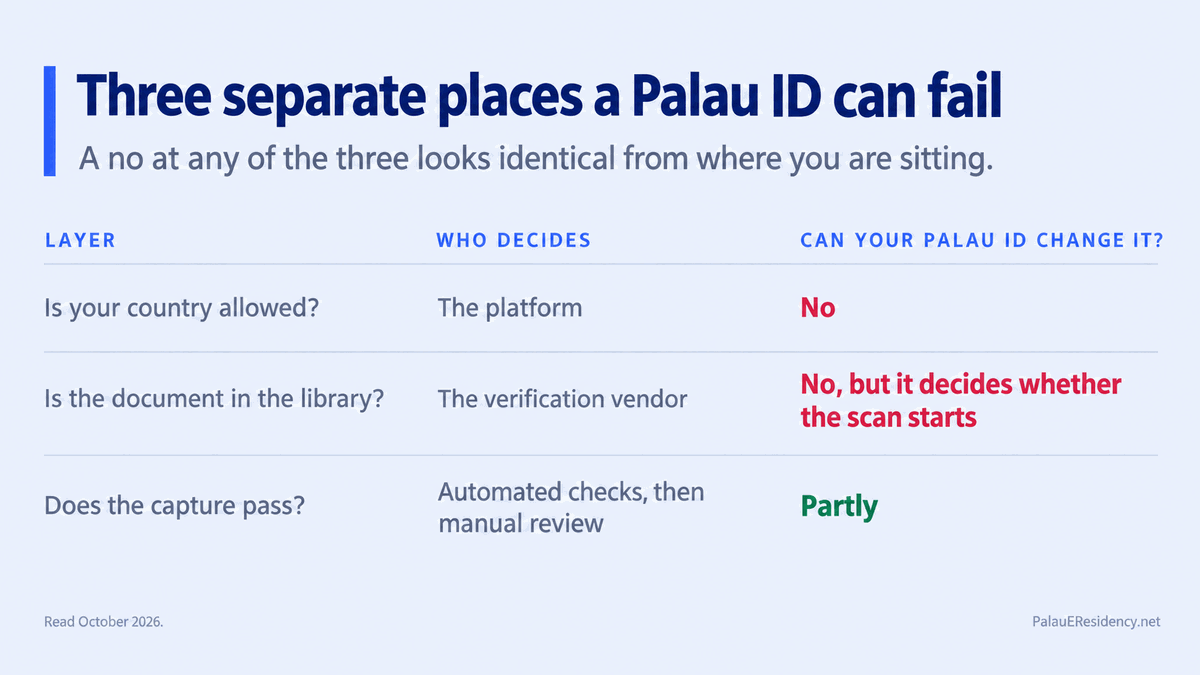
Palau ID verification fails or succeeds in three separate places, and almost everything written about it collapses them into one. A platform has to allow your country, its verification vendor has to carry your document in its library, and the scan itself has to pass. A "no" at any of the three looks identical from where you are sitting: a red banner that does not tell you which wall you hit.
We spent this piece on the middle layer, because it is the one nobody covers and the one that explains why acceptance reports contradict each other so violently. We read the published Palau document libraries of seven identity-verification vendors rather than collecting anecdotes, and we quote them rather than paraphrase. The headline finding is that the vendors disagree — not marginally, but about whether the document exists at all.
| Layer | Who decides | Can your Palau ID change it? |
|---|---|---|
| Is your country of residence allowed? | The platform, from its own licensing and sanctions position | No |
| Is the document in the vendor's library? | The verification vendor's coverage for Palau | No, but it determines whether the scan even starts |
| Does the capture pass? | The vendor's automated checks, then manual review | Partly — the physical card and a clean capture are yours to control |
Hold those apart as you read. The rest of this site works through the first layer platform by platform — the exchange KYC tracker is the index — and this page is the only one about the second.
The layer nobody writes about: platforms buy their document reading
When an exchange asks you to photograph an ID, the software reading that photograph is almost never the exchange's own. Identity verification is a bought-in service, and the vendors compete on how many documents they can read. Each one maintains a template library: a list, country by country, of the documents its models have been trained on and its forensic checks know how to validate.
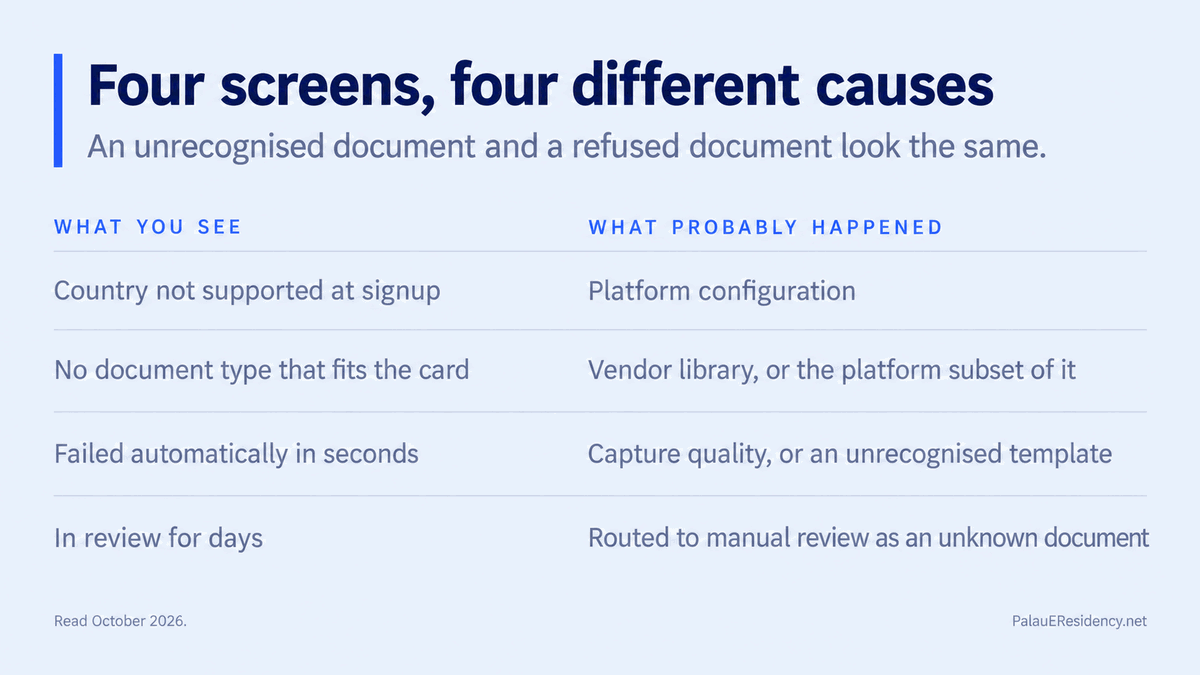
That library is the gate. A document outside it is not rejected for being suspicious — it is rejected, or kicked to a human, for being unrecognised. The distinction matters enormously to a Palau cardholder, because an unrecognised document and a refused document produce the same screen and need completely different responses.
| What you see | What probably happened | Where the fix is |
|---|---|---|
| "Country not supported" at signup, before any upload | Platform configuration | Nowhere in your documents |
| Document type dropdown has no option that fits the card | Vendor library, or the platform's chosen subset of it | Try passport if you hold one; otherwise support |
| Upload accepted, then failed automatically in seconds | Capture quality, or an unrecognised template | A physical card, good light, both sides |
| Upload accepted, then "in review" for days | Routed to manual review as an unknown document | Patience, then support |
Most vendors publish their libraries, which is what makes this checkable rather than speculative. We went and read them.
Sumsub verifies you into the programme, not out of it
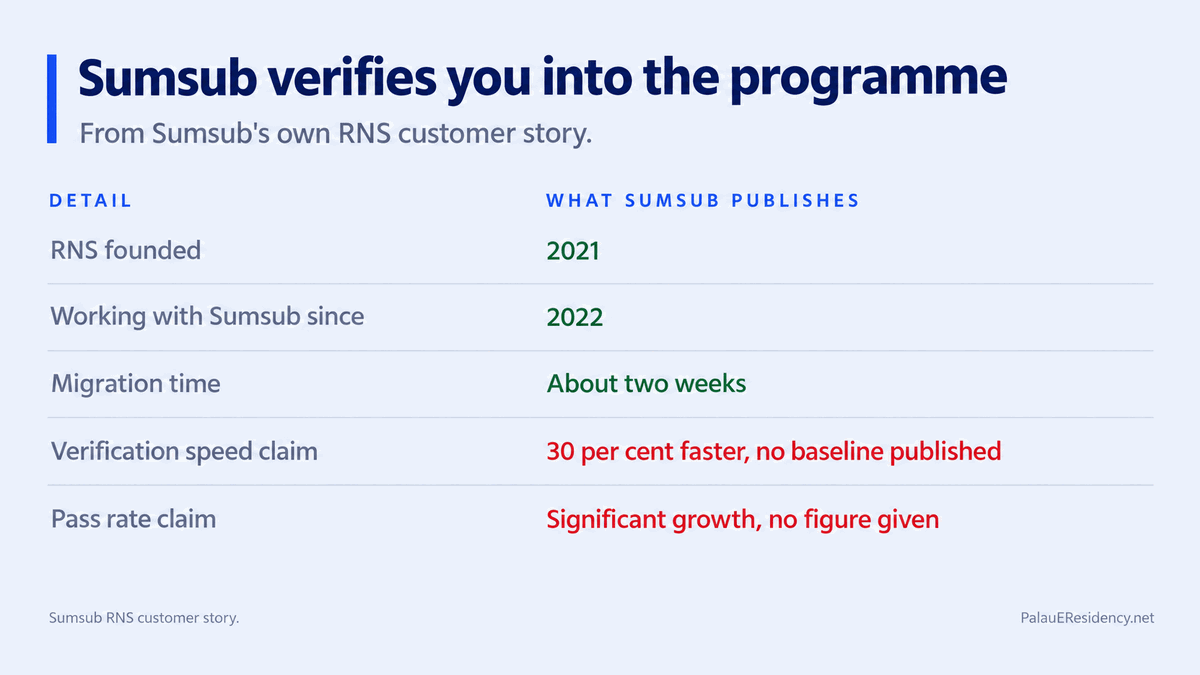
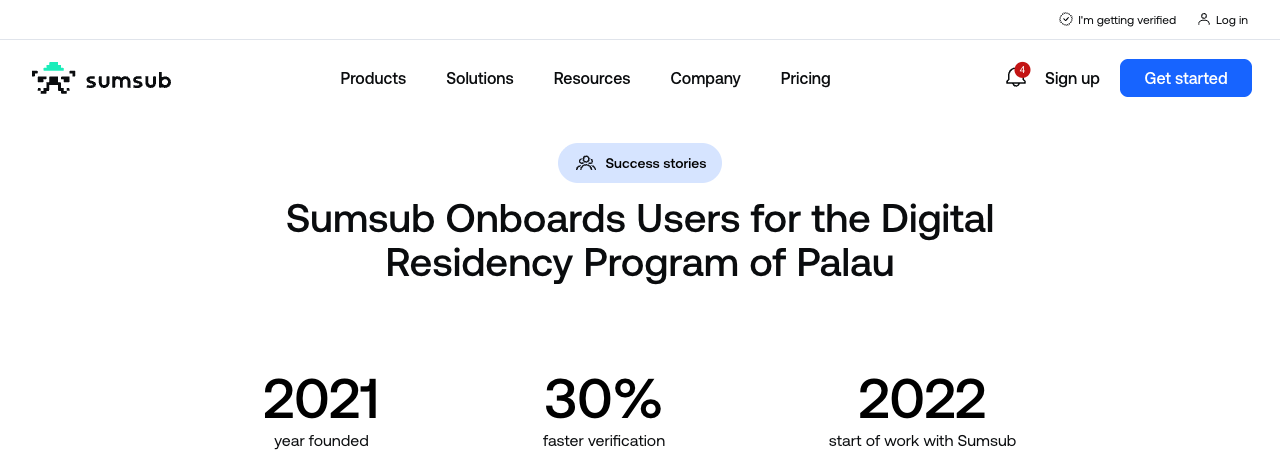
Here is the fact that reframes the whole question, and it has been sitting on a vendor's marketing site uncited for years: the identity-verification vendor that onboards applicants into the Palau Digital Residency programme is Sumsub. Its customer story is titled "Sumsub Onboards Users for the Digital Residency Program of Palau" and describes RNS as "the official tech partner of the Republic of Palau that provides a unique digital identity solution".
| From Sumsub's RNS customer story | Detail |
|---|---|
| RNS founded | 2021 |
| Working with Sumsub since | 2022 |
| Sumsub products RNS uses | ID Verification; Liveness and Face Match; AML Screening; AML Ongoing Monitoring |
| Verification speed claim | 30% faster (no baseline published) |
| Migration time | "The transition to Sumsub was completed in about two weeks" |
| Pass-rate claim | "a significant growth in pass rate" — no figure given |
This explains the shape of the application: RNS's own FAQ lists "identity verification, screening, corrections, video verification when required, internal review, and government review" as the steps that still apply after you pay, and answers the question of whether payment guarantees an ID with "No. Payment starts the application." Liveness and face match are exactly what Sumsub sells. We walk through the full sequence in the application timeline.
But it is worth being precise about what this relationship does not imply. Sumsub reading your passport to issue you a Palau ID is not Sumsub reading your Palau ID on behalf of someone else. Those are different checks, on different documents, configured by different clients. And Sumsub's support documentation disclaims the second one explicitly: "Sumsub does not define which data or documents are required, which regions are supported", because "the company you're verifying for decides which specific document types and countries are accepted."
Its default accepted list is "Passport (domestic or international)", "Driver's license", "ID card" and "Residence permit" — a Palau card sits in the third class on its face. On digital credentials it says only that "We accept digital identity documents from a limited number of countries", without naming them, and advises uploading "a photo or scan of a physical document" when a digital one cannot be verified. That is the same wall we found at Skrill and covered in physical versus digital Palau ID for KYC: the PDF is not the submission route, the card is.
What seven published vendor libraries actually say about Palau
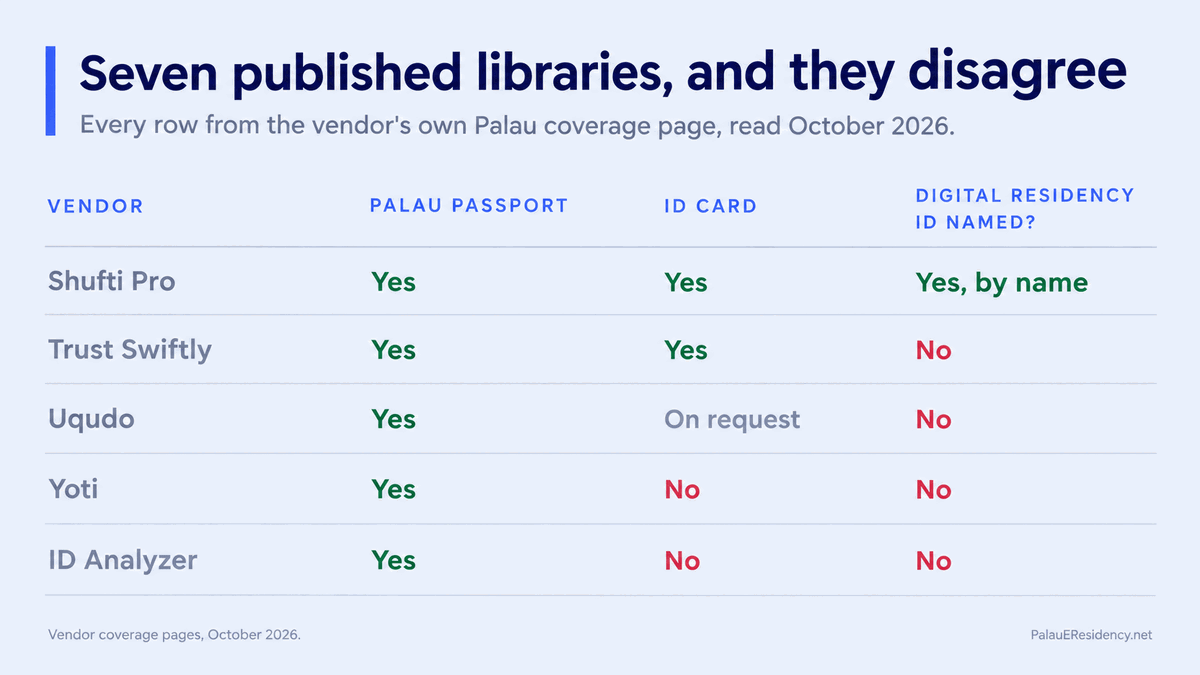
This is the comparison the question deserves and nobody has run. Every row below is from the vendor's own published coverage page, read in October 2026.
| Vendor | Palau passport | Driving licence | ID card / national ID | Digital Residency ID named? |
|---|---|---|---|---|
| Shufti Pro | Yes | Yes | Yes | Yes — by name |
| Trust Swiftly | Yes | Yes | Yes | No |
| Uqudo | Yes | "Supported upon request" | "Supported upon request" | No |
| Yoti | Yes (plus travel document) | No | No | No |
| ID Analyzer | Yes | No | No | No |
| Entrust, via Legl | Two of three columns ticked, which two not readable from the page | — | — | No |
| Sumsub | No per-country list published | — | — | No |
Shufti Pro is the outlier and the most useful page on the internet for this question. It lists the "Digital Residency ID (Palau ID)" as a "Web3 ID issued under Digital Residency Programme (2022)" that "accepts government documents for non-citizen verification and decentralised identity purposes", and its FAQ calls it "an emerging option for non-citizens". It also names the Palau address-document issuers it recognises — Palau Public Utilities Corporation, Palau National Communications Corporation, Bank of Guam and Bank of Hawaii — which is more specificity than anyone else offers and relevant to the proof-of-address problem.
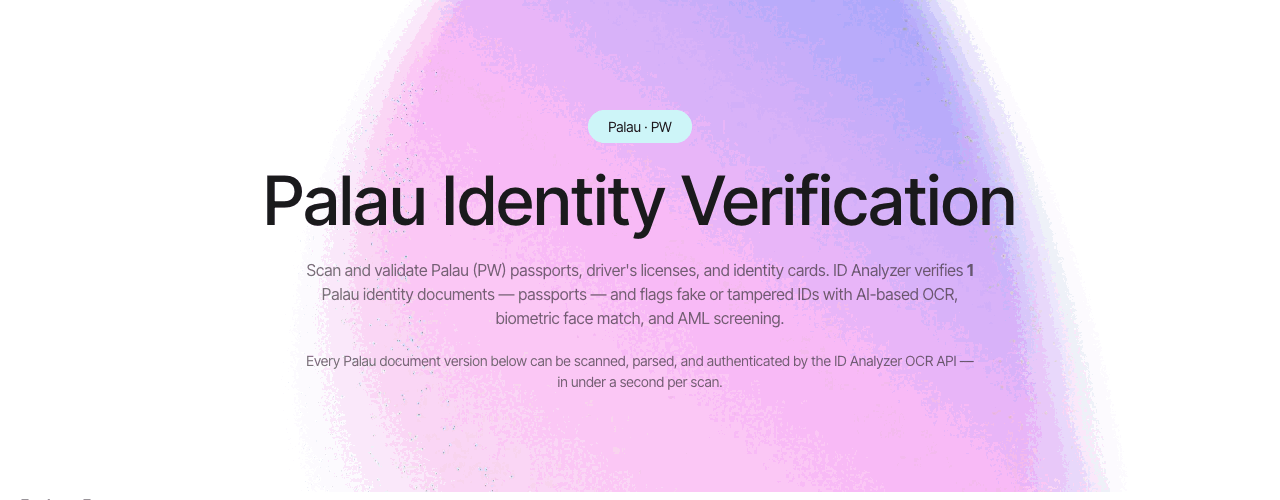
ID Analyzer sits at the opposite end. Its Palau page uses the country code PW and states plainly: "ID Analyzer supports 1 Palau identity document, including passports." Yoti's table gives Palau the code PLW and ticks passport and travel document, leaving national ID and residence permit blank. Uqudo supports passport data extraction outright and puts both the driving licence and the ID card behind "supported upon request. Please contact us for further assistance" — a phrase worth noticing, because it means the gap is commercial rather than technical.
| What a library entry tells you | What it does not tell you |
|---|---|
| Whether the vendor's models can read the document at all | Whether any given client has enabled it |
| Whether the vendor markets Palau coverage to buyers | Which exchange or bank uses that vendor |
| How current the vendor's template set is | Whether a human reviewer will accept the result |
No vendor publishes its client list and no platform publishes its vendor, so you cannot chain these two tables together into an answer for a specific exchange. What you can do is stop treating a rejection as a verdict on the document.
Why two vendors looking at the same card disagree
Because a template library is a product roadmap, not a statement of fact about the world. A vendor adds a document when enough paying customers need it, and Palau — population under 20,000 — is near the bottom of every such list on citizen volume alone. The digital residency programme inverts that: the numbers are large relative to the country, and they are the reason a vendor like Shufti Pro has bothered.
Three ordinary commercial reasons produce most of the disagreement, and none of them is about your card:
| Reason | What it looks like | Reader's takeaway |
|---|---|---|
| Library freshness | One vendor added the 2022 document, another has not revisited Palau since | Re-attempting months later is not pointless |
| Commercial gating | Uqudo's "supported upon request" | The platform, not you, can ask for it |
| Client configuration | Sumsub's "the company you're verifying for decides" | Same vendor, opposite outcomes on two sites |
The third is the one that makes forum threads useless. Two people can hit the same vendor through two platforms and get opposite results, both report honestly, and neither is wrong. It is also why we keep per-institution research rather than a single yes/no — the method is set out in how to research exchange KYC acceptance.
RNS says the same thing from its side, and more flatly than most marketing would allow: "Whether any organization accepts an identity document is determined by that organization and its rules."
The counterfeit crackdown, and the API announced a year ago
There is a reason beyond obscurity for caution at this layer, and it is unflattering. On 24 October 2025, RNS announced what Phemex's news desk reported as "a crackdown on counterfeit Palauan IDs used to bypass know-your-customer (KYC) procedures". KuCoin's flash item, sourced to MetaEra, carries the same announcement.
| Measure announced, 24 October 2025 | Wording as reported |
|---|---|
| Verification API | "providing an official API to KYC vendors and partner platforms" to check "document numbers, issue dates, and photos" |
| Blacklist integration | "integrate with global fraud blacklists" |
| Second check | "implement secondary verification processes" |
| Failure handling | Those failing it "marked as fraudulent", details "synchronized to a global fraud database" |
| Penalties | "permanent bans" for "forgers or impersonators" |
| Referral | Evidence "transferred to jurisdictions like China for prosecuting those involved in forging state documents and fraud" |
Two things follow, and the second is the finding.
First, the obvious one. A forged Palau ID is a forged state document. The announced consequences run from a permanent ban through inclusion in a shared fraud database to criminal referral, and a fraud-database entry follows you to institutions that have never heard of Palau. If that is the thought behind your interest in this card, the honest answer is on our page about what the programme does not guarantee, and the answer is don't.
Second, and more useful: we cannot find the API. A year after the announcement there is no public reference for it, no vendor coverage page citing it, and no named integration partner. The closest thing in RNS's platform documentation is a verification property gated to authorised clients. We are not alleging it does not exist — a vendor-to-vendor API would not necessarily be public — but an attestation service nobody can point to does not help the libraries above, and it is the single change that would most improve this card's standing. Ours is a negative finding, honestly reported: if it has shipped, it has shipped quietly.
What to do when your verification has already failed
Most readers arrive here after a rejection, so this is the practical part. Work the layers in order, because the cheapest diagnostic is the one that tells you whether to bother with the others.
| Symptom | Most likely layer | Next step |
|---|---|---|
| Country missing at signup | Platform | Stop. No document changes this one |
| No document type matches the card | Vendor library or platform subset | Use a passport if you have one; ask support which types they accept |
| Rejected in seconds, repeatedly | Capture or unrecognised template | Physical card, both sides, flat light, no glass |
| "Document could not be recognised" | Vendor library | Ask support whether the document type is supported, not whether Palau is |
| Stuck in manual review | Unknown template routed to a human | Wait; a human can accept what the model could not |
| Rejected after manual review | Platform policy | Believe it. Record the date and move on |
Two notes worth more than the table. Use the physical card. RNS states that "Downloading the PDF does not establish permission to use it in a particular verification process" or "guarantee acceptance by a third party", and that a Palau ID "is a Digital Residency identity with a physical card"; the vendors above are all scanning physical documents. And ask support a precise question — "is the Palau Digital Residency ID card a supported document type?" gets a checkable answer, where "do you accept Palau" gets a policy non-answer about countries.
Never present the card as something it is not. RNS's overview says it plainly: "Palau Digital Residency is not the same as citizenship, a passport, or physical residency in Palau." We go through the rest in is RNS.ID legit.
If the goal is a working account rather than a verified document
Then decide which you actually need, because this page has been about the document and the document is rarely the binding constraint. If a platform will not serve your country of residence, no credential fixes that, and a Palau ID will not move you. Our standing advice for crypto accounts is in Palau ID for crypto KYC, and the platform-by-platform research sits behind the tracker.
If what you are really trying to solve is business banking or payments as a location-independent founder, the constraint is usually jurisdiction rather than paperwork, which in practice means a company somewhere with straightforward remote registration — most often a US LLC. Firstbase and Doola both do this, and we cover the banking leg in US business bank accounts for nomads. Both are sponsored links and we may earn a commission at no cost to you. Neither issues a Palau ID, neither affects an RNS application, and forming a company is not the same thing as passing anybody's verification.
If you want the card for what it genuinely is — a second government-issued photo ID, backed by a programme whose onboarding vendor is a mainstream one — then start here is the ordered walkthrough. We may earn a commission if you apply through the link at the top of this page; that is disclosed there and changes nothing about this page, which reports that five of seven vendor libraries do not name this document.
Nothing here is legal, tax or immigration advice. Vendor libraries change without notice, every figure above is dated to October 2026, and no identity document obliges any company to open an account for you.
Related reading
- Physical vs digital Palau ID for KYC — why the card has to arrive before you verify
- Palau ID supported exchanges — the method for researching a platform before applying
- Palau ID exchange KYC tracker — the per-platform index
- Does Skrill accept Palau ID? — the digital-photocopy rule in full
- Does Binance accept Palau ID? — the most-asked platform question
- Palau digital residency limitations — what the programme does not guarantee
FAQ
Which KYC provider does the Palau digital residency programme itself use?
Sumsub. Its published customer story is titled "Sumsub Onboards Users for the Digital Residency Program of Palau" and describes RNS as "the official tech partner of the Republic of Palau". RNS has worked with Sumsub since 2022 and uses its ID Verification, Liveness and Face Match, AML Screening and AML Ongoing Monitoring products. That covers verification into the programme; it does not mean other platforms using Sumsub will read your Palau card.
Is the Palau Digital Residency ID in any verification vendor's document library?
Yes, in at least one. Shufti Pro's Palau page lists "Digital Residency ID (Palau ID)" by name, describing it as a "Web3 ID issued under Digital Residency Programme (2022)" and "an emerging option for non-citizens". Of the seven libraries we read in October 2026, it was the only one naming the document. Trust Swiftly and Uqudo list a generic Palau identity card; Yoti and ID Analyzer list the passport only.
Why did my Palau ID work on one site and fail on another?
Most often because the two sites configured the same capability differently. Sumsub's support pages state that "the company you're verifying for decides which specific document types and countries are accepted" and that Sumsub itself "does not define which data or documents are required, which regions are supported". Two platforms can use one vendor and reach opposite outcomes without either being an error.
Can I upload the PDF version of my Palau ID for verification?
Treat that as a no. RNS states that "Downloading the PDF does not establish permission to use it in a particular verification process" or "guarantee acceptance by a third party", and describes a Palau ID as "a Digital Residency identity with a physical card". Vendors generally want a capture of the physical document, front and back. Plan on waiting for the card to arrive.
Does a Palau ID let me verify on a platform that does not serve my country?
No. Country eligibility is set by the platform from its own licensing and compliance position, and it is checked before any document is read. A Palau digital residency does not change where you live, and misrepresenting your location is the fastest route to a closed account with funds inside it.
What happened with counterfeit Palau IDs?
On 24 October 2025 RNS announced a crackdown on what reporting described as "counterfeit Palauan IDs used to bypass know-your-customer (KYC) procedures". The announced measures included integrating with global fraud blacklists, a secondary verification process, permanent bans for confirmed forgers, inclusion in a shared fraud database, and evidence being referred for criminal prosecution. It also promised an official verification API for KYC vendors; we could find no public reference for that API a year later.
How do I find out whether a specific exchange will accept the card?
Ask its support a document-type question rather than a country question — "is the Palau Digital Residency ID card a supported document type on your verification flow?" — and record the date of the answer, because libraries and policies both move. Our per-platform research is indexed in the exchange KYC tracker, and the method we use is written up in the supported-exchanges guide.