Palau Digital Residency Vietnam 2026: What It Really Does
Palau digital residency in Vietnam 2026: the 183-day residence test, Resolution 05/2025's licensed-platform rule, and what Decree 284 fines a platform for.
We may earn a commission if you apply through this link. This site is independent and is not the official RNS.ID or Palau government site.
Key takeaways
- Vietnam's residence test asks where you live, not which cards you own. You are tax resident if you are in Vietnam 183 days or more in a calendar year or in 12 consecutive months from arrival, or if you have a permanent residence there — including a registered residence or a rented house on a definite lease. A Palau ID does not touch either limb.
- 2026 is the year Vietnam stopped being a grey zone, which cuts against the card, not for it. The Law on Digital Technology Industry took effect 1 January 2026, and Resolution 05/2025/NQ-CP built a licensed pilot market. Six months after the first provider is licensed, all trading by domestic investors is meant to run through licensed platforms.
- Decree 284/2026/ND-CP fines the platform VND 50–70 million for failing to verify the identity of an investor opening an account. That is the sentence that settles exchange acceptance in Vietnam: a licensed venue is paid nothing for taking an unfamiliar card and fined for getting identification wrong.
- Vietnamese bank verification runs on the chip-based citizen ID card, or a passport for foreigners. Circular 17/2024/TT-NHNN names those two documents. A Palau ID is not a third option, and no amount of correspondence makes it one.
- Viet Nam has not committed to CARF — and the real reporting exposure is domestic anyway. Licensed providers must report transactions of USD 1,000 or more and keep initiator and beneficiary details for at least ten years on servers in Vietnam.
On this page
- What a Palau ID changes for a Vietnamese citizen in 2026
- Can Vietnamese citizens apply for Palau digital residency?
- Vietnam's residence test counts days, not cards
- What a Vietnamese tax resident actually pays in 2026
- Resolution 05/2025 built a licensed market, and a six-month clock
- Decree 284/2026 fines the platform for an identity it cannot verify
- Vietnamese verification runs on the chip card
- CARF: Viet Nam has not committed, and that is not the win it looks like
- Where the card is useful, and who should skip it
What a Palau ID changes for a Vietnamese citizen in 2026

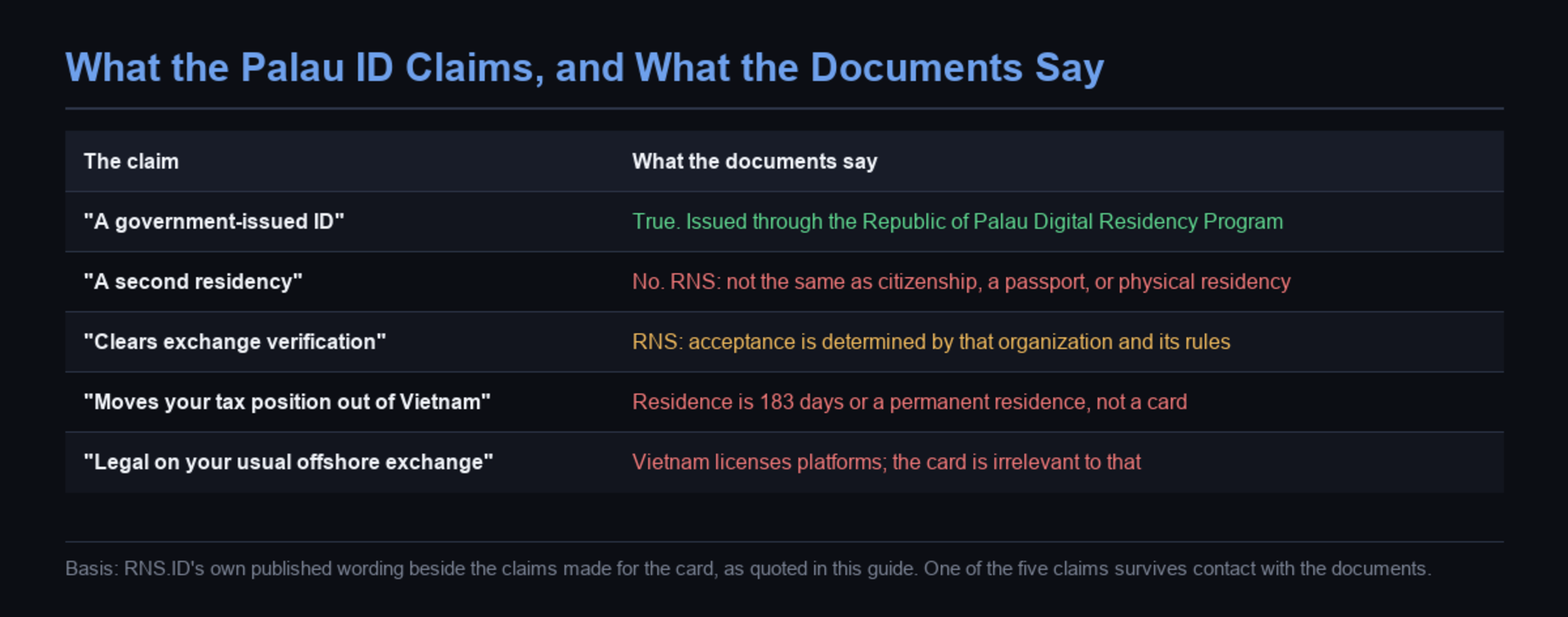
You are in Vietnam, you have seen a $288 card sold as an offshore identity, a way past exchange verification and a tax position outside the country, and 2026 is the worst year in a decade to buy it for any of those three reasons. The spend is real — the tiers our cost page records run from $288 for one year to $2,339 for ten, with orders final and nonrefundable — and it lands in the same year Vietnam wrote its first crypto statute, opened a licensing queue and started fining people. We read RNS.ID's own documentation against the Law on Digital Technology Industry, Resolution 05/2025/NQ-CP, Decree 284/2026/ND-CP and the State Bank's biometric circular on 23 November 2026. The pattern is the one this site keeps finding: the card is genuine, and the consequences claimed for it are not.
Here is the short version, claim by claim:
| The claim | What the documents say |
|---|---|
| "A government-issued ID" | True. It is "issued through the Republic of Palau Digital Residency Program" |
| "A second residency" | No. RNS: "Palau Digital Residency is not the same as citizenship, a passport, or physical residency in Palau" |
| "Clears exchange verification" | RNS: "Whether any organization accepts an identity document is determined by that organization and its rules" |
| "Moves your tax position out of Vietnam" | Nothing in Vietnamese law turns on which card you hold; residence is 183 days or a permanent residence |
| "Legal to use on your usual offshore exchange" | Vietnam now licenses platforms and penalises unlicensed routes; the card is irrelevant to that question |
Read the last two rows together, because they are the ones that have changed. In 2024 the honest answer to "is this useful in Vietnam" was probably not, and nobody is counting. In 2026 somebody is counting.
Can Vietnamese citizens apply for Palau digital residency?
Almost certainly yes — and the careful version of that answer is more useful than the number the affiliate pages quote.
Vietnam has never appeared on the exclusion list this programme published. The list our supported countries page records named North Korea, Iran, Syria, Cuba, Crimea and Sudan. But RNS's current documentation publishes no country list at all. Its eligibility page says only that "RNS.ID checks current country and compliance restrictions," that the list "is maintained by the service and can change," and that you should check the list shown in the product. Meanwhile the two biggest third-party guides disagree flatly about the count — one promotional page claims "83+" accepted countries, another comparison guide says 151 — and neither cites a source or a date, so we do not repeat either figure as fact. The list that binds you is the one rendered in your own checkout.
Three conditions apply to everyone, quoted rather than paraphrased:
| Condition | RNS's own wording |
|---|---|
| Payment is not approval | "Purchasing a term does not guarantee approval" |
| You are screened | "Applications pass identity, KYC/AML, sanctions and other reviews before government approval" |
| You spend a real document to get this one | "Prepare an original, valid government-issued identity document accepted by the verification flow" — a photocopy or screenshot is not accepted |
For a Vietnamese applicant that last row means your passport or chip-based citizen ID card does the work of obtaining the Palau card. Note the direction of travel, because it recurs below: the strong document is the one you already have.
Vietnam's residence test counts days, not cards
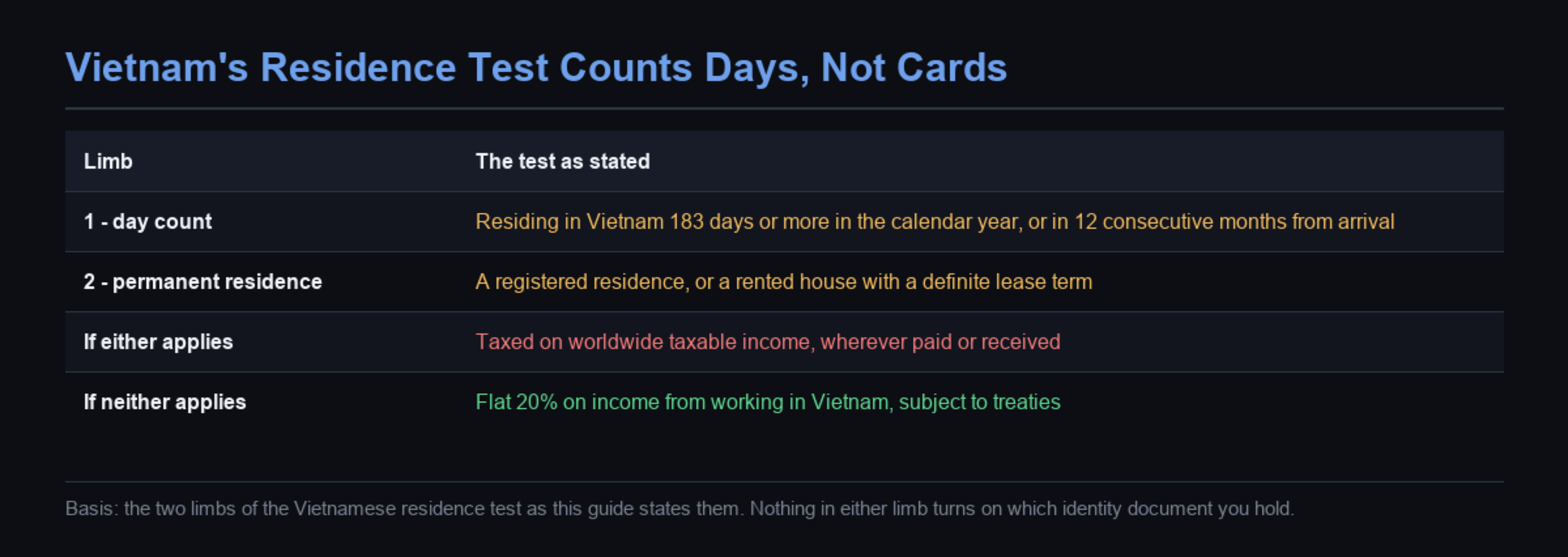
This is the section every competing page skips, and it decides the tax question before any crypto rule is reached.
Vietnam's test, as PwC's Vietnam summary states it on a page last reviewed 23 September 2026, has two limbs:
| Limb | The test as stated |
|---|---|
| 1 — day count | "Residing in Vietnam for 183 days or more in either the calendar year or the period of 12 consecutive months from the date of arrival" |
| 2 — permanent residence | "Having a permanent residence in Vietnam (including a registered residence or a rented house in Vietnam with a definite lease term)" |
| Consequence if either applies | Tax residents are taxed "on their worldwide taxable income," wherever it is paid or received |
| If neither applies | Non-residents pay a flat 20% on income from working in Vietnam, subject to treaties |
Read the two limbs and notice what is absent: any mention of a foreign identity document. Limb one counts days. Limb two asks whether you keep a home there — and the parenthesis is the trap, because a registered residence (hộ khẩu-style registration) or an ordinary lease is enough. Most people buying a Palau card from Hanoi or Ho Chi Minh City satisfy limb two before they count a single day.
There is also no mirror-image clause letting a Vietnamese citizen living in Vietnam argue out of residence by holding a Palauan card. And if you genuinely leave — a real move, a real home elsewhere, most of the year outside — you did not need a $288 card to achieve it. Severing Vietnamese residence is a question of where you live, which is the same conclusion our tax guide reaches from the other direction. This is general information and not tax advice.
What a Vietnamese tax resident actually pays in 2026
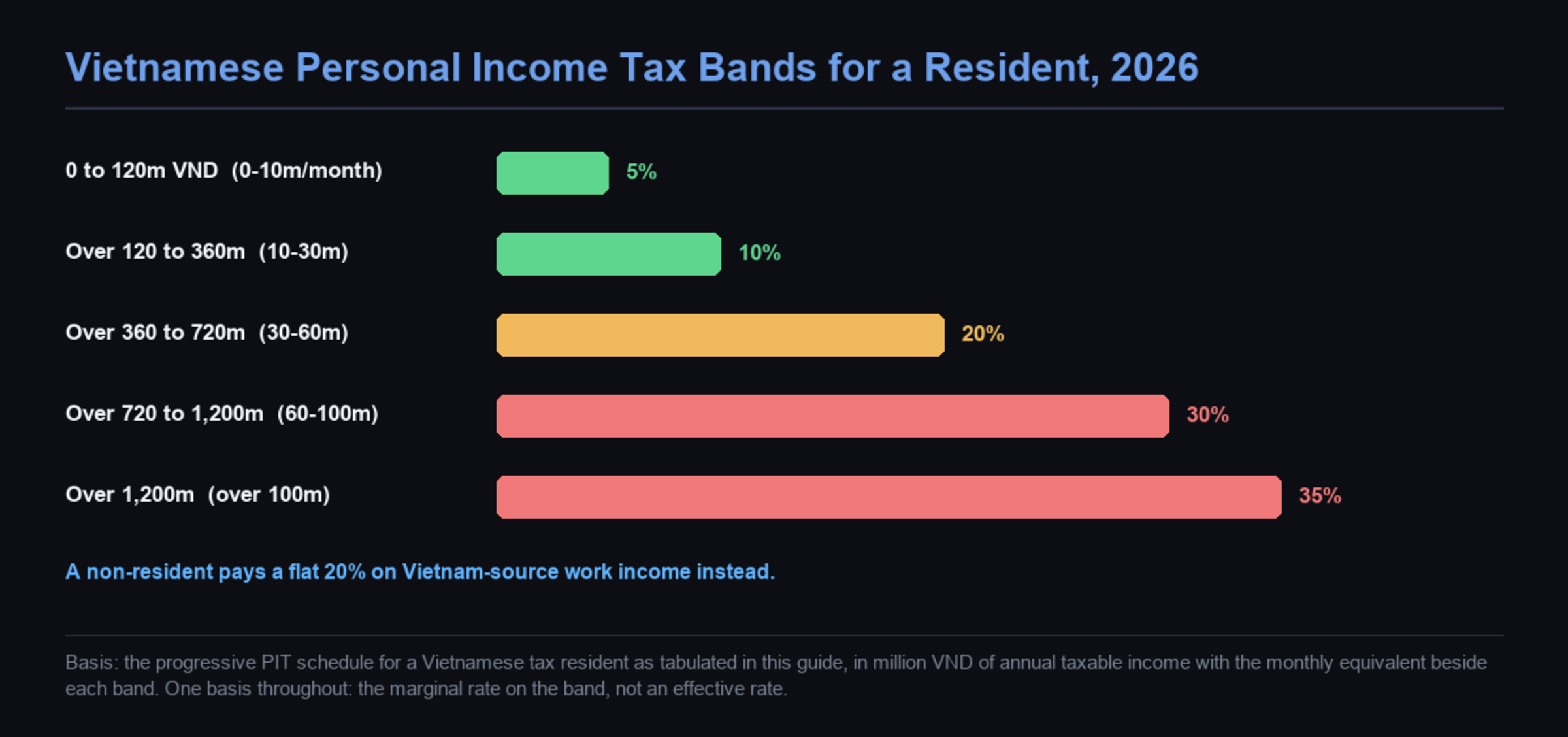
If either limb catches you, the rates below are what the card is implicitly being sold against. These are the resident bands on PwC's Vietnam page, reviewed 23 September 2026, in annual millions of Vietnamese dong:
| Annual taxable income (million VND) | Monthly equivalent (million VND) | Rate |
|---|---|---|
| 0 – 120 | 0 – 10 | 5% |
| Over 120 – 360 | Over 10 – 30 | 10% |
| Over 360 – 720 | Over 30 – 60 | 20% |
| Over 720 – 1,200 | Over 60 – 100 | 30% |
| Over 1,200 | Over 100 | 35% |
Two caveats belong with that table. First, it is the employment-income schedule; crypto activity inside the pilot is taxed differently, and we come to that below. Second, nothing in the table has an input for which identity card you own. That is the whole point of reproducing it. A reader doing this arithmetic is usually hoping the card changes a line in it, and there is no line for it to change.
If the real question is whether Palau taxes you instead, our Palau crypto tax page handles that; the short answer is that a residency product does not create a tax residence, and RNS does not claim it does.
Resolution 05/2025 built a licensed market, and a six-month clock
Here is what actually changed in 2026, and it is the material the Palau-ID pitch was written before.
The Law on Digital Technology Industry, passed 14 June 2025 and in force from 1 January 2026, recognises a digital asset as an asset under the Civil Code and defines a crypto asset as "a type of digital asset that employs cryptographic technology," per Watson Farley & Williams's analysis. Crypto is still not a lawful means of payment. Separately, Resolution 05/2025/NQ-CP — effective 9 September 2025 — created a five-year pilot market with licensed providers. The features that matter to an individual:
| Feature of the pilot | Detail |
|---|---|
| Who may serve you | Providers licensed by the Ministry of Finance, Vietnamese-incorporated, foreign ownership capped at 49% |
| Charter capital | VND 10,000 billion, at least 65% held by qualifying institutions |
| The six-month clock | Six months after the first provider is licensed, all trading by domestic investors must run through licensed platforms |
| Reporting | Providers report transactions of USD 1,000 or more |
| Data retention | Initiator and beneficiary details kept at least 10 years, on servers in Vietnam |
| Tax inside the pilot | Securities treatment — 0.1% of transaction value, withheld by the provider, no year-end PIT finalisation |
Procedurally the queue is open: the Ministry of Finance issued Decision 96/QD-BTC on 20 January 2026, which set the licensing procedure and gives applicants an initial written response within 20 working days and a decision within 30, with the State Securities Commission coordinating and the State Bank and Ministry of Public Security consulted on anti-money-laundering and cybersecurity, per Tilleke & Gibbins.
What we could not confirm: that any provider has actually been licensed yet. Reports describe seven applications with five found valid at a first stage in March 2026, and an August 2026 account still saying none had been licensed. We found nothing confirming a granted licence as at 23 November 2026, so treat the six-month clock as not yet started — and note that this is the one fact in this article most likely to be out of date by the time you read it. Check the Ministry of Finance before relying on it.
Decree 284/2026 fines the platform for an identity it cannot verify
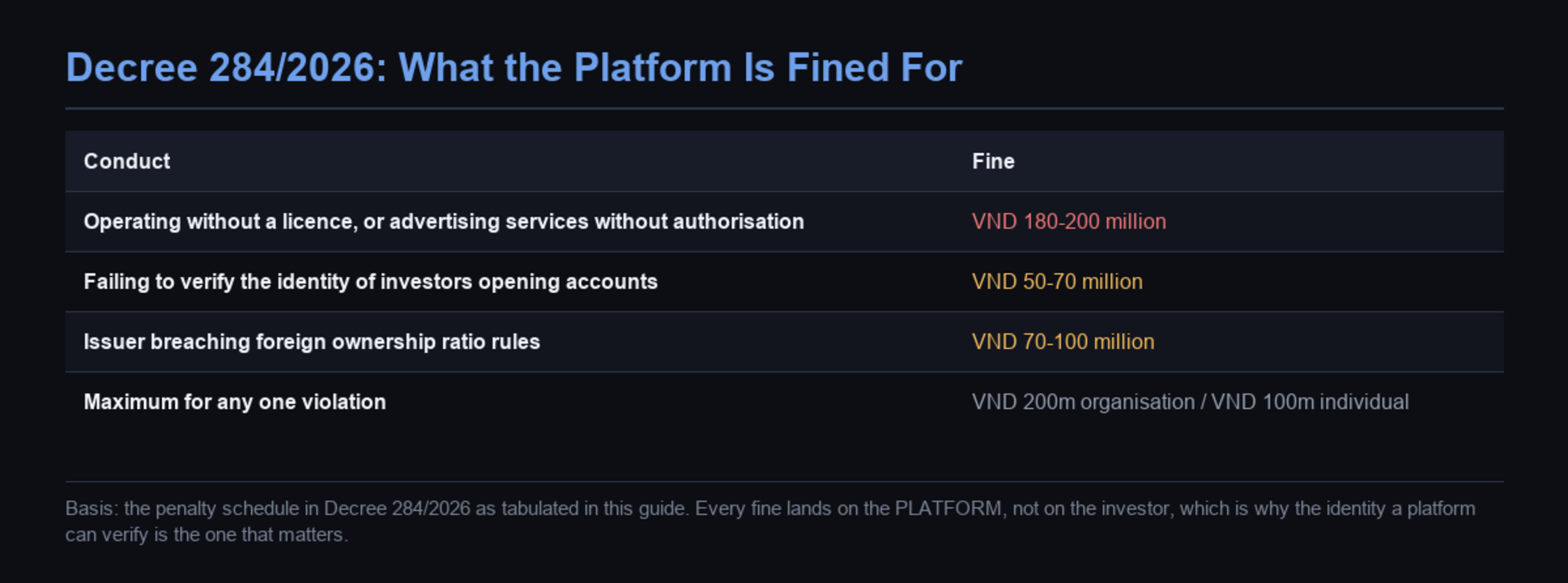
This is the section that answers "will an exchange here take my Palau ID", and it answers it from the exchange's side of the desk.
Decree 284/2026/ND-CP took effect 1 September 2026 and runs until Resolution 05/2025 ceases to have effect. Vietnam's own government news portal sets out the schedule, and the ceilings are VND 200,000,000 for an organisation and VND 100,000,000 for an individual:
| Conduct | Fine |
|---|---|
| Provider operating without a licence, or advertising services without authorisation | VND 180–200 million |
| Provider failing to verify the identity of investors opening accounts | VND 50–70 million |
| Issuer breaching foreign ownership ratio rules | VND 70–100 million |
| Maximum for any one violation | VND 200 million (organisation) / VND 100 million (individual) |
The bolded row is the whole answer. A licensed Vietnamese platform earns no fee premium for accepting an unfamiliar foreign card and carries a five-to-seven-figure dong penalty if its identification is found wanting. Its incentive is to accept the narrowest set of documents it can defend to a regulator, which is exactly the opposite of the incentive the "accepted at 100+ exchanges" marketing assumes. RNS says the same thing in its own register: acceptance "is determined by that organization and its rules," and downloading a copy of your ID "does not establish permission for a verification use or guarantee acceptance." Acceptance varies, and in a newly penalised market it varies downward.
On the investor side there are reports of fines for routing trades through unlicensed providers, but the figures quoted disagree — one summary says VND 15–25 million for individuals, another VND 30–50 million — and the government portal's own summary of the decree does not state an investor figure at all, so we do not rely on a number here. The direction is not in doubt even if the amount is: Vietnam has moved from indifference to a published penalty schedule, which is a reason to be more careful about your trading venue, not to buy a card you hope will obscure it. Our KYC loophole page covers why that framing was always weaker than it looked.
Vietnamese verification runs on the chip card
Step away from crypto for a moment, because the banking layer shows the same shape and is easier to verify.
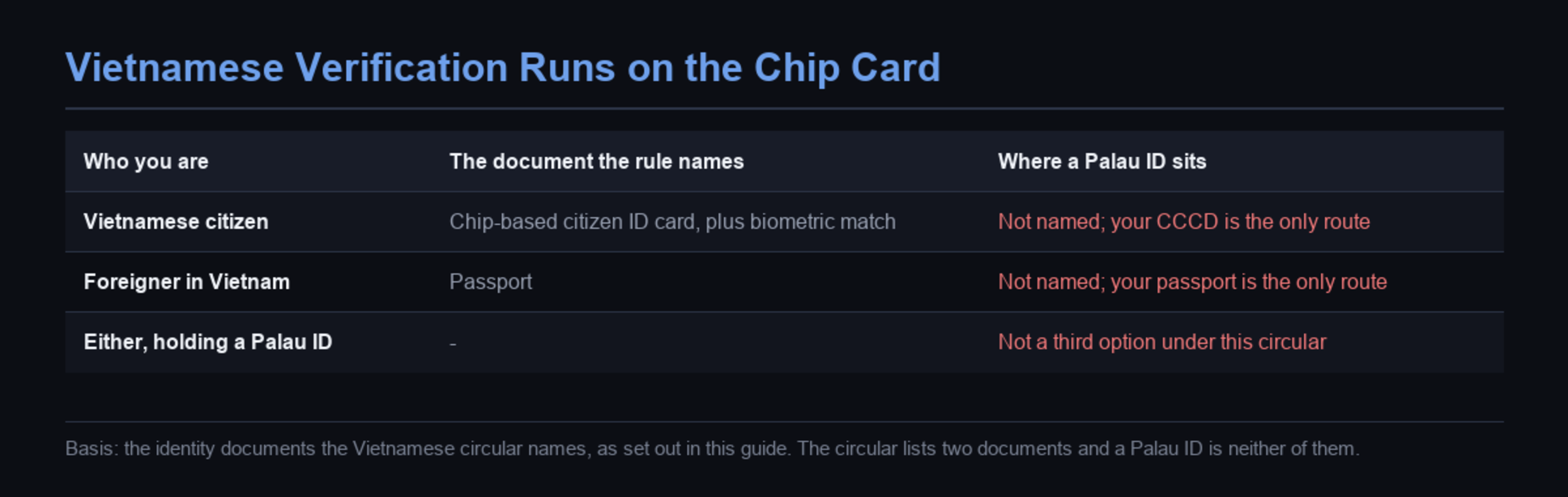
Under Circular 17/2024/TT-NHNN, issued by the State Bank of Vietnam on 28 June 2024, online banking verification is done against biometric data, and the documents named are specific: a valid chip-based citizen ID card for Vietnamese citizens, or a passport for foreigners, presented at a branch or through the bank's app. The organisation-account requirement took effect 1 July 2025. So:
| Who you are | The document the rule names | Where a Palau ID sits |
|---|---|---|
| Vietnamese citizen | Chip-based citizen ID card (plus biometric match) | Not named; your own CCCD is the only route |
| Foreigner in Vietnam | Passport | Not named; your passport is the only route |
| Either, holding a Palau ID | — | Not a third option under this circular |
Two things follow. First, a Vietnamese citizen's chip card is stronger here than anything a residency product can offer, because the verification is a biometric match against the national population database rather than a document check. Second, there is no document-shopping to do: the rule does not offer a menu. If the underlying need is proof of address rather than identity, note that RNS's mailing product is sold as a mailing address and not as proof of residence — our mailing service review and proof-of-address page set out why that distinction bites. Expectations about accounts in general are worth calibrating against our bank account guide.
CARF: Viet Nam has not committed, and that is not the win it looks like
The one place where Vietnam genuinely is an outlier, and the opposite of how it gets sold.
The OECD Global Forum's commitment list, last updated 14 September 2026, sorts jurisdictions by when they start exchanging crypto-account information. Viet Nam is in none of the committed groups:
| Group | Count | Where Viet Nam sits |
|---|---|---|
| First exchanges by 2027 | 46 | — |
| First exchanges by 2028 | 27 | — |
| First exchanges by 2029 | 4 | — |
| Relevant to CARF but not yet committed | 4 | El Salvador, Georgia, India, Viet Nam |
So a Vietnamese resident is not facing automatic exchange of crypto-account data on the 2027 or 2028 timetable that our CARF page describes for most of the world. Two reasons that is a thin comfort. First, the exposure that exists is domestic and already in force: licensed providers report transactions of USD 1,000 or more and retain initiator and beneficiary details for ten years on servers inside Vietnam, which is the Ministry of Public Security's jurisdiction rather than a treaty partner's. Second, CARF reporting keys off residence and the self-certification you give your provider, never off which card you produced. A Palau ID in a Vietnamese resident's file does not make the file unreportable; at most it makes the self-certification inconsistent with everything else in the record, which is a worse position than the one it was bought to improve.
Where the card is useful, and who should skip it
We are not against this product. We are against the four reasons it is sold to Vietnamese buyers.
Skip it if you are buying it to leave the Vietnamese tax net, to clear verification at a Vietnamese bank or a licensed platform, to make an offshore trading route lawful under the new pilot, or to create an address that reads as a residence. The first is answered by the 183-day and permanent-residence limbs, the second by Circular 17/2024's two named documents, the third by Resolution 05/2025 and Decree 284/2026, and the fourth by RNS's own description of its mailing product.
It may genuinely be worth it if you want a second government-issued photo ID so you are not posting your passport to minor services, you travel often and want a spare card-format document, or you have one specific venue that has already told you in writing that it accepts a Palau ID. That last clause is the entire test, and running it is free.
The honest summary is narrower than either the sales pitch or the scare story: Palau issues a real identity card, and Vietnam spent 2026 writing its identification and trading rules in terms the card cannot satisfy. Decide with both of those in front of you. If you are still weighing whether to apply at all, start here, and read our limitations page before you spend anything.
Related reading
- Palau digital residency limitations — what the programme does not guarantee, in its own words
- Palau digital residency risks in 2026 — governance, listings and the wider exposure
- Palau ID for crypto KYC — what acceptance actually depends on
- Palau digital residency for Filipino citizens 2026 — the same test applied to a neighbouring market
- Palau digital residency for Indian citizens 2026 — another CARF-uncommitted jurisdiction
- Palau digital residency cost in 2026 — the tiers, the reprint fee and the refund position
FAQ
Can Vietnamese citizens get Palau digital residency in 2026?
Vietnam has never appeared on the exclusion list this programme published, which named North Korea, Iran, Syria, Cuba, Crimea and Sudan. RNS's current documentation publishes no country list, saying only that it "checks current country and compliance restrictions" and that the list "is maintained by the service and can change." Purchasing a term does not guarantee approval, and applications pass identity, KYC/AML and sanctions review before Palau approves them.
Will a Vietnamese exchange or bank accept a Palau ID?
Nothing in the published rules creates a slot for it. Circular 17/2024/TT-NHNN names a chip-based citizen ID card for Vietnamese citizens and a passport for foreigners, and Decree 284/2026/ND-CP fines a provider VND 50–70 million for failing to verify the identity of investors opening accounts. Acceptance varies and is decided by each organisation under its own rules, which in a newly penalised market means narrower documents, not wider ones.
Does a Palau ID reduce my Vietnamese tax?
No. You are tax resident if you are in Vietnam 183 days or more in a calendar year or in 12 consecutive months from arrival, or if you have a permanent residence there including a registered residence or a rented house on a definite lease. Residents are taxed on worldwide income at 5% to 35% on the 2026 schedule. Neither limb mentions a foreign identity document. This is general information, not tax advice.
Is it legal for a Vietnamese resident to trade crypto in 2026?
Crypto assets are recognised as assets under the Law on Digital Technology Industry, in force since 1 January 2026, but they are not a lawful means of payment. Resolution 05/2025/NQ-CP created a licensed pilot market, and six months after the first provider is licensed all trading by domestic investors is meant to run through licensed platforms. We could not confirm that any provider had been licensed as at 23 November 2026, so check the Ministry of Finance for current status rather than assuming either way.
What tax applies to crypto transactions inside Vietnam's pilot?
During the pilot, crypto transactions follow the securities regime: 0.1% of transaction value, withheld and remitted by the licensed provider, with no year-end personal income tax finalisation required. Dedicated crypto tax rules were still pending when this page was written. A Palau ID has no effect on a tax withheld at the platform, because the platform withholds it on the transaction rather than on the holder's documents.
Does Vietnam report crypto accounts under CARF?
Not yet. The OECD Global Forum's list, last updated 14 September 2026, places Viet Nam among four jurisdictions identified as relevant to CARF that have not committed to implement it, alongside El Salvador, Georgia and India. The domestic reporting is the live obligation instead: licensed providers report transactions of USD 1,000 or more and keep initiator and beneficiary details for at least ten years on servers in Vietnam.
Does a Palau ID let me live in or travel to Palau?
No. RNS's own overview says Palau Digital Residency "is not the same as citizenship, a passport, or physical residency in Palau," and lists universal third-party acceptance and access to a bank or exchange among the things it does not promise. Any entry right you have as a Vietnamese passport holder comes from Palau's visa rules, not from this card — see can you travel with a Palau ID.