Palau Mailing Service 2026: Form 1583 and the Catch
The Palau mailing service needs an active Palau ID, a signed USPS Form 1583 and a video notary. We read the seven 2026 docs: it is not proof of address.
We may earn a commission if you apply through this link. This site is independent and is not the official RNS.ID or Palau government site.

Key takeaways
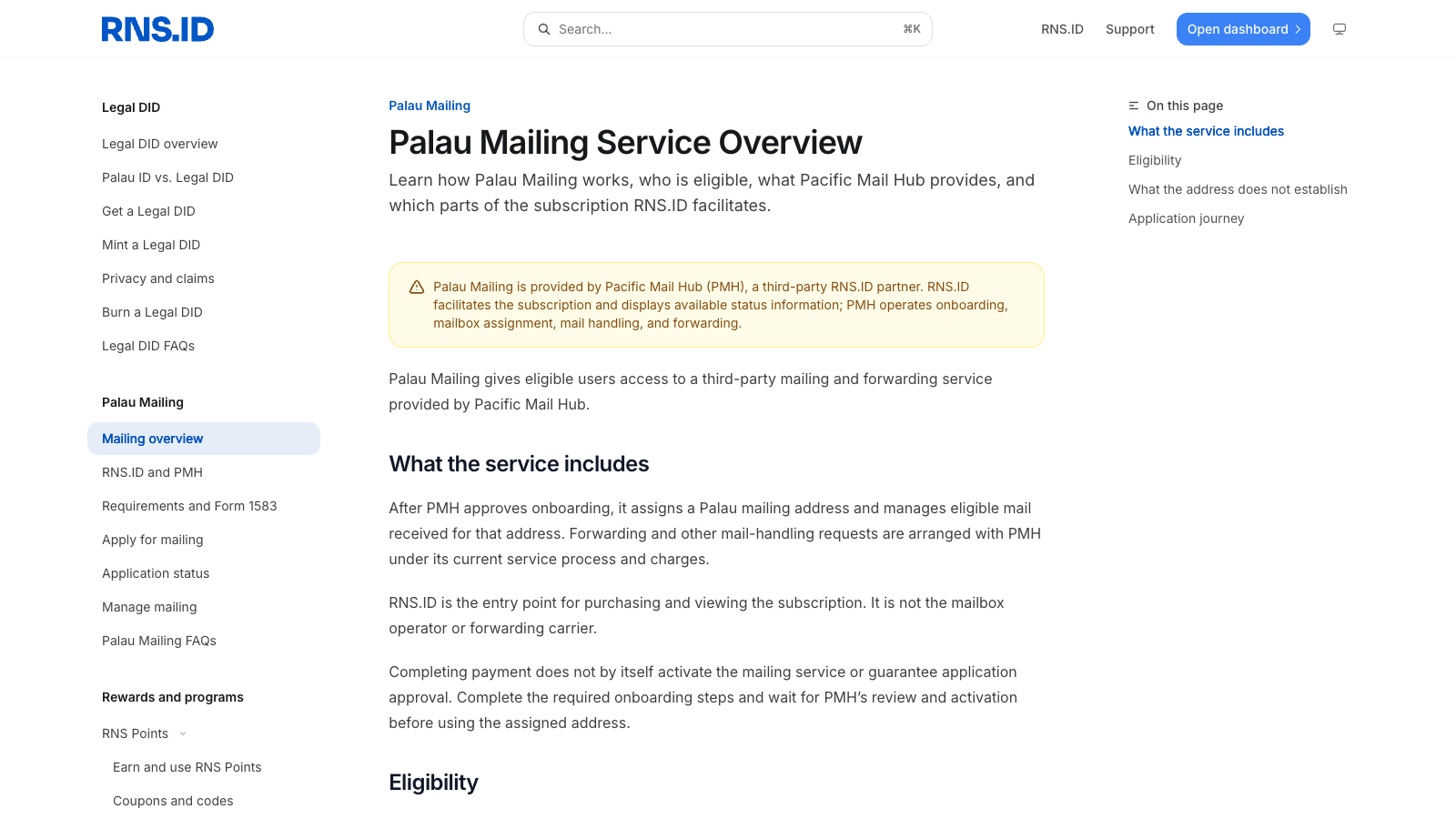
- The Palau mailing service is not run by RNS. Its own documentation says "Palau Mailing is provided by Pacific Mail Hub (PMH), a third-party RNS.ID partner." RNS sells the subscription, confirms your Palau ID and shows a status label. PMH reviews your documents, assigns the box and decides whether you are approved.
- Onboarding runs on a USPS form, and that form tells you what you are buying. PMH requires a signed PS Form 1583 plus an online video-notary session. USPS titles that form "Application for Delivery of Mail Through Agent", and it exists for commercial mail receiving agencies — which is why RNS's own management page tells you to "confirm the sender accepts a commercial mailing address".
- All six accepted secondary-address documents are American. The list is a U.S. state, territory or tribal ID card, a lease, a home or vehicle insurance policy, a mortgage or deed of trust, a vehicle registration card, or a voter card. For a European applicant the realistic routes are a lease or an insurance policy.
- Nobody can quote you a current price. RNS shows the figure at checkout and publishes none in the docs. The only published numbers are from Palau's 2023 Ministry of Finance regulation, reported as US$65 a year plus a US$35 forwarding deposit, US$100 at signup — and forwarding charges themselves sit with PMH.
- It is explicitly not proof of address. RNS says the assigned address is "not proof of Palau residence, a residential address, or legal, domicile, or tax residence", and adds: "Do not purchase the service solely to satisfy a third party's proof-of-address request."
On this page
- Palau mailing service: the short answer
- RNS sells it. PMH runs it. That split matters.
- PS Form 1583 is a USPS form, and that tells you what the address is
- The secondary-document list is a problem if you are not American
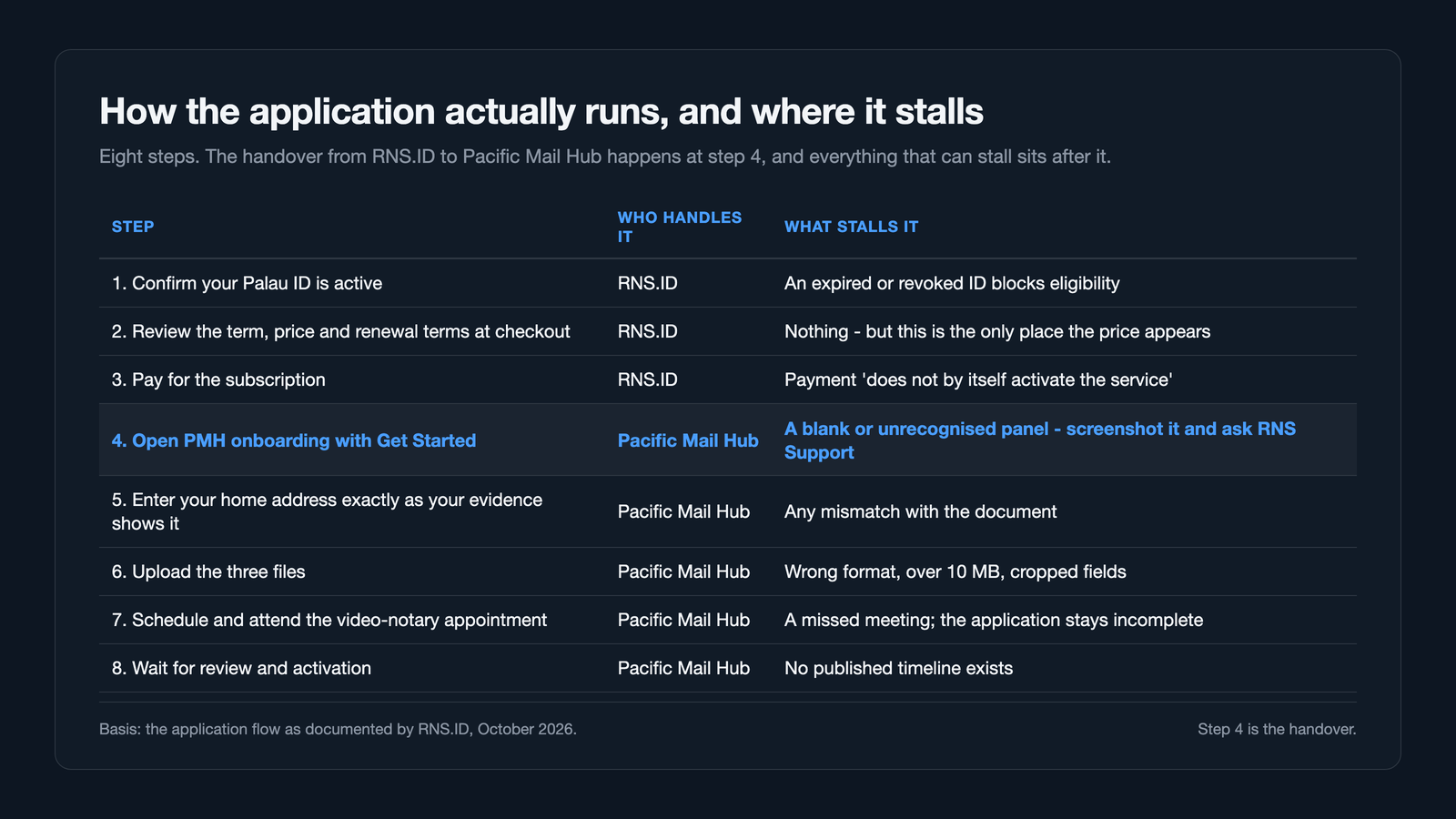
- How the application actually runs
- "In Progress" hides five different states
- What it costs, and why nobody can quote you a price
- Will a bank accept the Palau mailing service address?
- Who should buy it in 2026
- Related reading
- FAQ
Palau mailing service: the short answer
Most people reach the Palau mailing service after a bank or an exchange has asked them for proof of address, and that is the one job RNS says it will not do. The money is small by residency standards — the only published figures are a US$65 annual subscription and a US$35 forwarding deposit from Palau's 2023 regulation — but the cost of buying it for the wrong reason is a rejected verification and a subscription you cannot use, and RNS writes "no refunds" into its address-complaint language. We read all seven of RNS's palau-mailing documentation pages on 28 October 2026, then checked the form they hang on against the USPS Domestic Mail Manual.
The service is real and it does something useful: a Palau mailbox, operated by a third party, that receives mail for you and forwards it on request. What it is not is a residential address you can hand to a compliance desk.
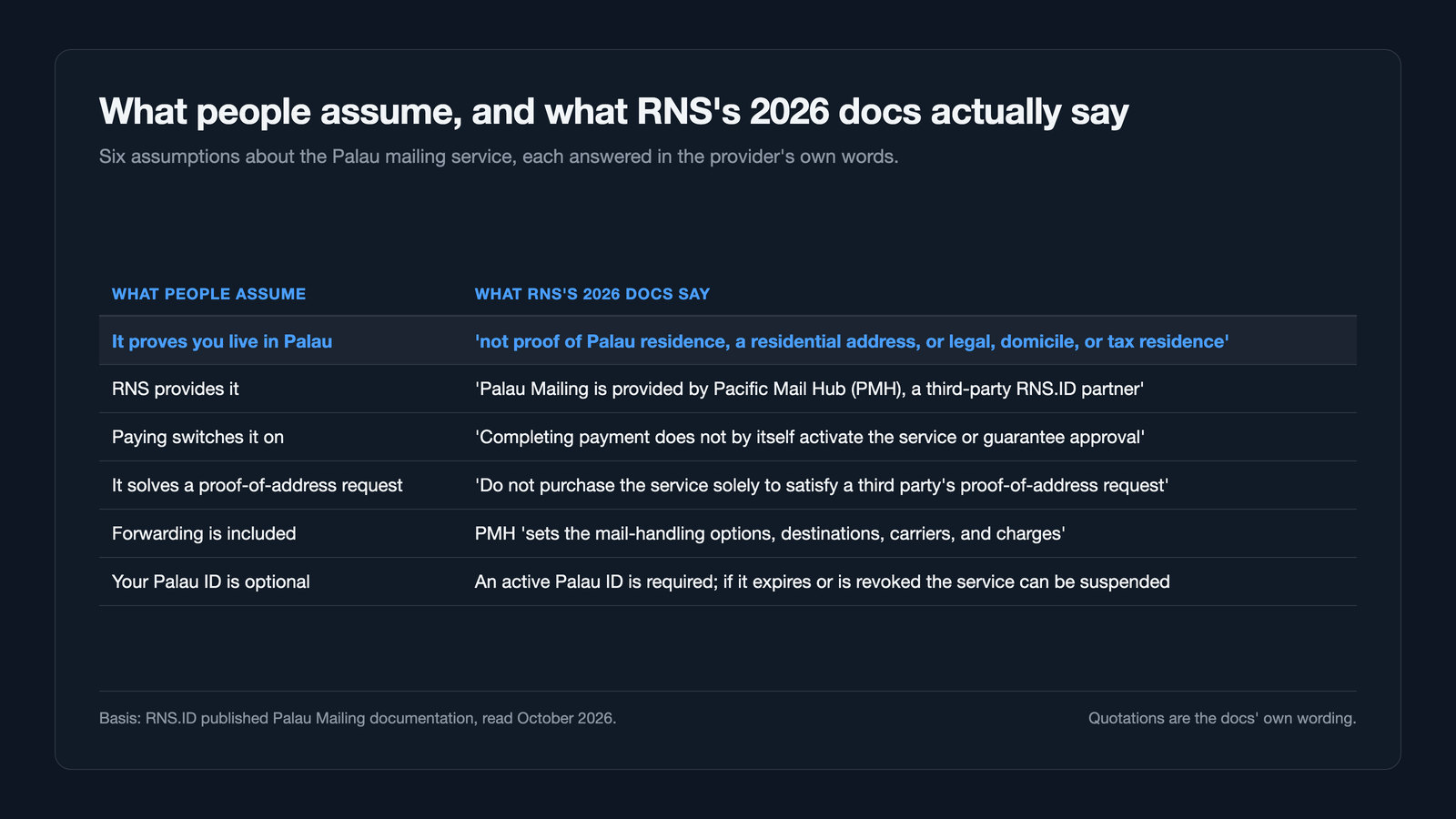
| What people assume | What RNS's 2026 docs say |
|---|---|
| It proves you live in Palau | "not proof of Palau residence, a residential address, or legal, domicile, or tax residence" |
| RNS provides it | "Palau Mailing is provided by Pacific Mail Hub (PMH), a third-party RNS.ID partner" |
| Paying switches it on | "Completing payment does not by itself activate the service or guarantee approval" |
| It solves a proof-of-address request | "Do not purchase the service solely to satisfy a third party's proof-of-address request" |
| Forwarding is included | PMH "sets the mail-handling options, destinations, carriers, and charges" |
| Your Palau ID is optional | An active Palau ID is required; if it expires or is revoked the service can be suspended |
Read the last row with your renewal date in mind. The mailbox is a dependent product: let the ID lapse and the address can go with it. Our renewal and reprint guide covers that side.
RNS sells it. PMH runs it. That split matters.
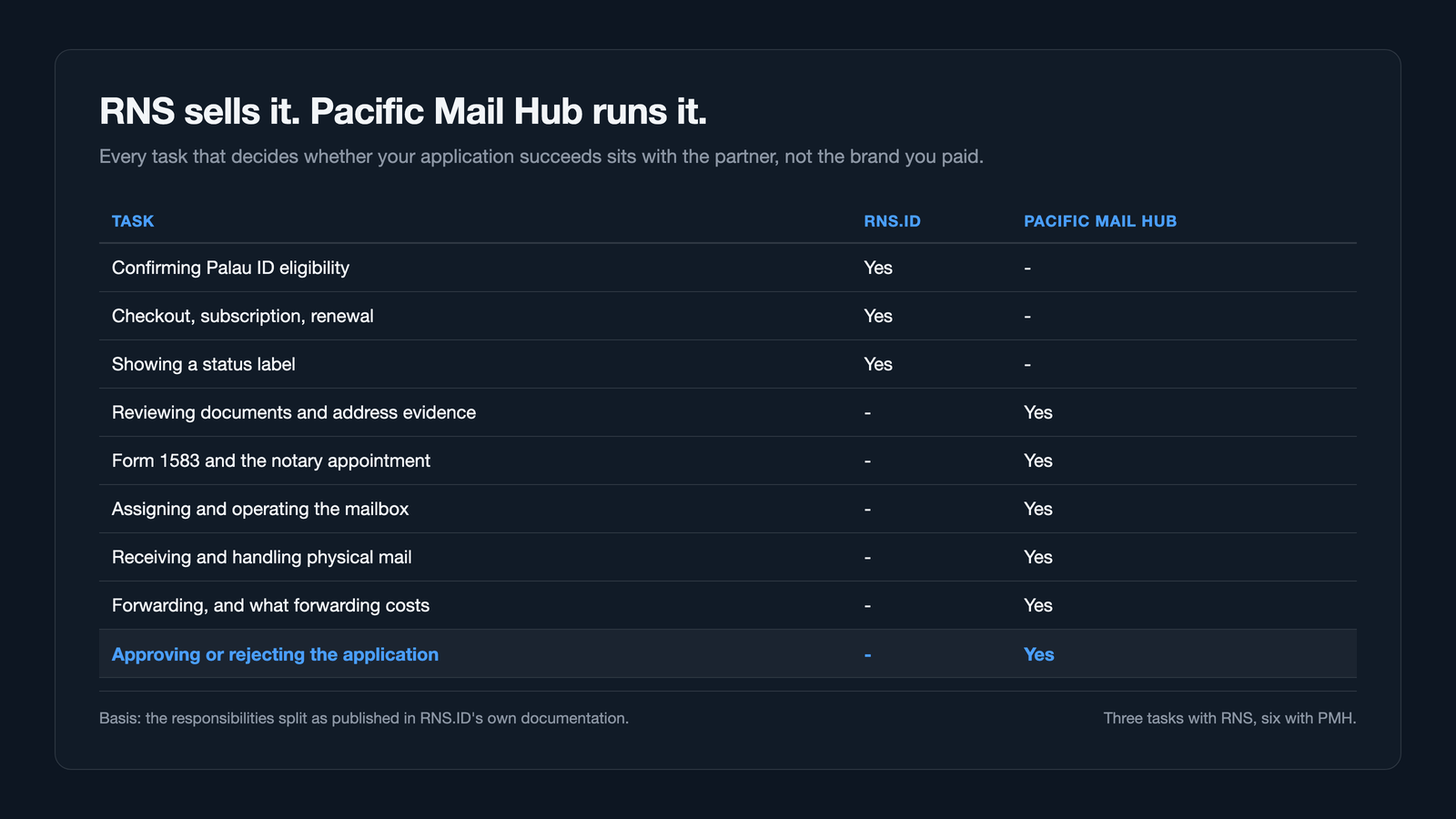
This is the part that changes how you troubleshoot. RNS publishes a responsibilities page precisely because the two halves of the service belong to two different companies, and sending a question to the wrong one is how applications stall for weeks.
| Task | RNS.ID | Pacific Mail Hub |
|---|---|---|
| Confirming Palau ID eligibility | Yes | — |
| Checkout, subscription, renewal | Yes | — |
| Showing a status label | Yes | — |
| Reviewing documents and address evidence | — | Yes |
| Form 1583 and the notary appointment | — | Yes |
| Assigning and operating the mailbox | — | Yes |
| Receiving and handling physical mail | — | Yes |
| Forwarding, and what forwarding costs | — | Yes |
| Approving or rejecting the application | — | Yes |
RNS states the boundary plainly: it "displays status received from the service", and PMH "controls its application and mail-operation decisions". RNS also says it "does not handle physical mail". So a failed payment is an RNS problem, a rejected document is a PMH problem, and a status label that looks wrong is an RNS problem about a PMH decision.
One detail is worth knowing before you plan around this service: the forwarding contact RNS currently lists for PMH is a Gmail address, pacificmailhub@gmail.com, and RNS tells you to use whatever contact appears on your own active service page if it differs. That is not a reason to avoid the service, but it does tell you the scale of the operation you are handing your post to, and it is a good argument for not routing anything irreplaceable through it.
PS Form 1583 is a USPS form, and that tells you what the address is
Here is the finding that answers most of the questions people actually have. PMH's onboarding requires a completed, signed PS Form 1583. That is not a PMH form or an RNS form. It is a United States Postal Service form, and USPS titles it Application for Delivery of Mail Through Agent.
The rules behind it sit in the USPS Domestic Mail Manual at section 508.1.8, Commercial Mail Receiving Agencies. Read that section and the service stops being mysterious, because every requirement PMH imposes is a line in it.
| What PMH asks for | The USPS rule behind it (DMM 508.1.8) | What it tells you |
|---|---|---|
| A signed Form 1583 | The form authorises a CMRA to receive mail for an addressee | You are appointing an agent, not acquiring a residence |
| An online video notary | The addressee may acknowledge the signature before a notary "in person or by real-time audio and video", commissioned in a U.S. state, territory, possession or D.C. | The notary step is a postal requirement, not an upsell |
| Your Palau ID plus a second document | The addressee must provide acceptable primary and secondary identification, current and not expired | Two documents is the floor, not PMH being difficult |
| Your current home address | The CMRA must verify the addressee "resides or conducts business at the address shown on the form" | The address you already have is what underwrites the new one |
| — | A CMRA address must carry "PMB" or the "#" sign, or mail risks return as "Undeliverable as Addressed, Missing PMB or # Sign" | Your Palau address will be visibly an agent address |
That last row is the catch in this article's title. A CMRA box is required to be addressed with a PMB or # designator, which is exactly the marker a compliance system looks for when it is deciding whether an address is residential. RNS says the same thing in plainer words on its management page: confirm "the sender accepts a commercial mailing address". The form you sign to get the address is the reason the address will not pass as a home.
Why a USPS form governs an address in Palau
Because Palau sits inside the U.S. ZIP Code system. The Domestic Mail Manual's section 608.2 carries a table of ZIP Codes under the heading "Territory, Possession, or Freely Associated State", and two of its rows are Palau.
| ZIP Code | State abbreviation | City | Territory, possession, or freely associated state |
|---|---|---|---|
| 96939 | PW | Ngerulmud | Palau |
| 96940 | PW | Koror | Palau |
So a Palau address is written in U.S. format, with a two-letter code and a five-digit ZIP, and U.S. postal rules reach it. That does not make it a domestic U.S. address in every respect: the same section requires a computer-generated customs declaration, PS Form 2976 or 2976-A, on items containing goods sent from those ZIP Codes to the United States, and places Palau in Zone 9 for rate purposes. Useful for mail. Not a U.S. address for anything else.
The secondary-document list is a problem if you are not American
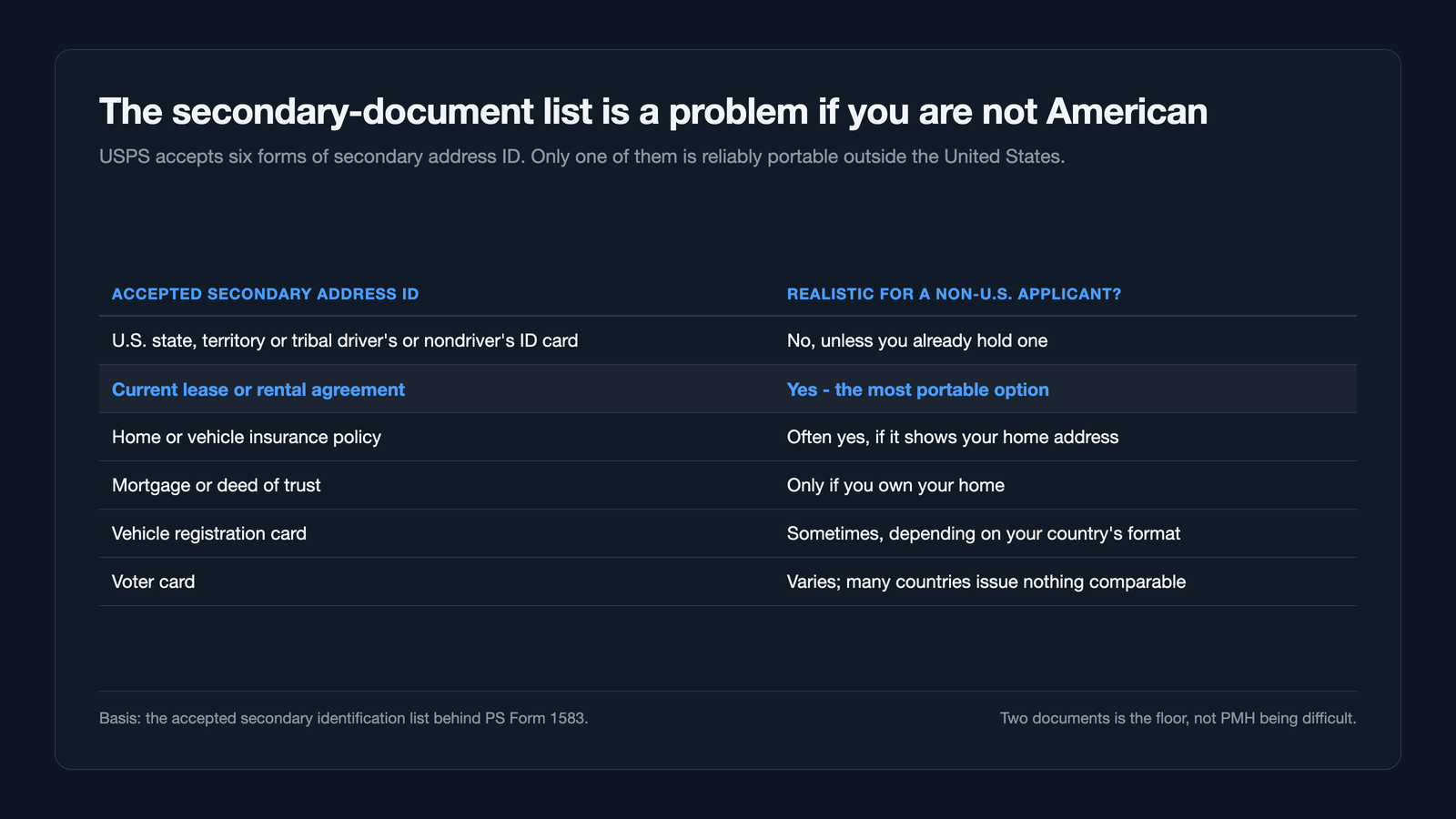
RNS publishes the list of accepted Secondary Address ID types, and this is where a lot of European and Asian applicants will stop. Every option on it is a U.S. document or a document type that U.S. households produce.
| Accepted Secondary Address ID | Realistic for a non-U.S. applicant? |
|---|---|
| U.S. state, territory or tribal driver's or nondriver's ID card | No, unless you already hold one |
| Current lease or rental agreement | Yes — the most portable option |
| Home or vehicle insurance policy | Often yes, if it shows your home address |
| Mortgage or deed of trust | Only if you own your home |
| Vehicle registration card | Sometimes, depending on your country's format |
| Voter card | Varies; many countries issue nothing comparable |
Two rules sit on top of that list and account for most corrections. The first: "The name and home address entered in the application should match the supporting document." The second, on the form itself: "Do not sign with a nickname." A lease in a shortened first name, or an insurance policy at an old flat, is a correction cycle waiting to happen.
The upload mechanics are strict and easy to get right. PMH takes exactly three files: your Palau ID image and one Secondary Address ID image as JPG, JPEG or PNG, and the signed Form 1583 as a clear PDF. "Each file can be up to 10 MB." Name each file with your own first and last name, and leave nothing cropped — names, dates and address fields all have to be legible. RNS adds that PMH's upload page wins any disagreement: "its current on-screen requirements control if they differ from an older guide."
How the application actually runs
The order matters here, because two of these steps cost money and one of them cannot be undone by buying the product again.
| Step | Who handles it | What stalls it |
|---|---|---|
| 1. Confirm your Palau ID is active | RNS.ID | An expired or revoked ID blocks eligibility |
| 2. Review the term, price and renewal terms at checkout | RNS.ID | Nothing — but this is the only place the price appears |
| 3. Pay for the subscription | RNS.ID | Payment "does not by itself activate the service" |
| 4. Open PMH onboarding with Get Started | PMH | A blank or unrecognised panel — screenshot it and ask RNS Support |
| 5. Enter your home address exactly as your evidence shows it | PMH | Any mismatch with the document |
| 6. Upload the three files | PMH | Wrong format, over 10 MB, cropped fields |
| 7. Schedule and attend the video-notary appointment | PMH | A missed meeting; the application stays incomplete |
| 8. Wait for review and activation | PMH | No published timeline exists |
RNS gives one instruction twice, in two different documents, which usually means people have done the opposite: "Do not start another subscription to work around" a correction request or a missed meeting. Corrections arrive by email from PMH with a secure link, and the RNS "In Progress" page shows neither the correction nor a continue button — so the email is the only route forward.
There is also a security line in the requirements page that is worth carrying into the appointment: "The notary or PMH should not ask for your RNS.ID password, two-factor code, wallet recovery phrase, or private key." Nothing in a notarisation needs any of those. If a session asks, end it and contact support rather than improvising.
"In Progress" hides five different states
The single most confusing thing about this product is that RNS shows you a summary while PMH holds the detail. RNS says so itself, and documents what each label can be concealing.
| RNS.ID label | What it can actually mean | What to do |
|---|---|---|
| Not Started | PMH onboarding has not begun | Use Get Started |
| In Progress | Incomplete application, an ID hold, under review, a correction requested, or waiting to schedule | Read PMH's latest email; do not rebuy |
| Meeting Scheduled | Scheduled, missed, failed, or ready to activate | Follow PMH's rescheduling email if the meeting did not succeed |
| Active | The address is live | Contact PMH for mail handling |
| Rejected | PMH did not approve the application | Read PMH's notice before anything else |
| Suspended | The qualifying Palau ID, the subscription, or the service needs attention | Restore the ID first, then reopen the mailing page |
| Expired | The term has ended | Review renewal or repurchase |
Two of those seven are ambiguous by design, and both of the ambiguous ones are the ones you will spend time staring at. Treat the RNS dashboard as a progress bar and PMH's inbox as the record.
What it costs, and why nobody can quote you a price
Every page that gives you a number for this service is quoting the same 2023 document. Palau's Ministry of Finance issued a regulation setting physical and mailing address policy, and regional coverage at the time — Islands Business, 13 April 2023 — reported the fees as US$100 at signup: a US$65 annual subscription plus a US$35 deposit for mail forwarding. That is the only published figure anywhere, and it is now three and a half years old.
| Item | Published amount | Source and year |
|---|---|---|
| Annual mailing subscription | US$65 | Palau Ministry of Finance regulation, as reported April 2023 |
| Mail-forwarding deposit | US$35 | Same, April 2023 |
| Total at signup | US$100 | Same, April 2023 |
| 2026 RNS.ID subscription price | Not published | Shown at checkout only; absent from all seven docs |
| Per-item forwarding charges | Not published | Set by PMH, "destinations, carriers, and charges" |
So treat any figure you read, including that one, as a starting point and read the actual checkout screen. The Palau ID itself is a separate cost, covered in our Palau digital residency cost guide.
One renewal mechanic deserves a diary entry. RNS says "a failed renewal can cause the service to expire even if the Palau ID remains active" — the two subscriptions are independent in that direction, even though the ID is a prerequisite in the other. Check the saved payment method and payment priority before the term ends, not after.
Will a bank accept the Palau mailing service address?
This is the question behind most searches for the Palau mailing service, so here is the honest answer: you cannot assume so, acceptance varies, and the service's own documentation tells you not to buy it for this. Every platform decides for itself, and a CMRA address with a PMB designator is the kind of address compliance teams are specifically trained to catch.
| What a platform typically asks for | What this service gives you |
|---|---|
| A residential address where you live | A commercial mailbox operated by an agent |
| A document issued in your name at that address | An assigned address, after you prove a different home address |
| A recent utility bill or bank statement | Neither; PMH handles mail, it does not bill you for utilities |
| An address consistent with your other records | An address in Palau, probably inconsistent with everything else you have filed |
| An address that is not flagged as a mail-receiving agency | An address required by USPS rules to be designated PMB or # |
That is not a knock on PMH. It is what a mail-forwarding product is. If the underlying need is a verification document, read what a Palau ID can and cannot do for proof of address and our proof-of-address resource center before spending anything, and treat the existing Palau mailing address page as the shorter version of this warning. Banking expectations in particular need calibrating: see Palau digital residency and bank accounts.
Who should buy it in 2026
Buy it if you want a Palau mailbox for its own sake — a stable postal destination tied to your digital residency, with forwarding you arrange and pay for separately — and you can produce a lease or an insurance policy in your own name at your current home address. On those terms it is a modest, functioning service with a clear owner and a documented process.
Do not buy it to clear a proof-of-address wall, to establish residence, or to change where you are taxed. RNS rules out all three in writing, and the USPS form at the centre of the process is the reason the first one will not work. The best outcome this product can give you is mail that arrives; anything more than that is being read into it. For the wider picture of what the programme does and does not promise, our limitations guide is the page to read next.
Related reading
- Palau mailing address: what it is and what it is not — the short version of the proof-of-address warning
- Palau ID proof of address — what the card itself can and cannot do
- Palau ID proof of address resource center — the POA terms platforms use
- Palau digital residency bank account — why bank-account reports are unconfirmed
- Palau digital residency limitations — what the programme does not guarantee
- Palau digital residency cost — the ID's own pricing, verified
- Palau digital residency renewal and reprint — keeping the ID the mailbox depends on
FAQ
Who actually provides the Palau mailing service?
Pacific Mail Hub (PMH), a third-party partner. RNS.ID's role is to confirm your Palau ID eligibility, sell and renew the subscription, and display a status label; it says it "does not handle physical mail". PMH reviews your onboarding documents, assigns and operates the mailbox, receives mail, arranges forwarding, and decides whether the application is approved.
Do I need a Palau ID to buy the mailing service?
Yes, an active one. RNS lists an active Palau ID in your RNS.ID account as the first requirement, and says the mailing service can be suspended if that ID expires or is revoked. To reactivate, you renew or reactivate the ID first, then return to the Palau Mailing page and complete any reactivation step.
Why do I have to sign PS Form 1583?
Because you are appointing an agent to receive your mail. PS Form 1583 is a USPS form titled "Application for Delivery of Mail Through Agent", and USPS DMM 508.1.8 requires it before a commercial mail receiving agency can accept mail on an addressee's behalf. PMH generates the form through its own link; review every field before signing, and do not sign with a nickname.
Is the video-notary appointment really required?
Yes. PMH sends the meeting link and instructions to the email address used for the application, and the application stays incomplete until a required meeting succeeds. The step is a postal rule rather than a product choice: DMM 508.1.8 lets an addressee acknowledge the Form 1583 signature before a notary by real-time audio and video, provided the notary is commissioned in a U.S. state, territory, possession or the District of Columbia.
Does the Palau mailing address work as proof of address?
Treat the answer as no. RNS states the assigned address is not proof of Palau residence, not a residential address, and not proof of legal, domicile or tax residence, and that banks, exchanges or government bodies may reject it. Its own guidance is to confirm acceptance before buying and not to purchase the service solely to satisfy a third party's proof-of-address request.
What does the Palau mailing service cost in 2026?
RNS does not publish a price in its documentation; the subscription period, price and renewal terms appear at checkout. The only published figures come from Palau's 2023 Ministry of Finance regulation, reported that April as US$100 at signup — a US$65 annual subscription plus a US$35 mail-forwarding deposit. Per-item forwarding charges are set by PMH and are not listed anywhere.
Is mail forwarding included in the subscription?
Do not assume it is. RNS says PMH sets the mail-handling options, destinations, carriers and charges, and tells you to confirm them before requesting forwarding. Forwarding requests go to PMH using the contact shown on your active service page — currently a Gmail address, pacificmailhub@gmail.com — not to RNS.ID.
Why does my status say "In Progress" when nothing is happening?
Because that single label summarises several PMH states: an incomplete application, an ID hold, a review in progress, a correction request, or waiting for you to schedule the meeting. RNS does not show which one applies, and the "In Progress" page carries no correction details and no continue button. Check PMH's most recent application email, and do not start a second subscription to try to move things along.
Can I use the Palau mailing address to register a company or change my tax residence?
No. The address is a mailing address; RNS rules out legal residence, domicile and tax residence explicitly, and nothing about a forwarding mailbox changes where you are tax resident. This is general information and not tax or legal advice — take your own advice on anything with a filing attached, and read our limitations guide for the programme-level boundaries.