Palau Digital Residency for Pakistani Citizens 2026
What Palau digital residency does and does not do for a Pakistani in 2026: section 82(d) residency, PVARA's CNIC-or-passport KYC list, and CARF.
We may earn a commission if you apply through this link. This site is independent and is not the official RNS.ID or Palau government site.

Key takeaways
- Palau digital residency does not move a Pakistani's tax residence, and section 82(d) is the clause that closes the door. Since the Finance Act 2022 inserted it, a citizen of Pakistan is a resident individual if they are "not present in any other country for more than one hundred and eighty-two days during the tax year" or are "not a resident taxpayer of any other country." Either branch is enough on its own.
- That clause is aimed precisely at the perpetual traveller the card is sold to. A Palau ID gives you no physical presence anywhere and makes you a resident taxpayer of nowhere, so it satisfies the second branch rather than escaping it.
- Pakistan's crypto onboarding rules now name the two documents that count. Regulation 98(4)(a) of the Pakistan Virtual Asset Services Regulations, 2026 requires a licensed provider to verify an individual's "full name as shown on CNIC or a passport", plus nationality, address, place of birth, bank account details and source of funds.
- Those rules reach offshore venues that market to Pakistanis. An activity counts as carried on "in Pakistan" where it "targets, solicits, promotes to, or onboard persons in Pakistan", and providing an unlicensed service carries up to five years' imprisonment or a fine up to Rs 50 million.
- Pakistan is absent from the OECD's CARF commitment list, but that is not privacy. The Global Forum list updated 14 September 2026 names 46 jurisdictions for 2027, 27 for 2028 and 4 for 2029, and Pakistan appears in none of them — while Pakistan has been a CRS signatory since 7 June 2017, with first financial-account exchanges intended from September 2018.
On this page
- What Palau digital residency changes for a Pakistani in 2026
- Can Pakistani citizens apply for Palau digital residency?
- Section 82(d) is the clause that defeats the pitch
- What a Pakistani resident actually pays, and why the pitch sells
- Pakistan's licensed exchanges ask for a CNIC or a passport
- Offshore venues, the travel rule, and the honest gap
- Pakistan is not on the CARF list, and that is not the comfort it sounds like
- Where the card is useful, and who should skip it
What Palau digital residency changes for a Pakistani in 2026
Your choice of identity document. Nothing that a Pakistani tax officer or a PVARA-licensed exchange is obliged to care about.
That is a narrower answer than the pages selling this product give, and 2026 is the year the gap became measurable, because the Pakistani side of the ledger moved twice. The Virtual Assets Act, 2026 — Act No. XIII of 2026 — received presidential assent on 4 March 2026 and was gazetted the next day with the words "It shall come into force at once." Five months later PVARA notified the Pakistan Virtual Asset Services Regulations, 2026 under S.R.O. 1419(I)/2026, dated 21 August 2026. I read both in their gazette form for this piece, along with the Income Tax Ordinance's residence section, and a foreign digital residency card appears nowhere in any of them.
I also went looking for a Pakistan-specific account of this product and found none. The pages ranking for Palau digital residency are launch-era write-ups from 2022 to 2024 plus one first-person "loophole" post that cites no statute; the pages covering Pakistan's new crypto regime never mention digital residency. Readers between the two get a sales pitch or silence.
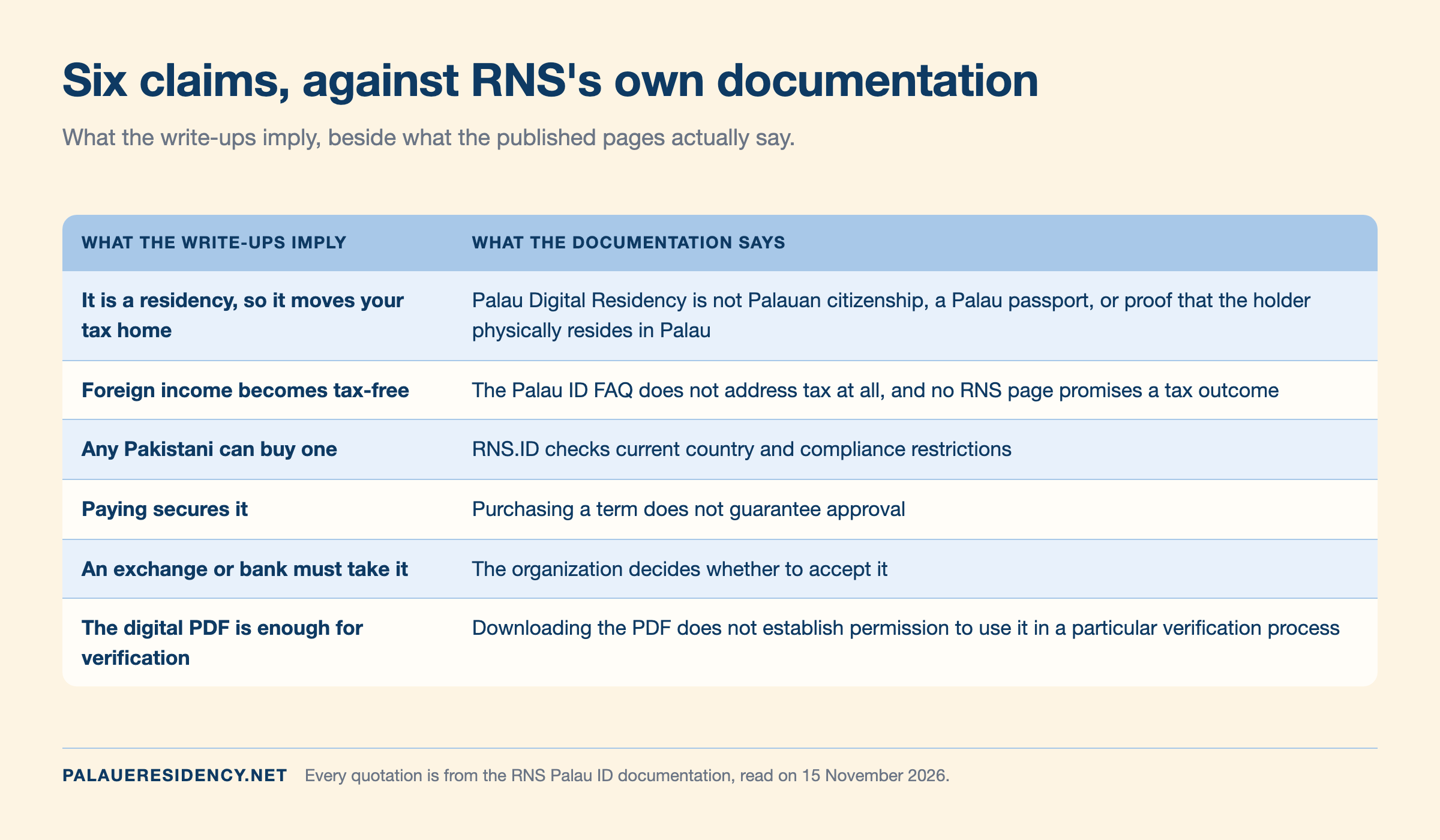
So here is the comparison both sides skip. On the left, what the resale write-ups imply. On the right, what RNS's own documentation says, read on 15 November 2026.
| What the write-ups imply | What the documentation says |
|---|---|
| It is a residency, so it moves your tax home | "Palau Digital Residency is not Palauan citizenship, a Palau passport, or proof that the holder physically resides in Palau" |
| Foreign income becomes tax-free | The Palau ID FAQ does not address tax at all; no RNS page promises a tax outcome |
| Any Pakistani can buy one | "RNS.ID checks current country and compliance restrictions" |
| Paying secures it | "Purchasing a term does not guarantee approval" |
| An exchange or bank must take it | "The organization decides whether to accept it" |
| The digital PDF is enough for verification | "Downloading the PDF does not establish permission to use it in a particular verification process" |
Notice what is missing from the right-hand column: there is no tax claim in it to argue with. The tax story was added by resellers, not by the issuer, and our tax guide makes the same point in general terms. None of what follows is tax advice.
Can Pakistani citizens apply for Palau digital residency?
There is no published list of eligible nationalities, so there is no documented yes for Pakistan and no documented no either.
The eligibility page is procedural rather than geographic. An applicant "must be able to use an eligible RNS.ID account", must "provide an identity document accepted by the current verification flow", and the "verification interface determines which document types are accepted for your country or region". On countries it says only that "RNS.ID checks current country and compliance restrictions" and that the "restricted-country list is maintained by the service and can change".
Pakistan does not appear on the restriction lists this site has tracked, which name North Korea, Iran, Syria, Cuba, Crimea and Sudan — see our supported countries page. Treat that as an absence of evidence rather than a confirmation: the only list that binds you is the one rendered at checkout for your own account.
| Step | What RNS says | What it means for a Pakistani applicant |
|---|---|---|
| Identity document | Must be "accepted by the current verification flow" | A valid Pakistani passport meets this on its face |
| Document types | "The verification interface determines which document types are accepted for your country or region" | What the form accepts for Pakistan is only visible in the form |
| Country screening | "The restricted-country list is maintained by the service and can change" | Only checkout shows the list that applies to you |
| Payment | "Passing checkout does not replace identity verification or government approval" | Paying starts the process rather than finishing it |
| Approval | "Purchasing a term does not guarantee approval" | No published refund guarantee against a refusal |
| Acceptance | "The organization decides whether to accept it" | Issuance settles nothing about any third party |
Two of those rows decide whether your money comes back, so read them twice before paying. Our cost breakdown covers the tiers, and re-check any figure at checkout because RNS deliberately does not hard-code prices in its docs. If you do apply, the preflight checklist catches the document and photo problems that cause most rejections.
Section 82(d) is the clause that defeats the pitch
This is the part the relocation content written for Pakistanis has not caught up with, and it is unusually specific about the exact person this card is marketed to.
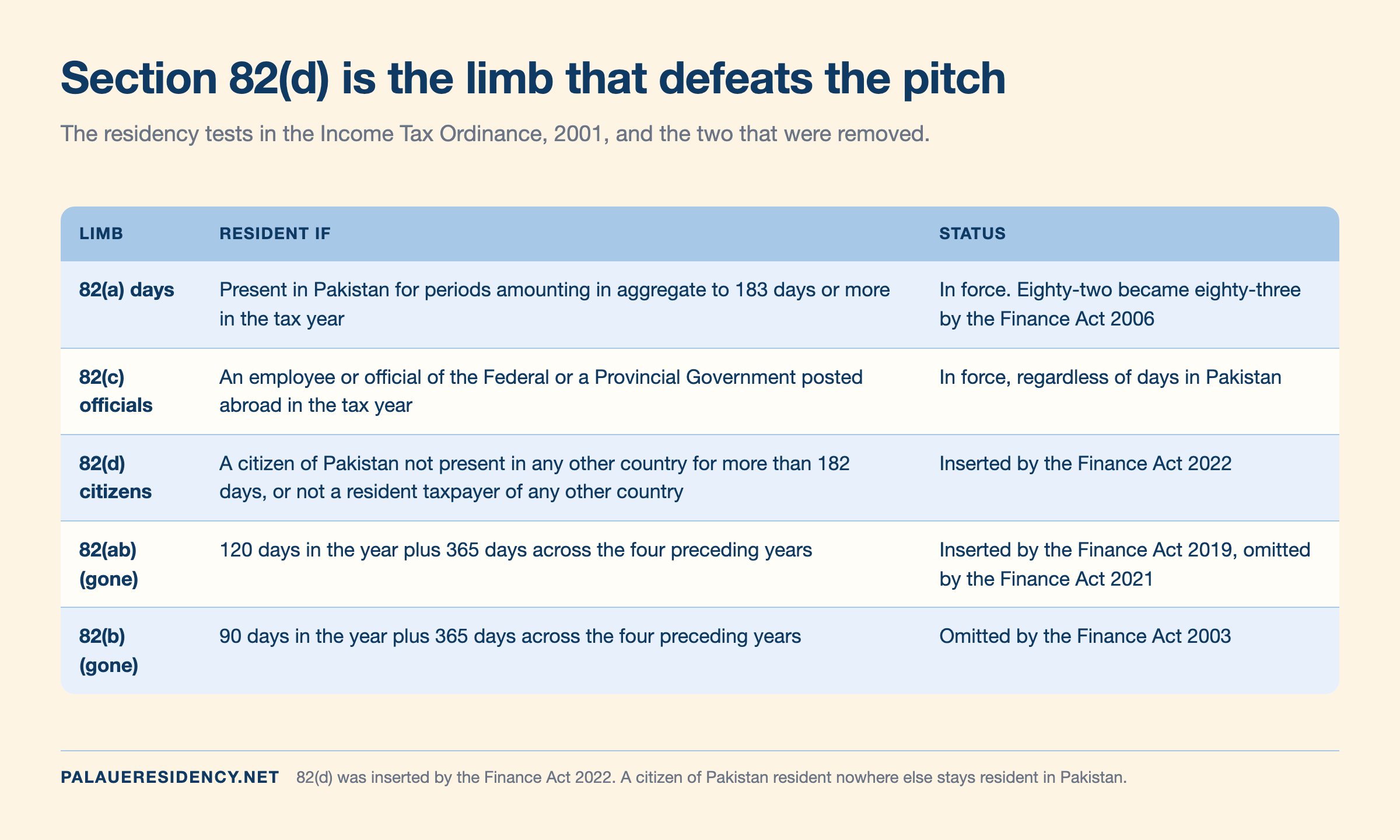
Section 82 of the Income Tax Ordinance, 2001 makes an individual a resident individual for a tax year — Pakistan's tax year runs 1 July to 30 June — if any one of its limbs applies. PwC's summary reads it the same way.
| Limb | Resident if… | Status |
|---|---|---|
| 82(a) days | Present in Pakistan for periods amounting in aggregate to 183 days or more in the tax year | In force; "eighty-two" became "eighty-three" by the Finance Act 2006 |
| 82(c) officials | An employee or official of the Federal or a Provincial Government posted abroad in the tax year | In force, regardless of days in Pakistan |
| 82(d) citizens | A citizen of Pakistan not present in any other country for more than 182 days, or not a resident taxpayer of any other country | Inserted by the Finance Act 2022 |
| 82(ab) (gone) | 120 days in the year plus 365 days across the four preceding years | Inserted by the Finance Act 2019, omitted by the Finance Act 2021 |
| 82(b) (gone) | 90 days in the year plus 365 days across the four preceding years | Omitted by the Finance Act 2003 |
Read 82(d) again, because it is doing something the other limbs do not. It is a catch-all for citizens who have left without landing anywhere, and it is written as an "or", so either branch is sufficient. You can fail the 183-day test in Pakistan comfortably and still be caught by being a resident taxpayer of nowhere.
A Palau ID lands you on the wrong side of both branches at once. It gives you no days of presence in any country — it is not a visa, and the issuer says plainly it is not "proof that the holder physically resides in Palau". And it does not make you a resident taxpayer of Palau: nothing in the application assesses you for Palau tax or registers you with a Palau tax authority. The product sold as an exit from residency is, under 82(d), evidence of the condition that keeps you in it.
That also makes "the 183-day rule" framing misleading for a citizen specifically. For a foreign national, 183 days is the test; for a citizen of Pakistan it is one limb out of three live ones, and the hardest to trip is not the one counting your days.
What a Pakistani resident actually pays, and why the pitch sells
Being resident matters because of what follows from it, and section 11 of the Ordinance is short about that: a resident person's income under a head of income is computed "by taking into account amounts that are Pakistan-source income and amounts that are foreign-source income", while a non-resident's takes into account "only amounts that are Pakistan-source income."
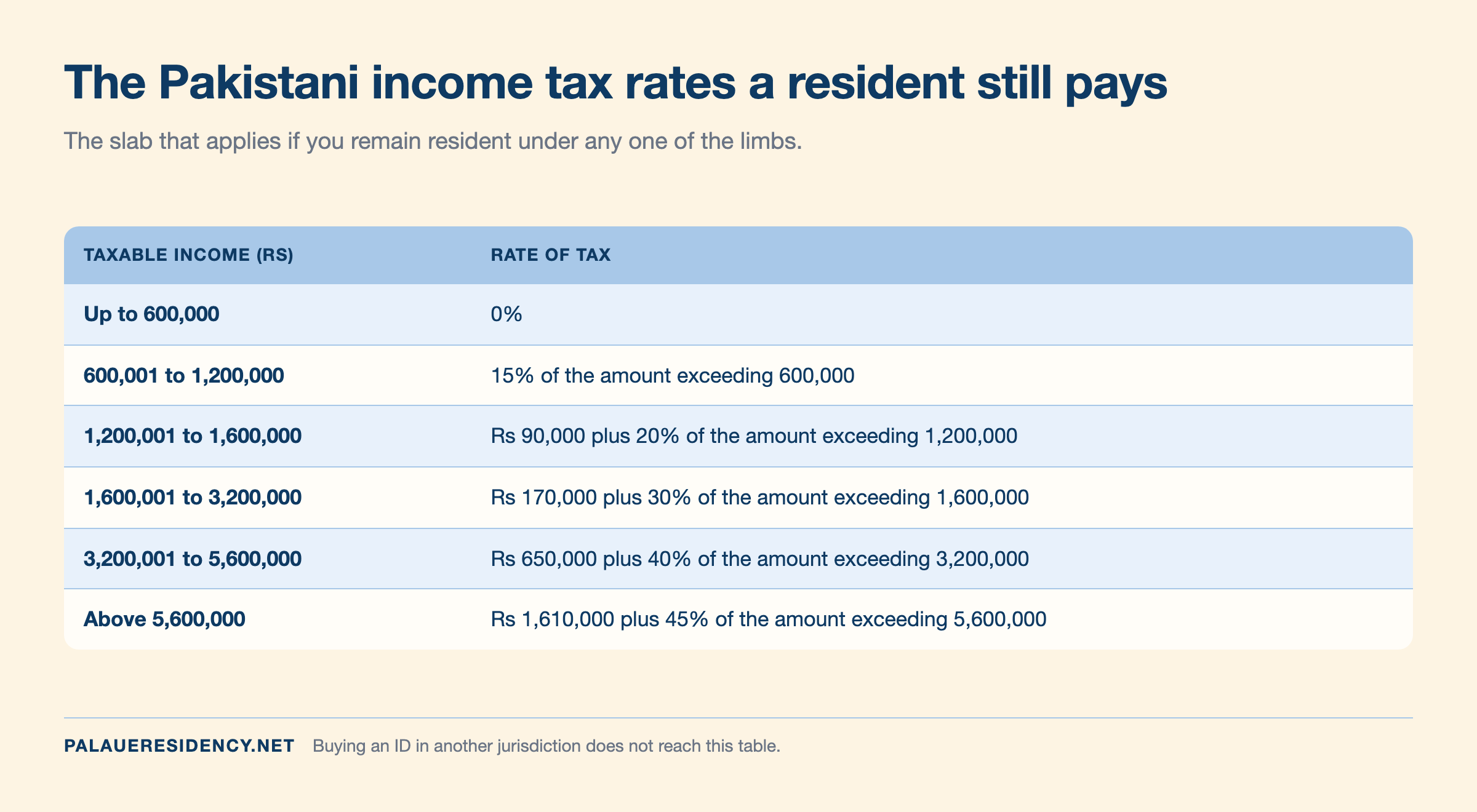
So the whole question is residence, and the money at stake is why an offshore card finds buyers at all. These are the rates for individuals other than salaried individuals — the band most freelancers and traders fall into — from the Tax Rate Card in KPMG's brief of the Finance Act 2026, enacted 27 June 2026.
| Taxable income (Rs) | Rate of tax |
|---|---|
| Up to 600,000 | 0% |
| 600,001 – 1,200,000 | 15% of the amount exceeding 600,000 |
| 1,200,001 – 1,600,000 | Rs 90,000 + 20% of the amount exceeding 1,200,000 |
| 1,600,001 – 3,200,000 | Rs 170,000 + 30% of the amount exceeding 1,600,000 |
| 3,200,001 – 5,600,000 | Rs 650,000 + 40% of the amount exceeding 3,200,000 |
| Above 5,600,000 | Rs 1,610,000 + 45% of the amount exceeding 5,600,000 |
A professional firm association of persons that is prohibited from incorporating pays 40% rather than 45% in the top band. A 45% marginal rate on worldwide income is a real incentive, and it is exactly why a $248 card gets described as a tax strategy. The incentive being genuine does not make the mechanism work: the rates in that table apply to a resident individual's foreign-source income under section 11(5), and the card does not change whether section 82 makes you one.
Pakistan's licensed exchanges ask for a CNIC or a passport
The second half of the pitch is about verification rather than tax: the claim that a Palau ID gets you through KYC. In Pakistan that claim now runs into a published list, and the list is short.
Under the Act, licensed providers "shall be deemed to be financial institutions" for the purposes of the Anti-Money Laundering Act, 2010 and must comply with all obligations under it, including reporting suspicious transactions to the Financial Monitoring Unit and appointing an AML, CFT or CPF compliance officer. Regulation 98 then sets out what the provider has to collect. Sub-regulation (4)(a) is the operative sentence for an individual customer, and it names the documents.
| Regulation 98(4)(a) field | What it requires | What a Palau ID supplies |
|---|---|---|
| Full name | As shown on CNIC or a passport | Neither — it is a third-country residency ID |
| Nationality | The customer's nationality | Does not establish Pakistani nationality |
| Address | The customer's address | A Palau mailing address is not a Pakistani address |
| Place of birth | The customer's place of birth | Not evidenced by the card |
| Bank account details | The customer's bank account | Unaffected by the card |
| Source of funds | Evidence of where the money came from | Unaffected by the card |
Four of those six fields have nothing to do with identity documents at all, which is the part the loophole posts leave out. Even if a verification interface accepted the card as a name document, the source-of-funds and bank-account fields still have to be satisfied with your actual banking history. Regulation 98(2) requires the licensee to verify customers "on the basis of documents, data and information obtained from the reliable source", and 98(5) bars it from establishing or continuing a relationship "where it is unable to complete required due diligence measures".
The banking side matches. SBP's BPRD Circular Letter No. 10 of 2026, dated 14 April 2026, replaced the 2018 prohibition and lets regulated entities open accounts for PVARA-licensed providers — which is what put licensed exchanges inside the formal banking system, and with it the customer records that system keeps. Acceptance of any ID still varies by venue and changes without notice; our exchange KYC guide and the KYC tracker record where the card has been seen to work, and the honest default is to assume no until a platform says yes in writing.
Offshore venues, the travel rule, and the honest gap
There is a real gap here and it deserves to be stated plainly rather than sold: Pakistani law does not control what documents a foreign exchange with no Pakistani presence chooses to accept.
What changed in 2026 is how narrow that gap is. The Regulations treat an activity as carried on "in Pakistan" where it "targets, solicits, promotes to, or onboard persons in Pakistan, including through marketing (where through website, mobile app or any other medium), payment rails, or provision of services in PKR or through channels accessible to Persons in Pakistan." The safe harbour out of that is demanding: no marketing or soliciting in Pakistan, no onboarding of persons in Pakistan, no PKR payment rails, and reasonable steps to prevent onboarding. Providing an unlicensed virtual asset service is a criminal offence under section 54(1), punishable with up to five years' imprisonment, a fine up to Rs 50 million, or both.
In other words, the venues genuinely outside the regime are the ones trying not to serve you, and the ones advertising to Pakistani users are the ones expected to be licensed. Where a licensee does handle a transfer, section 47 of the Act and Regulation 100 attach information to it.
| Travel rule element | What the Regulations require |
|---|---|
| Threshold | Transfers meeting or exceeding the PKR equivalent of USD 1,000 |
| Originator — minimum | Full name, plus account number, wallet address or other unique transaction identifier |
| Originator — additional | Where required by law, may include address, national identification number, customer identification number, or date and place of birth |
| Beneficiary — minimum | Name, plus account number, wallet address or other unique transaction identifier |
| Availability | Must be held and made available to the FMU, PVARA and other competent authorities on lawful request |
| Retention | Records of transactions, CDD data and risk assessments for not less than the period required by the AML Act, 2010 |
A national identification number sits in that list as an additional identifier. A Palau ID number is not one, which is the point: the card does not fill the field, it just leaves the provider unable to fill it.
Pakistan is not on the CARF list, and that is not the comfort it sounds like
Pakistan is genuinely absent from the OECD's crypto reporting timetable, and I want to be accurate about what that does and does not mean.
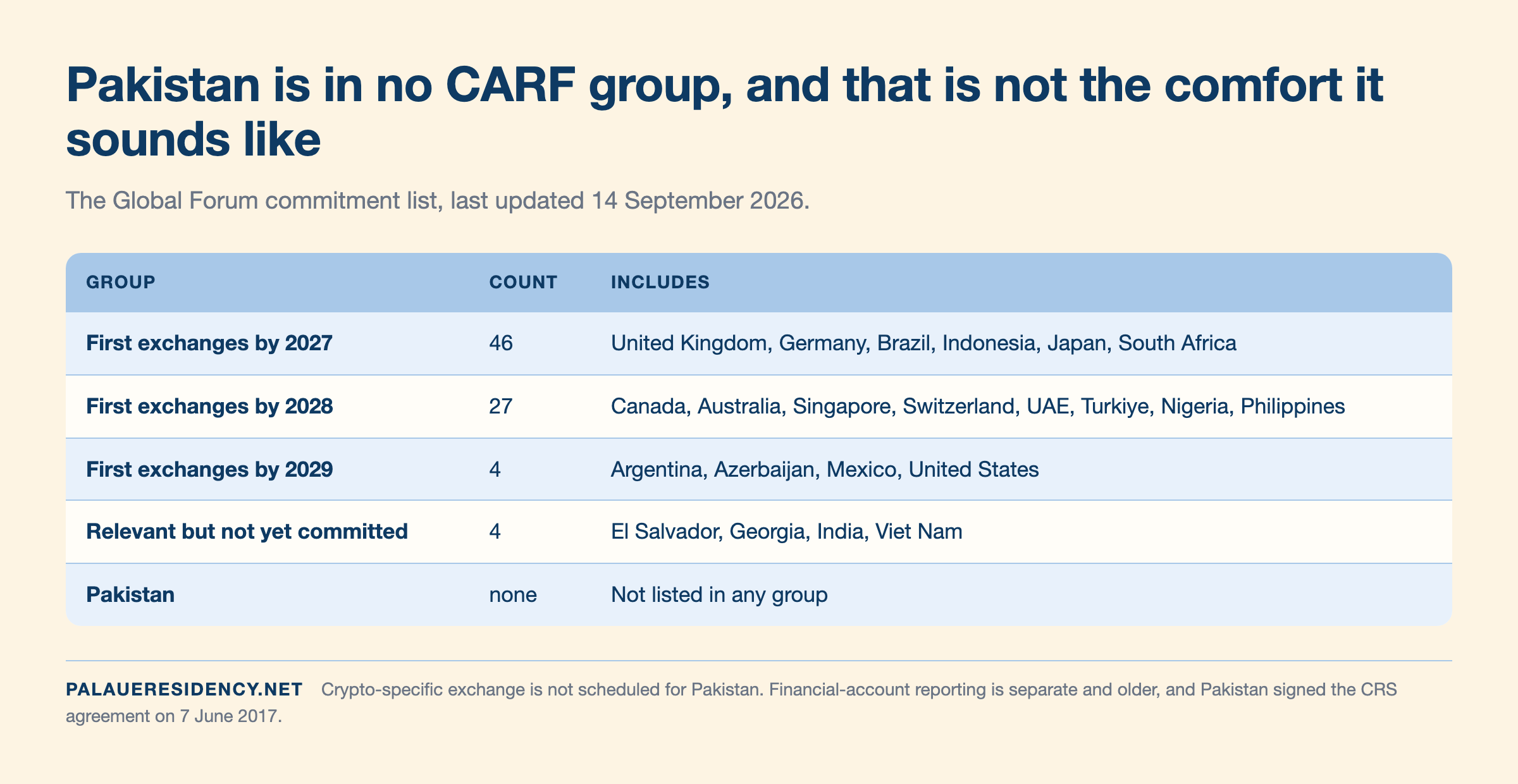
The Global Forum's CARF commitment list, last updated 14 September 2026, names every jurisdiction in the commitment process. Pakistan is in none of the four groups.
| Group | Count | Includes |
|---|---|---|
| First exchanges by 2027 | 46 | United Kingdom, Germany, Brazil, Indonesia, Japan, South Africa |
| First exchanges by 2028 | 27 | Canada, Australia, Singapore, Switzerland, UAE, Türkiye, Nigeria, Philippines |
| First exchanges by 2029 | 4 | Argentina, Azerbaijan, Mexico, United States |
| Relevant but not yet committed | 4 | El Salvador, Georgia, India, Viet Nam |
| Pakistan | — | Not listed in any group |
Two things follow, and they pull in opposite directions. Crypto-specific automatic exchange is not scheduled for Pakistan, so the contrast with India — which the Global Forum lists as relevant and in the process of committing — is real. But financial-account reporting is a separate and older channel, and Pakistan is in it. The OECD's CRS signatory list, status 30 October 2026, records Pakistan signing the Multilateral Competent Authority Agreement on 7 June 2017, with first exchange intended from September 2018.
Both regimes route by the jurisdiction where the account holder is tax resident, self-certified at onboarding, not by which card was photographed. The card changes neither, and a self-certification naming a tax residence you do not have is a false declaration with or without a supporting document. Our CARF guide covers that machinery.
Where the card is useful, and who should skip it
Skip it if any of these describe you:
- You want out of the Pakistani net. The exit runs through section 82 — your days in Pakistan, your days elsewhere, and whether you are a resident taxpayer somewhere else. Section 82(d) is built to catch the person who is nowhere, and a card is not days and not a tax registration.
- You want to clear KYC at a licensed Pakistani provider. Regulation 98(4)(a) asks for a name as shown on a CNIC or passport, and for your bank details and source of funds besides.
- You are hoping it fixes a failed verification offshore. RNS's own position is that issuance does not require a third party to approve a verification request, and that "the organization decides whether to accept it" — read our risks page before paying.
- You expect it to help you travel. It is not a passport; see passport versus digital residency. RNS tells you to check the requirements of the relevant government or organisation before relying on the ID.
Where it can be worth the money is narrower and more honest: a second, government-issued photo ID with a deliverable physical card, for someone who already accepts that it changes no tax position, creates no residence anywhere, and guarantees no acceptance anywhere. On that basis it is a real product — just not the one the loophole posts are selling, and in Pakistan the gap between the two widened in 2026.
Related reading
- Palau digital residency for Indian citizens — the deemed-residency rule next door
- Palau digital residency for Nigerian citizens — a six-limb residency test and TIN/NIN onboarding
- Palau digital residency for South African citizens — the SARS exit file this card cannot produce
- Palau digital residency for UK citizens — HMRC residence and UK reporting
- Palau digital residency limitations — what it does not guarantee
- Is RNS.ID legit? — who runs the programme, under what authority
FAQ
Can Pakistani citizens get Palau digital residency?
RNS publishes no list of eligible nationalities, so there is no documented yes to quote. Its eligibility page says only that "RNS.ID checks current country and compliance restrictions" and that the "restricted-country list is maintained by the service and can change". A Pakistani passport meets the identity-document requirement on its face; the screening that matters is only visible at checkout for your own account.
Does a Palau ID change my Pakistani tax residency?
No. Section 82 of the Income Tax Ordinance, 2001 makes you a resident individual on any one of its limbs, and clause (d) catches a citizen of Pakistan who is "not present in any other country for more than one hundred and eighty-two days during the tax year" or who is "not a resident taxpayer of any other country". A digital residency card gives you neither presence nor resident-taxpayer status, so it does not help you fail either branch.
Is the 183-day rule how Pakistani residency works for a citizen?
Only partly. Section 82(a) uses 183 days of presence in Pakistan, but for a citizen of Pakistan clause (d) applies as well, and it looks at whether you spent more than 182 days in some other country or are a resident taxpayer elsewhere. The 120-day test people still cite was clause (ab), inserted by the Finance Act 2019 and omitted by the Finance Act 2021.
Will a Palau ID let me skip CNIC verification on a Pakistani crypto exchange?
No. Regulation 98(4)(a) of the Pakistan Virtual Asset Services Regulations, 2026 requires a licensed provider to verify an individual's "full name as shown on CNIC or a passport", together with nationality, address, place of birth, bank account details and source of funds. Regulation 98(5) bars the provider from continuing a relationship where it cannot complete those measures.
Is crypto legal in Pakistan in 2026?
It is regulated rather than banned. The Virtual Assets Act, 2026 was assented on 4 March 2026 and gazetted on 5 March, PVARA notified the Virtual Asset Services Regulations on 21 August 2026, and SBP's BPRD Circular Letter No. 10 of 2026 of 14 April 2026 replaced the 2018 banking prohibition for PVARA-licensed providers. Providing an unlicensed virtual asset service is an offence under section 54(1) carrying up to five years' imprisonment or a fine up to Rs 50 million.
Does Pakistan report crypto accounts under CARF?
Not on the published timetable. The OECD Global Forum's commitment list, last updated 14 September 2026, names 46 jurisdictions for 2027, 27 for 2028, 4 for 2029 and 4 as relevant but not yet committed, and Pakistan is in none of them. Pakistan has, however, signed the CRS agreement for financial-account information, on 7 June 2017 with first exchanges intended from September 2018.
Does holding a Palau ID make my foreign income tax-free in Pakistan?
No. Section 11(5) computes a resident person's income by taking into account both Pakistan-source and foreign-source amounts, and only a non-resident is confined to Pakistan-source income under section 11(6). Palau's own rates would only become relevant if you were tax resident in Palau, which this card does not make you. This is general information and not tax advice — take Pakistani advice on your own facts.
What are the Pakistani tax rates for a freelancer in 2026?
For individuals other than salaried individuals, the Tax Rate Card in the Finance Act 2026 charges 0% up to Rs 600,000, then 15% of the excess over Rs 600,000, then Rs 90,000 plus 20% above Rs 1,200,000, Rs 170,000 plus 30% above Rs 1,600,000, Rs 650,000 plus 40% above Rs 3,200,000, and Rs 1,610,000 plus 45% above Rs 5,600,000. A professional firm association of persons prohibited from incorporating pays 40% instead of 45% in the top band.