Palau Digital Residency for South African Citizens 2026
What Palau digital residency does and does not do for a South African in 2026: the two SARS residency tests, CARF from 1 March 2026, and claims to skip.
We may earn a commission if you apply through this link. This site is independent and is not the official RNS.ID or Palau government site.

Key takeaways
- A Palau digital residency card is not an input to either SARS residency test. South African residency turns on where you naturally return to, or on days: more than 91 days in the current year of assessment, more than 91 days in each of the five preceding years, and more than 915 days across those five. An ID card appears in none of it.
- The document that would actually help is the one this card cannot produce. When you cease residency on the ordinary-residence basis SARS asks for a foreign tax residence certificate; on the treaty basis it asks for "a certificate of tax residence from the foreign revenue authority." A Palau ID is not a tax residence certificate, and no part of the application assesses you for Palau tax.
- CARF took effect in South Africa on 1 March 2026. SARS says providers "must begin collecting reportable information" from that date, the first reporting period runs to 28 February 2027, the first return is due 31 May 2027, and the initial exchange between jurisdictions is scheduled for September 2027.
- The one lever that genuinely reduces a resident's foreign employment tax is counted in days, not cards. Section 10(1)(o)(ii) needs more than 183 full days abroad in a 12-month period including a continuous period exceeding 60 full days, and exempts only the first R1.25 million.
- RNS publishes no list of eligible nationalities, so "can a South African apply" has no documented yes. Its own wording is that the "restricted-country list is maintained by the service and can change", and that "purchasing a term does not guarantee approval."
On this page
- Palau digital residency in South Africa: what actually changes
- Can a South African apply? What RNS actually publishes
- The "0% tax" claim, and the step it skips
- How SARS actually decides that you are a tax resident
- Palau digital residency and the SARS exit file: what the card cannot supply
- The one lever that does work: 183 days, 60 days, R1.25 million
- CARF: from 1 March 2026 your crypto data reaches SARS anyway
- Acceptance, travel, and who should skip this
Palau digital residency in South Africa: what actually changes
Short answer: your mailing options, and nothing a SARS auditor would recognise.
I went looking for a South-Africa-specific account of this card and there isn't one. The pages that rank are expat-tax firms writing about ceasing residency in general, and not one of them mentions a digital residency product. The pages selling the card, meanwhile, never mention South Africa. The reader sitting between the two gets no answer, which is the gap this article fills.
So here is the comparison both sides skip. On the left, what the marketing around Palau digital residency implies. On the right, what RNS's own documentation actually says.
| What the write-ups imply | What the documentation says |
|---|---|
| It is a residency, so it moves your tax home | "Palau Digital Residency is not Palauan citizenship, a Palau passport, or proof that the holder physically resides in Palau" |
| Foreign income becomes tax-free | No RNS documentation page promises any tax outcome; the FAQ does not address tax at all |
| Any South African can buy one | "Current regional restrictions and government approval still apply" |
| Paying secures it | "Payment starts the application journey" — verification, screening, internal review and government review all still follow |
| It is an ID you can use anywhere | Use in verification is allowed "only when the third party's current rules allow it" |
| A bank or exchange must take it | "RNS.ID does not guarantee account opening, continued access, or acceptance of a Palau ID by any financial service" |
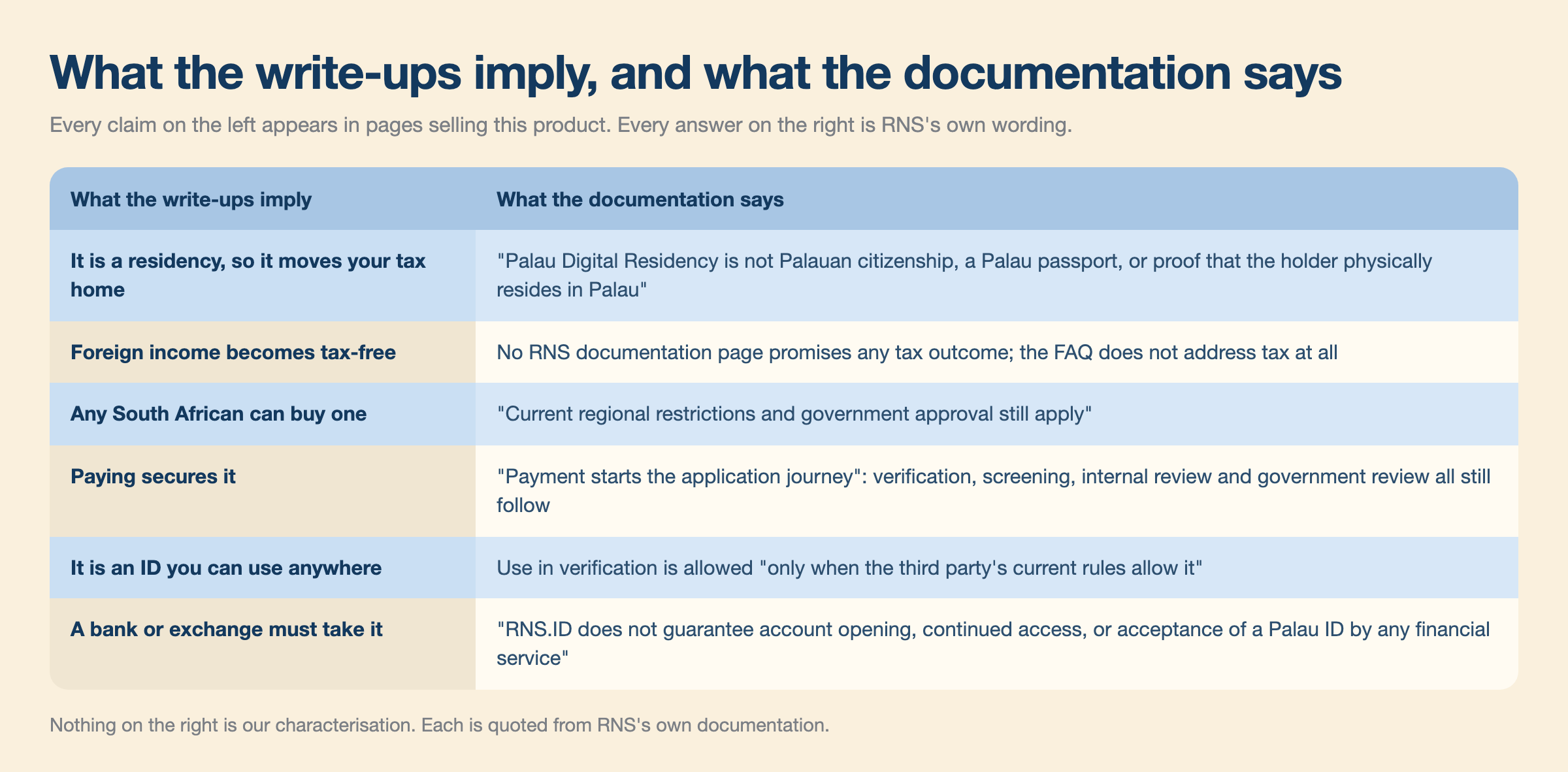
Every quote in that right-hand column is from RNS's own docs, read on 11 November 2026. Note what is absent: there is no tax claim anywhere in it to argue with. The tax story is something resellers added on top.
Can a South African apply? What RNS actually publishes
There is no published list of eligible nationalities, which means there is no documented yes for South Africa and no documented no either.
What the eligibility page gives you is procedural. An applicant "must be able to use an eligible RNS.ID account", must complete the identity and compliance checks, and "current regional restrictions and government approval still apply." On countries specifically: "RNS.ID checks current country and compliance restrictions", the "restricted-country list is maintained by the service and can change", and you are told to review the list shown in the product rather than a copy of it elsewhere.
South Africa does not appear on the restriction lists this site has tracked, which name North Korea, Iran, Syria, Cuba, Crimea and Sudan. That is an absence of evidence rather than a confirmation — the only list that binds is the one rendered at checkout for your own account.
| Requirement | What RNS says | What it means for a South African |
|---|---|---|
| Identity document | "Use the original document, not a photocopy, screenshot, or picture of a copy" | A valid SA passport satisfies this on its face |
| Address | "Enter a complete street address and use the application's address-review action" | A real deliverable address; your home address is normally fine |
| Country screening | "The restricted-country list is maintained by the service and can change" | Only checkout shows the list that applies to you |
| Payment | "Passing checkout does not replace identity verification or government approval" | Paying is the start of the process, not the end |
| Approval | "Purchasing a term does not guarantee approval" | No refund guarantee is published against a refusal |
| Refusal | "You may request an appeal within 30 days from the date the application was denied" | "An appeal does not guarantee approval" |
| Renewal | "For Palau ID, renewal may be attempted up to 60 days before renewal" | Check Next Deduction Date and cancel first if you do not want it |
Two of those rows decide whether your money comes back, so read them twice before you pay. Our cost breakdown covers the current tiers, though RNS notes that "current terms, prices, availability, discounts, and add-ons are intentionally not hard-coded" in its docs — so re-check any price at checkout.
The "0% tax" claim, and the step it skips
The line you see repeated is that Palau charges nothing on income earned outside Palau, so a Palau residency makes your foreign income tax-free. The second half does not follow from the first, and the gap between them is this whole article.
A country's domestic rate only matters once that country has the right to tax you, and that happens when you are tax-resident there. This card does not make you tax-resident in Palau. RNS's documentation says it is not proof that the holder physically resides in Palau, and there is no step in the application where Palau assesses your residency for tax purposes, because that is not what is being sold.
It is also worth knowing that Palau is not a no-tax jurisdiction in the way the pitch implies. The Global Forum's January 2026 peer review of Palau records a 60-day individual residence test and a wages-and-salaries tax rising from 6% to 12%, which our CARF guide sets out in detail. So the fantasy version of this card — resident of a zero-tax country — is not even the country being described.
Which leaves South African rules applying exactly as they did before the card arrived. Our tax guide makes that point in general terms; what follows is the South African version. None of this is tax advice — the only claim here is that the ID is not a position you can take.
How SARS actually decides that you are a tax resident
By asking where you naturally return to, and failing that, by counting days. SARS's tax and non-residents guidance sets out two routes, and neither has a field for an identity document.
| Test | What it measures | Effect |
|---|---|---|
| Ordinarily resident (common law) | Whether "South Africa is the country to which that individual will naturally and as a matter of course return" — your real home | Resident for that year of assessment, regardless of days |
| Physical presence, first leg | More than 91 days in the current year of assessment | One of three requirements |
| Physical presence, second leg | More than 91 days in each of the five preceding years of assessment | One of three requirements |
| Physical presence, third leg | More than 915 days in total across those five preceding years | One of three requirements |
| Failing any single leg | SARS: failing any one requirement means the test is not met | Not resident under this test |
| Ceasing under physical presence | A continuous period of at least 330 full days outside South Africa | Treated as non-resident from the day you left |
| What residents pay on | Worldwide income, "irrespective of where their income was earned" | Subject to exclusions and credits |
| What non-residents pay on | South African source only — SA bank interest, SA rental, services rendered in SA | The position people are trying to reach |
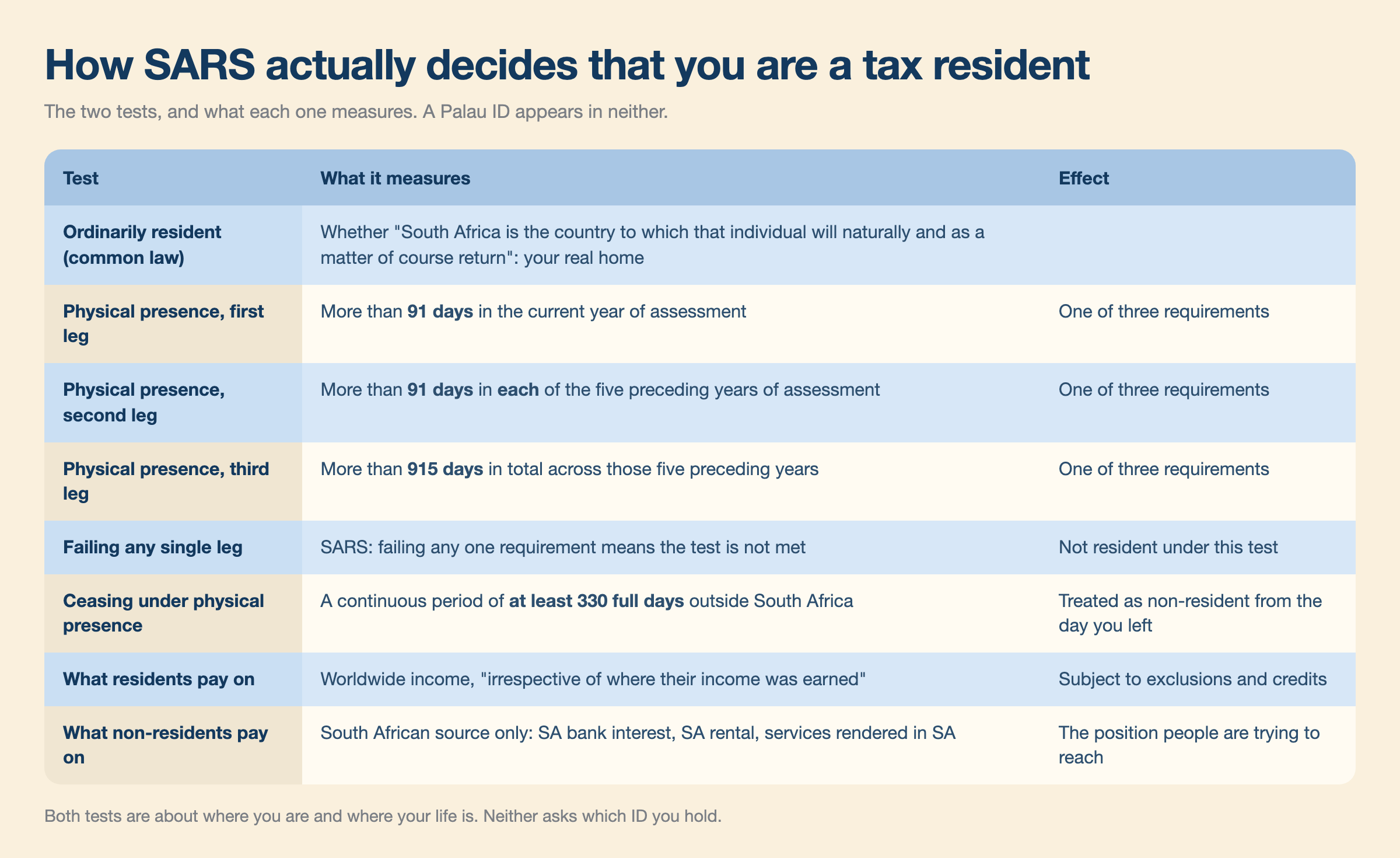
The ordinarily-resident test is the one that catches people, and no product can touch it. It is a common-law enquiry into your real home: family, property, business interests, where you return to between trips. A card bought online moves none of that, and the physical presence test does not come into play at all while you remain ordinarily resident.
Which is the quiet answer to the question most readers arrive with. If you were hoping a Palau ID would move you out of South African residency, there was never a mechanism for it to use.
Palau digital residency and the SARS exit file: what the card cannot supply
This is the section I would read first, because it is where the question stops being abstract. Ceasing South African tax residency is a documented process with a document list, and you can simply check the card against it.
SARS's cease to be a resident guidance says you inform SARS through the RAV01 form on eFiling, entering the cessation date under Income Tax Liability Details — and that the date you enter "will be regarded as the day the taxpayer becomes a non-resident." A Declaration form then "must be completed and be submitted with the relevant supporting documentation", after which "a case will be created whereby the taxpayer will receive a letter from SARS to submit supporting documents."
Here is that document list, against what a Palau digital residency can do for each line.
| What SARS asks for | Basis | Can a Palau ID supply it? |
|---|---|---|
| Signed declaration of the basis on which you qualify | All | No — you supply the basis; the card is not one |
| "Letter of motivation setting out the facts and circumstances in detail" | All | No |
| "A copy of your passport/travel diary, including all pages of your passport" | All | No — this is your SA passport and your movements |
| Type of visa held abroad | Ordinary residence | No — the card is not a visa or a residence permit |
| Proof of permanent residence abroad, if any | Ordinary residence | No — RNS says it is not proof of physical residence in Palau |
| Foreign tax residence certificate, if available | Ordinary residence | No — and this is the row people assume it fills |
| Details of SA property, business interests, family and social ties, return visits | Ordinary residence | No |
| "A certificate of tax residence from the foreign revenue authority" | Treaty | No — Palau does not assess you, so no authority issues one |
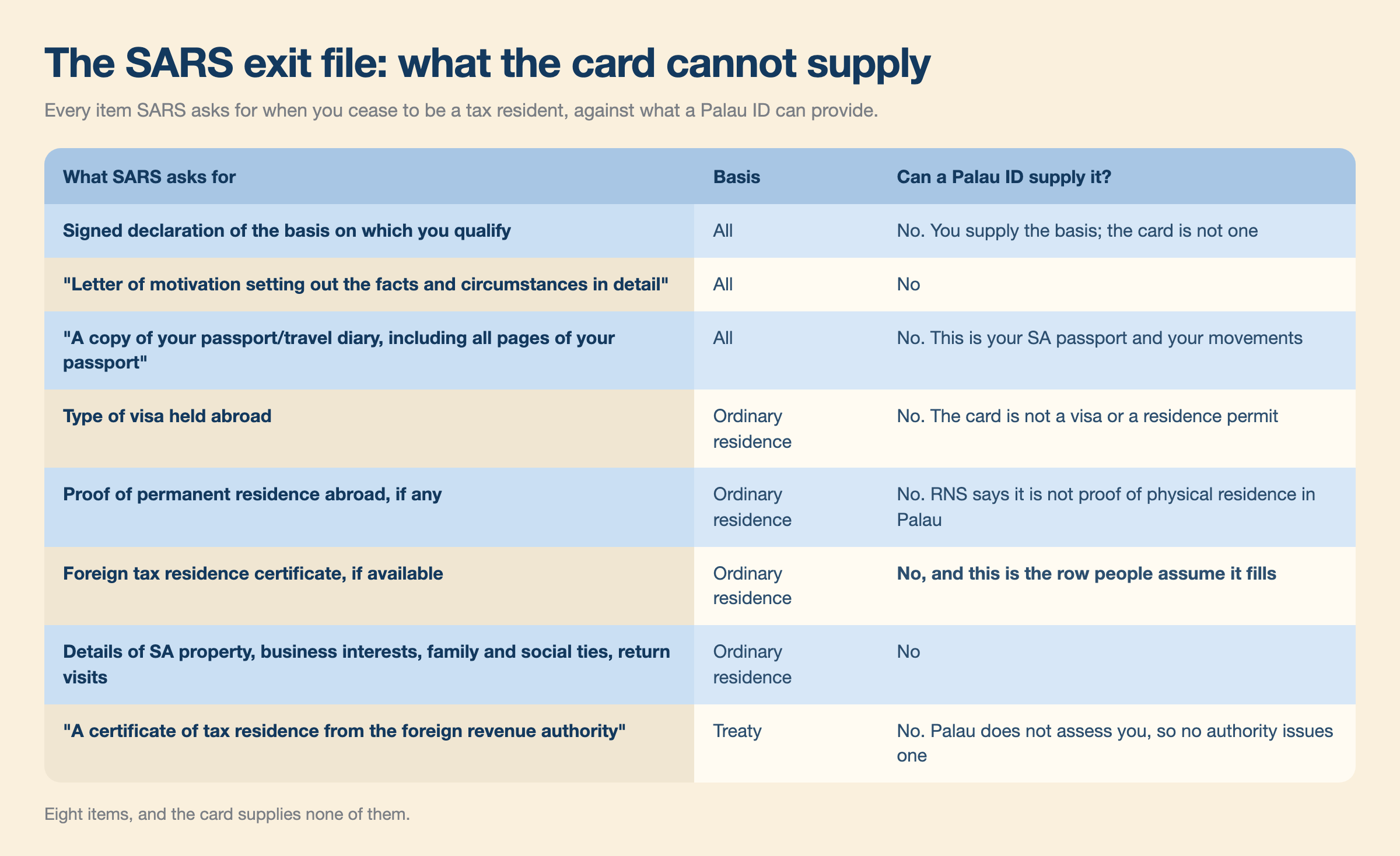
Read the right-hand column as a whole. Every line SARS cares about concerns your life and your movements, and the two that look abroad want something issued by a revenue authority — a tax residence certificate. The card comes from a programme whose own FAQ says it is not proof you live in Palau. It is not a weak version of what SARS wants; it is a different kind of object.
Worse, Palau is a poor choice for the treaty route specifically. The treaty basis needs a double tax agreement and a foreign authority willing to certify you, and by the Global Forum's own January 2026 finding, Palau "has not signed any treaty with any jurisdiction providing for the exchange of information for tax purposes."
The one lever that does work: 183 days, 60 days, R1.25 million
There is a real mechanism for a South African tax resident working abroad, and it is worth knowing precisely because it shows what a genuine lever looks like. It is measured in days outside the country.
Section 10(1)(o)(ii) exempts qualifying foreign employment income, and SARS's foreign employment income exemption page sets out both day tests and the cap.
| Condition | What SARS requires |
|---|---|
| Days abroad | Services rendered abroad for "longer than 183 full days in any 12-month period" |
| Continuous block | "A continuous period exceeding 60 full days outside South Africa in the same period of 12-months" |
| Cap | "Only the first R1.25 million of foreign employment income earned by a tax resident will qualify for exemption" |
| Cap effective from | "Years of assessment commencing on or after 1 March 2020" |
| Above the cap | Taxed in South Africa under the normal tax tables for that year |
| Who qualifies | An employee rendering services outside SA for an employer |
| Who does not | Non-residents; independent contractors are "excluded from the scope of section 10(1)(o)(ii)"; public-sector employment |
Notice the shape of it. Every condition is a fact about where you were and who employed you, verifiable from the passport stamps SARS already asked for above. A card cannot add a day to the 183, create the continuous 60, or raise the R1.25 million.
The exclusion of independent contractors matters for this site's usual reader: a freelancer invoicing foreign clients is not an employee, so the exemption is not theirs to use.
CARF: from 1 March 2026 your crypto data reaches SARS anyway
If the reason you are reading about a second ID is crypto, this is the section that has changed in 2026, and it changed in the direction opposite to the pitch.
SARS's own CARF page states: "On 1 March 2026, the CARF takes effect in South Africa and providers must begin collecting reportable information." South Africa is in the first wave of the OECD's commitment list, the 46 jurisdictions due to exchange first.
| Milestone | Date per SARS | What it means for you |
|---|---|---|
| CARF takes effect in South Africa | 1 March 2026 | Providers begin collecting reportable information |
| First reporting period | 1 March 2026 – 28 February 2027 | Your current year's activity is already in scope |
| First CARF return to SARS | Due 31 May 2027 | Filed by the provider, not by you |
| First exchange between jurisdictions | September 2027 | Offshore platforms' data reaches SARS |
| Who reports | "CASPs are required to report certain crypto-asset transaction information to SARS" | Individuals do not report under CARF directly |
| Retail payment threshold | "Reportable retail payment transactions exceeding EUR or USD 50,000" | Large crypto payments are a reportable category |
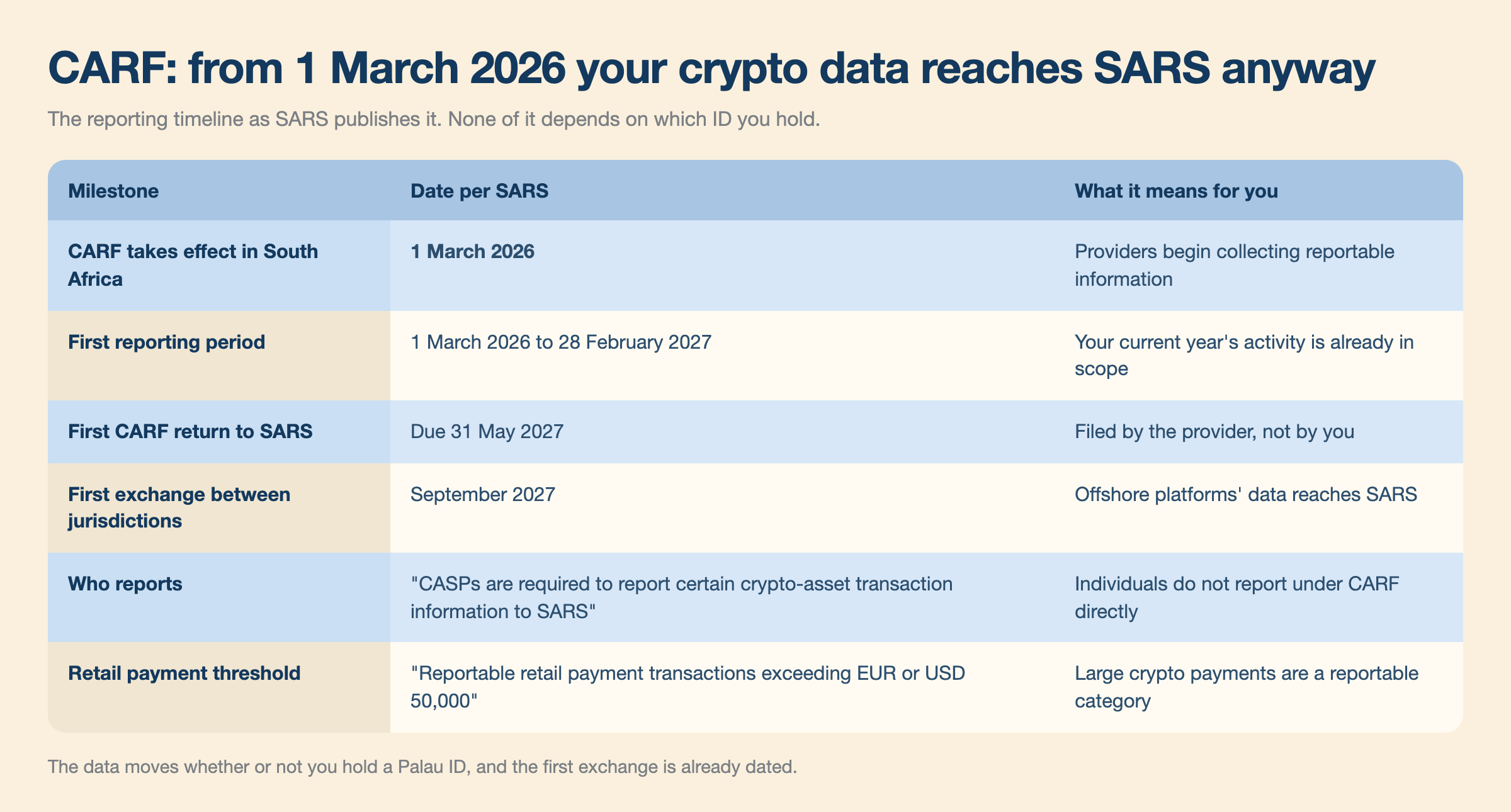
What gets reported is the part that settles the ID question. SARS says providers report customer identification details, the total number of wallets associated with each customer, and "aggregated transaction information in the prescribed CARF categories" — exchanges between crypto-assets, fiat-to-crypto purchases, crypto-to-fiat disposals and wallet transfers.
The routing field in CARF is the jurisdiction where you are tax resident — the thing the sections above show a card does not change. Presenting a different ID at onboarding does not redirect the report; at best it creates a mismatch between the ID on file and the residence you self-certified. Our CARF guide works through the narrow places where a Palau ID genuinely does help.
Acceptance, travel, and who should skip this
On acceptance, assume no until a platform says yes in writing. RNS's position is that the ID works in third-party verification "only when the third party's current rules allow it", that issuance "does not require a third party to approve a KYC or verification request", and that it does not guarantee "account opening, continued access, or acceptance of a Palau ID by any financial service." Our exchange KYC guide tracks which venues have actually been seen to accept it.
On travel, the card does not help a South African passport holder, and RNS does not claim it does. Palau's own entry requirements are a passport matter.
| Palau entry requirement | What the airport states |
|---|---|
| Passport validity | "All visitors must have a valid passport not less than 6 months from date of expiration" |
| Onward travel | "Proof of return arrangements (e-ticket receipt or a printed e-ticket confirmation)" |
| Entry form | A Palau Entry Form submitted within 72 hours before arrival |
| On arrival | Visitors sign the Palau Pledge |
| Visa-free length by nationality | Not stated on the page — confirm with the Palau Visitors Authority |
So who should skip this? If you want out of the SARS net, skip it: the exit is a document file about your life, and this card is not in it. If you are an employee chasing the 183/60 exemption, count days instead. If you are hoping it fixes a failed exchange verification, read our risks page and check the venue's rules before paying.
Where it can be worth the money is narrower: a second, government-issued photo ID with a deliverable card, for someone who already accepts that it changes no tax position and that acceptance is never guaranteed. That is a real product — just not the one being marketed.
Related reading
- Palau digital residency for UK citizens — HMRC residence and the UK reporting regime
- Palau digital residency for Canadian citizens — the CRA residential-ties test
- Palau digital residency for Indian citizens — the deemed-residency rule
- CARF crypto reporting and a Palau ID — where the data actually goes
- Palau digital residency tax guide — why the ID is not a tax position
- Palau digital residency limitations — what it does not guarantee
- Is RNS.ID legit? — who runs the programme, under what authority
FAQ
Can South African citizens get Palau digital residency?
RNS publishes no list of eligible nationalities, so there is no documented yes to quote. Its eligibility page says only that "current regional restrictions and government approval still apply" and that the "restricted-country list is maintained by the service and can change". A South African passport meets the original-document requirement; the compliance screen is only visible at checkout.
Does a Palau ID change my South African tax residency?
No. SARS decides residency by the ordinarily-resident test — whether "South Africa is the country to which that individual will naturally and as a matter of course return" — or by the physical presence day counts. An identity document is not an input to either, and RNS says the ID is not proof the holder physically resides in Palau.
Will a Palau ID help me cease my SA tax residency with SARS?
No. SARS asks for a signed declaration, a letter of motivation, all pages of your passport, and on the ordinary-residence basis a foreign tax residence certificate; the treaty basis needs "a certificate of tax residence from the foreign revenue authority." The card is none of those, and no part of the application assesses you for Palau tax.
What are the SARS physical presence test thresholds?
More than 91 days in South Africa in the current year of assessment, more than 91 days in each of the five preceding years of assessment, and more than 915 days in total across those five years. SARS says failing any one of the three requirements means the test is not met, and the test does not apply at all while you are ordinarily resident.
Does CARF mean SARS will see my offshore crypto?
That is the direction of travel. SARS says CARF took effect on 1 March 2026 with providers collecting from that date, a first reporting period ending 28 February 2027, a first return due 31 May 2027, and the initial exchange between jurisdictions scheduled for September 2027. Reports route by the jurisdiction where you are tax resident.
Can I use a Palau ID for KYC on a South African crypto exchange?
Assume not unless the platform says otherwise. RNS's own position is that the ID works in third-party verification "only when the third party's current rules allow it", and that issuance "does not require a third party to approve a KYC or verification request." Acceptance varies by venue and changes without notice.
Does the R1.25 million foreign employment exemption apply if I hold a Palau ID?
The card is irrelevant to it either way. The exemption needs services rendered abroad for longer than 183 full days in a 12-month period, including a continuous period exceeding 60 full days outside South Africa, and covers only the first R1.25 million. It is limited to employees — independent contractors are excluded from section 10(1)(o)(ii).
Does Palau digital residency let me live in or move to Palau?
No. RNS states it is "not Palauan citizenship, a Palau passport, or proof that the holder physically resides in Palau", and tells you to check the relevant government's requirements before relying on it for travel, immigration, residence or address evidence. Visiting Palau is handled by your passport under the ordinary visitor rules.