Palau Digital Residency for Turkish Citizens 2026
What Palau digital residency does and does not do for a Turkish citizen in 2026: the six-month residence test, MASAK identity rules, and CARF from 2028.
We may earn a commission if you apply through this link. This site is independent and is not the official RNS.ID or Palau government site.
Key takeaways
- Türkiye's residence test asks where you are, not what is in your wallet. The Turkish Revenue Administration's own filing says you are resident if your domicile is in Türkiye or you stay "continuously more than six months in one calendar year" — and that "provisional absence shall not interrupt the continuity." A Palau ID satisfies neither limb and defeats neither.
- A Palau ID is not a passport and not a residence permit, which is exactly the problem under Turkish AML rules. Article 6 of the Regulation on Measures verifies a foreign customer on "a passport, residence permit or other document" approved by the Ministry of Treasury and Finance. We found no evidence a Palau ID has been approved as that third option.
- There is no small-account exemption to hide in. MASAK's September 2025 Compliance Guide requires that in a continuing business relationship, identification "is carried out regardless of the amount." The TRY 30,000 figure people quote applies to one-off transactions, not to opening an account.
- Türkiye starts CARF exchanges in 2028, and the OECD list is published. Türkiye sits in the 27-jurisdiction 2028 group, not the 46-strong 2027 group — a two-year delay, not an exemption.
- Türkiye still has no standalone crypto transaction tax, and that is the real reason the card is unnecessary here. A proposed transaction tax was dropped from Law No. 7577 in April 2026. Türkiye taxes residents on worldwide income at 15% to 40%; the card changes none of it.
On this page
- What Palau digital residency changes for a Turkish citizen in 2026
- Can Turkish citizens apply for Palau digital residency?
- Articles 3 to 5: domicile, or six continuous months
- What a Turkish resident actually pays in 2026
- MASAK identifies you regardless of the amount
- The CMB "active providers" list is not a licence list
- CARF: Türkiye exchanges from 2028
- Where the card is useful, and who should skip it
What Palau digital residency changes for a Turkish citizen in 2026

You are Turkish, you have read that a $288 Palau card buys an offshore identity, a way past exchange verification and a tax position outside Türkiye, and all three claims are doing different amounts of work. The decision is a four-figure one — the tiers our cost page records run from $288 for one year to $2,339 for ten — set against a residence test that counts days and domicile, and an AML regime that names the documents it will accept. We read RNS.ID's own documentation against the Turkish Revenue Administration's residency filing, MASAK's identification rules and the OECD's CARF commitment list on 21 November 2026. The gap between the pitch and what either government publishes is this page.
Here is the summary, and the pattern is that the card is real while the consequences claimed for it are not:
| The claim | What the documents say |
|---|---|
| "A government-issued ID" | True. RNS calls it "a government-issued identity product" issued through Palau's Digital Residency Program |
| "A second residency" | No. "Palau Digital Residency is not Palauan citizenship, a Palau passport, or proof that the holder physically resides in Palau" |
| "Clears exchange verification" | Only "when the third party's current rules allow it," and RNS "does not guarantee … acceptance of a Palau ID by any financial service" |
| "Moves your tax position out of Türkiye" | Nothing in Turkish law turns on which card you hold; residence is domicile or six continuous months |
| "Gives you a Palau address" | The mailing service "is a mailing address, not a residential address or proof of residence, domicile, or tax residence" |
That last row is the one worth reading twice, because the address product is usually sold as the thing that completes the structure, and RNS itself rules out exactly the three uses a Turkish reader would want it for.
Can Turkish citizens apply for Palau digital residency?
Almost certainly yes — and the honest version of that answer is more careful than the one the affiliate pages give.
Türkiye has never appeared on the exclusion list this programme published. The list our supported countries page records named North Korea, Iran, Syria, Cuba, Crimea and Sudan. But RNS's current documentation no longer publishes a country list at all. The eligibility page says only that "the restricted-country list is maintained by the service and can change" and that applicants must satisfy "the eligibility rules shown during purchase and verification." So the real answer is that Türkiye is not excluded by any list we can read, and the list you are actually subject to is the one rendered in your own checkout.
Three further conditions apply to everyone, and they are quoted rather than paraphrased for a reason:
- "Purchasing a term does not guarantee approval." Payment starts an application; it does not finish one.
- "Applications pass identity, KYC/AML, sanctions and other reviews before government approval." Palau reviews you.
- You need "an original, valid government-issued identity document" — in practice a Turkish passport or identity card. Note the direction of travel: you spend a Turkish document to obtain a Palauan one.
None of that is a warning sign. It is an ordinary compliance funnel. It does mean the purchase is not the decision point, and our limitations page is the better place to test the reasons you are buying.
Articles 3 to 5: domicile, or six continuous months
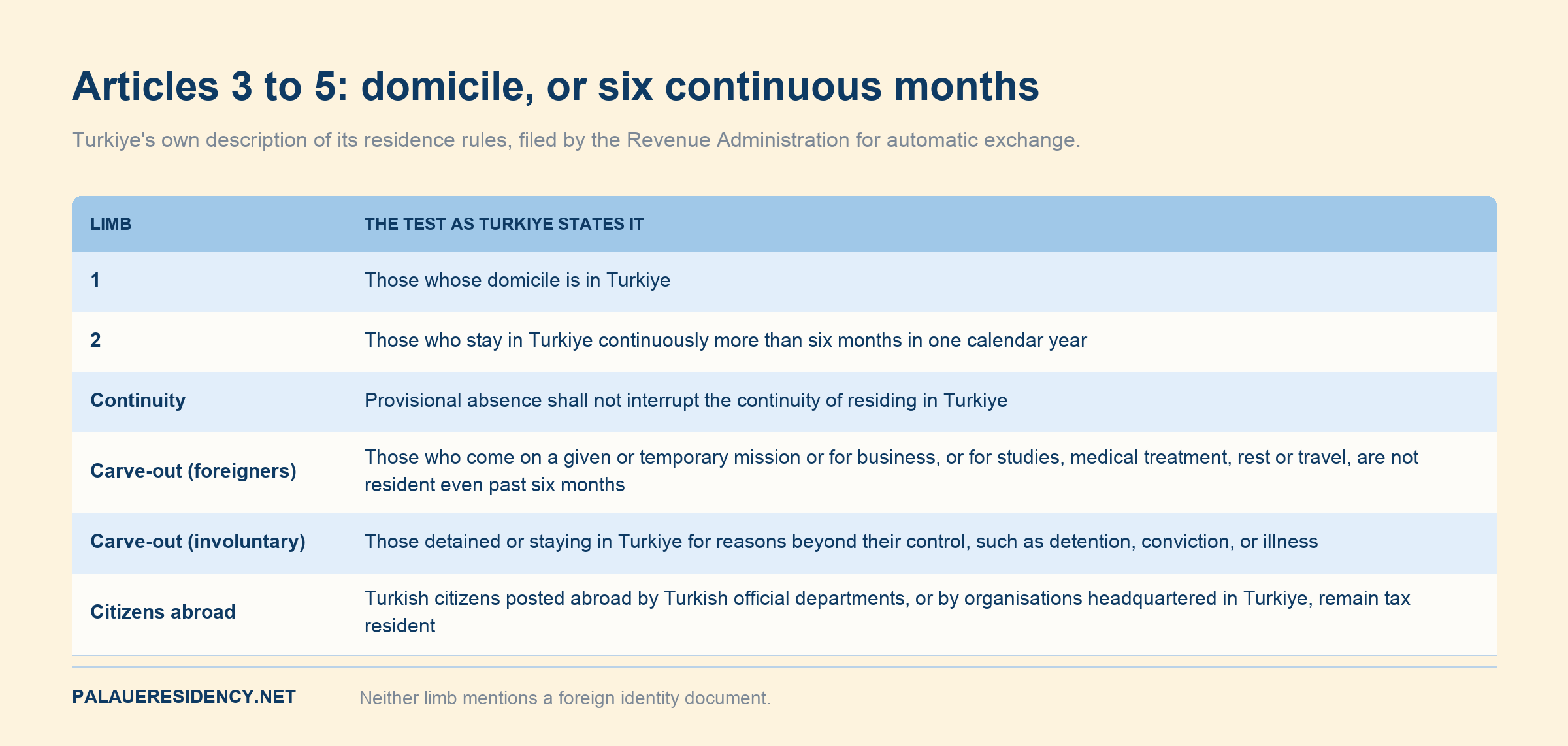
This is the section the competing pages skip entirely, and it is the one that settles the tax question.
Türkiye's own description of its residence rules — filed by the Turkish Revenue Administration for automatic exchange purposes, and pointing to Articles 3, 4 and 5 of Income Tax Law No. 193 — reads as follows. You are treated as residing in Türkiye if:
| Limb | The test as Türkiye states it |
|---|---|
| 1 | "Those whose domicile is in Türkiye" |
| 2 | "Those who stay in Türkiye continuously more than six months in one calendar year" |
| Continuity | "Provisional absence shall not interrupt the continuity of residing in Türkiye" |
| Carve-out (foreigners) | Those who come "on a given or temporary mission or for business," or "for studies, medical treatment, rest or travel," are not resident even past six months |
| Carve-out (involuntary) | Those "detained or stay in Türkiye for reasons beyond their control, such as detention, conviction, or illness" |
| Citizens abroad | Turkish citizens posted abroad by Turkish official departments or by organisations headquartered in Türkiye remain tax resident |
Read the two limbs and notice what is absent: any mention of a foreign identity document. Limb one is about domicile. Limb two counts days. The continuity sentence is the one that catches the people this card is marketed to, because a few weeks abroad is a "provisional absence" that does not reset anything.
Notice also that the carve-outs are written for foreigners coming to Türkiye. There is no mirror-image clause letting a Turkish citizen living in Türkiye argue out of residence by holding a Palauan card. And if you genuinely do leave — a real move, a real domicile elsewhere, more than half the year outside — then you did not need the card to achieve it. Severing Turkish residence is a question of where you live. A $288 card is not a shortcut through it, and our risks page covers what happens to people who treat it as one.
What a Turkish resident actually pays in 2026
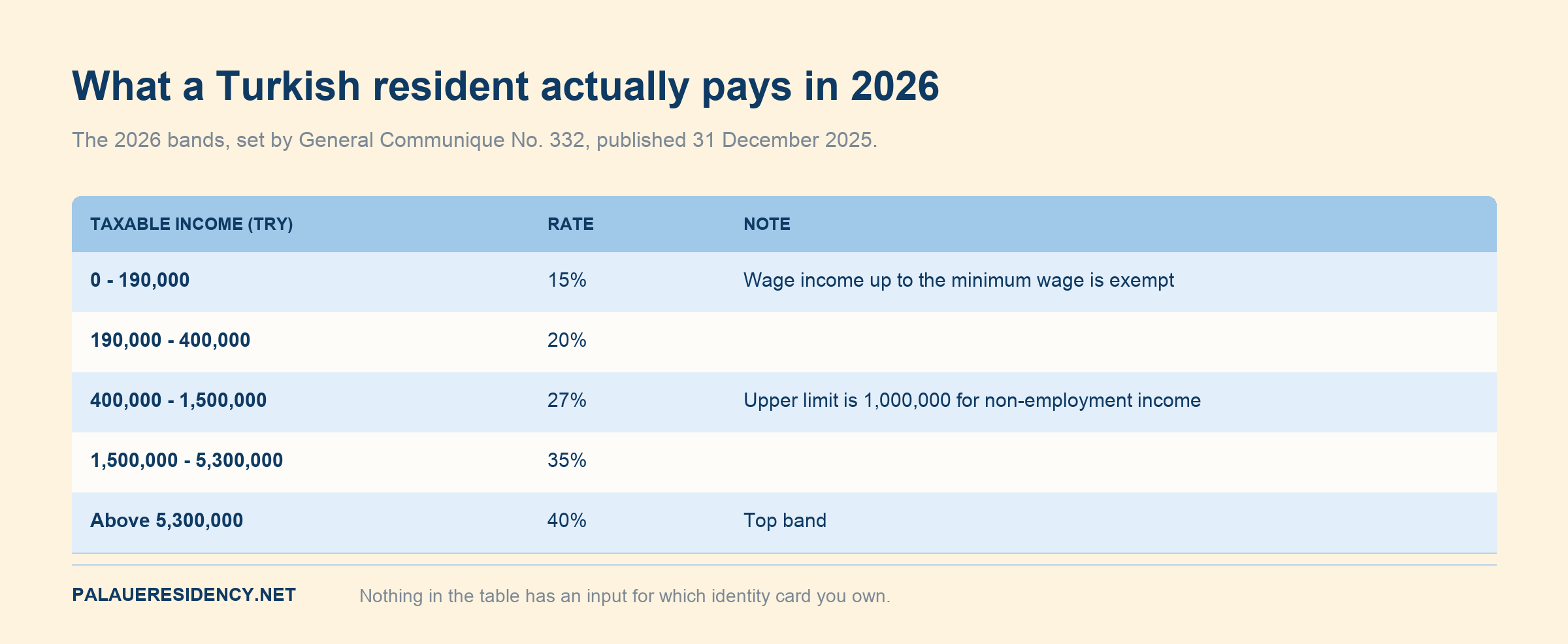
If limb one or limb two catches you, Türkiye "generally taxes its residents on their worldwide income," on PwC's Türkiye summary as reviewed on 9 September 2026. Non-residents are taxed on Turkish-source income only. The 2026 bands were set by General Communiqué No. 332, published 31 December 2025:
| Taxable income (TRY) | Rate | Note |
|---|---|---|
| 0 – 190,000 | 15% | Wage income up to the minimum wage is exempt |
| 190,000 – 400,000 | 20% | |
| 400,000 – 1,500,000 | 27% | Upper limit is 1,000,000 for non-employment income |
| 1,500,000 – 5,300,000 | 35% | |
| Above 5,300,000 | 40% | Top band |
Two honest caveats belong with that table. First, Türkiye has no standalone crypto-asset transaction tax: a proposed transaction tax was removed during the legislative process and is not part of Law No. 7577 of April 2026, per TANSEL Attorneys' Chambers commentary as at 18 May 2026. Ordinary income tax rules still reach crypto activity depending on whether it is commercial or incidental. Second, PwC's summary refers to a foreign-income exemption introduced by Law No. 7582; we could not verify its scope against a primary source, so we do not rely on it here and nor should you without a Turkish mali müşavir.
The point of the table is not the rates. It is that nothing in it has an input for which identity card you own.
MASAK identifies you regardless of the amount
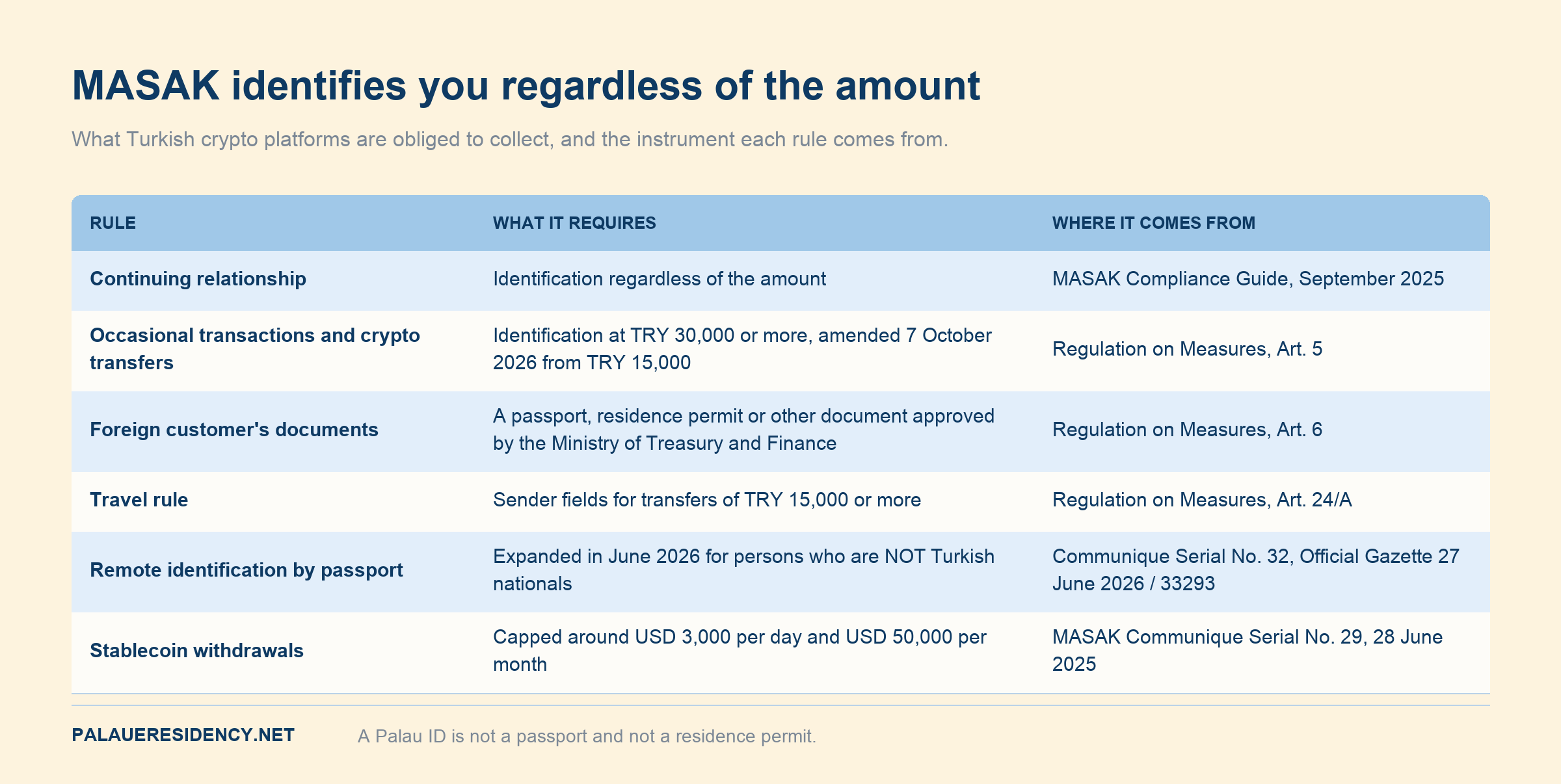
Here is the finding that matters most if you are buying the card to clear a verification screen.
Turkish crypto platforms are obliged parties under AML Law No. 5549 and MASAK's rules. On the MASAK Compliance Guide of September 2025, as summarised by Güneş & Güneş, "for a natural person, identity and address must be verified" — and in a continuing business relationship, identification "is carried out regardless of the amount." An exchange account is a continuing relationship. There is no threshold to stay under.
| Rule | What it requires | Where it comes from |
|---|---|---|
| Continuing relationship | Identification "regardless of the amount" | MASAK Compliance Guide, September 2025 |
| Occasional transactions and crypto transfers | Identification at TRY 30,000 or more, amended 7 October 2026 from TRY 15,000 | Regulation on Measures, Art. 5 |
| Foreign customer's documents | "A passport, residence permit or other document" approved by the Ministry of Treasury and Finance | Regulation on Measures, Art. 6 |
| Travel rule | Sender fields for transfers of TRY 15,000 or more | Regulation on Measures, Art. 24/A |
| Remote identification by passport | Expanded in June 2026 for persons who are not Turkish nationals | Communiqué Serial No. 32, Official Gazette 27 June 2026 / 33293 |
| Stablecoin withdrawals | Capped around USD 3,000 per day and USD 50,000 per month | MASAK Communiqué Serial No. 29, Official Gazette 28 June 2025 |
Article 6 is where the Palau ID runs out of road. A Palau ID is not a passport and not a residence permit, so it could only ever qualify as the "other document" the Ministry approves — and we found no evidence that any such approval exists for it. Pair that with the June 2026 amendment, which expanded the remote-passport route specifically for people who are not Turkish nationals, and the asymmetry is plain: the regulation is built around national documents and passports, which is why a Turkish citizen gains nothing by presenting a third country's card.
We should be precise about one thing. We did not find an official MASAK list of acceptable documents for Turkish nationals; several Turkish firms summarise the Regulation as requiring a Turkish identity card, driving licence or passport bearing the Turkish ID number, and MASAK's own guide states only that identity and address must be verified. Either way, nothing in the published rules creates a slot for a Palau card. If exchange verification is your actual goal, read Palau ID for crypto KYC and which KYC vendors read it before you spend anything.
The CMB "active providers" list is not a licence list
Two more pieces of Turkish law close off the remaining uses, and one of them is widely misread.
Law No. 7518 of July 2024 amended Capital Markets Law No. 6362 and made the Capital Markets Board the authority for crypto-asset service providers, with Communiqués III-35/B.1 and III-35/B.2 in force from 13 March 2025. Minimum capital is around TRY 250,000,000 for a platform and TRY 630,000,000 for a custodian, per SPK Bulletin 2025/68 of 31 December 2025. The CMB's transitional "active providers" list is not a list of fully licensed firms — it records entities that declared they would keep operating under the temporary provisions, which is a different claim from being licensed, and treating one as the other is the commonest error in English-language coverage of this market.
Separately, the Central Bank's Regulation on the Disuse of Crypto Assets in Payments has barred crypto from being used directly or indirectly in payments since April 2021. So a Palau ID does not change what you may legally do with crypto inside Türkiye, nor which venues may serve you. For the parallel European picture, our MiCA page covers how licensing regimes treat non-EEA documents.
CARF: Türkiye exchanges from 2028
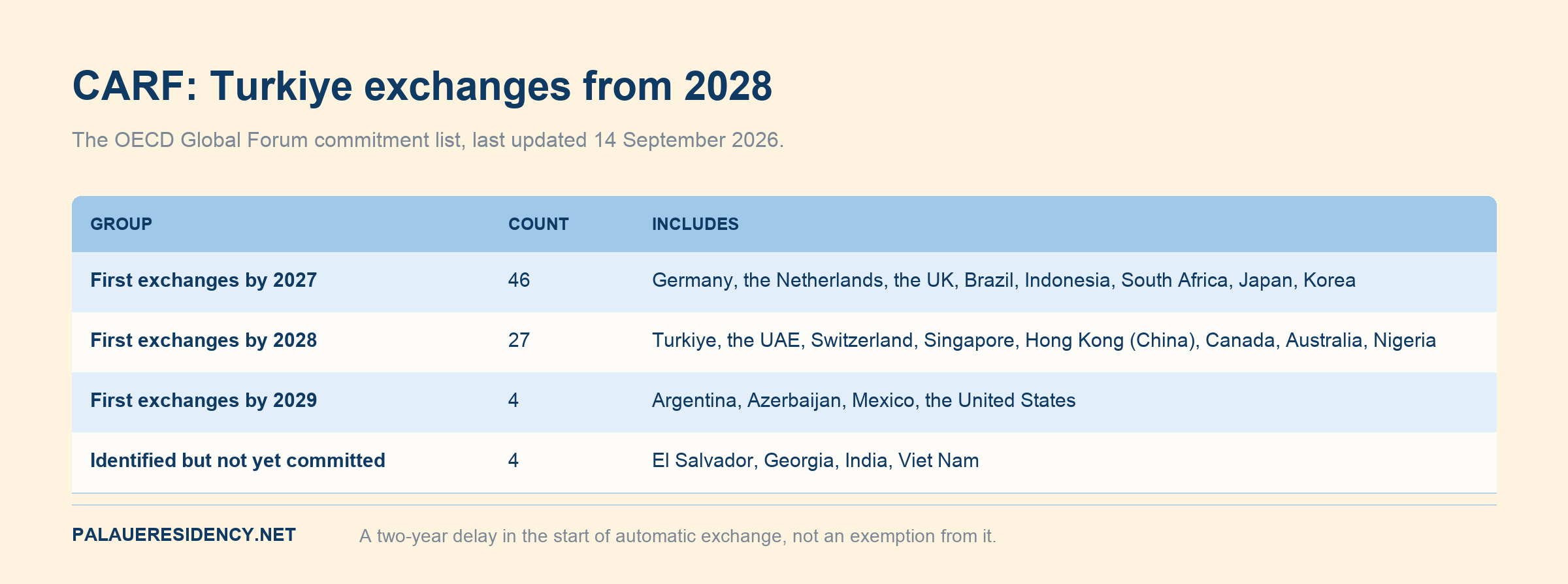
The reporting timetable is published, so there is no need to guess at it. The OECD Global Forum's commitment list, last updated 14 September 2026, places Türkiye in the group undertaking first exchanges by 2028:
| Group | Count | Includes |
|---|---|---|
| First exchanges by 2027 | 46 | Germany, the Netherlands, the UK, Brazil, Indonesia, South Africa, Japan, Korea |
| First exchanges by 2028 | 27 | Türkiye, the UAE, Switzerland, Singapore, Hong Kong (China), Canada, Australia, Nigeria |
| First exchanges by 2029 | 4 | Argentina, Azerbaijan, Mexico, the United States |
| Identified but not yet committed | 4 | El Salvador, Georgia, India, Viet Nam |
Being in the 2028 group is a two-year delay in the start of automatic exchange, not an exemption from it. And CARF reporting keys off where a user is resident and the self-certification they give their provider — not off which identity card they produced. A Palau ID in a Turkish resident's file does not make that file unreportable; at worst it makes the self-certification inconsistent with the rest of the record, which is the opposite of what the buyer wanted.
Where the card is useful, and who should skip it
We are not against this product. We are against the four reasons it is usually sold to Turkish buyers.
Skip it if you are buying it to leave the Turkish tax net, to clear verification at a Turkish-licensed venue, to obtain a residence or travel right, or to create a Palau address that reads as a residence. The first is answered by Articles 3 to 5, the second by Article 6 of the Regulation on Measures, the third by RNS's own sentence that this is "not Palauan citizenship, a Palau passport, or proof that the holder physically resides in Palau," and the fourth by RNS's own description of the mailing product.
It may genuinely be worth it if you want a second government-issued photo ID to avoid posting your passport to minor services, you are a frequent traveller who wants a spare card-format document, or you have a specific venue that you have already confirmed accepts it in writing. That last clause is the whole test, and it is free to run before you pay.
The honest summary is narrower than either the sales pitch or the scare story: Palau issues a real identity card, and Türkiye has written its residence and identification rules in terms the card cannot satisfy. Decide with both of those in front of you. If you are still weighing whether to apply at all, start here.
Related reading
- Palau digital residency limitations — what the programme does not guarantee, in its own words
- Palau digital residency risks in 2026 — the governance file, the EU listing and the US subpoena
- Palau ID for crypto KYC — what acceptance actually depends on
- Palau ID verification: which KYC vendors read it — the vendor layer beneath the screen
- Palau digital residency for UK citizens 2026 — the same test applied to a different tax authority
- Palau digital residency tax guide — why "tax-free Palau" is the wrong question
FAQ
Can Turkish citizens get Palau digital residency?
Türkiye has never appeared on the exclusion list this programme published, which named North Korea, Iran, Syria, Cuba, Crimea and Sudan. RNS's current documentation no longer publishes a country list, saying only that the restricted-country list "is maintained by the service and can change" and that applicants must satisfy the rules "shown during purchase and verification." Purchasing a term does not guarantee approval, and applications pass identity, KYC/AML and sanctions review before Palau approves them.
Does a Palau ID reduce my Turkish tax?
No. The Turkish Revenue Administration's own filing treats you as residing in Türkiye if your domicile is in Türkiye or you stay "continuously more than six months in one calendar year," with provisional absence not interrupting that continuity. Neither limb mentions any foreign identity document, and Türkiye generally taxes residents on worldwide income at 15% to 40% in 2026. Leaving the Turkish net requires actually leaving; no card substitutes for that.
Will a Turkish crypto exchange accept a Palau ID?
Nothing in the published rules creates a slot for it. Article 6 of the Regulation on Measures verifies a foreign customer on a passport, a residence permit, or another document approved by the Ministry of Treasury and Finance, and we found no evidence a Palau ID has that approval. RNS itself says acceptance holds only "when the third party's current rules allow it" and that it "does not guarantee … acceptance of a Palau ID by any financial service."
Is there a transaction amount below which I avoid identification in Türkiye?
Not for an exchange account. MASAK's September 2025 Compliance Guide requires that in a continuing business relationship identification is carried out regardless of the amount, and an exchange account is a continuing relationship. The TRY 30,000 figure — raised from TRY 15,000 on 7 October 2026 — applies to occasional transactions and transfers, not to onboarding.
Does Türkiye tax crypto gains in 2026?
There is no standalone crypto-asset transaction tax. A proposed transaction tax was removed during the legislative process and is not part of Law No. 7577 of April 2026. Ordinary Turkish income tax rules can still apply depending on whether the activity is commercial or incidental, so this is a question for a Turkish tax adviser rather than a reason to assume nothing is due.
When does Türkiye start reporting crypto accounts under CARF?
- The OECD Global Forum's commitment list, last updated 14 September 2026, places Türkiye among the 27 jurisdictions undertaking first exchanges by 2028, behind the 46 starting in 2027. Reporting keys off a user's residence and self-certification rather than the identity document presented, so holding a Palau ID does not take a Turkish resident's account out of scope.
Can I use a Palau mailing address as proof of address in Türkiye?
RNS rules this out in its own documentation: the mailing service "is a mailing address, not a residential address or proof of residence, domicile, or tax residence." Turkish AML rules require a natural person's address to be verified as well as their identity, so an address product its own provider declines to call proof of residence is not a solution to that requirement.
Does a Palau ID let me live in or travel to Palau?
No. RNS's FAQ is explicit that Palau Digital Residency "is not Palauan citizenship, a Palau passport, or proof that the holder physically resides in Palau," and its overview lists physical residency among the things the product is not. Any entry right you have as a Turkish passport holder comes from Palau's visa rules, not from this card — see can you travel with a Palau ID.