Palau Digital Residency Statistics: The 2026 Numbers
Palau digital residency statistics from the programme's own 2026 annual report: 70,946 applications, 68,867 approved, 47,000 active, 31% renewing.
We may earn a commission if you apply through this link. This site is independent and is not the official RNS.ID or Palau government site.
Key takeaways
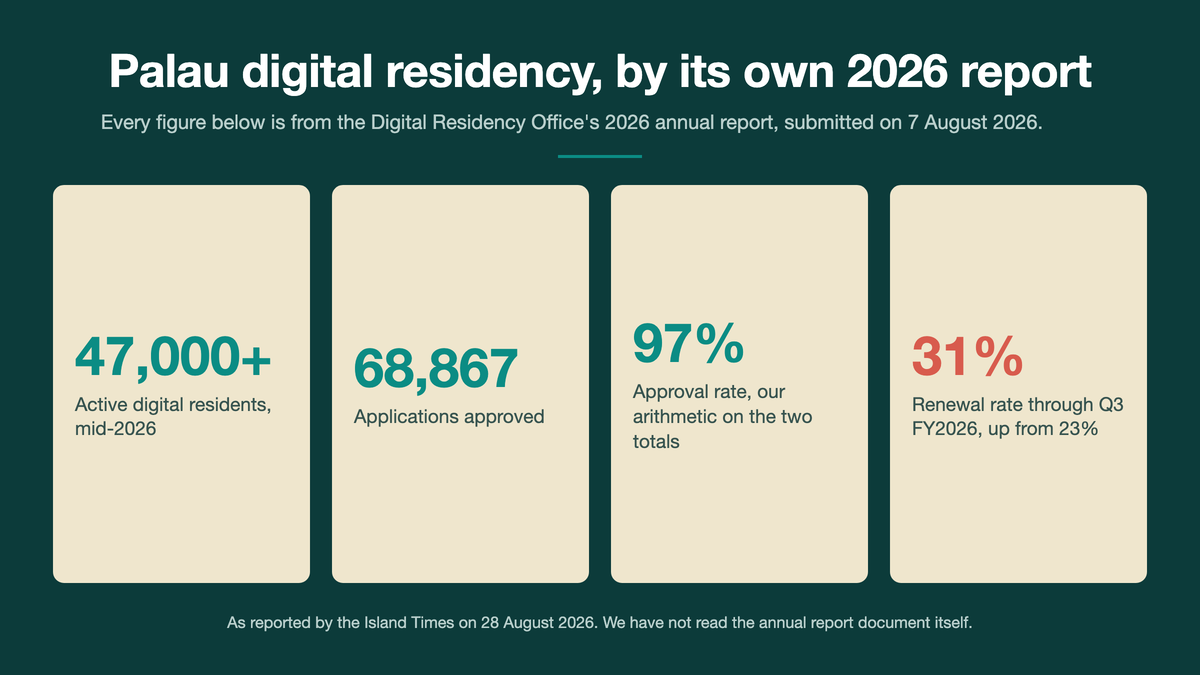
- The programme reports more than 47,000 active digital residents, up more than 50% in a year, out of 70,946 applications received and 68,867 approved as of mid-2026. Figures are from the Digital Residency Office's 2026 annual report, submitted to the Olbiil Era Kelulau on 7 August 2026.
- The approval rate is 97%. 68,867 of 70,946 applications were approved — about 2,079 were not. That is our arithmetic on the reported totals, and it is not the same thing as a guarantee: RNS's own documentation says a paid record "records payment, not approval".
- About 21,900 approved IDs are not active. Approvals exceed active residents by roughly a third, which is what a programme whose cheapest term is one year looks like after four years.
- Renewals are the weakest number and the most useful one. The renewal rate rose from 23% in fiscal 2025 to 31% through the third quarter of fiscal 2026 — improving, and still a minority of holders choosing to pay again.
- Revenue is $8.95 million since February 2022, including $1.66 million in fiscal 2026. Across 68,867 approvals that is roughly $130 of reported government revenue per approved ID, and the report does not disclose how the retail price is split with the service provider.
On this page
- Palau digital residency statistics: the 2026 numbers
- 97% of applications are approved, and approval is still not a promise
- 47,000 active against 68,867 approved
- The renewal rate is 31%, and it is the figure to read before buying ten years
- From 800 residents to 47,000: the four-year series
- $8.95 million since February 2022, and the split the report does not give
- Why half the internet still says 4,700
- The risks the office names about itself
- What the numbers should change about your decision
- Related reading
- FAQ
Palau digital residency statistics: the 2026 numbers
Look up Palau digital residency statistics and you get a decade's worth of mismatched snapshots: 800 sign-ups, 4,258 residents, 4,700 residents, 47,000 residents. Two of those numbers are from the same year and differ by a factor of ten. That matters because the thing you are deciding is whether to buy a one-year, five-year or ten-year identity product from a programme whose size, approval odds and survival rate you cannot see from the shop window.
So here is every figure the programme has published about itself this year, dated, with the arithmetic it implies spelled out rather than left to you. One caveat first, because it is the kind of thing other pages leave unsaid: we have not read the annual report document itself. Every 2026 figure below is as reported by the Island Times on 28 August 2026, which attributes them to the Digital Residency Office's 2026 annual report — submitted to the Olbiil Era Kelulau on 7 August and presented by President Surangel S. Whipps Jr. in his capacity as acting minister of finance.
| Metric | Figure | As of | Where it comes from |
|---|---|---|---|
| Active digital residents | more than 47,000 | mid-2026 | 2026 annual report |
| Year-on-year growth in active residents | more than 50% | mid-2026 | 2026 annual report |
| Applications received | 70,946 | mid-2026 | 2026 annual report |
| Applications approved | 68,867 | mid-2026 | 2026 annual report |
| Renewal / extension rate | 31% (from 23%) | Q3 FY2026 | 2026 annual report |
| Revenue, fiscal 2026 | $1.66 million | FY2026 to date | 2026 annual report |
| Revenue since launch | $8.95 million | February 2022 onward | 2026 annual report |
| Compliance statement | "100% compliant with RPPL 11-14 and its service-provider agreement" | 2026 report | 2026 annual report |
Four of those eight rows have never appeared on a page aimed at buyers. The rest of this guide takes them one at a time.
97% of applications are approved, and approval is still not a promise
Divide 68,867 approvals by 70,946 applications and you get 97.07%. About 2,079 applications did not result in an approved ID — just under 3%.
| Application outcome | Count | Share |
|---|---|---|
| Applications received | 70,946 | 100% |
| Approved | 68,867 | 97.1% |
| Not approved | about 2,079 | 2.9% |
| Approved but no longer active | about 21,900 | 31.8% of approvals |
Those percentages are ours, not the report's; the report publishes the two totals and we divided them.
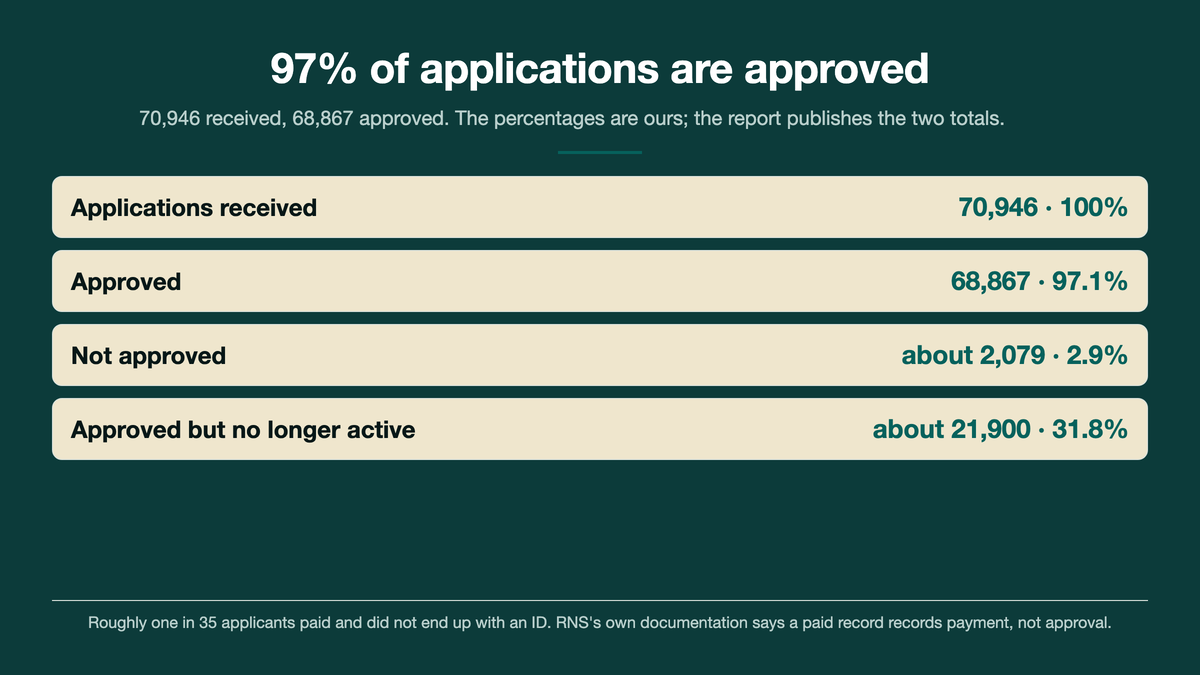 Read the 97% carefully in both directions. It tells you that a complete, honest application from a supported country is very likely to clear — this is a screening process, not a selection contest. It also tells you that roughly one in 35 applicants paid and did not end up with an ID, which is the part worth knowing before you treat the fee as a formality.
RNS says the same thing in its own words. Its support documentation states that a paid record "records payment, not approval, ID issuance, or service activation", that identity verification, screening, review and government review all still apply, and that "an appeal does not guarantee approval". A 97% approval rate and "payment is not approval" are not in tension — they are the same fact seen from either end. If you want the full pre-application version, the documents checklist and the requirements page are where the 3% usually goes wrong.
47,000 active against 68,867 approved
The two headline figures in the report are not the same measure, and the difference between them is the most interesting number nobody has printed. 68,867 IDs have been approved. More than 47,000 are active. The gap is roughly 21,900 — about 32% of every ID ever approved.
That is not evidence of anything going wrong. The programme's entry-level term is one year, it has been running since February 2022, and a one-year ID bought in 2023 and not renewed is an expired ID, not a cancelled one. A 32% inactive share after four years is what arithmetic does to a product with short terms and a renewal rate in the low thirties.
What it does mean is that "47,000 digital residents" and "68,867 people have been approved" answer different questions, and anyone quoting the larger number as the programme's current size is overstating it by a third. When you see an acceptance claim framed as "a programme with nearly 70,000 residents", that is the approvals-since-launch figure doing work the active figure would not support.
It also sets the frame for the next number, because an expiring ID is a decision point, and the report tells us how those decisions go.
The renewal rate is 31%, and it is the figure to read before buying ten years
Of the numbers in this report, the renewal rate is the one that should move a purchase decision. It went from 23% in fiscal 2025 to 31% through the third quarter of fiscal 2026 — a real improvement, and still a minority.
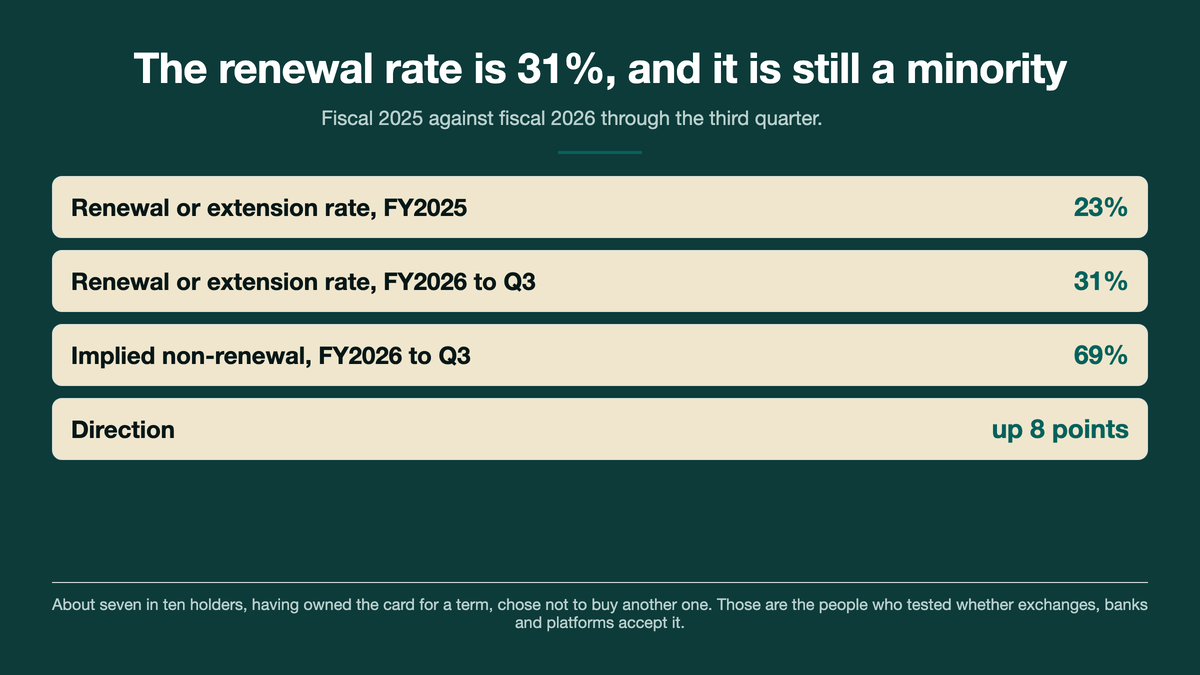
| Renewal measure | Fiscal 2025 | Fiscal 2026 (through Q3) |
|---|---|---|
| Renewal / extension rate | 23% | 31% |
| Implied non-renewal | 77% | 69% |
| Direction | — | up 8 points |
Two honest readings sit side by side here, and we would not pretend one of them is settled. The optimistic reading is that renewals are climbing fast in percentage terms as the ID finds real uses, and that a product people keep paying for is a product that works. The sceptical reading is that about seven in ten holders, having owned the card for a term, chose not to buy another one — and those are the people who actually tested whether exchanges, banks and platforms accept it.
Either way the practical conclusion is the same, and it is not the one the pricing page nudges you toward: if you are new to this, the long term is a bet on an acceptance record you have not personally verified yet. The cheapest way to find out whether the ID clears the specific checks you care about is the shortest term, then renew if it does — the mechanics are on the renewal and reprint page, and the current listed terms are on the cost page. We do not restate prices here, because RNS now says pricing is deliberately not fixed in its documentation.
From 800 residents to 47,000: the four-year series
The growth story has never been assembled in one place, because each figure was published by a different outlet in a different year. Here it is end to end.
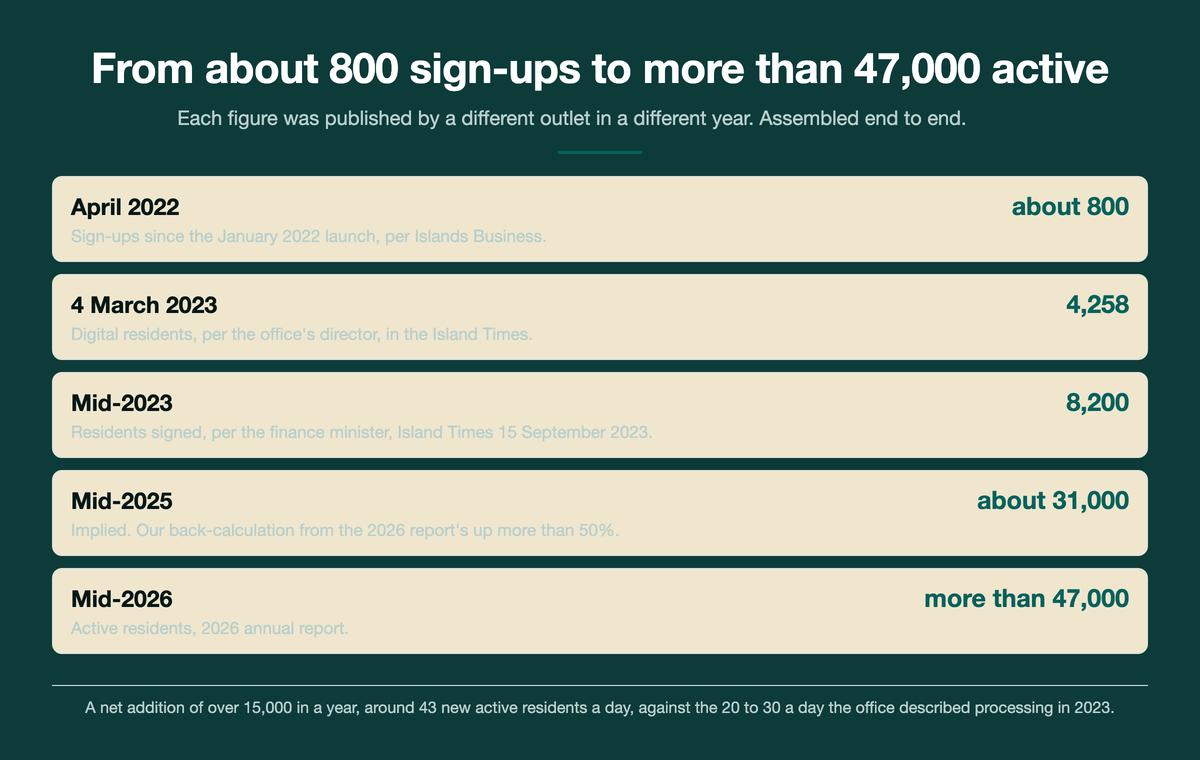
| Date | Reported figure | Measure | Source |
|---|---|---|---|
| April 2022 | about 800 sign-ups | sign-ups since January 2022 launch | Islands Business |
| 4 March 2023 | 4,258 digital residents | residents, per the office's director | Island Times |
| Mid-2023 | 8,200 signed | residents signed, per the finance minister | Island Times, 15 September 2023 |
| Mid-2025 | about 31,000 (implied) | back-calculated from "up more than 50%" | our arithmetic on the 2026 report |
| Mid-2026 | more than 47,000 | active residents | 2026 annual report |
The 2022 launch was described at the time as "much slower than expected" against a fee of US$248, with interest split roughly evenly between the Americas, Asia and Europe. Four years later the net addition alone is over 15,000 in a year — around 43 new active residents a day, against the 20 to 30 a day the office described itself processing in 2023.
For scale, Estonia's e-Residency programme — the scheme Palau's is constantly compared with — reports more than 130,000 e-residents and over 40,000 companies started. Palau is now a substantial fraction of Estonia's headcount while doing something much narrower, which is the whole argument on the Palau vs Estonia page.
$8.95 million since February 2022, and the split the report does not give
Revenue is the part of the report that invites the most careless reporting, so take the two figures separately. $1.66 million in fiscal 2026 and $8.95 million cumulatively since February 2022. Palau's fiscal year ends on 30 September and the report was submitted on 7 August, so the fiscal 2026 figure is a partial year, not a full one — the renewal number in the same report is explicitly "through the third quarter".
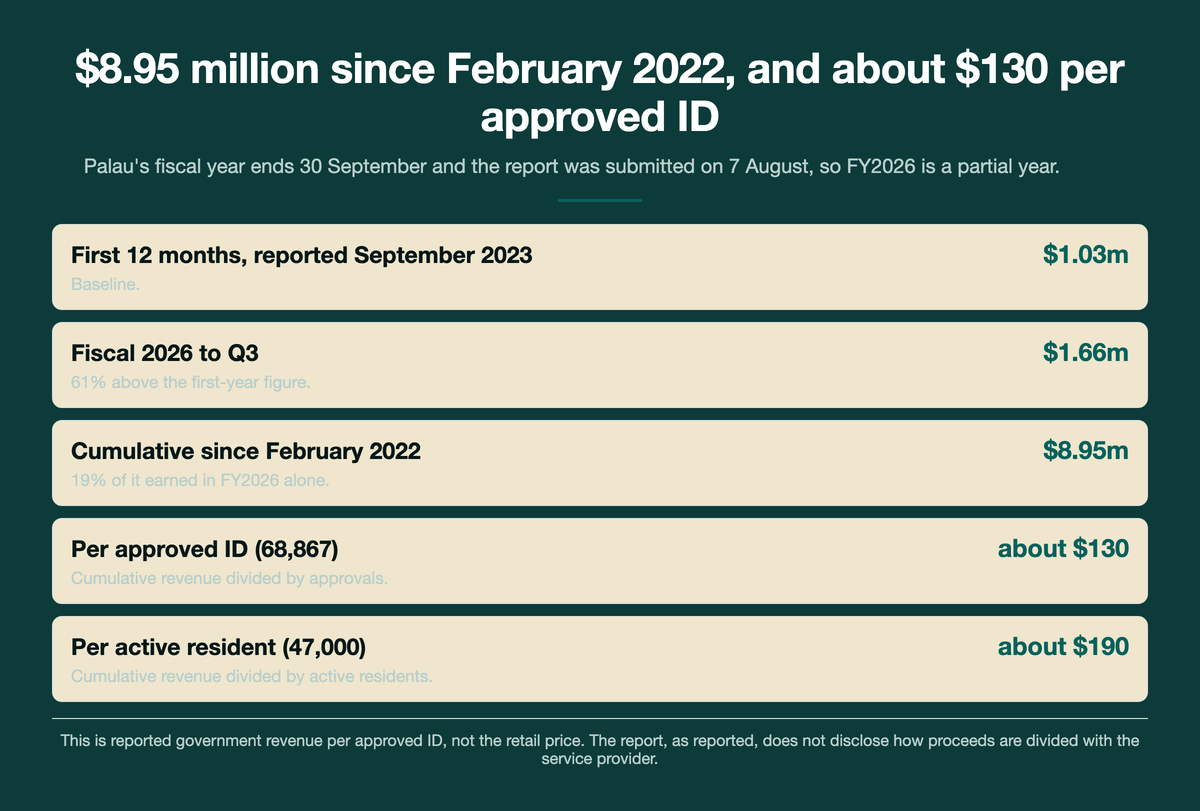
| Revenue measure | Figure | Our arithmetic |
|---|---|---|
| First 12 months (reported September 2023) | $1.03 million | baseline |
| Fiscal 2026 (to Q3) | $1.66 million | 61% above the first-year figure |
| Cumulative since February 2022 | $8.95 million | 19% of it earned in FY2026 alone |
| Per approved ID (68,867) | about $130 | cumulative revenue ÷ approvals |
| Per active resident (47,000) | about $190 | cumulative revenue ÷ active |
That $130 is the number to sit with. It is reported government revenue per approved ID, and it is well below what a single multi-year ID retails for. There are several innocent explanations — the mix is weighted toward the cheapest term, the figure may count only the government's share, revenue recognition may lag — and the report, as reported, does not disclose how proceeds are divided with the service provider. The Island Times raised precisely that open question: how much of the roughly $9 million remains for Palau after operating and service-provider costs. We cannot answer it from published sources, so we are flagging it rather than modelling it. Anyone telling you the government's take per ID is a specific number is guessing.
Why half the internet still says 4,700
Here is the discrepancy that sent us down this road. Estonia's e-Residency programme publishes an official Estonia vs Palau comparison, originally from March 2023 and updated 8 April 2026, and it says: "According to the official government website, Palau now has 4,700 digital residents and counting."
That is a tenth of the figure Palau's own office reported four months later, and it cannot be reconciled with "up more than 50% over the past year". The likeliest explanation is mundane: 4,700 is roughly the right number for early 2023 — the office's director gave 4,258 in March of that year — and the page was refreshed in 2026 without that line being revisited. It is a stale statistic in an otherwise careful document from a government source, which is exactly the kind of number that propagates. It has already been copied onto syndicated mirrors of that post.
The lesson is not that Estonia is unreliable. It is that in this niche the authority of the publisher is a poor guide to the age of the figure, and a number without a date attached is not evidence. That is the same test we apply to acceptance claims on the is RNS.ID legit page and to user reports in the Reddit reviews round-up.
The risks the office names about itself
A programme's annual report is a sales document and a risk register at once, and the second half gets quoted far less. This one names three constraints plainly: cybersecurity, staffing and funding.
On security, the office reports running vulnerability assessments and penetration tests across the Root Name System, Ministry of Finance databases and service-provider networks, with an emphasis on immigration and ASYCUDA systems, and says Palau will align with the NIST Cybersecurity Framework 2.0. MITRE training produced what the report describes as Palau's first fully trained cybersecurity analyst — a real step, and also a sentence that tells you the baseline it started from.
On capacity, the report cites difficulty recruiting experienced staff and insufficient staffing to sustain the programme, manage fintech projects and expand services, alongside limited marketing funds. It also notes that the Palau Financial Intelligence Unit's 2024 examination final report remains pending.
None of that is a reason to avoid the product, and the report's own compliance line is that the programme is "100% compliant with RPPL 11-14 and its service-provider agreement". It is a reason to read roadmap promises conservatively: an office that says it is short of staff and marketing money is telling you which things will arrive late. The limitations page is the inventory of what the ID does not do today.
What the numbers should change about your decision
Three of these figures should change behaviour, and the rest are context.
The 97% approval rate means the application is not the risk — acceptance is. Nothing in this report says anything about whether an exchange, bank or platform will take the card, and that is the question most buyers actually have. Our acceptance research is per-institution for that reason, from the exchange KYC tracker to the individual bank and payment pages.
The 31% renewal rate argues for the shortest term first. Buy a term, test the two or three checks you care about, renew if it clears them. A ten-year commitment made before any personal evidence is a bet on other people's acceptance reports.
The 32% inactive share tells you how to read programme-size claims. "Nearly 70,000 residents" is the approvals-since-launch figure; the active count is more than 47,000.
If you do decide to apply, start here is the ordered walkthrough, and apply through the official provider rather than a reseller — payment does not guarantee approval, orders are processed as RNS describes, and nothing on this site is affiliated with RNS or the Palau government. We may earn a commission if you apply through our link, which is disclosed at the top of this page and does not change what we publish: the renewal rate above is the opposite of a sales argument, and it is in the takeaways because it is the most useful number in the report.
A last word on what these statistics are not. They measure the programme's commercial health, not the card's usefulness to you, and they say nothing about travel, residence or business rights — the ID still does not entitle the holder to reside in Palau, and digital residency does not open a company there. Nothing here is legal, tax or immigration advice, and programme rules change without notice.
Related reading
- RNS.ID review — the programme assessed on what it delivers
- Is RNS.ID legit? — what the official documents support
- Palau digital residency cost — current listed terms and what is refundable
- Palau vs Estonia e-residency — 47,000 against 130,000, and two different products
- Palau digital residency limitations — what the card does not guarantee
- Palau digital residency Reddit reviews — how to weigh user reports against official figures
FAQ
How many Palau digital residents are there in 2026?
More than 47,000 active digital residents, according to the Digital Residency Office's 2026 annual report, submitted on 7 August 2026 and reported by the Island Times on 28 August. That is a different measure from the 68,867 applications the same report says have been approved since February 2022. Roughly 21,900 approved IDs are no longer active, which is what you would expect from a programme whose entry-level term is one year.
What is the Palau digital residency approval rate?
About 97%. The 2026 report gives 70,946 applications received and 68,867 approved; the percentage is our division of those two totals, not a figure the office published. Around 2,079 applications — just under 3% — did not result in an ID. RNS's own documentation is explicit that payment "records payment, not approval", and that identity verification, screening and government review still apply.
How many people renew their Palau digital residency?
The renewal and extension rate was 23% in fiscal 2025 and 31% through the third quarter of fiscal 2026. It is improving quickly, and it still means roughly seven in ten holders did not buy another term. We read that as an argument for starting with the shortest term and renewing only once the ID has cleared the specific checks you need.
How much revenue has Palau made from digital residency?
$8.95 million since February 2022, including $1.66 million in fiscal 2026 — a partial year, since Palau's fiscal year ends on 30 September and the report was submitted on 7 August. Across 68,867 approved IDs that averages about $130 of reported revenue per approval. The report does not disclose how proceeds are split with the service provider, so what Palau keeps after costs is not a published number.
Why do some sites say Palau has only 4,700 digital residents?
Because Estonia's official e-Residency comparison page, updated 8 April 2026, still carries that line, and syndicated copies repeat it. The figure is about right for early 2023 — the office's director reported 4,258 residents in March 2023 — and appears not to have been revisited when the page was refreshed. Palau's own 2026 report puts active residents above 47,000.
Does the programme say it is compliant and audited?
The 2026 report states that the programme is "100% compliant with RPPL 11-14 and its service-provider agreement", and describes penetration testing across the Root Name System, Ministry of Finance databases and service-provider networks, plus planned alignment with the NIST Cybersecurity Framework 2.0. The same report notes that the Palau Financial Intelligence Unit's 2024 examination final report is still pending, so that one is not closed.
Does a bigger programme mean wider acceptance of the Palau ID?
No, and the report contains no acceptance data at all. Growth measures how many people bought an ID, not how many institutions take it, and acceptance is set by each exchange, bank or platform under its own rules. Check the institution you care about individually rather than inferring from programme size.