Palau ID Data Security 2026: Who Holds Your Passport Scan
Who holds your Palau ID passport scan and face check in 2026, what Palau's own cyber security regulation requires, and who has to tell you if it leaks.
We may earn a commission if you apply through this link. This site is independent and is not the official RNS.ID or Palau government site.

Key takeaways
- Palau ID data security has two custodians, not one, and Palau's own regulation says so. Paragraph 14(b) of regulation MOF-DR-01.1 stores Office copies of every application "as a backup copy to the files stored on the Service Provider's servers." The provider holds the primary copy; the government holds the backup.
- The regulation's security duties bind the Office, not the provider. The Office director must maintain security complying "at all times" with RPPL 11-14 and ISO 27001; what the provider must do comes from an operating agreement that is not published.
- A breach must be reported immediately — to a manager inside the Office. Paragraph 5(e) requires that "all breaches and compromises of PII must be reported, immediately to the ISM." There is no paragraph requiring that you be told, and the UCL DPI Map records Palau as having no data leak disclosure process.
- The provider's privacy notice never names the two things the application requires. It lists email, wallet addresses, order data and uploaded files — no passport image, no ID scan, no facial capture — while the verification page requires an original identity document plus a live facial check matched against it.
- The "offline" claim has a documentary basis, and it is narrower than the headline. Paragraph 6(d) requires remote access "completely disabled for all servers used as primary or back up file servers" — a rule written for the Office's servers in March 2023, not a statement about the provider's.
On this page
- What Palau ID data security actually means in 2026
- Who holds your passport scan
- What you hand over, and what the privacy notice names
- Palau's cyber security regulation, read in full
- The breach-notice gap in Palau ID data security
- The 2024 ransomware attack and the 2025 extortion attempt
- Two laws, one gap: 6 PNCA § 205-206 and a private provider
- What to check before you upload anything
What Palau ID data security actually means in 2026
You upload a passport page and a live photo of your own face to a product that starts at $288, and the two documents that identify you most completely are now somewhere you cannot see.
The stakes are not hypothetical. The ministry that houses the programme's own office was hit by ransomware in March 2024, roughly 25,000 government files went out of the door, and in September 2025 people claiming DragonForce affiliation used those same old files to try to extort the programme's provider. So we read the three documents that decide what happens to your scan: Palau's own cyber security regulation, the provider's privacy notice, and the verification page that collects the documents. The three do not describe the same system, and the gaps between them are the story.
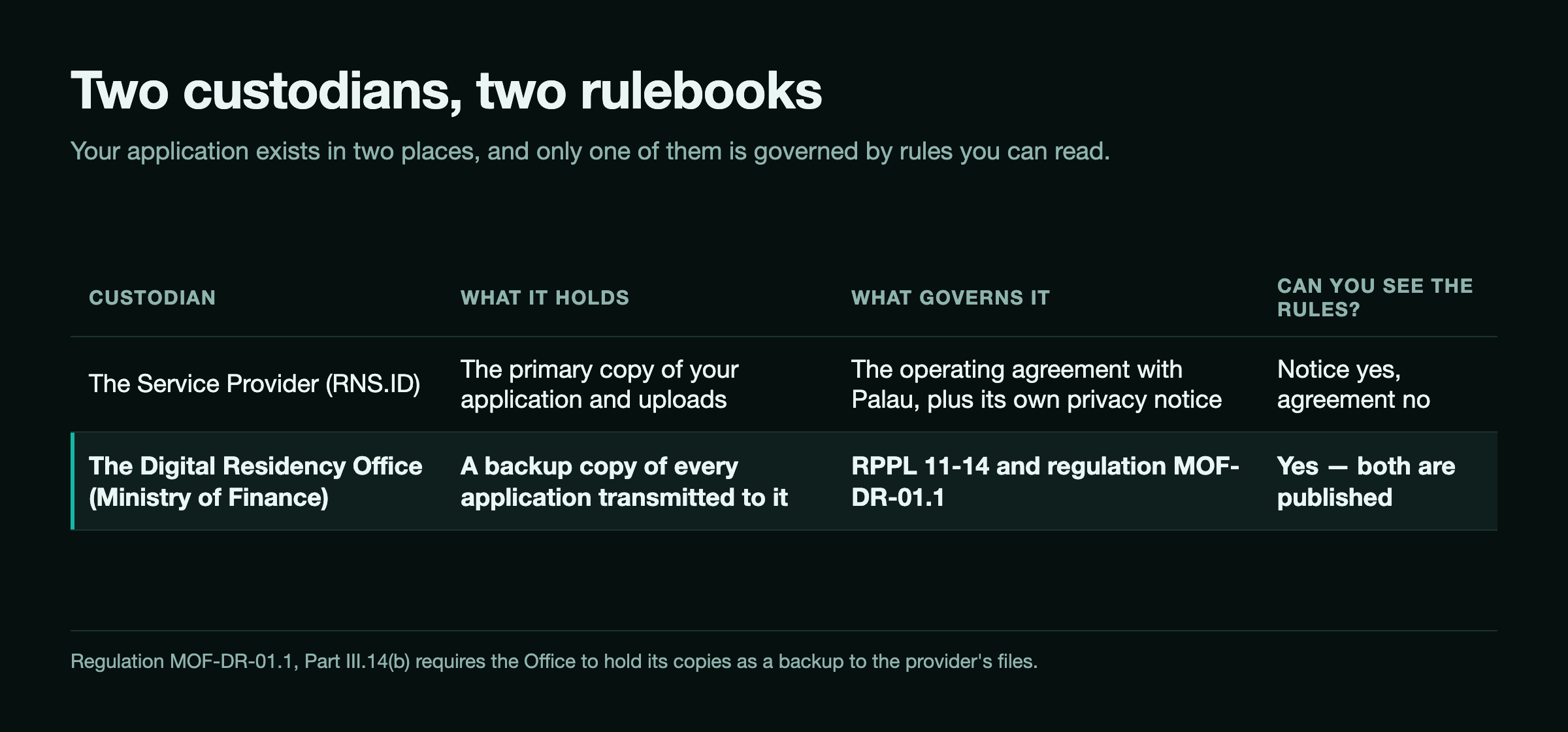
Here is the structure, which only becomes visible once you read the regulation:
| Custodian | What it holds | What governs it | Can you see the rules? |
|---|---|---|---|
| The Service Provider (RNS.ID) | The primary copy of your application and uploads | The operating agreement with Palau, plus its own privacy notice | Notice yes, agreement no |
| The Digital Residency Office (Ministry of Finance) | A backup copy of every application transmitted to it | RPPL 11-14 and regulation MOF-DR-01.1 | Yes — both are public |
Two custodians, two rule sets, one of which you cannot read. That asymmetry is the finding, and everything below is detail on it.
Who holds your passport scan
Both of them, and the government's copy is the one with published rules attached.
The Digital Residency Office sits inside Palau's Ministry of Finance. It was created by RPPL 11-14, the Digital Residency Act, which amended Chapter 10 of Title 13 of the Palau National Code and added a new Subchapter III. The Act gave the Office authority over "all activities authorized, required or permitted by the Act, to include all responsibilities of service providers," and let it make regulations under section 5. It used that power in March 2023 to issue MOF-DR-01.1, Digital Residency Program Cyber Security, sixteen pages signed by the Minister of Finance and approved by President Surangel S. Whipps, Jr.
Paragraph 14(b) of that regulation is the sentence that answers this section's question:
Copies of all Digital Residency Applications transmitted to the Office by the Service Provider in compliance with the operating agreement will be stored as a backup copy to the files stored on the Service Provider's servers.
Read it slowly. The Service Provider's servers hold the files, copies travel to the Office, and the Office's set is a backup of the provider's. The regulation's scope paragraph says it from the other direction: it covers the Office "reviewing, storing and safeguarding all pending, approved and disapproved Digital Residency Applications." Rejected applications are explicitly in scope, which matters if you assumed a refusal makes your documents go away.
What the regulation does not do is bind the provider. Part II paragraph 3 puts the duty on "the Office director," to maintain security complying "at all times with the requirements of RPPL 11-14, ISO 27001 and this regulation." The provider's obligations live in the operating agreement, which the regulation refers to repeatedly and which is not published. Our page on who runs the programme covers the corporate side.
What you hand over, and what the privacy notice names
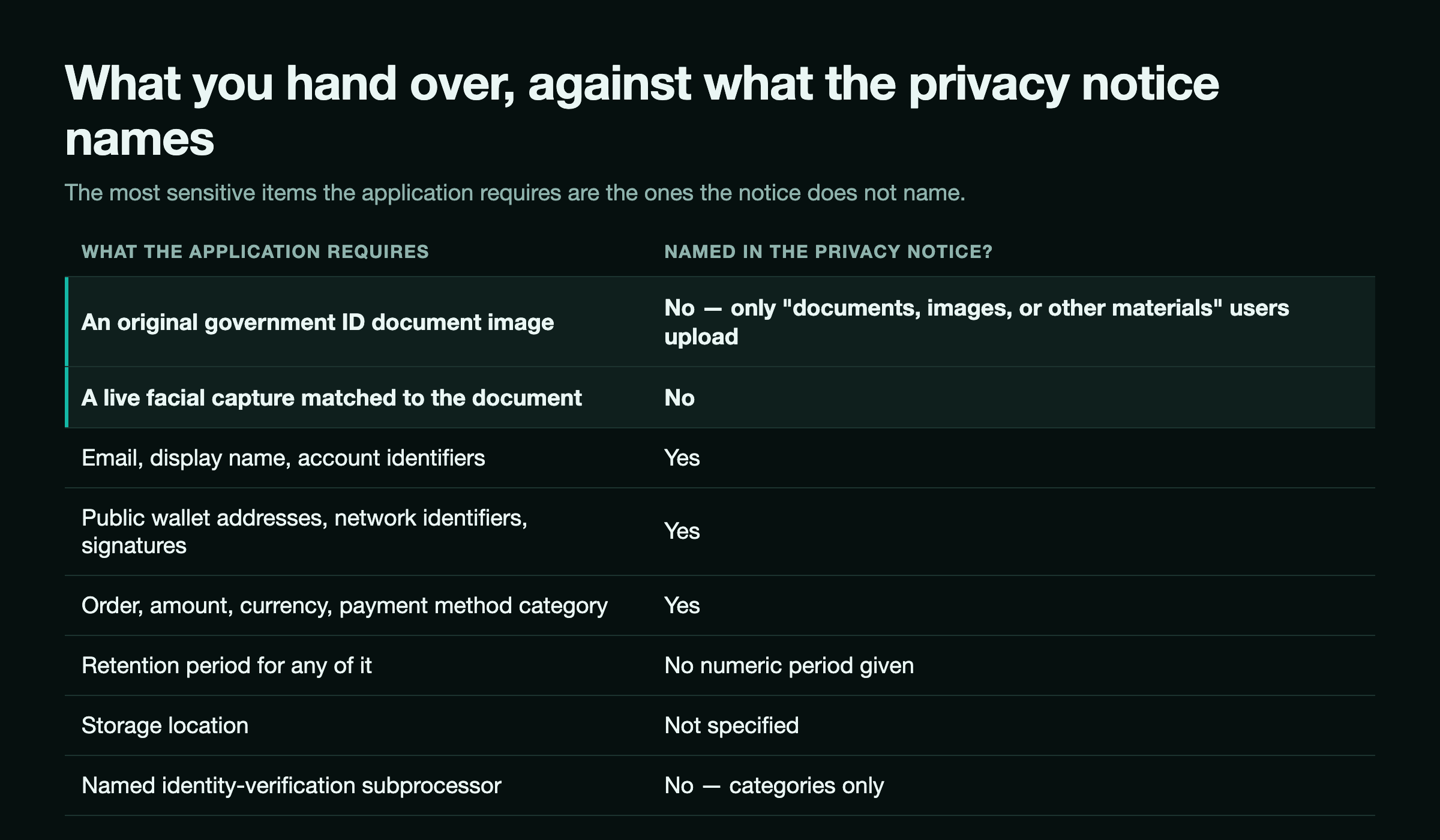
This is the gap that surprised us most, and it is checkable in two browser tabs.
The identity verification page is specific about what the flow collects. You must use "the original identity document, not a photocopy, screenshot, or scanned printout," valid and fully readable. You photograph or upload the requested page, and you may be asked for a further side or image. Then there is a live facial check — "Face the camera directly and keep your full face in the frame" — following on-screen movement instructions, with the capture compared against the document. The page names no verification vendor, says nothing about who sees the images, and sets no retention period. For the vendor layer underneath, see our KYC vendor page.
Now open the privacy notice, dated 28 July 2026 and given in the name of Cryptic Labs LLC, which it says "operates the RNS.ID online platform." No jurisdiction and no registered address appear on it. Here is what it names against what the application asks for:
| What the application requires | Named in the privacy notice? |
|---|---|
| An original government ID document image | No — only "documents, images, or other materials" users upload |
| A live facial capture matched to the document | No |
| Email, display name, account identifiers | Yes |
| Public wallet addresses, network identifiers, signatures | Yes |
| Order, amount, currency, payment method category | Yes |
| Retention period for any of it | No numeric period given |
| Storage location | Not specified |
| Named identity-verification subprocessor | No — categories only |
The notice carries a line that reads differently once you have seen the flow: "Do not submit sensitive documents or other information unless the relevant feature requests them." The feature does request them, and the notice does not describe what happens next. On retention it says account data is "generally retained while the account is active and for an appropriate period afterward" — an appropriate period is not a period. It does offer real rights, including access, deletion, portability and complaint to a data-protection authority, by emailing a privacy contact, and accepts that information "may" be processed outside your country.
Palau's cyber security regulation, read in full
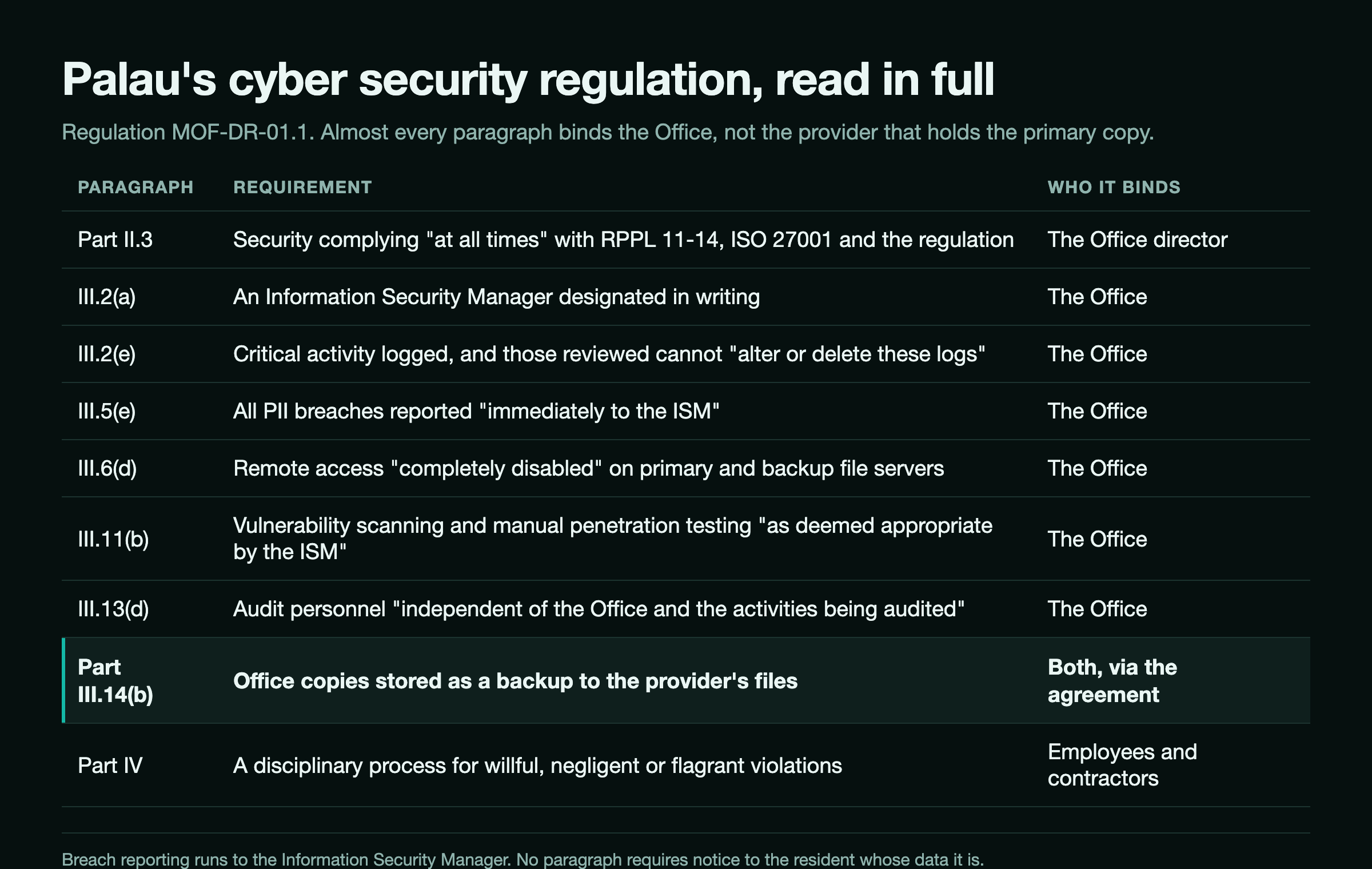
Here is what MOF-DR-01.1 actually requires, which is more than the seller guides suggest and less than a certificate.
| Paragraph | Requirement | Who it binds |
|---|---|---|
| Part II.3 | Security complying "at all times" with RPPL 11-14, ISO 27001 and the regulation | The Office director |
| III.2(a) | An Information Security Manager designated in writing | The Office |
| III.2(e) | Critical activity logged, and those reviewed cannot "alter or delete these logs" | The Office |
| III.5(e) | All PII breaches reported "immediately to the ISM" | The Office |
| III.6(d) | Remote access "completely disabled" on primary and backup file servers | The Office |
| III.11(b) | Vulnerability scanning and manual penetration testing "as deemed appropriate by the ISM" | The Office |
| III.13(d) | Audit personnel "independent of the Office and the activities being audited" | The Office |
| III.14(b) | Office copies stored as a backup to the provider's files | Both, via the agreement |
| Part IV | A disciplinary process for willful, negligent or flagrant violations | Employees and contractors |
Three things follow. First, ISO 27001 is the standard the drafting follows, not a certificate anyone holds: the regulation establishes policies "in accordance with the provisions of" ISO 27001, and we found no published ISO 27001 certification or SOC 2 report for either custodian. Second, the air-gap language is real but specific — paragraph 12(b) cites "the stand-alone nature of critical Digital Residency Program information systems," which is why anti-malware updates "must be applied individually to each system." That is the documentary basis for the "stored offline" claim, and it is a rule about the Office's servers. Third, penetration testing is discretionary, at the ISM's judgement, with no published cadence.
One oddity goes to how finished the document is. Its own arrangement of paragraphs lists twenty-four paragraphs for Part III, including "Protection of Records" and "Privacy and Protection of Personally Identifiable Information." In the copy published on palaugov.pw, Part III runs 1 to 17 and has neither heading; that material appears inside paragraph 7, which carries two subparagraphs both lettered "c." We describe the published text, not any internal version.
The breach-notice gap in Palau ID data security
Paragraph 5(e) is unambiguous about reporting, and about who receives the report.
All breaches and compromises of PII must be reported, immediately to the ISM.
The definition that follows is broad and genuinely good drafting — a breach is "the actual or suspected compromise, unauthorized disclosure, unauthorized acquisition, unauthorized access, and/or any similar occurrence" where someone other than an authorised user accesses or potentially accesses PII, or where an authorised user accesses it for an unauthorised purpose. Suspected counts. Insider misuse counts. Potential access counts.
What is missing is the next step. The report goes to the Information Security Manager, inside the Office. No paragraph in the regulation requires that the affected digital resident be notified, sets a deadline for telling anyone outside, or names a regulator to be informed. The provider's security and scam reporting page is thorough on phishing, impersonation and what RNS will never ask for — your password, 2FA codes, authenticator QR code, wallet seed phrase or private key — but it has no section on what happens if the provider itself is breached. Its privacy notice makes no breach-notification commitment either.
The UCL Institute for Innovation and Public Purpose reaches the same conclusion from outside. Its DPI Map entry for Palau, version 2026-11-06, records the digital ID as active and regulated, with procedural rules for enrolment and terms of data storage and sharing available — and marks "data leak disclosure process" as no, "ID data handling terms" as no, and "codified digital ID legal status" as no. So the practical answer to "who has to tell me?" is: nobody, by rule. You would learn about it the way everyone learned about the 2024 attack — from the news.
The 2024 ransomware attack and the 2025 extortion attempt
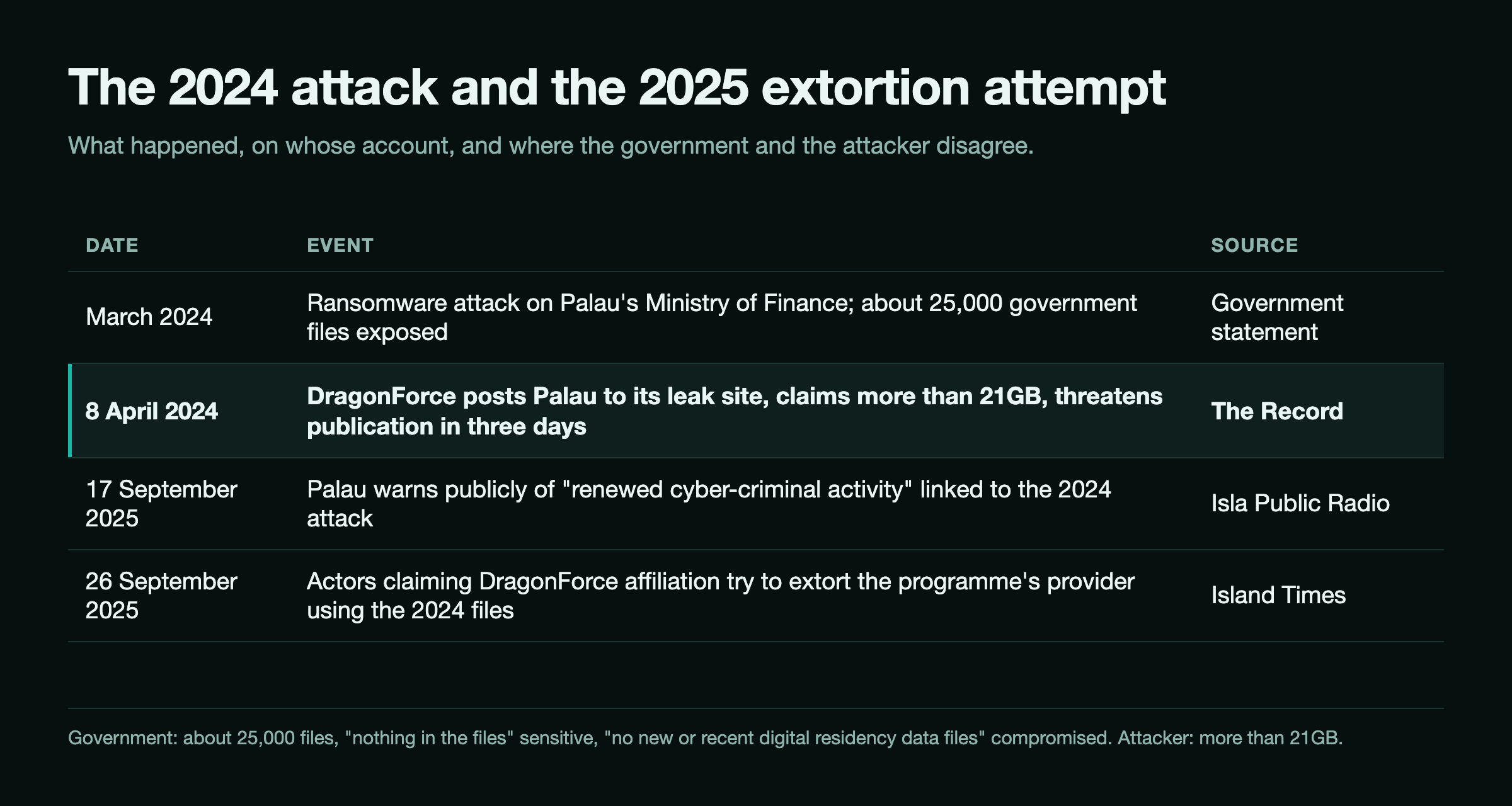
This is the part competitors mention and nobody connects to the custody structure above.
| Date | Event | Source |
|---|---|---|
| March 2024 | Ransomware attack on Palau's Ministry of Finance; ~25,000 government files exposed, from Finance and from Human Resources, Culture, Tourism and Development | The Record; Island Times |
| 8 April 2024 | DragonForce posts Palau to its leak site, claims more than 21GB, threatens publication in three days | The Record |
| 17 September 2025 | Palau warns publicly of "renewed cyber-criminal activity" linked to the 2024 attack | Isla Public Radio |
| 26 September 2025 | Actors claiming DragonForce affiliation try to extort the programme's provider using the 2024 files | Island Times |
The two sides do not agree on the scale, and we are not going to pick a winner:
| Claim | Government | Attacker |
|---|---|---|
| Volume | ~25,000 files | More than 21GB |
| Sensitivity | "Nothing in the files" was sensitive or important | Implied leverage worth paying for |
| Contact | Notes found from both LockBit and DragonForce; never contacted by either | "In three days, all the data from Palau will be available on our blog" |
| Residency data | "No new or recent digital residency data files have been compromised" | Extortion attempted on 2024 files |
The quotes are from Jay Anson, the Ministry of Finance CISO who also directs the Digital Residency Office, speaking to The Record in April 2024 and Island Times in September 2025. He called the extortion attempt contained with no breach detected, said no 2025 data was accessed, and said records are stored offline, releasable only by court order through the Attorney General: "The program remains fully sovereign under Palau."
Take those statements at face value and the situation is still this: the March 2024 attack hit the ministry that houses the office holding the backup copy of every application. Officials say no residency data was taken, recovery took about five days, and the worst case Anson named was phishing or business email compromise. The target tells you the backup custodian sits inside the blast radius of ordinary government IT — an argument for reading the regulation, not for panic. Our risks page covers the governance file, including the 2025 US subpoena for programme records: a second route by which your application is read by someone you did not choose.
One fresh number belongs here, because security costs money. Island Times reported on 17 November 2026 that digital residency brought in $2.14 million against a projected $2.8 million for the fiscal year ended 30 September 2026, while the government over-collected overall by $13.3 million. The programme's own 2026 annual report names cybersecurity, funding and staffing as challenges. A programme under its revenue target is not in crisis, but discretionary penetration testing plus a funding gap is a combination worth noting.
Two laws, one gap: 6 PNCA § 205-206 and a private provider
The regulation cites a Palau privacy statute, and the independent trackers say Palau has no data protection act. Both are right, and the reconciliation is the point.
MOF-DR-01.1 grounds itself partly in the Privacy Act, 6 PNCA § 205-206, "Storage of and access to personal information," which it quotes at length. The duties are substantive: an agency holding personal information must ensure it is "protected from loss, unauthorized access, modification, disclosure, or other misuse"; may not keep it "longer than is required for the purposes for which the information may lawfully be used"; and may not repurpose it, subject to exceptions including consent, law enforcement, serious threats to public health or safety, non-identifying statistical use, or "pursuant to the order of a court of competent jurisdiction."
Now notice the subject of every one of those sentences. It is an agency. The Digital Residency Office is an agency of the Ministry of Finance. Cryptic Labs LLC, operating the RNS.ID platform, is not. That is why the UCL DPI Map can mark Palau's national Data Protection Act as "no" while Palau's own regulation cites a privacy statute: there is a public-sector privacy provision, and there is no general statute reaching a private service provider holding your passport image.
| Question | The Office | The provider |
|---|---|---|
| Bound by 6 PNCA § 205-206 | Yes, as an agency | Not as an agency |
| Retention limited by published rule | Yes — no longer than lawfully required | No period published |
| Purpose limitation with listed exceptions | Yes | Notice states legal bases, no equivalent list |
| Must report a breach, and to whom | Yes — immediately, to the ISM | No published commitment |
| Rules you can read before you buy | Yes | Privacy notice only; agreement unpublished |
That table is the honest summary of Palau ID data security in 2026: the custodian with the weaker published rules holds the primary copy. None of this makes the card a bad product — it makes it one whose data terms you should read rather than assume, and the posts promising privacy are the least reliable guide to it. See our KYC loophole page for why that pitch fails on its own terms.
What to check before you upload anything
Five checks, all free, all doable before you pay:
- Read the regulation, not the marketing. MOF-DR-01.1 is public and sixteen pages. Paragraphs 5(e), 6(d) and 14(b) are the three that concern you, and they take five minutes.
- Ask the provider two questions in writing before you apply: how long the ID image and facial capture are retained after a decision, including after a rejection, and which verification subprocessor performs the check. Neither is published; both are answerable.
- Check the hostname every time. The provider's own guidance is that "a logo, copied design, advertisement, or search result is not proof that a page is official." Type or bookmark the address before uploading identity documents.
- Assume your file is readable by a court order. The Attorney General route is official policy, and the 2025 subpoena shows a foreign prosecutor can ask too. If that is disqualifying for you, no security control fixes it.
- Do not buy it as a privacy product. It is a second government-issued photo ID. Treat the privacy claims in affiliate guides — end-to-end encryption, zero-knowledge proofs — as unaudited vendor-side assertions, because no published certificate backs them.
The takeaway is narrower than either the sales pitch or the scare story: Palau publishes more about how it guards your application than most ID programmes do, and the custodian holding the original copy publishes less. Decide with that in front of you. If you are still weighing whether to apply at all, our limitations page is the better place to start.
Related reading
- Palau digital residency risks in 2026 — the EU listing, the US subpoena and the governance file
- Is RNS.ID legit? — who runs the programme, under what authority
- Palau ID verification: which KYC vendors read it — the vendor layer beneath the verification flow
- Palau ID KYC loophole — why the privacy-and-bypass pitch fails in 2026
- Palau digital residency statistics — applications, approvals and renewals in the 2026 report
- RNS.ID company — the corporate side of the service-provider relationship
FAQ
Is Palau digital residency data secure?
Palau publishes a cyber security regulation for the programme, MOF-DR-01.1 of March 2023, requiring logging that reviewed staff cannot alter, remote access disabled on primary and backup file servers, independent audit personnel and immediate internal reporting of any suspected PII breach. Those duties bind the Digital Residency Office. The private provider holding the primary copy is governed by an unpublished operating agreement and its own privacy notice, which sets no retention period.
Who stores my Palau ID passport scan?
Both the service provider and the Palau government. Paragraph 14(b) of the regulation says copies of all applications transmitted to the Office are "stored as a backup copy to the files stored on the Service Provider's servers," so the provider holds the primary set and the Office holds a backup. The regulation's scope covers pending, approved and disapproved applications alike.
Will I be told if my Palau ID data is breached?
Nothing we found requires it. Paragraph 5(e) requires that all breaches and compromises of personally identifiable information be reported "immediately to the ISM" — the Information Security Manager inside the Office — and no paragraph requires notice to the affected resident. The UCL DPI Map records Palau as having no data leak disclosure process, and the provider's privacy notice makes no breach-notification commitment.
Was Palau digital residency data stolen in the 2024 ransomware attack?
Officials say no. The March 2024 attack hit the Ministry of Finance and exposed roughly 25,000 government files; DragonForce claimed more than 21GB, which the ministry's CISO disputed, saying nothing in the stolen files was sensitive. When actors claiming DragonForce affiliation tried to extort the programme's provider in September 2025 using those older files, the same official said "no new or recent digital residency data files have been compromised."
Is RNS.ID ISO 27001 certified?
We found no published ISO 27001 certificate or SOC 2 report for RNS.ID or for the Digital Residency Office. The regulation says it establishes policies "in accordance with the provisions of" ISO 27001 and requires the Office director to comply with it at all times, which is a standard the rules follow rather than a certification anyone holds. Ask the provider directly if a certificate matters to your decision.
Does Palau have a data protection law?
It has a public-sector one. The regulation cites the Privacy Act at 6 PNCA § 205-206, which requires an agency holding personal information to protect it from loss and misuse, to keep it no longer than lawfully required, and to limit its use to the original purpose subject to listed exceptions including a court order. Those duties attach to "an agency," which is why the UCL DPI Map separately records no national Data Protection Act reaching a private provider.
How long is my ID image kept if my application is rejected?
No published source answers this. The regulation puts "pending, approved and disapproved" applications within the Office's storage and safeguarding scope, so a rejection does not take your file out of scope, and 6 PNCA § 205-206 limits an agency to keeping information no longer than lawfully required without naming a period. The provider's notice gives no numeric retention period at all, so ask before you apply.