Palau E-Residency Company Formation: The 2026 Answer
Palau e-residency company formation is not sold: Palau's register needs a resident director and the FIB wants $500,000 and a 20% Palauan workforce.
We may earn a commission if you apply through this link. This site is independent and is not the official RNS.ID or Palau government site.
Key takeaways
- RNS does not sell company formation, and its own documentation never uses the word. The Palau ID overview does not mention company registration, incorporation or corporate services anywhere, and it files "delivery of a future roadmap service" among the things buying an ID does not promise. Read 2026-10-12.
- Palau's Digital Residency Act excludes the card from the decision by name. The law provides that digital residency will not count when a foreign investment application, a bank account application or a foreign worker application is evaluated.
- The register's own form asks for something a digital resident is not. Under the Corporations Act that went online on 20 January 2025, at least one director of a Palau corporation must be a lawful resident of Palau — and the registry warns that "if even 1 share is owned by a non-citizen, then a FIB certificate may be required as well."
- That certificate has a floor of $500,000. 28 PNCA § 106 bars a Foreign Investment Approval Certificate for any business involving a foreign investment of less than $500,000, or one whose workforce is less than 20% citizens of the Republic.
- Estonia, the programme Palau was modelled on, says so plainly. Its official comparison, updated 8 April 2026, states: "It is currently not possible to register a company in Palau with the digital residency." An Estonian company costs €265 and takes 15 minutes.
On this page
- Palau e-residency company formation: the short answer
- What RNS sells, and the word its documentation never uses
- Palau's own law takes digital residency off the table
- The register since 20 January 2025: fast, cheap, and still not open to you
- The $500,000 gate: a Foreign Investment Approval Certificate
- Reserved activities and the front-company trap
- Palau vs Estonia e-residency company formation: two answers
- If what you want is a company, not a card
- Bottom line
- Related reading
- FAQ
Palau e-residency company formation: the short answer
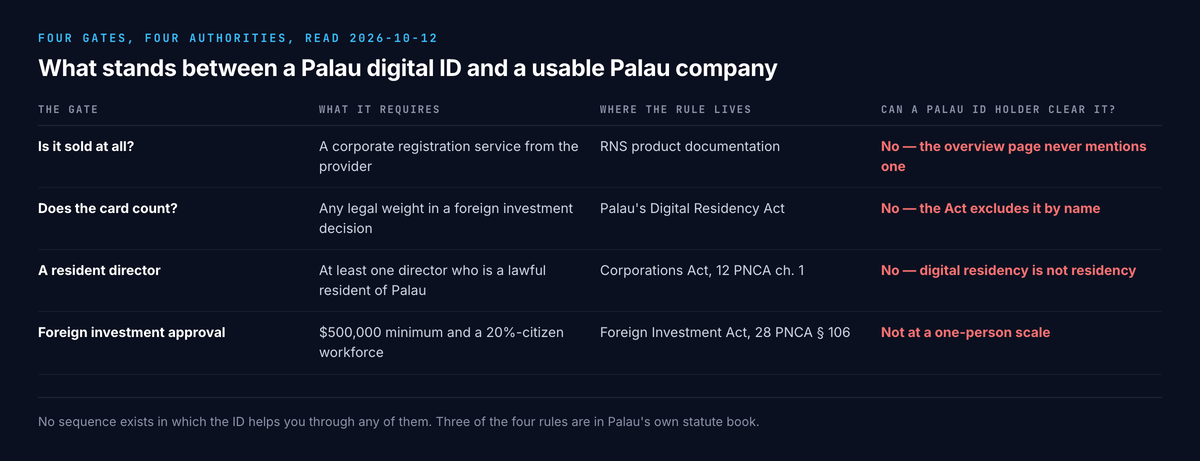
 Palau e-residency company formation does not exist as a product you can buy, and the reason is not that RNS has been slow to build it. Four separate published rules stand between a digital residency ID and a usable Palau company, and three of them are in Palau's own statute book. We read all four on 2026-10-12, along with the registry's live fee schedule and the Foreign Investment Board's own application checklist.
This matters because the comparison people make is Estonia, where the ID and the company are one pipeline — e-residents there have started over 40,000 companies. Palau borrowed the name and not the mechanism, and the gap is wide enough that the Estonian government documents it rather than leaving it to blogs.
| The gate | What it requires | Where the rule lives | Can a Palau ID holder clear it? |
|---|---|---|---|
| Is it sold at all? | A corporate registration service from the provider | RNS product documentation | No — the overview page never mentions one |
| Does the card count? | Any legal weight in a foreign investment decision | Palau's Digital Residency Act | No — the Act excludes it by name |
| A resident director | At least one director who is a lawful resident of Palau | Corporations Act, 12 PNCA ch. 1 | No — digital residency is not residency |
| Foreign investment approval | $500,000 minimum and a 20%-citizen workforce | Foreign Investment Act, 28 PNCA § 106 | Not at a one-person scale |
Four gates, four different authorities, and no sequence in which the ID helps you through any of them. The rest of this page is the detail, because the detail is what tells you whether a future roadmap release would change the answer.
What RNS sells, and the word its documentation never uses
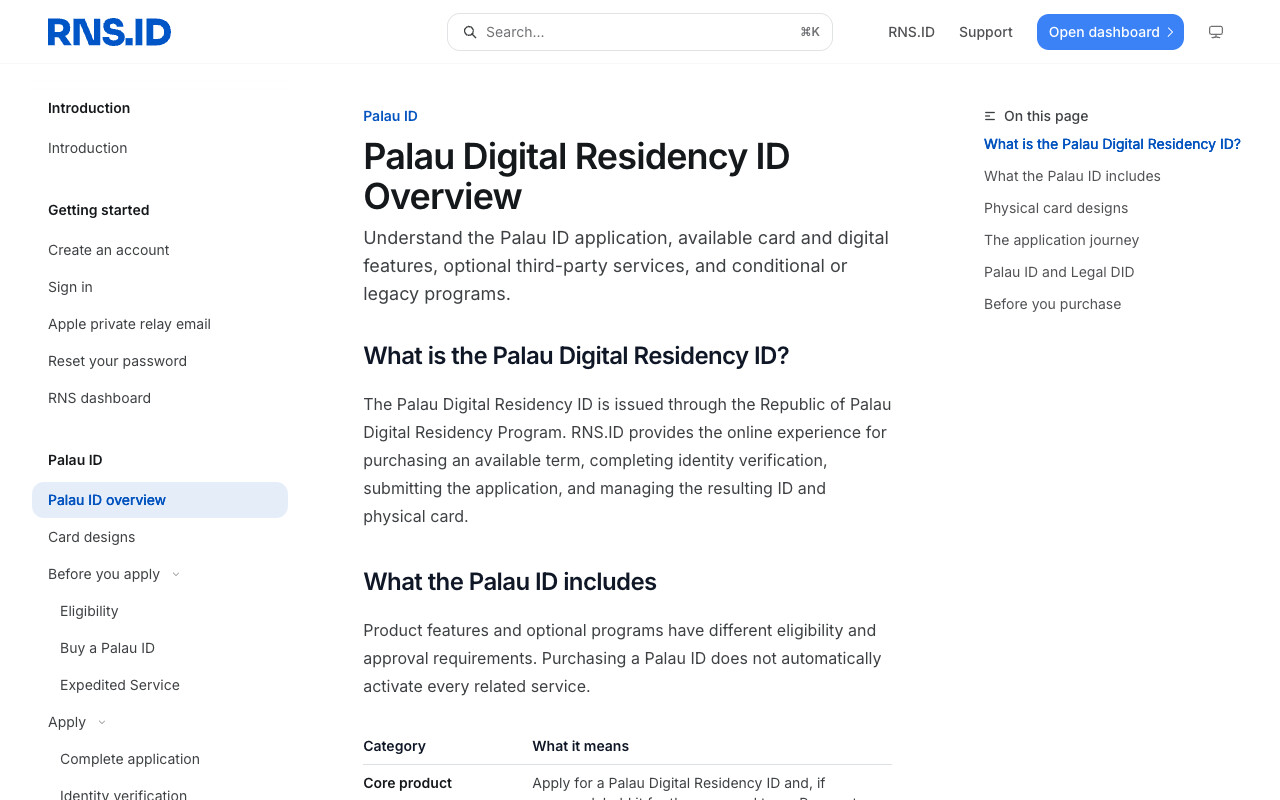
Start with the product, because this is the cheapest check and almost nobody runs it. RNS's documentation is RNS's own writing, it is public, and a careful buyer should read it before the shop window. On companies it is not cautious — it is silent.
| Where you look | What it says about companies |
|---|---|
| docs.rns.id Palau ID overview | No mention of company registration, incorporation, corporate services or an "e-corporation" anywhere on the page |
| The same page's list of what is included | An ID for an approved term, a physical card, "an eligible PDF download", "related Legal DID actions where available", and optional Palau Mailing |
| The same page's non-promises | "Guaranteed approval, access to a bank or exchange, universal third-party acceptance, or delivery of a future roadmap service" |
| docs.rns.id support FAQs | Nothing on company registration, business formation or corporate services |
| What the ID is | "Palau Digital Residency is not the same as citizenship, a passport, or physical residency in Palau" |
Read the third row twice.
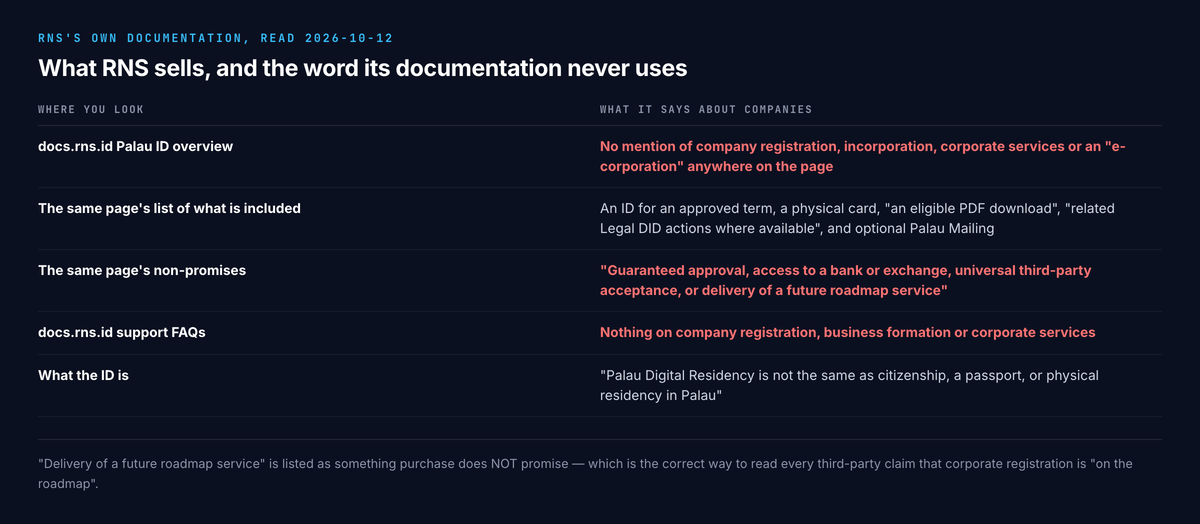
 "Delivery of a future roadmap service" is listed as something purchase does not promise — the correct way to read every third-party claim that corporate registration is "on the roadmap." RNS has explicitly declined to be held to delivery of one.
Estonia's official comparison is the source most often quoted on the roadmap point, and it is worth quoting exactly: Palau "does have registration of 'e-Corporations' on its roadmap," alongside "addresses with US ZIP codes, virtual phone numbers, digital banking." That is Estonia characterising a competitor, not Palau committing to a date, and the same table marks Palau's company registration status as "No (but in the roadmap)."
One more RNS line belongs here, because it is the one people stretch furthest: Palau Mailing "is not proof of residence," as we set out on the Palau mailing address page. A mailing address is not a registered office, and it is not the residency a director has to have.
Palau's own law takes digital residency off the table
The programme exists because the Olbiil Era Kelulau passed a Digital Residency Act, signed in December 2021 after the bill initially died in the Senate and was then passed 10-3 with the digital-currency-exchange references removed. Reporting from Palau at the time, in the Island Times, sets out what the statute does and does not reach — and this is the part that goes unquoted everywhere else.
The Act gives a non-citizen a digital residency ID without physical residence, and with it the ability to open digital accounts, hold a physical mailing address and take a digital phone number. It then limits itself, twice. First, "the digital residency ID does not entitle the bearer to reside in Palau nor obtain a driver's license." Second — and this is the clause that settles the company question — the law provides that digital residency will not count in evaluating foreign worker applications, bank account applications, or foreign investment applications.
That third category is not incidental. A foreign investment application is exactly the gate a non-citizen has to pass to own a Palau business, and the statute that created digital residency instructs the decision-maker to disregard it. The Island Times put the conclusion in one sentence at the time: "The digital residency ID is not equivalent to allowing digital residents to establish a business in Palau."
So the honest framing is not "Palau has not got round to it yet." Palau legislated the ID and the business gate as separate things, and said which way the separation runs. The same logic reaches banking — see Palau digital residency bank account, where bank-account reports are unconfirmed, and the Act's exclusion of bank account applications is why.
The register since 20 January 2025: fast, cheap, and still not open to you
Here is the twist that makes this page worth writing: Palau reformed its company law, and the new system is genuinely good. It is just not a digital residency product.
Palau passed a new Corporations Act at 12 PNCA Chapter 1, and its online register commenced 20 January 2025, run by the Financial Institutions Commission as Registrar. The reform summary is blunt about what it swept away: the old law needed three incorporators, documents "acknowledged" before a Clerk of the Court or a notary public, and then signature by the President of the Republic — "outdated requirements (obstacles, actually)," in the government's own words, and now gone.
| Registering a Palau for-profit corporation (2026) | Detail |
|---|---|
| Articles of Incorporation, Form A-1 | $250.00 |
| Normal turnaround once filed | 1-2 days |
| Approvals needed beyond the Registrar | None |
| Original notarised signatures | Never needed |
| Minimum number of directors | 1 |
| Directors who must be a lawful resident of Palau | At least 1 |
| Registered agent and address in the Articles | Required |
| Government photo ID scan per director | Required |
| Annual returns | Required, filed online |
Two rows in that table are the whole story.
 A corporation can have a single director, which sounds ideal for a solo founder — and at least one director must be a lawful resident of Palau, which a digital resident is not, by the explicit terms of both the Digital Residency Act and RNS's own documentation. With one director, the single director is the resident one.
The registry's own how-to page adds the shareholder half of the problem in a single warning: "if even 1 share is owned by a non-citizen, then a FIB certificate may be required as well." Not a majority stake. One share. That is the on-ramp to the next section, and it is the reason a nominee structure is the first thing people reach for and the worst thing they could do.
The $500,000 gate: a Foreign Investment Approval Certificate
The Foreign Investment Act is the oldest of the four gates and the highest. 28 PNCA § 103(a) is unambiguous: "No non-citizen shall carry on a business enterprise in the Republic, either directly or indirectly, without first obtaining a foreign investment approval certificate." Section 103(b) extends it to acquiring any ownership interest in a citizen-owned enterprise. The 2025 Corporations Act reform paper confirms the two regimes stack rather than replace: the Act "would in no way replace the requirements set out in the Foreign Investment Act."
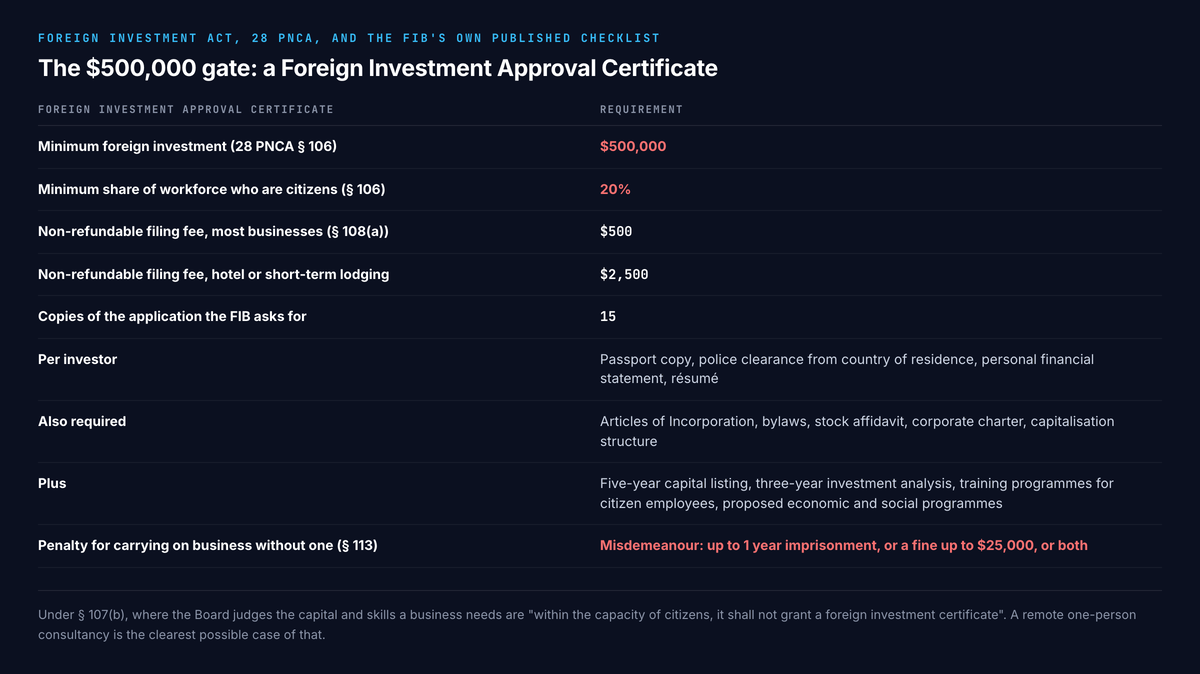
Then § 106 sets the floor, and it is the number that ends most conversations.
| Foreign Investment Approval Certificate | Requirement |
|---|---|
| Minimum foreign investment (28 PNCA § 106) | $500,000 |
| Minimum share of workforce who are citizens (§ 106) | 20% |
| Non-refundable filing fee, most businesses (§ 108(a)) | $500 |
| Non-refundable filing fee, hotel or short-term lodging | $2,500 |
| Copies of the application the FIB asks for | 15 |
| Per investor | Passport copy, police clearance from country of residence, personal financial statement, résumé |
| Also required | Articles of Incorporation, bylaws, stock affidavit, corporate charter, capitalisation structure |
| Plus | Five-year capital listing, three-year investment analysis, training programmes for citizen employees, proposed economic and social programmes |
| Penalty for carrying on business without one (§ 113) | Misdemeanour: up to 1 year imprisonment, or a fine up to $25,000, or both |
The documentary load above comes from the Foreign Investment Board's own published checklist, which opens by telling applicants to consult an attorney. One discretionary provision outranks all of it: under § 107(b), where the Board judges that the capital and the technical and managerial skills a business needs "are such as to be within the capacity of citizens, it shall not grant a foreign investment certificate." A remote one-person consultancy is the clearest possible case of that.
One caveat on sources, because they disagree and the disagreement is instructive. The FIB checklist, written under RPPL 9-64, tells applicants to get their corporate charter from "the Registrar of Corporations located at the Office of the Attorney General." The 2025 reform paper and the live registry both put Registry Services under the Financial Institutions Commission. The 2025 position is the current one; the older government PDF has not been updated. Check with the Board before relying on either.
Reserved activities and the front-company trap
Even with half a million dollars, a licence, and a resident director, a tranche of Palau's economy is closed. 28 PNCA § 105 reserves business activities for citizens outright or requires citizen ownership, and the FIB restates the current split.
| Status under 28 PNCA § 105 | Activities |
|---|---|
| Reserved exclusively for citizens | Wholesale or retail sale of goods; all land transportation including bus, taxi and car rental; any form of water transportation services; travel and tour agencies, dive shops, chartered fishing and surfing businesses; commercial fishing other than highly migratory species |
| Requires local ownership | Handicraft and gift shops (hotel and airport premises exempt); bakeries; bar services outside a restaurant or hotel complex of 50+ rooms; manufacturing of products already made by wholly Palauan-owned enterprises; equipment rentals for land and water use; raising and harvesting farm-raised and maricultured species |
Which brings us to the shortcut, and to the clearest warning in any of these documents. The reform paper describes front companies — "nominally owned and operated by local Palauan citizens listed as shareholders and directors, but that, in reality, are owned and operated by persons — usually non-citizens — that don't appear in the official documents" — as "reported to be widespread in Palau," and then explains that the new Act is built to find them.
Section 1601(f) requires a Palau corporation to maintain beneficial ownership information and "make that information accessible to the Registrar upon request free of charge and without the need for a court order." Section 1601(g) defines a beneficial owner as the natural person who "exercises ultimate effective control." Submitting false documents to the Registrar is a crime, § 114 of the Foreign Investment Act applies the same misdemeanour penalty to anyone who "knowingly aids or assists in any manner whatsoever" a § 103 violation, and all corporations had to re-register within a year of commencement or face administrative dissolution. A nominee arrangement built on a $288 identity card is not a structure. It is an offence with a paper trail, and the register was redesigned to produce the trail.
Palau vs Estonia e-residency company formation: two answers
The two programmes are compared constantly because Palau's was modelled on Estonia's. On the specific question of palau e-residency company formation versus the Estonian route, the published positions are not close. Figures below are from Estonia's official start a company page and Palau's registry and statutes, read 2026-10-12.
| Palau Digital Residency | Estonia e-Residency | |
|---|---|---|
| Can you register a company with the ID? | No | Yes |
| Official statement | Digital residency "will not count" in a foreign investment decision | "Register a company in Estonia rapidly and 100% online" |
| Company registration state fee | $250 Form A-1, plus an FIB certificate for any non-citizen share | €265 |
| Time to register | FIB applications are evaluated against 13 statutory criteria | 15 min - 1 hour |
| Minimum capital or investment | $500,000 foreign investment floor for a certificate | No practical minimum |
| Resident director required | Yes — at least 1 | No |
| Local address or contact person | Registered agent and registered office in Palau | Legal address / contact person, €200-400 a year |
| Qualified electronic signatures | No | Yes |
| Does it change your personal tax residency? | No | "E-Residency does not affect your personal tax residency" |
The honest reading is that these are different products wearing a shared label, which is the argument we make at greater length in Palau vs Estonia e-residency and across the e-residency countries comparison. Estonia sells a company-formation rail with an identity credential attached. Palau sells an identity credential, and the identity credential is what you should judge it as — the limitations page is the full inventory, and the benefits page assesses the claims one at a time. None of this is legal, tax or immigration advice, and programme rules change without notice.
If what you want is a company, not a card
Separate the two purchases and the decision gets easy. If the goal is a bank-ready entity you can invoice through this quarter, no Palau product delivers it, and the two routes people actually use are an Estonian OÜ or a US LLC. For the US route, Doola and Firstbase both form and maintain a US LLC for non-residents, including the registered-agent and EIN work that trips people up. Those are sponsored links and we may earn a commission at no cost to you. Neither is affiliated with RNS or Palau, neither issues any identity document, and what a bank does with a new entity is still the bank's decision — the realistic version is in US business bank account for nomads.
If the goal is the identity credential instead, the Palau ID is the thing being sold, and it should be judged on its acceptance record rather than on a corporate roadmap. Start here is the ordered walkthrough and the cost page has RNS's listed terms. Payment does not guarantee approval, and acceptance varies by organisation. What you should not do is buy the card as a step toward the company: nothing in the published rules makes it one.
Bottom line
Palau e-residency company formation is not available in 2026, and four published rules say so independently. RNS's own documentation never mentions corporate registration and lists roadmap delivery among its non-promises. Palau's Digital Residency Act instructs decision-makers to disregard digital residency when weighing a foreign investment application. The Corporations Act that went online on 20 January 2025 requires at least one director who is a lawful resident of Palau, and the registry flags that a single non-citizen share can pull in the Foreign Investment Board. And 28 PNCA § 106 sets that board's floor at $500,000 and a 20%-citizen workforce, with § 107(b) directing refusal where citizens could do the work anyway.
The useful part is that Palau's company law got better and cheaper in 2025 — $250, one to two days, no notary, no presidential signature. It got better for people who live in Palau. For everyone else the gate is the Foreign Investment Board, and a digital residency ID is the one credential the statute says not to count.
If a corporate registration service does ship, the test will be the one applied here: a published rule with a fee and a form, not a roadmap line. Until then, treat the card as its own documentation describes it — not citizenship, not a passport, and not physical residency in Palau. Nothing on this page is legal, tax or immigration advice.
Related reading
- Palau vs Estonia e-residency — the two programmes side by side
- Palau digital residency limitations — the full inventory of what the card does not do
- E-residency countries — where Palau sits among the programmes
- RNS.ID company — who RNS is and what its role actually is
- Palau digital residency bank account — the other application the Act excludes
- Palau digital residency tax — why an ID does not move your tax residency
FAQ
Can I register a company in Palau with a Palau digital residency ID?
No. RNS's product documentation does not offer company registration, and Palau's Digital Residency Act provides that digital residency will not count when a foreign investment application is evaluated. The Corporations Act also requires at least one director who is a lawful resident of Palau, and the registry warns that a single non-citizen share may require a Foreign Investment Board certificate. Estonia's official comparison, updated 8 April 2026, states that "it is currently not possible to register a company in Palau with the digital residency."
What about the "e-Corporation" on the Palau roadmap?
The roadmap reference comes from Estonia's comparison page describing a competitor, not from a commitment with a date attached. RNS's own overview page lists "delivery of a future roadmap service" among the outcomes buying a Palau ID does not promise. If it ships, it will arrive with a fee and a form, and that is what to wait for.
How much does it actually cost to register a company in Palau?
The Articles of Incorporation for a for-profit Palau corporation are Form A-1 at $250.00, filed online, with normal turnaround of one to two days. A non-citizen shareholder adds a Foreign Investment Approval Certificate: $500 non-refundable for most businesses, $2,500 for a hotel or short-term lodging facility, and 28 PNCA § 106 bars the certificate below $500,000 of foreign investment.
Does a Palau ID count as residency for the resident-director requirement?
No, and both sides say so. RNS's documentation states that "Palau Digital Residency is not the same as citizenship, a passport, or physical residency in Palau," and the Digital Residency Act provides that the ID "does not entitle the bearer to reside in Palau nor obtain a driver's license." The Corporations Act asks for a director who is a lawful resident of Palau, which is a different status entirely.
Can I use a Palauan nominee shareholder or director instead?
This is the worst available option. The government's own 2025 reform paper names front companies — nominally owned by citizens, really controlled by non-citizens — as "reported to be widespread in Palau" and describes the new Act as built to detect them. Section 1601(f) requires beneficial ownership information to be given to the Registrar on request without a court order, submitting false documents to the Registrar is a crime, and 28 PNCA § 114 applies a misdemeanour penalty of up to a year's imprisonment or a $25,000 fine to anyone who knowingly assists a § 103 violation.
Which businesses can a foreigner never own in Palau?
28 PNCA § 105 reserves several activities exclusively for citizens: wholesale and retail sale of goods, all land transportation including taxis and car rental, any form of water transportation, travel and tour agencies with dive shops and chartered fishing, and commercial fishing other than for highly migratory species. A second list — bakeries, handicraft and gift shops, standalone bar services, equipment rentals and some manufacturing — requires citizen ownership rather than being closed outright.
If I want a company I can actually use, what should I look at instead?
An Estonian OÜ is the closest thing to what people expect from "e-residency company formation": €265 to register, 15 minutes to an hour, fully online, with a legal address or contact person at €200-400 a year. A US LLC is the other common route for non-residents. Either way the company and the Palau ID are separate purchases solving separate problems, and no bank or platform is obliged to accept either — acceptance varies, and this is not legal or tax advice.