Palau ID Card 2026: Rev. 2026-A vs Rev. 2023-B
Palau ID card 2026 ships as Rev. 2026-A, whose back now carries a three-line MRZ. We compared both revisions, their security features and the KYC effect.
We may earn a commission if you apply through this link. This site is independent and is not the official RNS.ID or Palau government site.
Key takeaways
- There are two Palau ID cards in circulation and RNS now names them both: Rev. 2023-B and Rev. 2026-A. The revision is printed on the back, and RNS says the date you ordered or received a card "does not by itself identify its revision".
- The back of 2026-A carries a three-line machine-readable zone. 2023-B carried a stacked barcode instead. Three lines of 30 characters is the TD1 layout ICAO Doc 9303 Part 5 defines for ID-1 size cards — the shape a document reader expects on a national ID card.
- The front has been relabelled like a travel document. LN, FN, ID #, DOB, ISS and EXP become Surname, Given Names, Document No., Date of Birth, Date of Issue and Date of Expiry; dates move from "Jul 26, 1990" to "26 JUL 1990"; and the height, weight, hair-colour and eye-colour fields are gone from the front.
- Security features changed rather than simply increased. Both revisions use colour-shifting ink and UV-fluorescent printing. 2026-A adds microprinting, and the raised tactile details RNS lists for 2023-B are not listed for 2026-A.
- A redesign does not expire your card. RNS is explicit: "A 2023-B card does not become invalid because 2026-A has been introduced." Validity is the expiry date, your ID status and the annual screening in the Terms of Service — never the revision number.
On this page
- Palau ID card 2026: what actually changed
- Find the Rev. mark before you read anything else
- The front: passport labels replace driver's-licence fields
- The back is the real change, and it is an MRZ
- Security features, revision by revision
- The counterfeit crackdown this redesign follows
- Will 2026-A verify where 2023-B did not?
- A redesign does not expire your 2023-B card
- Renewal, replacement and the annual screening nobody mentions
- Related reading
- FAQ
Palau ID card 2026: what actually changed

If the Palau ID card in your wallet does not match the pictures you have just seen online, nothing has gone wrong and nothing has been withdrawn — there are simply two designs in circulation and almost nobody writing about the programme has noticed. That matters more than a cosmetic refresh, because until this revision the card had no machine-readable zone at all, and a card a document reader cannot parse is a card that fails the one job most buyers had in mind. We read RNS's own card-designs documentation on 30 October 2026, compared the two revisions field by field, and then checked what the verification vendors that actually read documents say about Palau.
The short version: this is the first redesign RNS has documented publicly, it moves the card's layout towards travel-document conventions, and it changes what a machine can do with the back of it.
| What people assume | What RNS's 2026 documentation says |
|---|---|
| There is one Palau ID card design | Two revisions are documented, "Rev. 2023-B" and "Rev. 2026-A", and "both revisions may remain in use" |
| A new design retires the old one | "A 2023-B card does not become invalid because 2026-A has been introduced" |
| My order date tells me which I have | "The date you placed an order or received the card does not by itself identify its revision" |
| The redesign is cosmetic | The back changes from a stacked barcode to "a three-line machine-readable zone" |
| More security features were added | Microprinting was added; the raised tactile details listed for 2023-B are not listed for 2026-A |
| A newer card verifies anywhere | "Each organization determines which identity documents and formats it accepts" |
Read the last row as the standing rule for this whole page. Nothing below changes the fact that acceptance varies by organisation, and the card is not a passport. For what the card is for in the first place, our Palau ID card guide is the broader piece.
Find the Rev. mark before you read anything else
Every question about the new design collapses into one question you can answer in ten seconds: which card are you holding? RNS prints the answer on the back, and it moved the marking between revisions, which is itself a quick way to tell them apart.
| Revision | Where the "Rev." marking is printed |
|---|---|
| Rev. 2023-B | Near the bottom of the back, beneath the right side of the barcode |
| Rev. 2026-A | On the right of the back, above the three lines of machine-readable text |
Two things are worth saying plainly here, because RNS says them and nobody repeats them. First, RNS publishes no launch date for 2026-A. Its sample images carry a disclaimer that the illustrative names and dates "do not establish a revision's launch date", so we cannot tell you the week the production line changed, and neither can anyone else who has only read the documentation. Second, RNS allows for marks it does not illustrate: "If your card has another revision mark, contact RNS.ID Support." Two revisions are documented; two is not stated to be the complete history.
If your card is in the post rather than in your hand, the revision is not something the tracking page reports — see our card shipping and tracking guide for what that flow does tell you.
The front: passport labels replace driver's-licence fields
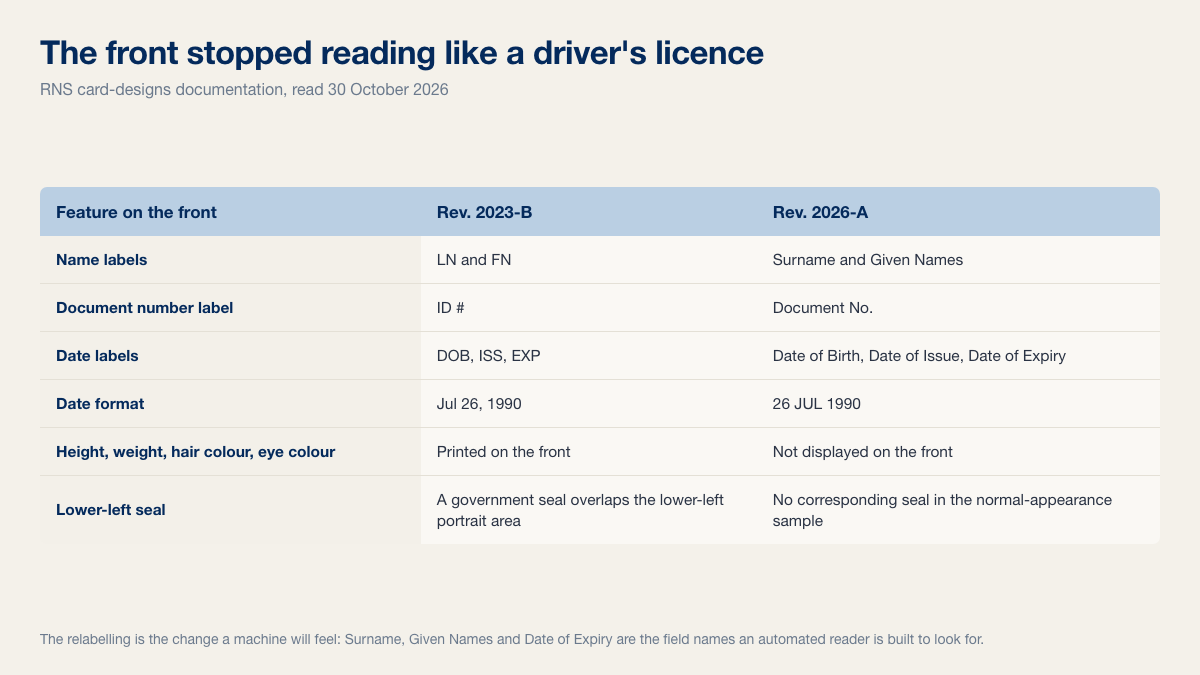
Put the two fronts side by side and the design intent is obvious. 2023-B was laid out like a North American ID card: abbreviated labels, a month-day-year date, and a block of physical descriptors. 2026-A reads like the data page of a travel document.
| Feature on the front | Rev. 2023-B | Rev. 2026-A |
|---|---|---|
| Name labels | LN and FN | Surname and Given Names |
| Document number label | ID # | Document No. |
| Date labels | DOB, ISS, EXP | Date of Birth, Date of Issue, Date of Expiry |
| Date format | Jul 26, 1990 | 26 JUL 1990 |
| Height, weight, hair colour, eye colour | Printed on the front | Not displayed on the front |
| Lower-left seal | A government seal overlaps the lower-left portrait area | No corresponding seal in the normal-appearance sample |
The dropped descriptors are the change a human reviewer will feel. Height, weight, hair colour and eye colour are self-reported fields that a compliance reviewer cannot check and a forger has no reason to get wrong, so removing them loses nothing and removes four lines of noise. The relabelling is the change a machine will feel: "Surname", "Given Names" and "Date of Expiry" are the field names an automated reader is built to look for, and 26 JUL 1990 is unambiguous in a way that Jul 26, 1990 is not once you leave the United States.
Neither of those is RNS claiming conformance with any standard. It is a layout that has stopped fighting the conventions.
The back is the real change, and it is an MRZ
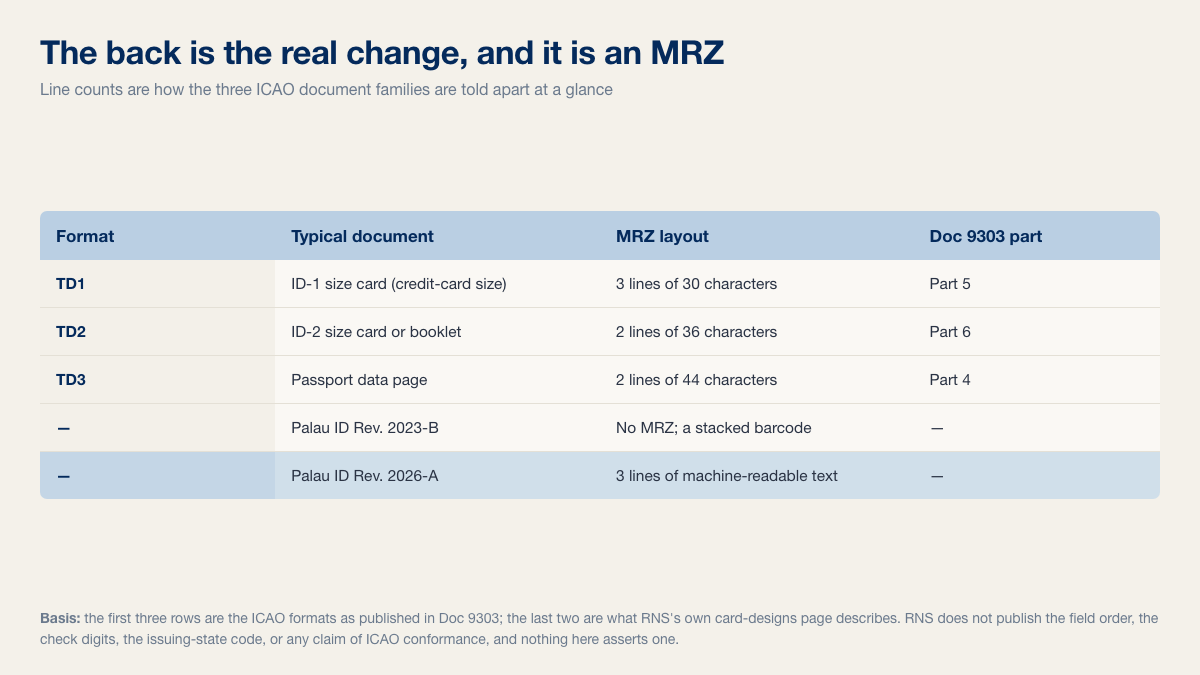
Here is the finding that made us write this page. On 2023-B the machine-readable element is "a stacked barcode on the lower left". On 2026-A it is "a three-line machine-readable zone across the lower portion" — and RNS defines the term for its readers as "the block of letters, numbers, and < characters on the back of 2026-A".
Three lines is not an arbitrary choice. It is the layout ICAO Doc 9303 uses for cards the size of a Palau ID, and the line count is how you tell the three document families apart at a glance.
| ICAO document format | Typical document | MRZ layout | Doc 9303 part |
|---|---|---|---|
| TD1 | ID-1 size card (credit-card size) | 3 lines of 30 characters | Part 5 |
| TD2 | ID-2 size card or booklet | 2 lines of 36 characters | Part 6 |
| TD3 | Passport data page | 2 lines of 44 characters | Part 4 |
| — | Palau ID Rev. 2023-B | No MRZ; a stacked barcode | — |
| — | Palau ID Rev. 2026-A | 3 lines of machine-readable text | — |
Basis: the first three rows are the ICAO formats as published in Doc 9303; the last two are what RNS's own card-designs page describes. Line and character counts are the standard's, not RNS's.
Be careful about what this does and does not prove. RNS says three lines of machine-readable text. It does not publish the field order, the check digits, the issuing-state code, or any claim of ICAO conformance, and a sample image resized for a documentation page cannot settle any of that. What changed, verifiably, is that the card now presents data in the physical shape a document reader is built to find — and a stacked barcode on an unfamiliar card is the shape most readers have no profile for. The difference between those two situations is the whole argument of this page, and it is still an argument about plumbing rather than a promise about outcomes.
Security features, revision by revision
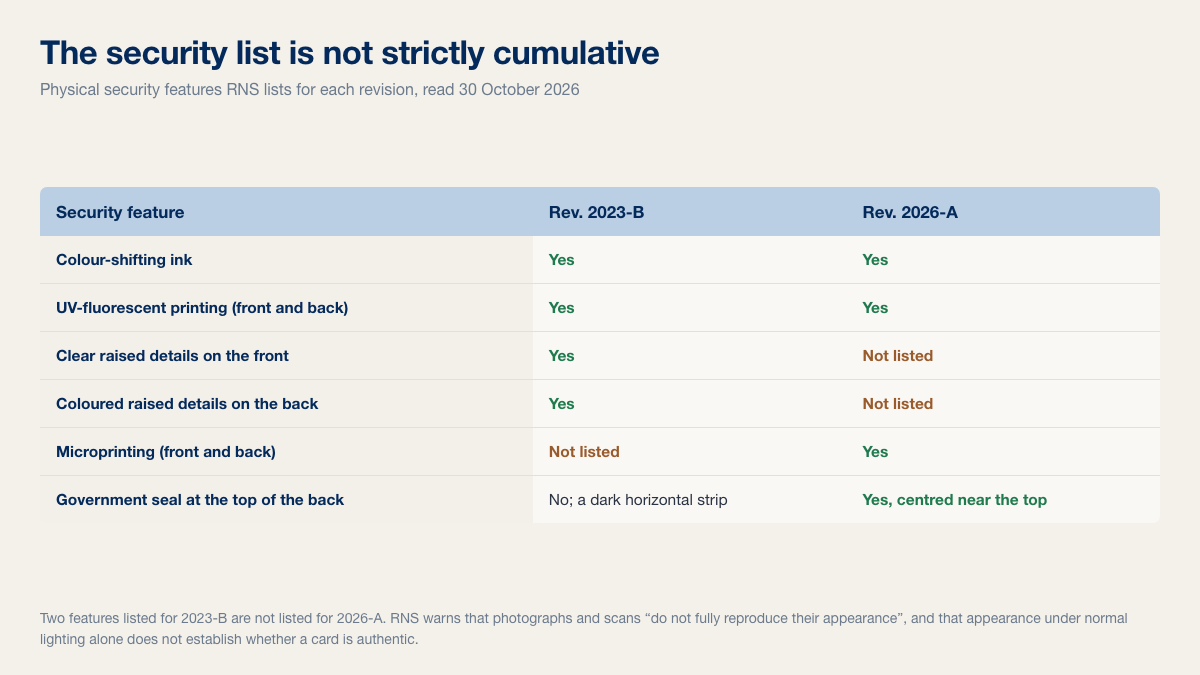
RNS lists physical security features for both revisions, and the list is not strictly cumulative. That is unusual enough to be worth a table rather than a sentence.
| Security feature | Rev. 2023-B | Rev. 2026-A |
|---|---|---|
| Colour-shifting ink | Yes | Yes |
| UV-fluorescent printing (front and back) | Yes | Yes |
| Clear raised details on the front | Yes | Not listed |
| Coloured raised details on the back | Yes | Not listed |
| Microprinting (front and back) | Not listed | Yes |
| Government seal at the top of the back | No; a dark horizontal strip | Yes, centred near the top |
RNS's viewing guidance is practical: tilt the card to see the colour shift in the horizontal line on the front, use UV light for the fluorescent designs, and use magnification for 2026-A's microprinting. It also warns that photographs and scans "do not fully reproduce their appearance", which is the sentence to remember the next time a platform asks you to upload a picture of the card. Our physical versus digital Palau ID guide covers why that distinction keeps deciding verification attempts.
One caution from RNS, aimed at anyone reviewing a card rather than carrying one: "Appearance under normal lighting alone does not establish whether a card is authentic."
The counterfeit crackdown this redesign follows
A redesign that adds microprinting and a machine-readable zone is not a styling exercise, and the context is on the record. On 24 October 2025 RNS announced measures against counterfeit Palauan IDs used to bypass KYC procedures, including a blacklist and a promised official API for KYC vendors and partner platforms.
A year later we could still find no public reference for that API, which is why we treat the card itself as the more informative signal. Microprinting raises the cost of a convincing fake; an MRZ gives a reviewer something to check against the printed fields rather than something to eyeball. Both are answers to the same problem, and they arrived in the physical product rather than in a developer portal.
Worth keeping in proportion: a tighter card does not make the programme's wider risks go away, and we catalogue those separately in our Palau digital residency risks guide.
Will 2026-A verify where 2023-B did not?
Nobody can promise you that, and anyone who does is guessing. What we can do is show you where the decision is actually made, because it is not made by RNS and it is not made by the platform's support desk either — it is made by the identity-verification vendor behind the platform, and those vendors publish what they read.
| Vendor library (checked October 2026) | What it says about Palau |
|---|---|
| Shufti Pro | Lists four Palau documents, including "Digital Residency ID (Palau ID)" as a "Web3 ID issued under Digital Residency Programme (2022)", an "emerging option for non-citizens" |
| ID Analyzer | "ID Analyzer supports 1 Palau identity document, including passports" — no ID card named |
| Sumsub | Publishes an RNS customer story as the programme's onboarding vendor, while stating that the company you are verifying for decides which document types and countries are accepted |
Notice what Shufti Pro says about the other Palau document in its list. It describes the Palau passport as a primary identity document with a machine-readable zone and international-standard security features, and the Digital Residency ID as an emerging Web3 ID. That contrast — one document a reader can parse, one it cannot — is precisely the gap 2026-A narrows. It does not close it, because a vendor that can read a document still needs the platform to permit that document, and permission is a separate setting.
So the honest forecast is mechanical, not optimistic: the MRZ removes one specific reason an automated flow fails, leaving the country rules, the document-type whitelist and each platform's own policy entirely intact. Our KYC vendor comparison is the long version, and RNS's own community-reported use cases page is worth reading for what it refuses to be: "not an official acceptance or partner directory".
A redesign does not expire your 2023-B card
This is the question most existing holders arrive with, so here is the direct answer, in RNS's words: you can continue using an otherwise valid 2023-B card, and you do not need to replace it "solely because a newer design exists". The things that do govern validity are separate from the design entirely.
| What governs whether your card still works | What does not |
|---|---|
| The expiry date printed on the card | The revision number printed on the back |
| Your Palau ID's current lifecycle status in the dashboard | Whether a newer design has been introduced |
| The annual KYC/AML, criminal-background and sanctions screening in the Terms of Service | Whether your card has microprinting |
| Whether the organisation in front of you accepts the document at all | Which seal is on the back |
RNS adds a note for reviewers that cuts both ways, and it is the fairest sentence on its card-designs page: "A different layout from the newer revision does not by itself mean an older card is invalid." If a platform's support agent tells you otherwise, that is a policy decision dressed as a fact, and the revision table above is what you quote back.
Renewal, replacement and the annual screening nobody mentions
If you want a 2026-A card, the documented route is renewal rather than a replacement order: RNS states that a completed renewal "includes a newly produced physical card with an updated expiration date". It does not promise which revision that card will be, so treat the design as a consequence of renewing, never a reason to renew early.
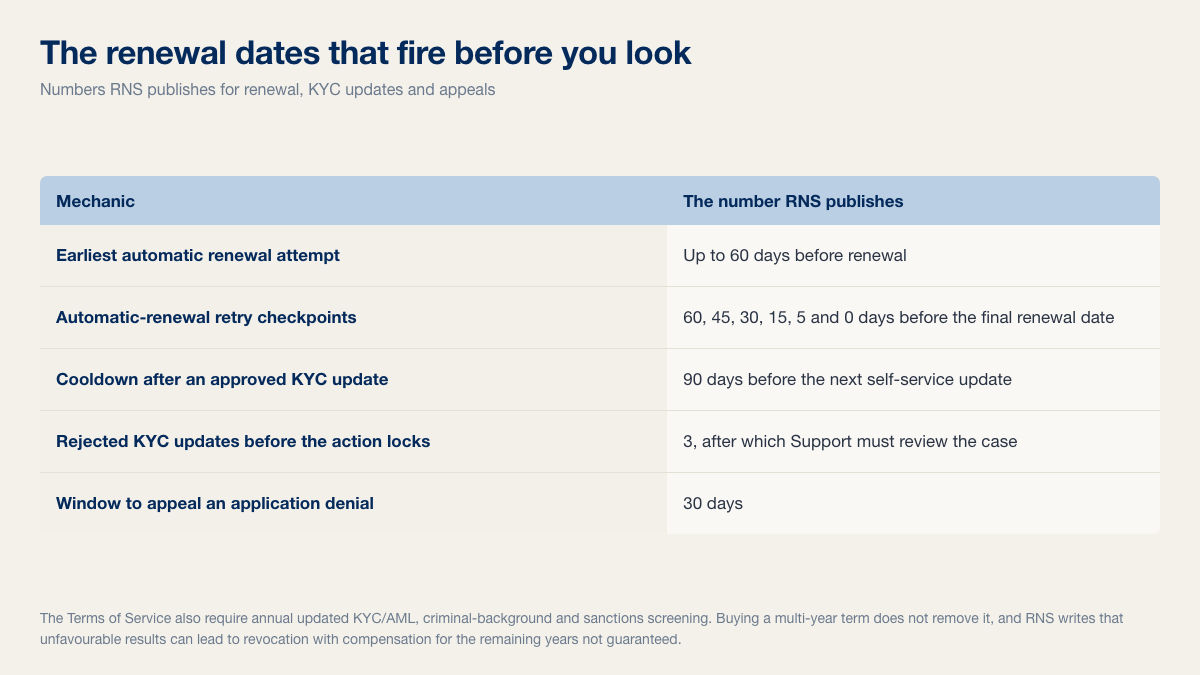
The renewal machinery has dates worth putting in a calendar, because several of them fire before you would think to look.
| Mechanic | The number RNS publishes |
|---|---|
| Earliest automatic renewal attempt | Up to 60 days before renewal |
| Automatic-renewal retry checkpoints | 60, 45, 30, 15, 5 and 0 days before the final renewal date |
| Cooldown after an approved KYC update | 90 days before the next self-service update |
| Rejected KYC updates before the action locks | 3, after which Support must review the case |
| Window to appeal an application denial | 30 days |
Two of those deserve a sentence each. The annual screening is the one almost no guide to this programme mentions: the Terms of Service require annual updated KYC/AML, criminal-background and sanctions screening, buying a multi-year term "does not remove this requirement", and RNS writes that unfavourable results can lead to revocation of Digital Residency status with compensation for the remaining years "not guaranteed". And deleting a Palau ID cancels every active subscription on the same RNS.ID account, not just the ID — including a Palau Mailing subscription — and can clear protected pricing permanently. Our renewal and reprint guide walks the mechanics; this page's point is narrower, which is that none of it is triggered by a redesign.
One last practical note: if a printed field is wrong on the card you already have, updating your verified details in the app does not reprint it. RNS says changed information "may appear only on a replacement or renewed card".
Related reading
- Palau ID card: benefits, limits and use cases — what the card is for, before you worry about which revision it is
- Palau ID verification: which KYC vendors read it — the seven published document libraries, and where they disagree
- Physical vs digital Palau ID for KYC — why the card and the PDF are treated differently
- Palau digital residency renewal and reprint — the route to a newly produced card
- Palau ID shipping and tracking — what the tracking flow reports, and what it does not
- Palau digital residency risks — the programme-level risks a redesign does not touch
- RNS Legal DID vs Palau ID — the on-chain identity product sold alongside the card
FAQ
How do I tell which Palau ID card revision I have?
Look for the "Rev." marking on the back of the physical card. On Rev. 2023-B it sits near the bottom, beneath the right side of the barcode; on Rev. 2026-A it sits on the right, above the three lines of machine-readable text. RNS states that the date you ordered or received the card does not by itself identify the revision, so the printed mark is the only reliable answer.
Is my Rev. 2023-B Palau ID card still valid in 2026?
Yes, if it is otherwise valid. RNS says plainly that a 2023-B card "does not become invalid because 2026-A has been introduced", and that both revisions may remain in use. Check the expiry date printed on the card and your Palau ID status in the dashboard; a revision number does not establish the validity of an individual card.
Do I need to pay for a new card to get the 2026-A design?
No. RNS says you do not need to replace an otherwise valid 2023-B card solely because a newer design exists. A completed renewal does include a newly produced physical card with an updated expiry date, but RNS does not promise which revision that card will carry, so renewing for the design alone is a gamble on a detail it has not committed to.
Does the new MRZ mean exchanges will accept the Palau ID?
It does not guarantee anything, and acceptance varies by platform. A machine-readable zone removes one specific failure — a document reader with no profile for a stacked barcode — but the platform still applies its own document whitelist, country rules and compliance policy, and RNS states that each organisation decides what it accepts. Ask the platform which documents and formats it takes before you rely on the card.
What security features does the Palau ID card have?
Both revisions use colour-shifting ink and UV-fluorescent printing on the front and back. Rev. 2023-B additionally has clear raised details on the front and coloured raised details on the back; Rev. 2026-A instead has microprinting on both sides. RNS warns that some features are not visible under normal lighting and that photographs or scans do not fully reproduce them.
When did Rev. 2026-A start shipping?
RNS does not publish a date. Its sample images carry an explicit disclaimer that the illustrative details "do not establish a revision's launch date", and no order or delivery date identifies a revision on its own. If you need to know which card a specific order produced, the printed "Rev." mark on that card is the only documented answer.
Does the PDF digital copy show the new design?
The card-designs page is about the physical card and points to the separate digital-copy flow for the PDF. RNS also states that downloading the PDF "does not establish permission to use it in a particular verification process or guarantee acceptance by a third party", so treat the file as a convenience rather than a second document.
What is the annual screening, and can it cancel my card?
RNS's Terms of Service require annual updated KYC/AML, criminal-background and sanctions screening, and buying a five- or ten-year term does not remove it. Under the ID Renewal Terms, unfavourable screening results can lead to revocation of Digital Residency status, and RNS writes that compensation for the remaining years of a subscription is not guaranteed. Respond to any requested update rather than letting it sit.