RNS Legal DID vs Palau ID: What the 2026 Docs Say
RNS Legal DID is a non-transferable Ethereum token, not a second Palau ID. We read all seven 2026 docs: what it shows publicly and what it cannot undo.
We may earn a commission if you apply through this link. This site is independent and is not the official RNS.ID or Palau government site.
Key takeaways
- An RNS Legal DID is not a second Palau ID, and it is not a copy of your card. RNS's own words: it is "a non-transferable on-chain identity token connected to verified identity claims and issued to a specific wallet", and "it is not a copy of the original identity document."
- The name points at a standard the product is not registered under. We read the W3C DID Extensions method registry on 26 October 2026: it lists 274 DID methods and not one of them is RNS's or Palau's. The single
did:ldidentry belongs to an unrelated company, Shujin Public Service (Qingdao) Co., Ltd., on the ChainMaker ledger. - Production minting is Ethereum only, and the token can never move. RNS says a Legal DID "cannot be transferred to another wallet, including another wallet you control", and that it provides no "token-recovery or migration action for a wallet you cannot access."
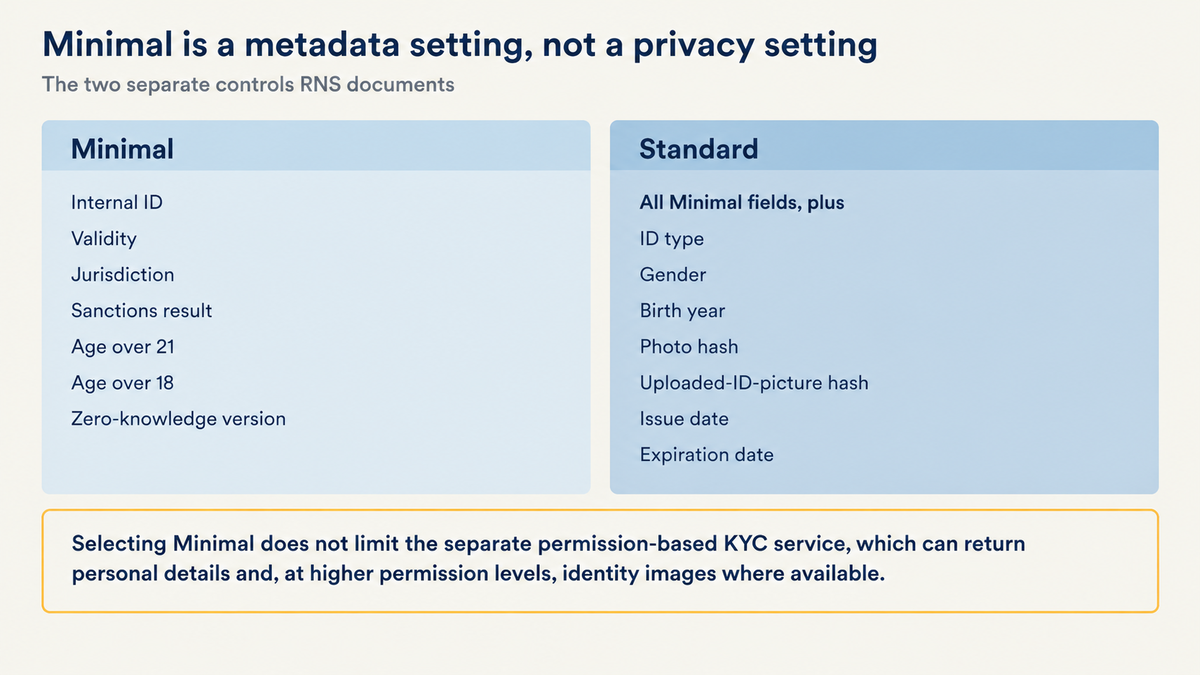
- The privacy switch most people reach for does not do what they think. Choosing the Minimal claims profile does not restrict the separate permission-based KYC service, which "can return personal details and, at higher permission levels, identity images where available."
- A token sitting in your wallet proves nothing about your residency. It "can remain in your wallet after the underlying identity expires or is revoked", and RNS is explicit that expiry or revocation "does not itself burn the token."
On this page
- RNS Legal DID vs Palau ID: the one-line difference
- What a Legal DID actually is
- The name says DID. The W3C registry does not list it.
- Two routes in, and only one of them is Palau residency
- Minimal vs Standard: what you are publishing on a public chain
- Five things you cannot undo
- A token in your wallet is not a valid identity
- Why nobody can sell you a Legal DID
- Is it worth minting in 2026?
- Related reading
- FAQ
RNS Legal DID vs Palau ID: the one-line difference
People reach this page because RNS sells two identity products and the second one is named after a standard it does not implement. The money at stake is real on both sides: the Palau ID is a published $288 for one year, while the standalone Legal DID price appears only at checkout, and the one irreversible mistake in the flow — minting to a wallet you later cannot open — has no support ticket that fixes it. RNS says so itself. We read all seven of RNS's Legal DID documentation pages on 26 October 2026, cross-checked the comparison against its Palau ID overview, and checked the product name against W3C's registry of DID methods.
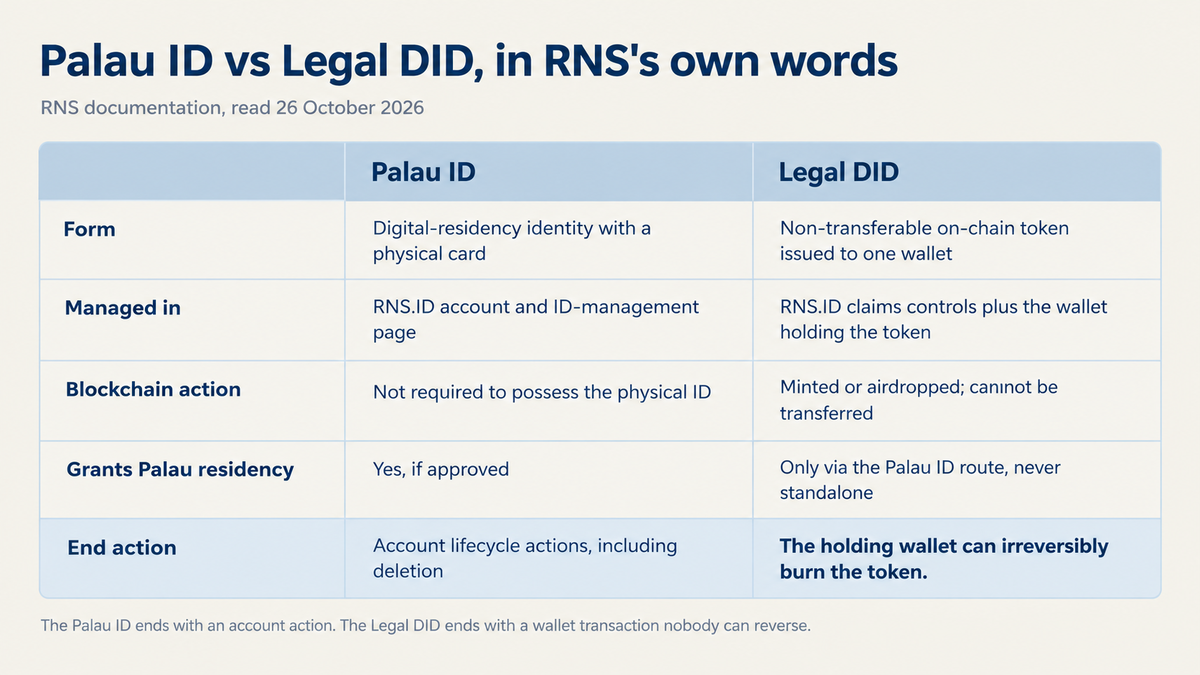
The short version: the Palau ID is the thing a border officer or an exchange looks at, and the Legal DID is a token in a wallet that points at the same verified identity. RNS publishes its own side-by-side, and this is what it says.
| Palau ID | Legal DID | |
|---|---|---|
| Form | Digital-residency identity with a physical card and supported digital copy | Non-transferable on-chain token issued to a specific wallet |
| Basis | A Palau Digital Residency application and government review | A supported verified identity — an eligible Palau ID, or a standalone journey |
| Managed in | RNS.ID account and ID-management page | RNS.ID claims controls plus the wallet holding the token |
| Blockchain action | Not required to possess the physical ID | Minted or airdropped to a wallet; cannot be transferred |
| Acceptance | Decided by each recipient or service | Decided by each integrated verifier or service |
| End action | Account-based lifecycle actions, including deletion when offered | The holding wallet can irreversibly burn the token |
Read the last row twice. The Palau ID ends with an account action you can ask support about; the Legal DID ends with a wallet transaction that nobody at RNS can reverse.
What a Legal DID actually is
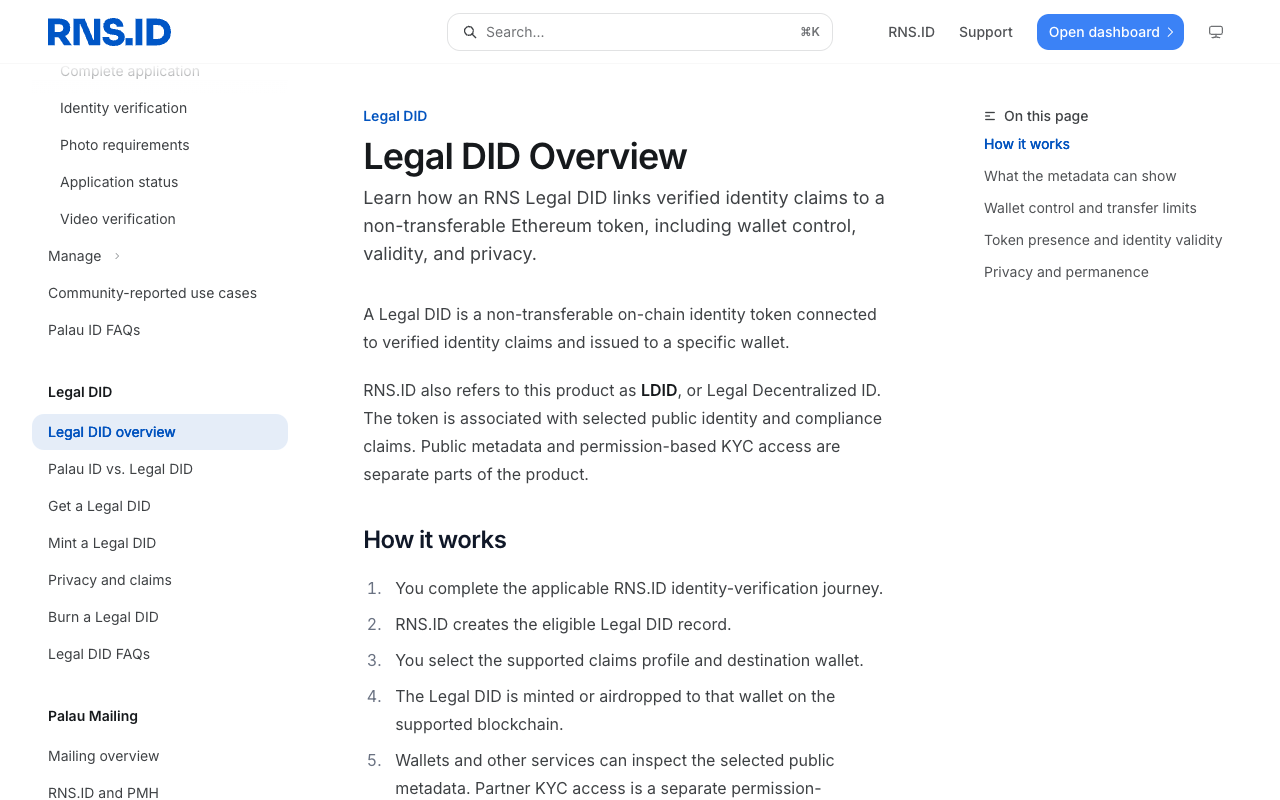
RNS also calls the product LDID, short for Legal Decentralized ID, and its nav bar on rns.id carries that label. Underneath the branding is a fairly ordinary arrangement: you complete an identity-verification journey, RNS creates an eligible record, you pick a claims profile and a destination wallet, and the token is minted or airdropped to that wallet. Services can then inspect the public metadata, while a separate permission-controlled service handles actual KYC lookups.
Two mechanics matter more than the rest.
The first is the network. Production minting supports Ethereum only. RNS repeats this in four separate documents and attaches an instruction to it: if the wallet selector, the mint review or the wallet prompt shows Sepolia or any non-Ethereum network, "or if those screens disagree", stop, do not sign or pay, and send support a screenshot. That is phrased as a security control, not a convenience note, and it is the kind of warning a company writes after seeing the failure.
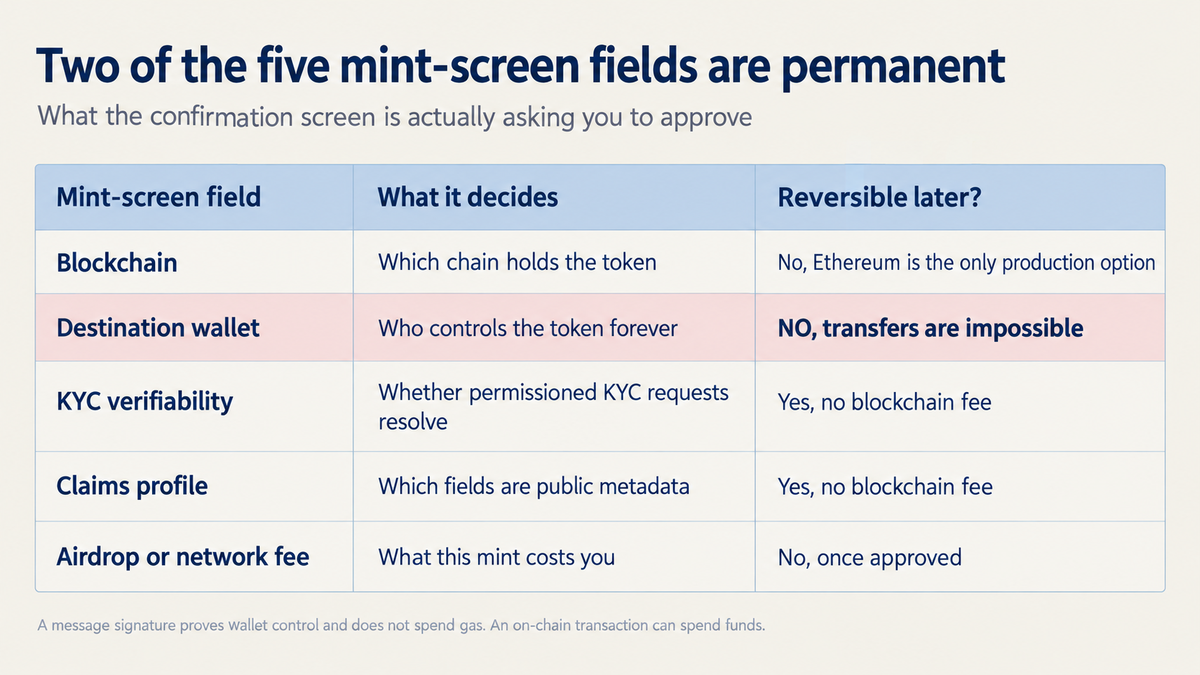
The second is what the mint screen is actually asking you to approve. RNS's confirmation screen "summarizes the blockchain, destination wallet, KYC verifiability, claims profile, and airdrop or network fee", and the documentation draws a distinction worth carrying into any wallet prompt you ever see: "A message signature proves wallet control and does not spend gas; an on-chain transaction can spend funds. Reject any unexpected network, contract, amount, or permission."
| Mint-screen field | What it decides | Reversible later? |
|---|---|---|
| Blockchain | Which chain holds the token | No — Ethereum is the only production option |
| Destination wallet | Who controls the token forever | No — transfers are impossible |
| KYC verifiability | Whether permissioned KYC requests resolve | Yes, with no blockchain fee |
| Claims profile | Which fields are public metadata | Yes, with no blockchain fee |
| Airdrop or network fee | What this mint costs you | No, once approved |
Two of those five are permanent. They are the two in the middle of the screen.
The name says DID. The W3C registry does not list it.
Here is the finding we have not seen anywhere else, and it is the reason this page exists. A "DID" is a defined thing: Decentralized Identifiers (DIDs) v1.1 — a W3C Candidate Recommendation Snapshot published on 5 March 2026 — describes them as "a new type of identifier that enables verifiable, decentralized digital identity", and every real DID method is registered with a prefix such as did:web or did:key so that software can resolve it.
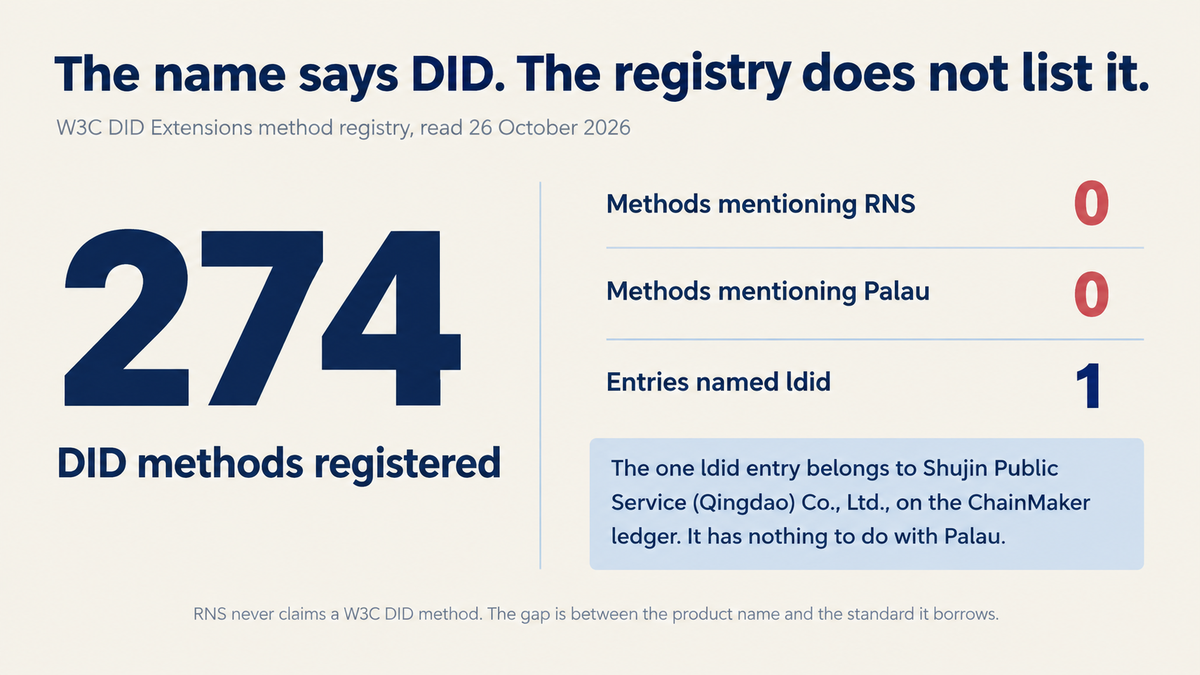
So we checked. On 26 October 2026 the W3C DID Extensions method registry listed 274 methods. None mentions RNS, and none mentions Palau. The one entry named ldid is registered to Shujin Public Service (Qingdao) Co., Ltd., its verifiable data registry is ChainMaker, and its specification lives in an unrelated GitHub repository. It has nothing to do with Palau digital residency.
To be fair to RNS: its documentation never claims a W3C DID method. It describes a token, public metadata and a permissioned API, and that description is accurate throughout. The gap is between the product name and what a reader familiar with decentralised identity will assume the name implies.
| What the name suggests | What RNS's docs actually describe |
|---|---|
A resolvable did: identifier | A token ID in a wallet, inspected as metadata |
| Interoperability with DID resolvers and verifiable credentials | "A supported integration and the permissions granted to it" |
| A credential you present anywhere | "Each service applies its own eligibility, compliance, and jurisdiction rules" |
| Portable between your own wallets | Non-transferable, "including another wallet you control" |
The closer technical match is ERC-5192: Minimal Soulbound NFTs, a Final Ethereum standard whose abstract defines a soulbound token as "a non-fungible token bound to a single account." That is the behaviour RNS documents. If you already read our page on what "Palau NFT ID" does and does not mean, this is the same lesson arriving through a more technical-sounding door.
Two routes in, and only one of them is Palau residency
There are two ways to end up holding one, and conflating them is an expensive mistake, because only one of them produces a card.
| Via a Palau ID | Standalone Legal DID | |
|---|---|---|
| Starting point | An eligible Palau ID journey | An existing supported legal identity |
| Grants Palau Digital Residency? | Yes, if approved | No |
| Produces a physical card? | Yes, after approval and verification | No |
| Price | Palau ID term price — $288 for one year on rns.id, 26 October 2026 | Shown "in the current checkout and application" only |
| Early option | Pre-mint request, queued and airdropped after approval | Mint after identity, KYC and AML review |
RNS is blunt about the standalone route: it "uses an existing supported legal identity and does not grant Palau Digital Residency." If residency is what you want, the Legal DID is not a shortcut to it — our cost breakdown covers the terms that are.
The pre-mint option is the one to watch if you are mid-application. You can pay a fixed fee and queue a request before the Palau ID is active, and RNS warns in the same breath that the request "is not an early approval of the Palau ID." It is also limited per application rather than per wallet: the flow will not take a second pre-mint request for an application that already has a mint record. And across both routes the same sentence applies — "Payment alone does not mean the application is approved or the token has been minted."
Minimal vs Standard: what you are publishing on a public chain
This is the section to read before you touch the claims selector, because the metadata you choose is public and permanent in a way account settings are not. RNS offers two profiles.
| Profile | Metadata fields |
|---|---|
| Minimal | Internal ID, validity, jurisdiction, sanctions result, age-over-21, age-over-18, zero-knowledge version |
| Standard | All Minimal fields, plus ID type, gender, birth year, photo hash, uploaded-ID-picture hash, issue date, expiration date |
The photo fields hold hashes rather than images, which is the right design. But the trap is one layer up, and RNS states it in its first two sentences on the subject: "Legal DID has two separate controls: a public metadata profile and a KYC-access setting. Selecting Minimal metadata does not limit every verification channel to the Minimal fields."
In other words, the privacy control most people would reach for governs the token's public metadata and nothing else. The separate permission-based KYC service "is not limited to a yes-or-no verification result" — an authorised request "can return personal details and, at higher permission levels, identity images where available." Picking Minimal and assuming you have minimised disclosure is the specific misreading the documentation is written to prevent. Turning KYC access off, meanwhile, "does not hide your selected public metadata, erase historical blockchain records, or remove the Legal DID from its wallet."
One more wrinkle for anyone who later corrects a name or a date on a linked Palau ID: an approved update "may be reflected in identity information in the token's metadata, such as age-related claims or birth year", without re-minting and without changing the profile you chose. The two records are not independent. Which vendors can read any of this is a separate question, and we treat it separately in which KYC vendors read a Palau ID.
Five things you cannot undo
Most RNS.ID friction is billing, and billing can be argued with. This product's friction is on-chain, and it cannot.
| Action | Undo path | Who can help |
|---|---|---|
| Minted to the wrong wallet | None — transfers are impossible | Nobody |
| Lost access to the holding wallet | None — no recovery or migration action | Nobody |
| Confirmed a burn | None — the token is destroyed | Nobody |
| Published Standard claims, then switched to Minimal | Setting changes; the chain history does not | You, partially |
| A third party cached your old metadata | None guaranteed | The third party, maybe |
Each row is RNS's own position, not our inference. On wallets: "RNS.ID does not provide a way to recover or move an existing Legal DID from a wallet you cannot access", and recovering your RNS.ID account or changing its sign-in wallet "does not restore the destination wallet's keys." On burning: only the wallet that currently holds the token can burn it, support "cannot burn the token on your behalf", and support equally "cannot reverse a confirmed burn, restore the same token, or recover a wallet's private keys."
The fourth and fifth rows are the ones people underestimate. Changing a claims profile costs no blockchain fee, which makes it feel like a settings toggle — but RNS notes that public metadata and blockchain history "can be copied or cached by third parties", and that changing a profile or turning KYC off "cannot guarantee removal of information that another party previously received or recorded." A wallet or marketplace may also keep showing a stale profile until it refreshes, which is not evidence that your change failed.
If you do burn one, you can mint again — but RNS wants that understood precisely: a new request "creates a new token, not a restoration of the token you burned", it is subject to current eligibility and fees, and "you should not assume a later mint will be free." Burning a Legal DID is also not the same as deleting a Palau ID; those are separate lifecycle actions with separate consequences.
A token in your wallet is not a valid identity
This is the sentence we would put on the product page if it were ours: "A token can remain in your wallet after the underlying identity expires or is revoked." Expiry does not burn it. Revocation does not burn it. RNS spells out the consequence in its FAQ — the identity status "can be invalid even though the token still exists."
Two practical readings follow. If you hold one, it is not a renewal reminder and not proof of anything; the term on your Palau ID is still the thing that lapses, and our renewal, reprint and reship guide covers that clock. And if you are ever on the other side of the transaction — being shown somebody's Legal DID as evidence — the presence of a token tells you only that a token was once issued.
Acceptance is a separate matter again, and RNS declines to promise it in three different documents: a Legal DID "does not guarantee that an exchange, financial institution, decentralized application, or other third party will accept it", and a service's ability to read public metadata "does not guarantee acceptance or give it permission-based KYC access." That is the same ceiling the card runs into, which we set out in what Palau digital residency does not guarantee.
Why nobody can sell you a Legal DID
Non-transferability has a consequence worth stating plainly, because the search traffic around on-chain identity attracts offers. A Legal DID cannot be delivered to you by anyone except RNS's own mint flow, to a wallet you control at the moment of minting. It cannot be transferred between two wallets held by the same person, so it certainly cannot be transferred from a seller to a buyer. Any listing, DM or "verified identity for sale" offer is therefore describing something it cannot hand over.
RNS's security guidance is the right companion here. It names the two official domains — the product at rns.id and the documentation at docs.rns.id — advises caution with "misspellings, extra words, unusual subdomains, URL shorteners, and links sent through direct messages", and states the test that settles most of these conversations: "A logo, copied design, advertisement, or search result is not proof that a page is official."
The burn documentation adds the wallet-specific version of the same advice. If the Legal DID you expect is not visible, "do not connect an unrelated wallet or approve an unknown contract" — verify the address and network first. On a product whose single irreversible action is a contract call from your own wallet, a prompt you did not expect is the whole attack.
Is it worth minting in 2026?
Our read: it is a reasonable extra if your Palau ID journey already includes one and you have a self-custody wallet whose recovery phrase you have genuinely stored. It is a poor substitute for anything. It will not get you residency on the standalone route, it will not make an exchange accept you, and it introduces one failure mode the card does not have — a permanent binding to a wallet, with no support path if that wallet is lost.
Disclosure, since it is the mechanism that funds this page: this site earns a commission when someone applies for a Palau ID through our RNS link. That is exactly why the sections above quote RNS's own documentation rather than our enthusiasm, including the parts that say a token guarantees nothing. If you are weighing the programme as a whole rather than this one feature, start with is RNS.ID legit and the risks worth checking before you reach a checkout.
Related reading
- Palau ID guide — what the card is, and what it is for
- Palau NFT ID — why the Web3 wording confuses this product
- Palau ID verification: which KYC vendors read it — the layer that decides acceptance
- Palau digital residency limitations — what the programme does not guarantee
- Palau digital residency cost — the terms, verified
- Palau ID vs a second passport for crypto users — the bigger comparison
FAQ
What is an RNS Legal DID?
RNS describes it as "a non-transferable on-chain identity token connected to verified identity claims and issued to a specific wallet", also branded LDID or Legal Decentralized ID. Public metadata can show validity, jurisdiction, sanctions-screening results and age thresholds, while actual KYC lookups run through a separate permission-controlled service. RNS adds that it "is not a copy of the original identity document."
Is a Legal DID the same as a Palau ID?
No. The Palau ID is a digital-residency identity with a physical card, granted after a Palau Digital Residency application and government review. The Legal DID is a wallet-held token based on a verified identity. RNS states that a Legal DID is "not the physical card, a replacement for the card in every context, or proof that a third party must accept the Palau ID."
Do I need a Palau ID to get a Legal DID?
Not always. An eligible Palau ID journey can include a corresponding Legal DID, and RNS also offers a standalone route built on an existing supported legal identity. The standalone route has its own checkout, application and verification flow, and RNS is explicit that it "does not grant Palau Digital Residency" — so it produces no card.
Which blockchain does a Legal DID use?
Production minting supports Ethereum only. RNS says Sepolia and other test networks "are not valid production options", that both the mint review and the wallet prompt must show Ethereum, and that if either shows another network or the two screens disagree you should stop before signing or paying and contact support with a screenshot.
Can I move my Legal DID to a different wallet?
No. RNS states that Legal DIDs "cannot be transferred between wallets, including between two wallets you control", and that changing your RNS.ID sign-in wallet or connecting a different one does not move an existing token. There is also no recovery or migration action for a wallet you can no longer access, so confirm the destination address before you mint.
Does choosing Minimal claims keep my data private?
Only the public metadata. RNS says the claims profile and the KYC-access setting are two separate controls, and that selecting Minimal "does not limit every verification channel to the Minimal fields." The permission-based KYC service can return personal details and, at higher permission levels, identity images where available, depending on the integration and the permissions granted to it.
Is a Legal DID a W3C DID?
RNS's documentation does not claim that, and the registry agrees. We read the W3C DID Extensions method registry on 26 October 2026: of its 274 registered DID methods, none is RNS's or Palau's, and the single did:ldid entry belongs to Shujin Public Service (Qingdao) Co., Ltd. on ChainMaker. In behaviour the token is closer to an ERC-5192 soulbound NFT — "a non-fungible token bound to a single account" — than to a resolvable did: identifier.
Can I buy a Legal DID from someone else?
No, and the reason is structural rather than a policy choice. Because the token cannot be transferred even between two wallets belonging to the same person, no seller can deliver one to a buyer's wallet. Any offer to sell you a Legal DID is describing something the contract does not permit, so treat it as the scam RNS's security guidance describes and check the domain before acting.